Is a Master’s Degree Better Than a Post-Bacc? What Outcomes Show
Is a one- or two-year master’s in biomedical sciences really a smarter bet than a post-bacc if your goal is medical school — or is that just very expensive marketing?
You’ve probably heard the script:
- “Master’s looks more impressive.”
- “An SMP is basically med school year 1 — schools love it.”
- “GPA repair? Just do a master’s and reset your academic record.”
Most of that is either incomplete or flat-out wrong.
Let’s tear this apart using what actually matters: admissions outcomes, how AMCAS calculates your numbers, and what real programs publish (when they’re not cherry-picking their shiny stats).

Myth #1: A Master’s “Fixes” a Low GPA Better Than a Post-Bacc
This is the most dangerous myth in the premed ecosystem.
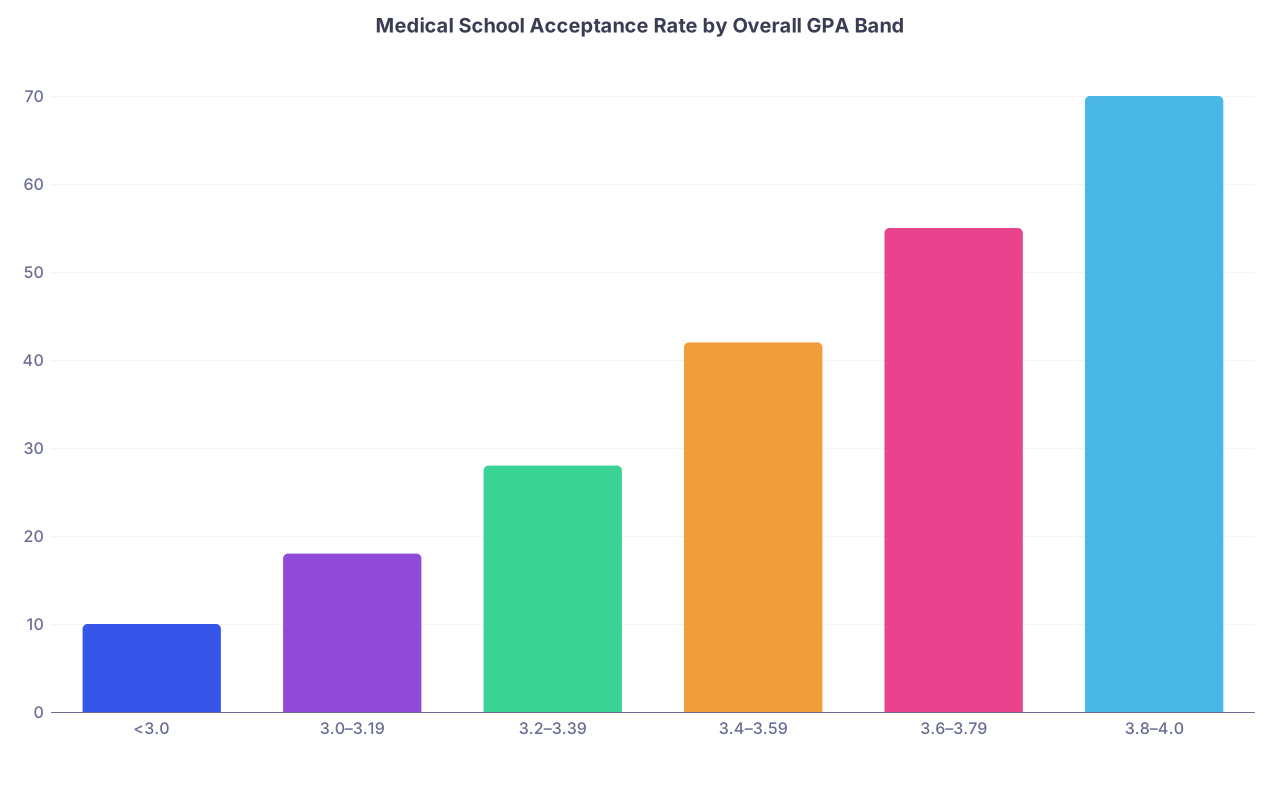
Reality: For MD schools, your undergraduate GPA is king. Master’s GPA is a separate, secondary number.
AMCAS (MD) does this:
- Calculates undergrad BCPM (science) GPA
- Calculates undergrad total GPA
- Then lists post-bacc undergrad GPA and graduate GPA as separate lines
Your 2.9 undergrad does not become a 3.6 because you got a 3.8 in a master’s. They sit side-by-side, and adcoms look at both, with undergrad usually weighted more heavily.
AACOMAS (DO) now also keeps undergrad and graduate GPA distinct. Grade replacement is gone. Same problem.
A post-bacc is still undergraduate-level work. Those A’s:
- Directly raise your undergrad GPA denominator
- Make your trend line look better
- Improve both overall and science GPA in the category schools care about most
A master’s gives you:
- A shiny grad GPA line
- No change to your original undergrad GPA category
When is this distinction massive?
- If you’re sitting at:
- 2.7–3.0 undergrad GPA
- Weak or inconsistent science grades
- Lots of C’s in prerequisites
You don’t need a flattering separate number. You need repair in the original category that’s dragging you down. That’s what a good undergrad post-bacc does.
GPA Example
Student A: 2.8 cGPA, 2.7 sGPA. Completes 32 credits of upper-level undergrad sciences in a post-bacc at 3.9.
- New undergrad GPA might rise to ~3.1–3.2, with a strong upward trend visible in the actual core metric.
Student B: Same starting GPA. Completes a 30-credit master’s at 3.9.
- Undergrad GPA remains 2.8/2.7. Now shows 3.9 graduate GPA. Some committees will give credit, but the undergrad issue is still staring them in the face.
Who’s more viable to a broad range of MD/DO schools? Usually Student A.
Myth busted: For GPA repair, a traditional (undergrad-level) post-bacc usually moves the needle more where it counts.
Myth #2: “Master’s Looks More Impressive to Medical Schools”
Impressive is cheap. Predictive is what matters.
Adcoms care about signals of readiness:
- Can you handle med-school-level science content?
- Can you sustain high performance over time?
- Did you fix previous weaknesses or just outrun them?
There are three main buckets of programs premeds confuse:
Career-enhancer/content master’s
- E.g., MS in Biomedical Sciences at a non-medical-school campus, MPH, MS Physiology with no linkage
- Often solid training, but not specifically built or validated as med school predictors
- Outcomes are highly variable and often not well-published
Special Master’s Programs (SMPs) linked to a med school
- Examples:
- Georgetown SMP
- Boston University MAMS
- Cincinnati, EVMS, Loyola MAMS
- Often take actual med school courses or parallel them
- Can be very predictive if you crush it and the program is respected
- Examples:
Undergrad post-bacc (formal or DIY)
- Classes often overlap with or extend beyond premed prerequisites
- Clear signal of improved academic behavior in the same space where you previously struggled
The unsexy truth:
- Strong performance in a serious undergrad post-bacc is often just as compelling as many generic master’s programs
- Only top-tier SMPs with strong correlations to med school curricula and transparent outcomes truly stand apart
Adcoms know:
- Lots of master’s programs exist primarily to enroll desperate premeds
- Graduate grades are often slightly inflated vs undergrad
- Some programs admit applicants that med schools wouldn’t touch, then heavily market the small success subset
So no, a random “Biomedical Sciences MS” does not automatically outrank a deliberate, high-performing post-bacc record.
Master’s “impressive factor” is heavily program-dependent. The logo and structure matter more than the word “master’s.”
Myth #3: Master’s Programs Have Better Acceptance Outcomes Across the Board
Program websites love big numbers:
“80% of our graduates matriculate to medical or professional school within 2 years.”
Sounds incredible. Until you ask:
- 80% of who?
- Did they exclude:
- Those who didn’t complete the program?
- Those who didn’t apply to med school?
- Those who pivoted careers?
- “Medical or professional” = MD, DO, PA, dental, podiatry, nursing, etc. Which ones?
You’ll see the same games in some post-bacc marketing, but master’s programs often lean on these numbers more aggressively because tuition is higher.
Here’s the key pattern in outcomes:
Top SMPs (Georgetown, Cincinnati, BU MAMS, some EVMS, etc.):
- Solid med school matriculation rates, often 50–70%+ for serious, high-performing students
- But these students usually:
- Already have ~3.0–3.4 undergrad
- Decent MCATs
- Decent extracurriculars
The program polishes and proves readiness. It rarely resurrects a completely broken record.
Mid/low-tier master’s:
- Outcomes are often much weaker or opaque
- Many grads still need:
- Higher MCAT
- Additional coursework
- Multiple cycles
Well-structured post-baccs:
- Formal post-baccs with advising and linkage sometimes show 60–90% acceptance among committed, competitive completers
- DIY post-baccs don’t have centralized stats, but many students successfully push themselves into 3.3–3.6 GPA territory + strong MCAT and get in
The confounder nobody mentions:
- The best outcomes come not from “master’s vs post-bacc” but from matching the intervention to the problem:
- Weak GPA → Undergrad GPA repair via post-bacc (sometimes followed by SMP)
- Decent GPA but question mark on rigor → Consider strong SMP
- GPA fine, MCAT poor → Neither fixes that; you need MCAT work
- Zero clinical exposure → Neither magically solves that either
Myth busted: There’s no universal “master’s > post-bacc” acceptance advantage. The data is messy, selection-biased, and heavily dependent on student profile and program quality.
Who Actually Benefits More From a Master’s?
Sometimes, the contrarian answer is: a master’s is better. For specific people.
You’re more likely to benefit from a strong master’s or SMP if:
Your undergrad GPA is borderline but not catastrophic
- Roughly 3.2–3.5, with some unevenness
- You already meet many schools’ minimum screens
- You want to show you can handle med-school-like rigor
Your science foundation is OK but not clearly elite
- B’s in core sciences, few A’s
- You want to show A-level work in high-level physiology, pharmacology, etc.
You target schools that explicitly value their SMPs
- Some med schools strongly favor their own linked programs
- Conditional interviews or guaranteed interviews with certain metrics
You want an exit plan if medicine doesn’t happen
- Some master’s (e.g., MPH, MS in Biostats, certain physiology programs with research emphasis) have legitimate non-MD career value
- You care about employability, not just admissions
In these cases, a carefully chosen, reputable master’s or SMP can:
- Strengthen your narrative
- Signal maturity and academic resilience
- Open specific linkage/priority pipelines
But it does not erase a 2.6 GPA or a string of C’s in Chem and Orgo. That’s magical thinking.
Who Usually Does Better With a Post-Bacc?
You probably need a post-bacc first (or instead) if:
Your undergrad GPA is <3.0 or sGPA is very weak
- A master’s will not lift that to a competitive range
- Some SMPs won’t even admit you below certain GPAs
Your prereqs are old, scattered, or missing
- You never took physics, or your orgo was 10+ years ago
- You switched careers and were never premed in college
You have to prove you’re a different student now
- Big upward trend needed
- You want to show:
- No more withdrawals
- No more C’s in key courses
- Consistent A-/A work across 24–40 credits
Money and risk matter
- Many post-baccs (especially DIY at state schools or community colleges, where appropriate) are far cheaper than private SMPs
- If you bomb an SMP, it’s a double hit: huge debt + clear signal you struggled in grad-level work
A solid post-bacc record can:
- Get your cumulative and science GPA above common cutoffs
- Demonstrate mature study habits and time management
- Provide letters from faculty who saw you at your best, not your confused 19-year-old version
Some students then add a targeted SMP later as a capstone if they still need another signal. That stack (post-bacc → strong SMP) can be powerful. But skipping GPA rehab and praying the SMP will save you? Bad bet.
Other Variables People Ignore (At Their Own Risk)
The master’s vs post-bacc debate usually hides these critical factors:
1. MCAT Timing and Integration
- High-intensity SMP + MCAT = hard to do simultaneously without one suffering
- Many students should:
- Strengthen knowledge and GPA via post-bacc
- Then take MCAT with that stronger base
- Consider SMP only if needed afterward
2. Financial Reality
Approximate ranges:
- SMP at a private institution: $40k–$70k+ tuition alone, 1–2 years
- Many formal post-baccs: $20k–$40k
- DIY post-bacc at a state school or community college: often far lower, though quality and perception vary
If you’re borrowing:
- That SMP might cost you six figures over time
- If it doesn’t produce a clear admissions bump, you’ve just paid a premium for… a line on your CV
3. Risk of Visible Failure
- A 2.9 undergrad followed by a 3.9 post-bacc? Nice comeback story.
- A 2.9 undergrad followed by a 3.0 master’s with med-school-like courses? That’s a much bigger red flag.
An SMP is more binary:
- Crush it = big gain
- Struggle = door-closing
A post-bacc allows more incremental improvement with slightly less catastrophic downside.
4. Fit With Your Life
- Working full-time? Family obligations?
- SMPs often expect you to treat them like med school: near-total focus.
- A part-time or flexible post-bacc might match your reality better.
How To Decide: A Simple Framework
Forget the marketing. Ask these questions, in order:
What is my current undergrad cGPA and sGPA?
- <3.0? You almost certainly need undergrad GPA repair first.
- 3.0–3.3? Likely still some post-bacc work before or instead of SMP.
- 3.3–3.6? Now SMP vs focused post-bacc becomes a real choice, depending on trend and rigor.
What’s my MCAT situation?
- No MCAT yet? Plan coursework around realistic MCAT prep.
- Low MCAT (<505 MD, <500 DO)? Fix that first or alongside, not as an afterthought.
What exactly do my target schools say about these programs?
- Look for:
- Explicit statements on how they view SMPs vs post-bacc
- Any mention of their own programs and outcomes
- Minimum GPA/MCAT screens
- Look for:
If I completely crush this program, will it fix the right problem?
- Master’s crush = stronger grad GPA, possible med-school-rigor signal
- Post-bacc crush = stronger undergrad GPA and trend, better MCAT base
What is my realistic risk tolerance (financial + academic)?
- If an SMP goes badly, can I absorb that?
- If a post-bacc stretches to 2 years, can I handle the delay?
If your advisor or a program director cannot answer:
“Show me your actual matriculation breakdown for students with my starting GPA and MCAT,”
that’s your signal to be skeptical of blanket claims.
FAQ: Master’s vs Post-Bacc for Premeds
1. If I do both, which should come first: post-bacc or master’s?
Usually post-bacc first. Repair the undergrad GPA, fix your study habits, and build a stronger science base. Then, if needed, use a reputable SMP as a “final proof” of med-school readiness. Doing a master’s on top of a still-weak undergrad record is like putting a suit jacket over a torn T‑shirt — the problem shows through.
2. Will a 4.0 master’s compensate for a 2.7 undergrad GPA at MD schools?
Not in the way most people think. Some schools may be impressed by the 4.0 and give you a closer look, but many will still screen heavily off the undergrad GPA. You might improve your odds at certain DO schools or at institutions that value that specific SMP, but you haven’t actually solved the fundamental metric problem.
3. Are community college post-bacc classes acceptable, or do I need a 4-year university?
Context matters. If your earlier record is from a 4-year university and you suddenly move all coursework to a lower-cost community college, some schools may discount the rigor slightly. But strong performance is still better than no improvement. If possible, mix in or prioritize upper-division science at a 4-year institution, especially if you’re aiming for more competitive MD programs.
4. Do SMPs help if my main problem is a low MCAT, not GPA?
Not usually. SMPs are academic rigor tests, not MCAT prep courses. If your GPA is fine (say 3.5) but your MCAT is 498, the SMP doesn’t fix that — you need dedicated MCAT remediation. Some students hope that doing an SMP will somehow make the MCAT easier. It might help content-wise, but you’re risking a lot of money and bandwidth to indirectly address a test-prep problem.
5. How do linkage and guaranteed interview agreements factor into this decision?
They can be powerful, but only if you understand the fine print. Many “linkages” require hitting specific GPA and MCAT thresholds that are already high. Some “guaranteed interviews” aren’t guarantees of anything beyond one conversation. Evaluate:
- How many students actually meet those thresholds?
- How many linked interviews result in acceptances?
If a post-bacc has a robust, transparent linkage track record for students like you, it might beat a generic master’s with vague promises.
Key points:
- A master’s does not repair undergrad GPA; a post-bacc usually does more heavy lifting there.
- Outcome advantages depend on the student’s starting profile and the specific program quality, not the word “master’s.”
- The winning move is matching the intervention (post-bacc, SMP, or both) to your exact academic weaknesses, MCAT situation, and risk tolerance — not buying the most expensive option and hoping it impresses adcoms.