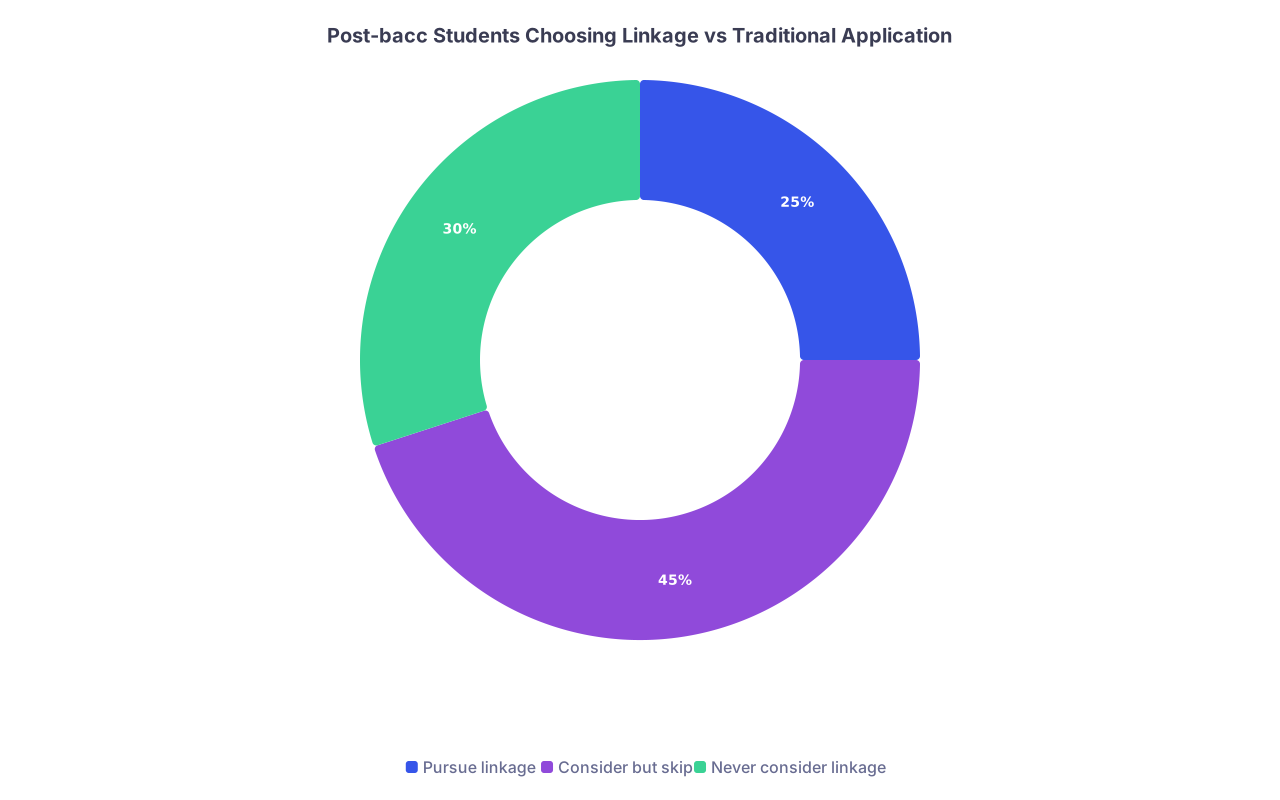
Top-tier “brand name” post-baccs are wildly overrated for medical school admissions.
That is not what the marketing brochures say, and it is not what premed forums repeat. But it is what the data, admissions behavior, and actual outcomes show once you strip away the prestige glow and look at who actually gets into medical school.
Let’s dismantle the mythology.
(See also: Myth vs Reality: Do Post-Bacc Programs Guarantee Med School Interviews? for more details.)
The Prestige Myth: “I Need an Ivy/Elite Post-Bacc to Be Competitive”
The dominant narrative goes like this:
You did not have a perfect premed path. Maybe your GPA is shaky, maybe you were a career changer, maybe you realized late. The solution? Pay $40,000–$70,000 for a brand-name post-bacc at Columbia, Penn, Goucher, Bryn Mawr, Scripps, Hopkins, Harvard Extension, or similar. The name will “signal” quality, “open doors,” and “impress” admissions committees.
It sounds plausible. It is also deeply incomplete.
Medical schools do not admit you because the word “Columbia” or “Penn” or “Harvard” appears on your transcript. They admit you because, in concrete terms, you have:
- A strong recent science GPA (usually 3.6+ in your last 30–40 credits
- A solid to strong MCAT
- Competent, specific letters of recommendation
- Evidence that you know what medicine is and will not bail
- A coherent narrative that explains your trajectory
You can accomplish every single one of those at a state university, regional private school, or local college that nobody on Reddit mentions.
When you look at who actually gets accepted to med school, the top-tier post-bacc brand is, at best, a supporting character. Often it barely shows up at all.
What Admissions Committees Actually Care About (Not the Brochure Version)
Let’s strip away the marketing language.
When adcoms review a career-changer or record-enhancer applicant, they are essentially asking four questions:
- Can you handle rigorous science now?
- Is your performance recent enough to be predictive?
- Does your MCAT align with your coursework performance?
- Do your experiences and letters indicate maturity, reliability, and fit for medicine?
Notice what is not in that list: the “tier” of your post-bacc institution.
Course rigor vs. name brand
Adcoms care whether the classes were real upper-division sciences with substantial exams and labs, not whether the building had ivy on the walls. They look at:
- Number of credits
- Level of courses (upper-division vs. just retaking intro bio/chem)
- Consistency of grades over time
If you took Organic Chemistry, Biochemistry, Physiology, and Cell Biology at a state school and earned mostly A’s, that answers their question about academic readiness better than a mixture of B’s and a C+ at a famous university.
Would an A at MIT or Hopkins reassure them that you did well in a competitive environment? Sure. But they know grade distributions vary wildly, and they’ve accepted thousands of students from places like CUNY, CSU, SUNY, and directional state schools where a 3.8 in post-bacc science work is rock-solid evidence.
The post-bacc GPA reset
For many applicants, the post-bacc (or DIY upper-level science slate) acts as a quasi-reset. If you tanked your early undergrad with a 2.7 and later rack up 35–45 credits of straight A/A- in demanding sciences, that trend is powerful. It tells committees you’ve figured out how to learn at a high level.
They look at trend and recency, not logo.
This is why you routinely see accepted applicants who did:
- Undergrad: 3.0 from random regional university
- Post-bacc: 3.9 across 40 credits at a local public college
- MCAT: 515
- And then end up at schools like UVM, Temple, Jefferson, MCW, NYMC, or even higher-ranked programs if the rest of the package is strong.
No Ivy post-bacc needed.
The Hard Truth About Linkage Agreements and “Pipelines”
Top-tier formal post-bacc programs love to advertise “linkages” and “special relationships” with medical schools. This sounds like a secret back door. Reality is more boring and more restrictive.
Most linkages are narrow and conditional
A typical linkage requirement from a well-known program will look something like:
- 3.7+ GPA in the post-bacc
- No grades lower than B+ in sciences
- MCAT above school’s median (often 510–515+)
- No retakes
- Strong committee letter
- Sometimes a residency or mission-fit requirement
Then there’s the catch no one emphasizes: you usually apply through the linkage during or immediately after the program, often before you’d naturally want to apply, with very little margin for error. If your MCAT is delayed, if you underperform a single term, if personal issues intervene, that special pipeline evaporates.
Linkages are not magic carpets. They’re narrow, high-wire routes for students who were going to look very competitive anyway.
“Preferential consideration” is vague for a reason
You’ll also see language like “Our graduates are routinely accepted at X School of Medicine” or “Our students enjoy strong relationships with Y medical school.” That is marketing copy. It tells you little about incremental advantage over an equally strong applicant from a non-brand program.
Medical schools love well-vetted, reliable programs that send them polished applicants who’ve been advised and filtered. But that is very different from “we prefer them over equally qualified candidates.”
The uncomfortable truth: if you hit the same academic metrics and MCAT at a nondescript school, you’re usually just as acceptable.
Data Reality Check: Who Actually Gets In?
Let’s look at the bigger picture rather than a handful of glossy success stories.
National acceptance numbers do not require elite brand names
AAMC data show that applicants with around:
- 3.4–3.6 cumulative GPA and
- 510–512 MCAT
have decent acceptance rates. Bump those numbers just a bit:
- 3.6–3.8 GPA and
- 512–515 MCAT
and the acceptance rates jump significantly, regardless of where those grades were earned.
You don’t see a category in the AAMC table for “elite post-bacc vs regular post-bacc.” Adcoms evaluate your academic record as a whole. The brand name is, at best, a minor context note.
Look at the matriculant pool at mid-tier and many upper-tier schools. A huge fraction come from state flagships, mid-level privates, and regional schools that no one would call “top-tier.” Many did DIY or informal post-baccs through local universities while working or caring for families.
Those people are not admitted in spite of the lack of a prestige post-bacc. They’re admitted because their recent performance and MCAT show they’re ready.
The Hidden Costs and Tradeoffs of Brand-Name Post-Baccs
Now we pivot to the part almost no one selling these programs highlights: opportunity cost.
Money that could have gone directly to med school
A one-year, formal post-bacc at a big-name institution can easily run:
- $30,000–$50,000+ in tuition and fees
- $20,000–$30,000+ in living expenses, especially in major cities
- Plus the cost of not working or working reduced hours
You can walk out of a year of post-bacc with $50,000–$80,000 in new debt before med school debt even starts. Many students push their total educational debt well past $300,000 by the time they finish residency.
Could you get nearly identical admissions value from:
- 30–40 credits at your local state university at $400–$800/credit,
- while continuing to work part-time,
- and finding clinical/extracurricular experiences locally?
Yes. You absolutely can. Thousands do.
Time and flexibility
Formal programs are rigid. You take their sequence, at their pace, often with a heavy course load engineered to qualify you for a linkage. If your MCAT timing or life situation doesn’t align, you’re stuck.
DIY or local options let you:
- Spread courses over more semesters to preserve GPA
- Align MCAT prep with your strongest semesters
- Maintain work or family responsibilities
- Start or continue clinical employment (scribe, MA, EMT, CNA, etc.)
Admissions committees do not penalize you for this. In fact, they often appreciate applicants who balanced real life with academics and still performed well.
Where Top-Tier Programs Do Help (When the Premium Might Be Worth It)
Everything so far has been critical of the myth, not the programs themselves. Many elite post-baccs are well-run and genuinely supportive. The issue is what people think they do versus what they really do.
There are a few scenarios where a high-profile, structured program can be a rational choice.
You need structure and tight advising
Some applicants are genuinely lost. They don’t know which courses to take, how to build a timeline, or how to sequence MCAT, activities, and applications. They benefit from:
- Built-in advising
- Committee letters that consolidate their story
- Mandatory shadowing or clinical placements
- MCAT integration into the curriculum
If you know you won’t design and execute a coherent plan on your own—and you have the financial cushion—buying that structure may save you from costly missteps.
You’re looking for a complete career-change cohort
Programs like Goucher, Bryn Mawr, Scripps, and similar classic career-changer post-baccs are designed for people coming from non-science, often non-academic careers into medicine. They create a small, intense cohort with built-in support. The alumni network is real. That can matter for motivation and retention.
Again, the advantage is not the name itself; it’s the ecosystem, the handholding, the cohort.
Your undergraduate record is so fractured that you need a heavily curated narrative
If you have multiple false starts, several institutions, old withdrawals, and a midlife pivot, a formal program with a committee letter and a very clear “this person has been vetted and is now thriving” narrative can simplify how your application is read. Not required, but sometimes helpful.
What Matters More Than Prestige: The Criteria You Should Actually Use
If you strip away the brand bias, choosing a post-bacc path becomes a more rational exercise. The filters change from “What looks most impressive?” to “What will best allow me to demonstrate I can succeed in med school science and handle the process?”
You should be asking:
- Where can I reliably earn A/A- in rigorous upper-level science with my current life constraints?
- Where can I keep my total debt reasonable relative to my future attending physician income?
- Where can I access meaningful clinical exposure and potentially work in a clinical job?
- Where can I get strong, detailed letters from people who actually know me?
For many people, that’s not an Ivy or elite private. It is a nearby university with good teaching, more accessible office hours, and less competitive grade distributions.

Common Scenarios: Brand Name vs Non-Brand Outcomes
Let’s walk through a few archetypes to drive this home.
Scenario 1: The 3.2 GPA career changer
You were a humanities major with middling grades 8 years ago. You now want medicine.
Option A: $50k formal elite post-bacc, full-time, 30 credits, heavy debt, minimal work.
Option B: Local state university, 30–40 credits part-time over two years while working as an MA or scribe.
If you earn a 3.8+ in your post-bacc coursework and a 512+ MCAT, both paths put you squarely in competitive territory. The difference? Debt and opportunity cost, not admissions outcome.
Scenario 2: The 2.7 GPA science major redemption arc
You already did biology or chemistry and it went poorly.
Here the name still is not the main driver. What you need is:
- 30–45 credits of upper-level sciences with A/A-
- Careful course selection to avoid repeating old mistakes
- Time to rebuild learning habits and test skills
You’re not getting extra forgiveness from adcoms just because your redemption happened at a famous school. They care that it happened at all and that it is sustained.
Scenario 3: The “I want a linkage” fantasy
You convince yourself that a linkage will spare you from the normal application grind.
Reality: to be remotely competitive for most linkages, you would need:
- A near-perfect post-bacc GPA
- A high MCAT on the first try
- To be comfortable locking yourself into one or two schools early
If you are strong enough to realistically meet those bars, you’re probably strong enough to be competitive applying broadly from a cheaper, less-famous setting.

The Real “Signal” You Send to Med Schools
Here’s the uncomfortable conclusion: the signal that medical schools care about is not “I got into Columbia’s post-bacc.” It is “I can crush medically relevant science now, under real-world constraints, and I understand what I’m signing up for.”
You can send that signal in many ways:
- A strong DIY post-bacc or second bachelor’s at a public university
- A formal structured program at a non-elite institution
- A few years of clinical work plus part-time coursework
- Or yes, an elite post-bacc—if it is the best overall fit, not just the shiniest label
The myth is that top-tier brand-name post-baccs are the ticket. The reality is that they are one vehicle among many, and often not the most cost-effective one.
Key points to remember:
- Medical schools care far more about your recent academic performance, MCAT, and clinical maturity than the brand name of your post-bacc.
- Linkages and “special relationships” are narrow, conditional, and mostly benefit already-strong applicants; they are not magic back doors.
- For most people, a well-chosen, affordable non-brand program—or DIY post-bacc—offers equal admissions power with far less financial baggage.