The idea that a formal, brand-name post-bacc is always better than piecing together DIY prereqs is a myth that costs students tens of thousands of dollars every year.
The cheaper route is not automatically worse. In many cases—when used strategically—it’s more efficient, less risky, and yields equivalent admissions outcomes.
Let’s dismantle the marketing and look at what actually moves the needle in medical school admissions.
(See also: The MCAT Boost Myth: What Post-Baccs Really Do for Your Score for more details.)
The Big Myth: “Real” Post-Baccs Are Respected, DIY Is Sketchy
There’s a persistent story in premed circles:
If you do your prereqs at a community college or through a DIY “informal post-bacc,” adcoms will side-eye your record.
If you pay $30–60k for a formal, branded certificate program, suddenly your grades “count more.”
Reality: medical schools care about performance in context. Not whether your tuition check went through a centralized program office.
What adcoms actually scrutinize:
- Your science GPA trends (especially BCPM: biology, chemistry, physics, math)
- Your MCAT score and how it matches your coursework
- The rigor and recentness of your academic work
- Whether you’ve demonstrated you can survive something that looks like a med-school-adjacent workload
Notice what’s missing: “Did this person pay for a formal post-bacc admissions package?”
When admissions committees talk about “post-bacc,” they’re not always using the same jargon you see in program brochures. To them, “post-bacc” usually just means “coursework after the bachelor’s degree.” Whether it was in a curated program or a la carte is secondary.
There are specific contexts where a formal post-bacc gives you an edge (more on that), but the blanket belief that DIY prereqs are inherently inferior is not supported by outcome data or by what adcoms actually say in committee rooms.
What the Data (and Deans) Actually Point To
If you look for large, randomized trials comparing formal post-baccs to DIY routes, you will not find them. Admissions is messy, self-selected, and noisy.
But we do have:
- Published AAMC data on GPA, MCAT, and acceptance rates
- Statements from med school deans and admissions directors
- Outcomes from known pipeline and linkage programs
- The brutal math of debt, opportunity cost, and risk
When you strip away the marketing, three factors consistently correlate with successful post-bacc → MD/DO transitions:
- Substantial upward trend in GPA, especially in upper-division science
- MCAT in a competitive range for target schools
- Documented academic resilience (you had a rough start, then clearly fixed it)
Whether that upward trend happened through:
- A name-brand one-year career-changer post-bacc at a private university
- Three years of night classes at a community college plus some upper-division university sciences
…turns out to matter less than students are led to believe.
Deans routinely say some version of: “We care that you went back, took rigorous science coursework, and excelled. We do not require you to have done an official post-bacc program.”
Actual quote paraphrased from multiple MD and DO schools at premed advisor conferences.
So where did the “DIY is second-class” narrative come from? Post-bacc programs themselves. They need to differentiate their product. The easiest way: cast doubt on anything that isn’t them.
When a Formal Post-Bacc Really Helps (and When It Doesn’t)
Contrary to the myth, formal post-baccs are not useless. They can be extremely powerful—for the right applicant profile.
They tend to shine in these specific scenarios:
1. You need heavy, structured hand-holding
If any of this is true:
- You struggled academically because you lack study skills and need explicit coaching
- You collapse without built-in advising, tutoring, and forced scheduling
- You’ve never navigated a large academic bureaucracy and don’t trust yourself to build a workable path
…then the institutional scaffolding of a well-run post-bacc can be worth paying for.
The myth is that everyone needs this. Many do not. But if you’re honest with yourself and know you thrive in highly structured environments, the “wraparound services” (advising, committee letters, MCAT planning support, maybe test-taking workshops) can absolutely change outcomes.
2. You’re a true career changer with no science background
If you’re a humanities or business major who has:
- Zero prereqs
- No lab sciences
- No idea what “buffer capacity” or “Michaelis-Menten” is
Then a career-changer post-bacc with a tightly sequenced curriculum is efficient. They know how to march non-science folks through Gen Chem → Bio → Orgo → Physics with minimal scheduling disasters.
Do you have to do it this way? No. You could do DIY at a state university or community college. But the cost of mistakes (taking classes out of order, getting boxed out of needed sections, missing application cycles) is higher when you’re clueless and planning solo.
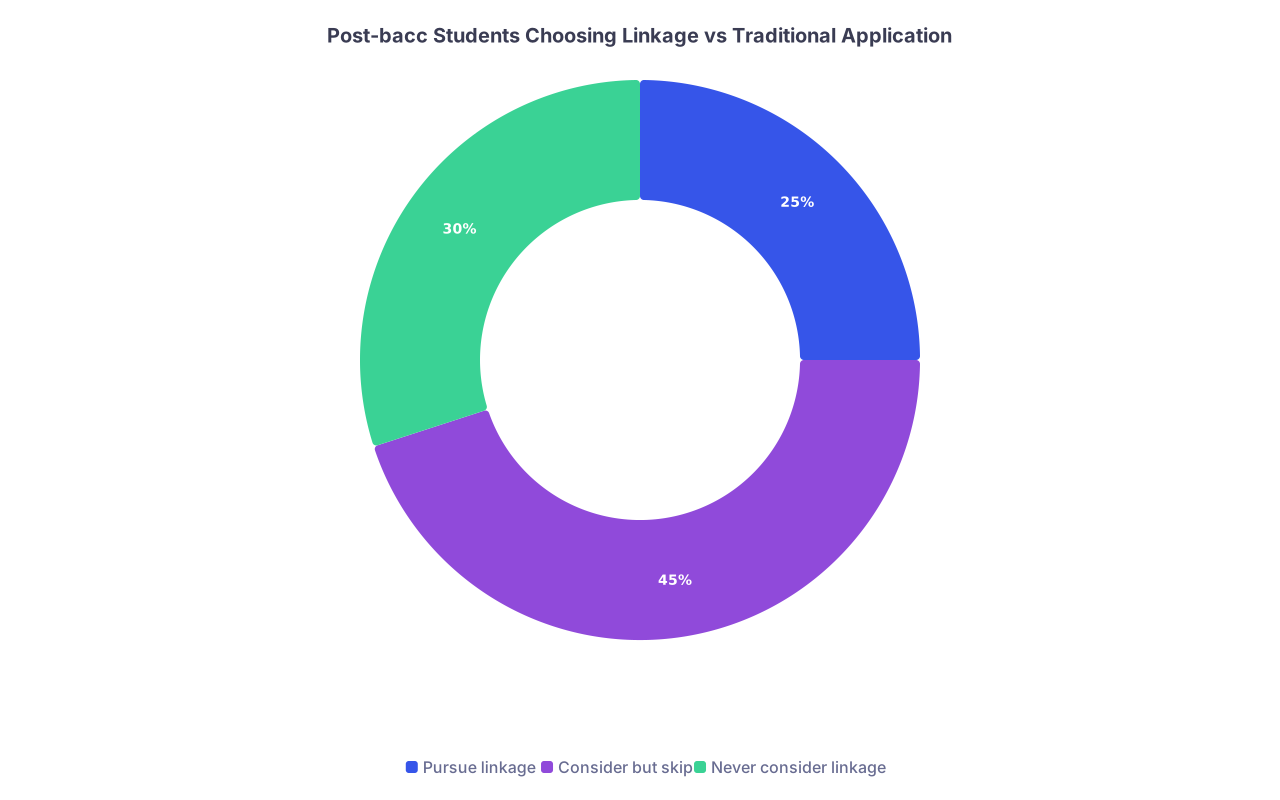
3. You’re targeting a linkage
This is where formal post-baccs can be uniquely powerful.
Some programs have explicit linkage or conditional acceptance pathways: complete our curriculum with a certain GPA and MCAT, and you move directly into a partner med school without a glide year.
These can be game-changers for:
- Older applicants who cannot afford extra cycles
- Career changers trying to cut down the timeline
- High-achieving students with clear school preferences
However, linkage isn’t magic. Look at the fine print:
- Not everyone in the program gets a linkage spot
- GPA/MCAT thresholds are often higher than the school’s median
- Many linkages are non-binding “guaranteed interview,” not guaranteed acceptance
If you’re not competitive for the linkage or unlikely to meet the thresholds, paying for the linkage “opportunity” makes a lot less sense.
4. You need a formal committee letter from somewhere
If your undergraduate institution won’t write you a committee letter or you burned bridges there, some formal post-baccs offer committee letters and heavy advocacy. For certain schools that still value committee letters, this can patch a hole.
But again, this is only decisive for a subset of applicants and schools.
The Underrated Strengths of DIY Prereqs
Now let’s challenge the default snobbery against DIY, especially at community colleges and state schools.
Cost: not just a side note, but a risk-adjustment
A typical one-year, full-time formal post-bacc (tuition + fees + living) at a private institution can easily run:
- $30,000–50,000 tuition alone
- $60,000–80,000 total cost of attendance if you are not working
DIY at a community college plus local state university:
- $5,000–15,000 in tuition over multiple years, depending on state and load
- Often combined with part-time or even full-time work
Why does this matter beyond your wallet? Because you are taking a gamble.
If you spend $60,000 and then:
- Don’t fix your GPA enough
- Underperform on the MCAT
- Decide medicine isn’t for you
- Have life derail your plans
You’re now deep in additional debt with no MD/DO acceptance to show for it.
DIY lets you:
- Start small, test whether you can earn A’s in sciences now
- Adjust speed based on performance and burnout
- Stop or pivot without a sunk-cost catastrophe
This isn’t just about being “cheap.” It’s about reducing the downside risk of an uncertain outcome.
Signal to admissions: rigor and trend, not sticker price
A common fear: “If I take prereqs at community college, med schools will think I’m weak.”
Reality is more nuanced:
- Some med schools do view extensive CC coursework skeptically, especially if:
- You had access to a four-year university and chose CC instead without clear reason
- Your CC coursework is the only place you ever got A’s after a history of B/C work at a university
- But many schools accept CC prereqs, especially for non-traditional students balancing work and family
DIY done well can send a powerful signal:
- You had adult responsibilities (job, kids, aging parents) and still crushed science courses
- You showed up at night after work and earned A’s despite non-ideal conditions
- You then added some upper-division sciences at a four-year to show you can handle higher-level rigor
That’s a story admissions understands: improvement, resilience, and maturity.
A bland 4.0 in a pampered, hand-held post-bacc cohort where everyone is pre-screened for success? That’s fine—but it’s not inherently more impressive.
Flexibility: building what you actually need
Formal programs are designed for a composite “ideal” student. You’re an actual human. You might need:
- Two semesters of upper-division biology, not four
- A DIY “GPA repair” sequence focused on biochem and physiology because your undergrad science GPA is the issue
- An extended timeline at 1–2 courses per term because you’re working as an EMT or MA
DIY prereqs let you configure:
- Timing (night vs day, fall/spring vs summer)
- Course selection (strategic mix of prereqs and GPA-boosters)
- Pace (heavy load for career changers with no job, light load for full-time workers)
Med schools are not awarding extra points for you suffering through a one-size-fits-all schedule you didn’t need.
Where DIY Does Backfire
Pretending DIY is always as good as the best-run formal post-bacc would be just as dishonest as saying the reverse. There are failure modes.
DIY can hurt you if:
- You scatter courses across three institutions without a coherent explanation
- You never progress beyond community college level despite having the option to do so
- You repeat easy A’s instead of pushing into upper-division science that mirrors med school content
- You ignore advising and miss core requirements or sequencing (like taking biochem before you’ve mastered orgo and basic metabolism)
The most damaging DIY error: not proving you can excel at a four-year institution in upper-division science, especially if your original undergrad GPA was weak.
If you’re going DIY, the higher-yield model for many is:
- Use community college strategically for some prereqs if needed for cost or access.
- Then, enroll at a local state university for 12–24 credits of upper-division biology/biochem/physiology/neuroscience.
- Crush those courses with A-level work to show “med-school-adjacent” rigor.
That hybrid—cheap where it can be, rigorous where it matters—is often more compelling than either “all CC forever” or “all expensive branded post-bacc.”
The Real Decision Framework: Not “Post-Bacc vs DIY”, But Fit vs Fiction
The productive question isn’t “Which is better, post-bacc or DIY?” It’s:
“For my academic history, financial reality, and life constraints, which path maximizes the odds of a strong upward trend with the least unnecessary risk?”
Strip away the brochure language and start from your data points:
- Undergrad GPA: just low overall, or specifically low in sciences?
- Do you already have most prereqs, or are you a blank slate?
- Are you working full-time or can you step away for 12–18 months?
- Can you realistically self-manage complex multi-term scheduling, or do you fall apart without external structure?
- Are you aiming for MD only, DO only, or open to both? Some DO schools are more flexible about community college and DIY paths.
Then map to broad categories:
- Heavy GPA repair with existing science background
- Generally: DIY + targeted upper-division science at a four-year is often as good or better than a one-size-fits-all post-bacc
- True career changer with no science and strong prior GPA
- Formal career-changer post-bacc or a well-planned DIY sequence at a solid state university can both work
- Non-traditional with job/family obligations
- DIY is almost always more realistic; formal full-time programs can be financially and logistically brutal
- Looking for pipeline/linkage to a specific med school
- Now the specific post-bacc’s track record and linkage agreements matter a lot
Notice the pattern: the “cheaper vs better” framing is a distraction. What matters is: can you construct an academic record that convinces a skeptical committee you’re now ready to handle a crushing medical curriculum?
Sometimes that’s easier with an $8,000 patchwork of classes and a lot of personal discipline. Sometimes it really is worth $60,000 in structure and access.
Anyone who tells you there’s a single “right” answer is selling something.
Key Takeaways
- Medical schools care about performance, rigor, and trend—not whether your classes were bundled into a fancy post-bacc package.
- DIY prereqs, especially when paired with strong upper-division coursework at a four-year institution, can match or surpass formal post-bacc outcomes for many applicants at a fraction of the cost.
- Formal post-baccs make sense when you genuinely need structure, linkage opportunities, or intensive advising—not just because someone told you the cheaper route “looks bad.”