The biggest mistake post‑bacc students make is starting at the wrong time—and then losing an entire year for no good reason.
If you want to start medical school two cycles from now, your calendar is not flexible. There is a right window and a wrong window. Start too late and you push your dream back by a full year. Start too early and you waste time, money, and momentum.
Let me walk you through the timing, step by step, cycle by cycle, month by month. You will see exactly when you must start your post‑bacc to matriculate in two cycles—and what you should be doing at each point.
(See also: Application Year vs Post-Bacc Year for more details.)
First, Define “Two Cycles” Precisely
People hand‑wave this phrase all the time. Let’s pin it down.
- Medical school applications (AMCAS/ AACOMAS) open: early May
- You can submit: end of May / early June
- Interviews: September–February
- Decisions and waitlist movement: October–August
- Matriculation: August of the following year
“Matriculate in two cycles” means:
- You are here now, before you have started your post‑bacc.
- You want to be sitting in an M1 orientation not this upcoming cycle, but the one after.
Concrete example:
- Today: January 2025
- Target matriculation: August 2027
- That means: Apply in June 2026.
Everything we discuss below uses that structure:
- Year 0: Now
- Year 1: Application year (submit in June of this year)
- Year 2: Matriculation year (start med school August of this year)
You want your post‑bacc start date aligned so that:
You have enough time to:
- complete the critical coursework,
- take the MCAT with a real shot at your score target,
- build clinical/volunteering experiences that are not laughably thin.
You are ready to submit in June of Year 1.
Not “planning to submit in August.” Not “personal statement still in Google Docs.” Submitting early.
The Core Rule: Your Post‑Bacc Must Start 12–18 Months Before Your Application Opens
Here is the blunt version:
- If you want to apply in June of Year 1, you should generally start your post‑bacc between January and August of Year 0.
- Earlier than that and you are stretching things out.
- Later than that and you will probably lose the “two cycle” goal, unless you already have a lot of boxes checked.
There are three common profiles. Where you fit determines your ideal start date.
Career‑changer (no core sciences done)
- Needs: 1–2 years of intensive basic sciences before MCAT.
- Ideal post‑bacc start: Summer/Fall of Year −1 or very early Year 0.
Translation: you probably need >18 months before application.
GPA‑repair / enhancer (science courses done, GPA weak)
- Needs: 24–32 credits of strong post‑bacc work, structured narrative of improvement.
- Ideal start: January–June of Year 0 for a June Year 1 application.
Hybrid (some prereqs missing + GPA weak)
- Needs more time. Pushing very hard to hit two cycles is usually a mistake.
I will assume you are in the GPA‑repair or light‑prereq category, because that is where “two cycles” is realistic without contortions.
Now let us lay out the exact timeline.
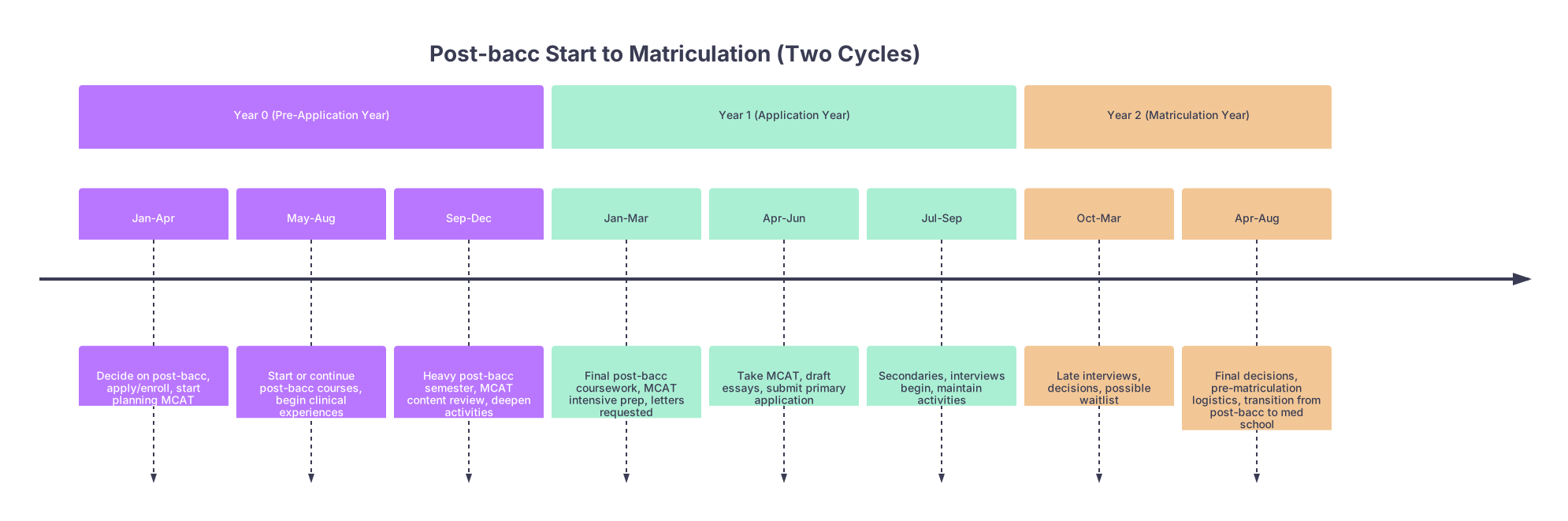
High‑Level Timeline: From First Post‑Bacc Class to Matriculation
| Period | Event |
|---|---|
| Year 0 (Pre-Application Year) - Jan-Apr | Decide on post-bacc, apply/enroll, start planning MCAT |
| Year 0 (Pre-Application Year) - May-Aug | Start or continue post-bacc courses, begin clinical experiences |
| Year 0 (Pre-Application Year) - Sep-Dec | Heavy post-bacc semester, MCAT content review, deepen activities |
| Year 1 (Application Year) - Jan-Mar | Final post-bacc coursework, MCAT intensive prep, letters requested |
| Year 1 (Application Year) - Apr-Jun | Take MCAT, draft essays, submit primary application |
| Year 1 (Application Year) - Jul-Sep | Secondaries, interviews begin, maintain activities |
| Year 2 (Matriculation Year) - Oct-Mar | Late interviews, decisions, possible waitlist |
| Year 2 (Matriculation Year) - Apr-Aug | Final decisions, pre-matriculation logistics, transition from post-bacc to med school |
This is the clean version. Now I will show you the messy reality month by month.
Month‑by‑Month: When to Start and What to Do (18 Months Before Application to Matriculation)
18–16 Months Before Application (January–March of Year 0)
At this point you should:
Decide if two cycles is actually realistic.
- If your undergrad science GPA is < 2.8, two cycles is aggressive. Strongly consider a longer runway.
- If you have no clinical exposure at all, you will be catching up hard.
Choose your post‑bacc format:
- Formal career‑changer program
- Formal academic‑record enhancer
- DIY post‑bacc at a local university
Start your first post‑bacc term if possible:
- Ideal spring load: 6–9 credits of upper‑division science
(e.g., Cell Bio, Physiology, Biochemistry if you have the prerequisites) - Or start with Gen Chem / Bio if you are missing basics, but understand that pushes MCAT back.
- Ideal spring load: 6–9 credits of upper‑division science
Begin shadowing/clinical exposure:
- Aim: at least 4–6 hrs/week in a sustained clinical role OR scribing job.
- You are playing catch‑up if you start this after the application year begins.
Your main goal now: prove you can earn A’s in real science classes and start building a believable clinical story.
15–13 Months Before Application (April–June of Year 0)
At this point you should:
Lock in your summer and fall schedules:
- Summer: target another 6–8 credits if you can handle it. GPA repair means volume + quality.
- Fall: aim for 8–12 credits of rigorous science; adcoms can tell when you took fluff.
Map your MCAT timing relative to coursework:
- For a June Year 1 application, the MCAT should be between January and May of Year 1.
- That means by December of Year 0, you want most core content complete (Gen Chem, Orgo, Bio, Physics, Biochem ideally).
Start MCAT light prep:
- 3–5 hours/week of CARS passages + content brush‑ups.
- Do not go “all in” yet, but stop pretending you have unlimited time.
Identify letter writers from your first term:
- New science professors who can speak to your current ability matter more than old “you were quiet but fine” letters from years ago.
If you have not started your post‑bacc by June of Year 0 and you are starting from a low science GPA, your two‑cycle plan is already under pressure.
12–10 Months Before Application (July–September of Year 0)
Now the clock really starts to matter.
At this point you should:
Be in full post‑bacc mode:
- Summer courses finishing or in progress.
- Fall schedule locked with a serious load.
Evaluate your GPA trend:
- After 12–16 credits, you want a clean run of A / A‑ grades.
- If you are still pulling B’s, the problem is not the timeline. It is the strategy, and you may need more time before application.
Increase clinical hours:
- Ideal cumulative by this point: ≥ 75–100 hours.
- If you are at zero, you must change that in the next 3–6 months. Commit to a weekly shift.
Begin research or community service if those are gaps:
- You do not need a first‑author paper, but you do need evidence that you know how to commit to something longer than 6 weeks.
Most students underestimate how obvious “last‑minute” looks on an application. A two‑cycle plan leaves no room for that.
9–7 Months Before Application (October–December of Year 0)
This is the pivot from “repair” to “application‑ready”.
At this point you should:
Finish a heavy fall semester with strong grades:
- After fall, you want at least 24 post‑bacc credits accumulated, preferably more.
- Your new trend should be undeniable: “Old GPA was 2.8, last 28 credits are 3.8+.”
Commit to an MCAT test window:
- Ideal for June application: test in March–May of Year 1.
- If you still have major content gaps, schedule April/May and plan accordingly.
Start structured MCAT prep:
- 10–15 hrs/week minimum by December.
- One diagnostic full‑length by the end of this year to get a baseline.
Make a letter of recommendation plan:
- At least 2 science professors from your post‑bacc.
- 1 non‑science or PI / supervisor letter.
- If you are a non‑traditional student, a strong professional supervisor letter helps.
If your grades are still shaky in December, your best move might be to delay your application one year instead of forcing the two‑cycle timeline. I have watched too many students apply too early, throw away $3,000+, and earn a stack of rejections that could have been prevented with 12 more months.
The Application Year (Year 1): Week‑by‑Week Priorities
Now assume you did the work in Year 0 and you are on track.
You are aiming to apply in June of Year 1 and matriculate in August of Year 2.
January–March of Year 1: Final Coursework + MCAT Ramp‑Up
At this point you should:
Run through your last heavy semester of post‑bacc:
- 8–12 credits of upper‑division science.
- No grade drama. Withdrawals and C’s here are red flags.
Increase MCAT prep to 15–20 hrs/week:
- Finish content review by end of February (for a March/April test).
- Start weekly full‑lengths by March.
Request letters of recommendation:
- Ask in January. Professors are far more responsive now than in May.
- Provide a short CV, unofficial transcript, and a 1‑page summary of your story + goals.
Outline your personal statement:
- Not writing the whole thing yet, but you should know your central narrative:
- “I had a rough start, recalibrated through X, demonstrated new ability via post‑bacc, now ready for medicine because Y.”
- Not writing the whole thing yet, but you should know your central narrative:
April–May of Year 1: MCAT and Application Drafting
This is the tightest squeeze in the entire plan.
At this point you should:
Take the MCAT:
- Ideal test dates: early April to mid‑May.
- That way you get your score before July and can adjust your school list rationally.
Draft and refine your personal statement:
- Aim to have a solid draft by the end of April.
- Revise through May with 1–2 trusted readers (do not crowdsource to 12 people; the essay will lose all voice).
Build your activities section:
- List every meaningful activity since college with:
- Dates, hours, supervisor.
- Clear, outcome‑focused descriptions.
- You should not need to “inflate” hours if you followed the Year 0 plan.
- List every meaningful activity since college with:
Lock in your school list:
- Based on:
- State residency
- GPA (cumulative + science) with post‑bacc trend
- MCAT practice scores (and official score if back in time)
- Overapplying to reach schools is a common self‑sabotage move.
- Based on:
Early June of Year 1: Submission Week
This week matters more than people think.
At this point you should:
Submit your primary application as early in June as possible:
- You can input everything and wait for your MCAT score, but do not wait to start the application because you are “still tweaking” your essay endlessly.
Confirm that:
- All transcripts (including post‑bacc) have been requested.
- Letters are in or pending and your writers have the deadlines.
Once you hit “submit”, your post‑bacc timing has done its job. Now you ride the rest of the cycle while defending the GPA trend you worked so hard to build.
The Gap Between Application and Matriculation (Year 1–2): Do Not Coast
Many post‑bacc students mistakenly think the hard part is over after submitting. Then they send schools an anemic “update” in January that shows they did almost nothing after June. Not ideal.
July–September of Year 1
At this point you should:
Finish any remaining post‑bacc courses:
- If you have summer classes, crush them. No senioritis.
Continue clinical, volunteering, or research:
- Maintain at least 5–8 hrs/week.
- If you can expand leadership in an existing role, do it. That reads better than starting something brand new just to pad your file.
Turn around secondary applications quickly:
- Within 7–10 days per school whenever possible.
- This is where many late post‑bacc students sink themselves—they burned all time/energy on coursework and MCAT and then crawl through secondaries.
October–March of Year 1–2: Interview Season
At this point you should:
Keep your transcript clean:
- If you take extra classes, they must be A’s. No exceptions.
Prepare for interviews:
- Know your story cold:
- Why medicine
- Why now (after earlier academic issues)
- Why you will not repeat old mistakes
- Know your story cold:
Send substantive updates:
- New grades
- New responsibilities at work/volunteering
- Posters, projects, or academic achievements
April–August of Year 2: Final Decisions and Matriculation
At this point you should:
- Wrap up any final academic work.
- Finalize financial aid, logistics, and transitions.
- You are now the version of yourself your post‑bacc was supposed to create: academically credible, clinically grounded, and ready.
When You Cannot Start a Post‑Bacc and Still Matriculate in Two Cycles
Let me be explicit about the limits. A two‑cycle plan breaks down if:
You are trying to start your very first science course less than 12 months before application.
Example: starting Gen Chem I in August and applying the next June. That is fantasy if you also need Orgo, Physics, Biochem, and MCAT.Your GPA hole is too deep:
- If your cumulative GPA is 2.3 and you have 140+ undergraduate credits, 24 post‑bacc credits in one year will not move the needle enough. Better to plan for three cycles with a heavier academic rebuild.
You insist on a late MCAT (June/July of Year 1) with no prior score:
- It pushes you late in the cycle.
- If the score is weak, you discover that too late to correct it.
In those situations, rushing to preserve the “two‑cycle” idea will usually cost you far more than taking an extra year and applying once, correctly.
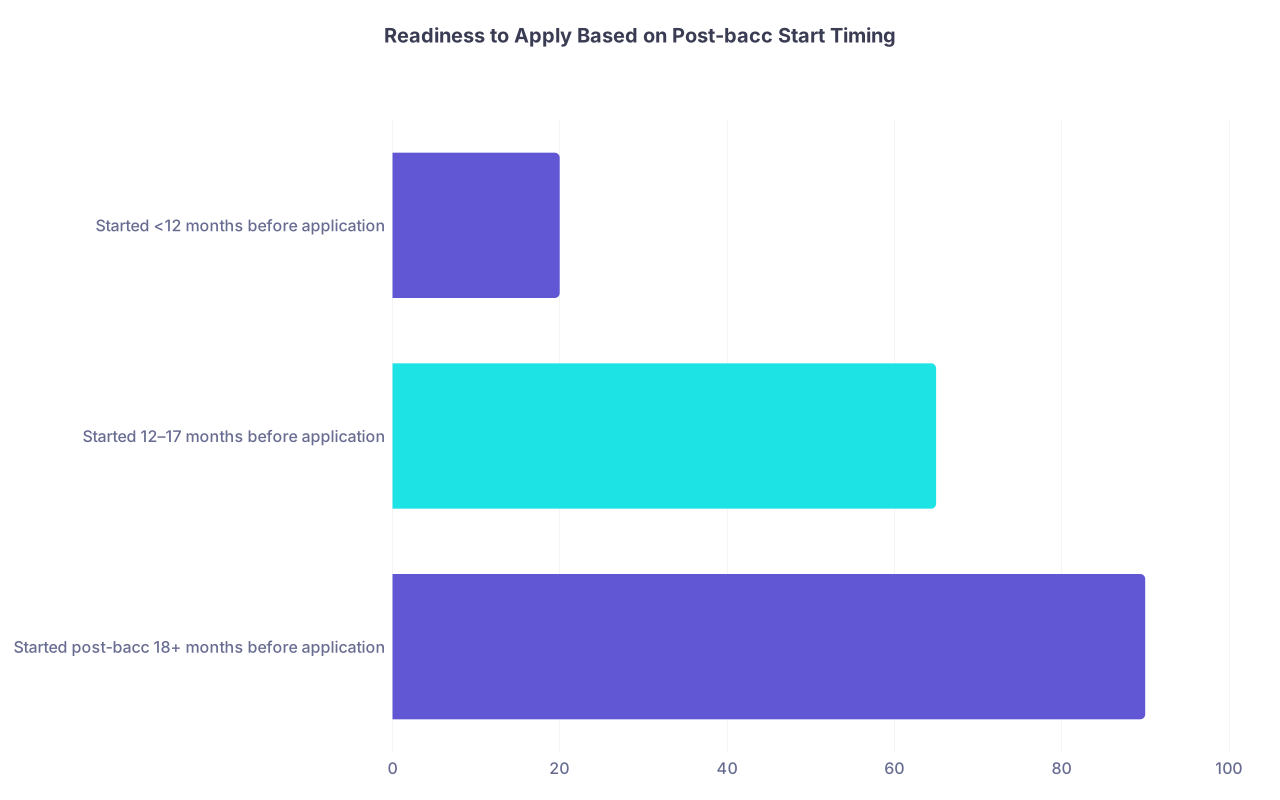
Quick Reality Check: Is Your Start Date On Track?
Here is a blunt summary you can apply right now.
| Category | Value |
|---|---|
| Started post-bacc 18+ months before application | 90 |
| Started 12–17 months before application | 65 |
| Started <12 months before application | 20 |
Rough interpretation (not literal acceptance rates, but realism levels):
18+ months before application:
You have room for:- Serious credit load
- Strong GPA trend
- Thoughtful MCAT prep
Two‑cycle matriculation is very realistic.
12–17 months before application:
Possible, but you must be:- Organized
- Already partly prepared
- Willing to work at full capacity
Any misstep and you push to three cycles.
< 12 months before application:
Two‑cycle matriculation is usually a bad bet unless:- You already have nearly all prereqs done
- Your GPA is borderline but not catastrophic
- You only need a small bump + fresh letters
The Bottom Line
Three things to keep in your head:
Work backward from your desired application June, not from some vague “I’ll start a post‑bacc next year.” If you want to apply in June Year 1, your post‑bacc should start no later than early Year 0, ideally 12–18 months before.
Your post‑bacc is not just about credits. It must produce:
- A clear, upward GPA trend,
- Strong science letters,
- Time for MCAT prep and clinical work.
If your chosen start date makes that impossible, the date is wrong.
Do not let the “two‑cycle” idea bully you into a weak application.
One strong, slightly later application beats two rushed, poorly prepared cycles every single time.