It’s March 1st. You’re staring at two rough plans on your notebook:
- Plan A: Start a post-bacc this fall, apply to med school at the same time.
- Plan B: Do the post-bacc first, then apply the next year.
(See also: Month-by-Month Timeline: From Post-Bacc Enrollment to AMCAS Submission for detailed guidance.)
Same calendar, totally different timelines. And if you screw up the order, you can easily lose an entire year.
Let’s walk this out like an actual timeline, not vague “work on apps” nonsense. Month-by-month, what belongs in your post-bacc year vs what belongs in your application year—and what absolutely should not overlap unless you enjoy burnout and C+ grades.
Big Picture: Two Separate Timelines You’re Trying to Stack
Here’s the core problem: you’re juggling three time-sensitive tracks:
- Post-bacc coursework (DIY or formal)
- MCAT preparation and test date
- Medical school application cycle (AMCAS/AACOMAS/TMDSAS)
Most people screw up by merging all three into one chaotic year. Usually:
- Starting post-bacc
- Taking core sciences for the first time
- Studying for MCAT
- Writing personal statements
- Doing secondaries
- Maybe working part-time
At the same time. That’s how you end up with mediocre grades, a rushed MCAT, and a late application.
Here’s how I’d sequence it if you want actual leverage:
- Post-bacc year: prioritize GPA repair or building a strong science record; optional early MCAT prep.
- Gap semester/year after post-bacc: MCAT + application year, when your academic trend is already visible.
To visualize the overlap problem:
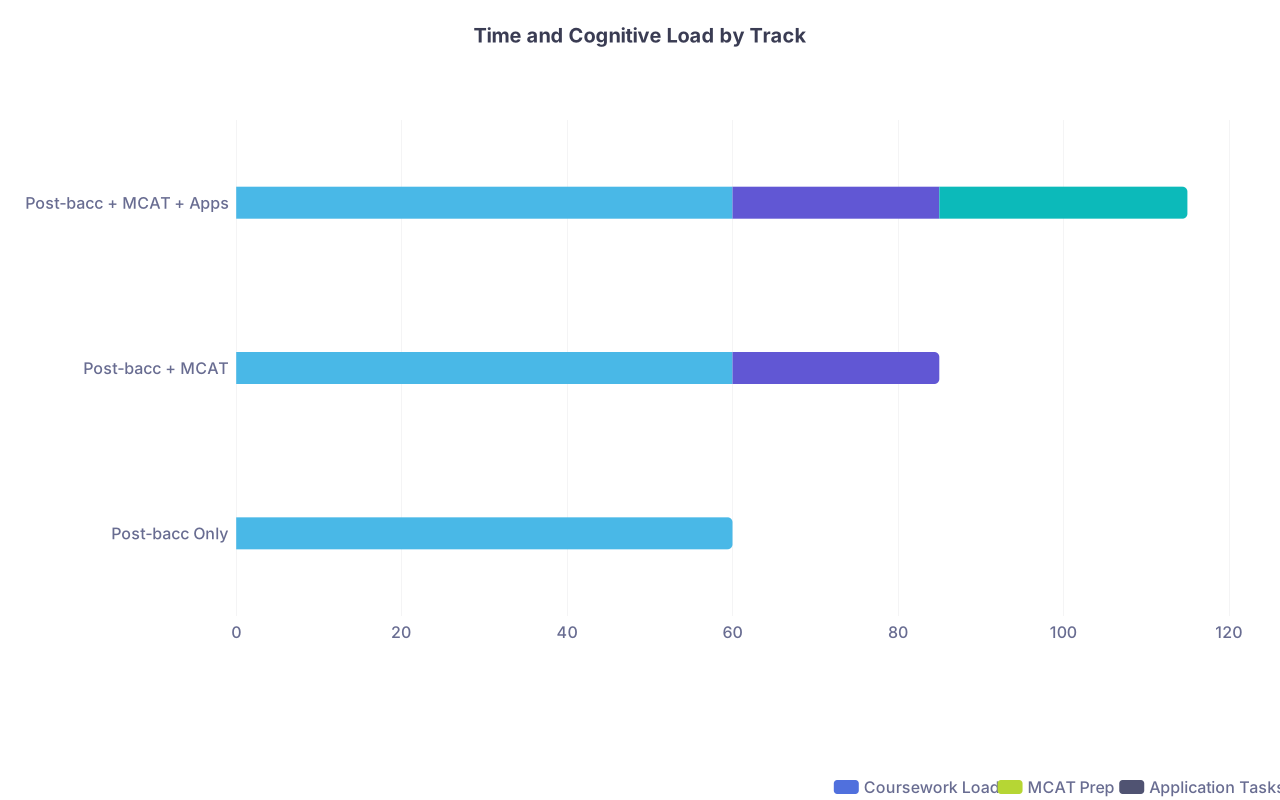
| Category | Coursework Load | MCAT Prep | Application Tasks |
|---|---|---|---|
| Post-bacc Only | 60 | 0 | 0 |
| Post-bacc + MCAT | 60 | 25 | 0 |
| Post-bacc + MCAT + Apps | 60 | 25 | 30 |
That last bar? That’s where people break.
Year 0: The Pre–Post-Bacc Planning Window (6–12 Months Before You Start)
You’re not in a post-bacc yet. You’re still deciding the path.
6–12 Months Before Post-Bacc Start
At this point you should:
- Audit your academic record honestly
- Calculate:
- Cumulative GPA
- Science GPA (BCPM)
- Identify:
- How many credits of C/D/F in sciences
- Any upward trend in the last 30–60 credits
- Calculate:
This determines whether you need:
A career-changer post-bacc (little science done)
An academic enhancer post-bacc/SMP (science done but weak)
Or just a few targeted upper-division courses (DIY)
Decide your target “application year”
- If you start a post-bacc in Fall 2025:
- Reasonable application cycles:
- 2026 (if you have most prereqs/MCAT already)
- 2027 (more common and safer)
- Reasonable application cycles:
- Build backwards from the intended matriculation year:
- Start med school 2028 → apply 2027 → finish post-bacc 2026–2027
- If you start a post-bacc in Fall 2025:
3–6 Months Before Post-Bacc Start
At this point you should:
Lock in MCAT timing strategy
- MCAT should be:
- After most core prereqs (chem, orgo, bio, physics, biochem)
- At least 2–3 months before you submit AMCAS
- Usually:
- April–May of application year or
- January–March before application year if you’re ahead
- MCAT should be:
Plan work/financial load
- Decide now:
- Full-time student, part-time work
- Part-time classes plus full-time work (only if you’re forced; med schools will notice the context)
- Do not assume you can:
- Take 12–16 credits of hard sciences
- Work 30+ hours
- Study for MCAT
- And write a polished application
You might survive it. You won’t impress anyone.
- Decide now:
Post-Bacc Year: What Belongs Here (and What Doesn’t)
Let’s assume a traditional academic calendar: Fall–Spring–(optional Summer).
Your post-bacc year has one main job: prove academic readiness. Everything else is secondary.
Post-Bacc Fall Semester (August–December)
At this point you should:
Front-load essential coursework
- Career-changer:
- Gen Chem I (+ lab)
- Bio I (+ lab)
- Maybe a math course (stats) if missing
- Academic enhancer:
- 2–3 upper-level bios:
- Physiology
- Cell bio
- Microbiology
- Genetics
- 2–3 upper-level bios:
- Career-changer:
Dial in study systems
- First month: figure out how many hours/week you actually need for A-level work
- By October: your routine should be predictable:
- Class
- Study hours
- Sleep (yes, that matters)
- Minimal ECs
Very light MCAT exposure (optional)
- If you’re planning to test next calendar year:
- Start:
- 1 CARS passage/day
- 1–2 short content videos a few times per week
Keep it casual. Grades first.
- Start:
- If you’re planning to test next calendar year:
Letters of recommendation groundwork
- Sit in front for at least one class you plan to get a LOR from
- Go to office hours once a month
- Ask 1–2 substantive questions about the material or your prep
This is the “prove you can actually handle science” semester. You’re not a full applicant yet. You’re building the case.
Post-Bacc Spring Semester (January–May)
Your fall grades are in. They either helped or hurt. At this point you should:
Continue or escalate rigorous coursework
- Career-changer:
- Gen Chem II
- Bio II
- Physics I
- Academic enhancer:
- More upper-level bios/chems:
- Biochem (if not done)
- Immunology
- Neuroscience, etc.
- More upper-level bios/chems:
- Career-changer:
Decide: Are you applying this upcoming cycle or the next?
- Use these checkpoints:
- Cumulative GPA on track?
- Science GPA trending upward?
- Do you have:
- At least 1–2 strong letter writers lined up?
- Shadowing and some clinical exposure?
- A realistic MCAT date within 3–5 months?
- Use these checkpoints:
If any of these are weak, you push the application year out. That’s not failure. That’s strategy.
- MCAT: light to moderate ramp up (if testing this year)
- If you’re aiming for a late spring/summer MCAT (while still in classes), do not wait until April to start:
- January–March:
- 5–8 hrs/week content review
- CARS practice regularly
- April–May:
- Increase only if your grades stay solid
If your grades slip, dial MCAT back.
- Increase only if your grades stay solid
- January–March:
- If you’re aiming for a late spring/summer MCAT (while still in classes), do not wait until April to start:
If you’re an academic-repair candidate, your MCAT must not sabotage your semester grades. GPA recovery is priority.
Post-Bacc Summer (Optional but Powerful)
Summer is the pivot point between post-bacc year and application year.
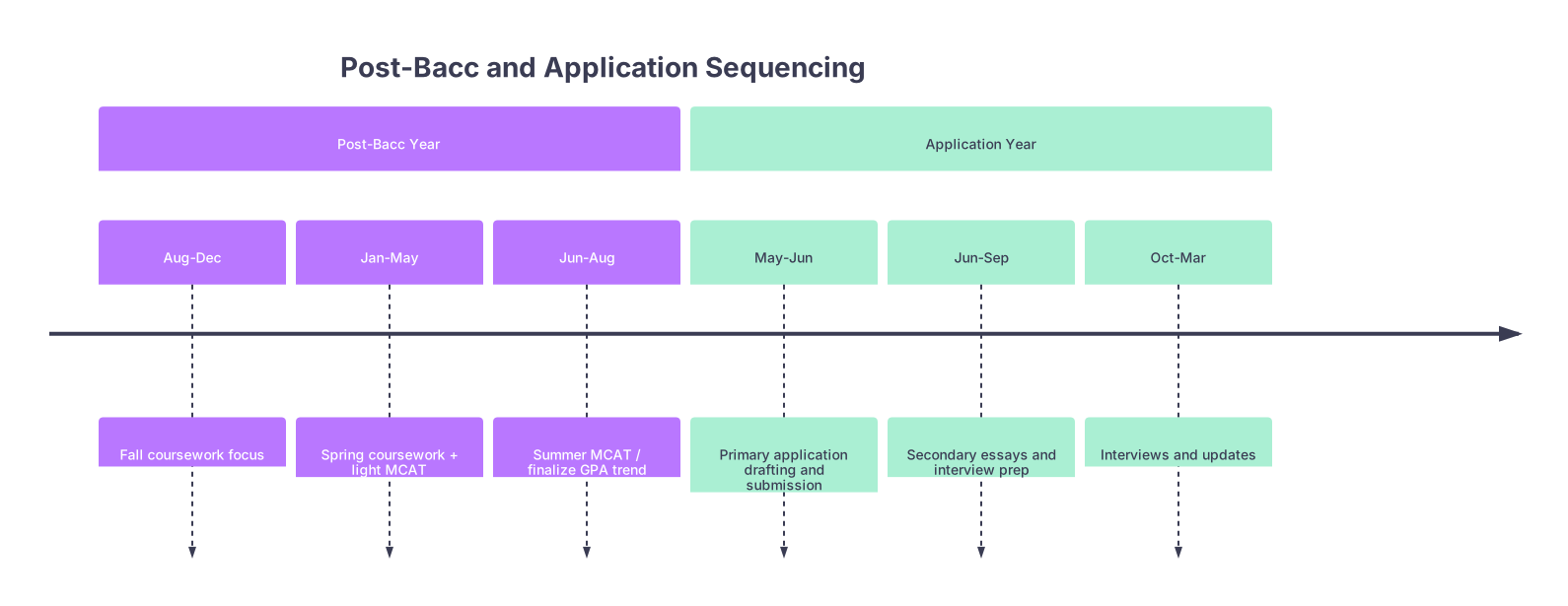
| Period | Event |
|---|---|
| Post-Bacc Year - Aug-Dec | Fall coursework focus |
| Post-Bacc Year - Jan-May | Spring coursework + light MCAT |
| Post-Bacc Year - Jun-Aug | Summer MCAT / finalize GPA trend |
| Application Year - May-Jun | Primary application drafting and submission |
| Application Year - Jun-Sep | Secondary essays and interview prep |
| Application Year - Oct-Mar | Interviews and updates |
At this point you should be in one of two modes:
Mode 1: MCAT Summer
- You’ve finished most prereqs by May
- Plan:
- June–August:
- 25–35 hours/week MCAT prep
- Full-lengths every 1–2 weeks once content’s mostly reviewed
- Test:
- Late June, July, or early August
- June–August:
You can work part-time. But MCAT + 40-hour work weeks? That’s how 505 scorers are made.
Mode 2: Extra Coursework + Light MCAT Intro
- You still need:
- Phys II
- Biochem
- Or more upper-level science to strengthen trend
- Plan:
- Take 1–2 summer courses
- Do very light MCAT (5 hrs/week) if planning to test in early fall or winter
- Application year likely starts next summer, not this one
Don’t compress everything into 3–4 chaotic months because you’re impatient. Med school will still be there in a year.
Application Year: What Moves Where
Now it’s the year you intend to submit AMCAS/AACOMAS. Your post-bacc grades are mostly in the books, or at least the trend is clear.
Let’s label this clearly:
- Post-bacc year: Aug 2025 – May 2026
- Application year: Jan 2027 – March 2028 (for matriculation in Fall 2028)
January–March of Application Year
At this point you should:
Lock in MCAT date (if not already done)
- Best windows:
- January–April of application year
Scores will be ready well before schools review your file.
- January–April of application year
- If you did a summer MCAT last year and scored well → you’re done.
- Best windows:
Start application groundwork
- AMCAS doesn’t open until May, but:
- Draft your activity list with bullet points for:
- Clinical
- Research
- Leadership
- Teaching
- Brainstorm personal statement themes:
- 3–4 key stories that illustrate motivation and suitability
- Build a rough school list:
- Based on:
- GPA trends
- MCAT (actual or realistic practice average)
- In-state preferences
- Based on:
- Draft your activity list with bullet points for:
- AMCAS doesn’t open until May, but:
This is pre-production. Low-stress but crucial. If you start this in May, you’re already behind.
April–June: The Core of Application Launch
This is where many people mix up “post-bacc year” and “application year.” By now, your post-bacc should largely be done or in its final semester with grades trending up.
At this point you should:
Finalize MCAT (if not already taken)
- Take no later than:
- Late May / early June
You can still submit your primary and have your score release align with early review.
- Late May / early June
- Take no later than:
Crush the primary application
- AMCAS typically:
- Opens for data entry: early May
- First submission date: late May/early June
- Your timeline:
- May:
- Finalize personal statement
- Polish activity descriptions (impact-focused, not just task lists)
- Confirm transcripts and course entries
- Confirm letters are requested in systems
- Early June:
- Submit primary (don’t play games waiting for a “perfect” draft until August)
- May:
- AMCAS typically:
Primary application is squarely application year work. If you’re still deep in make-or-break post-bacc classes, you probably rushed this phase.
July–September: Secondary Season and Interviews Start
At this point you should:
Tackle secondaries on a disciplined schedule
- Target:
- Turn around each secondary in 7–10 days max
- You’ll see:
- Repeat prompts:
- “Why our school?”
- “Diversity”
- “Challenge/failure”
- “Gaps/academic issues”
- Repeat prompts:
- Build re-usable skeletons, then customize.
- Target:
Prepare for early interview invites
- Especially if:
- You submitted primary in early June
- Turned in secondaries quickly
- Prep:
- 10–15 mock answers to core questions:
- Why medicine?
- Why this school?
- Tell me about a time you failed.
- Explain your academic record.
- 10–15 mock answers to core questions:
- Especially if:
Notice what’s missing here? Heavy coursework. If you’re still mid–post-bacc heavy load here and trying to keep up with secondaries, you’re going to rush one of them. Schools see that.
October–March: Interview Peak and Waitlist Season
At this point you should:
Continue interviews
- Timeline:
- Some schools interview into February or even March
- Maintain:
- A simple log of:
- Date
- Impressions
- Key people you met
- This helps with:
- Thank-you emails
- Update letters
- A simple log of:
- Timeline:
Send targeted updates (if allowed)
- You might:
- Finish a new course
- Earn a new responsibility at work
- Publish a poster/paper
- Only send meaningful updates, not filler.
- You might:
Plan for contingencies
- If cycles not going well by:
- February–March:
- Analyze:
- MCAT too low?
- GPA still weak?
- Very late application?
- Decide whether:
- Reapply with improved stats/strategy
- Add a formal SMP or additional post-bacc year
- Analyze:
- February–March:
- If cycles not going well by:
Application year is where you present the case you built in post-bacc. Don’t reverse those.
Common Sequencing Mistakes (and Better Alternatives)
Let me be blunt: I see the same three sequencing screwups over and over.
Mistake 1: Simultaneous First-Time Post-Bacc + MCAT + Application
Pattern:
- Start post-bacc fall → still shaky in sciences
- Prep for MCAT over winter → test in March/April
- Write primary in May while exhausted
- Turn in late June/July with mediocre MCAT and incomplete GPA repair
Better sequence:
- Year 1: Post-bacc + very light MCAT exposure
- Summer after Year 1: Strong MCAT focus
- Year 2: Apply with solid MCAT and full post-bacc transcript in
Mistake 2: Waiting for “Perfect” GPA Before Applying
Pattern:
- You keep adding one more semester of post-bacc
- Never comfortable with your numbers
- End up delaying the application cycle multiple years
Reality:
- Adcoms care more about:
- Upward trend
- Recent sustained A-level performance
- Context (full-time work + school, etc.)
Better rule:
- Once you have:
- At least 30–36 recent credits of strong science (mostly A’s)
- A competitive or at least reasonable MCAT
- A coherent narrative for your journey
→ It’s acceptable to apply.
Mistake 3: Treating Post-Bacc as “Extra” Instead of Core Repair
Pattern:
- You keep working full time
- Take 1–2 classes at a time, scattered
- Never show what you can do with a rigorous load
Better move:
- For academic enhancer:
- Aim for:
- 9–12 credits/semester of solid upper-level science
- At least:
- 2 consecutive strong semesters to prove consistency
- Aim for:
How Schools View Post-Bacc vs Application Year Events
Schools don’t care what you call the years. They care what each year proves.
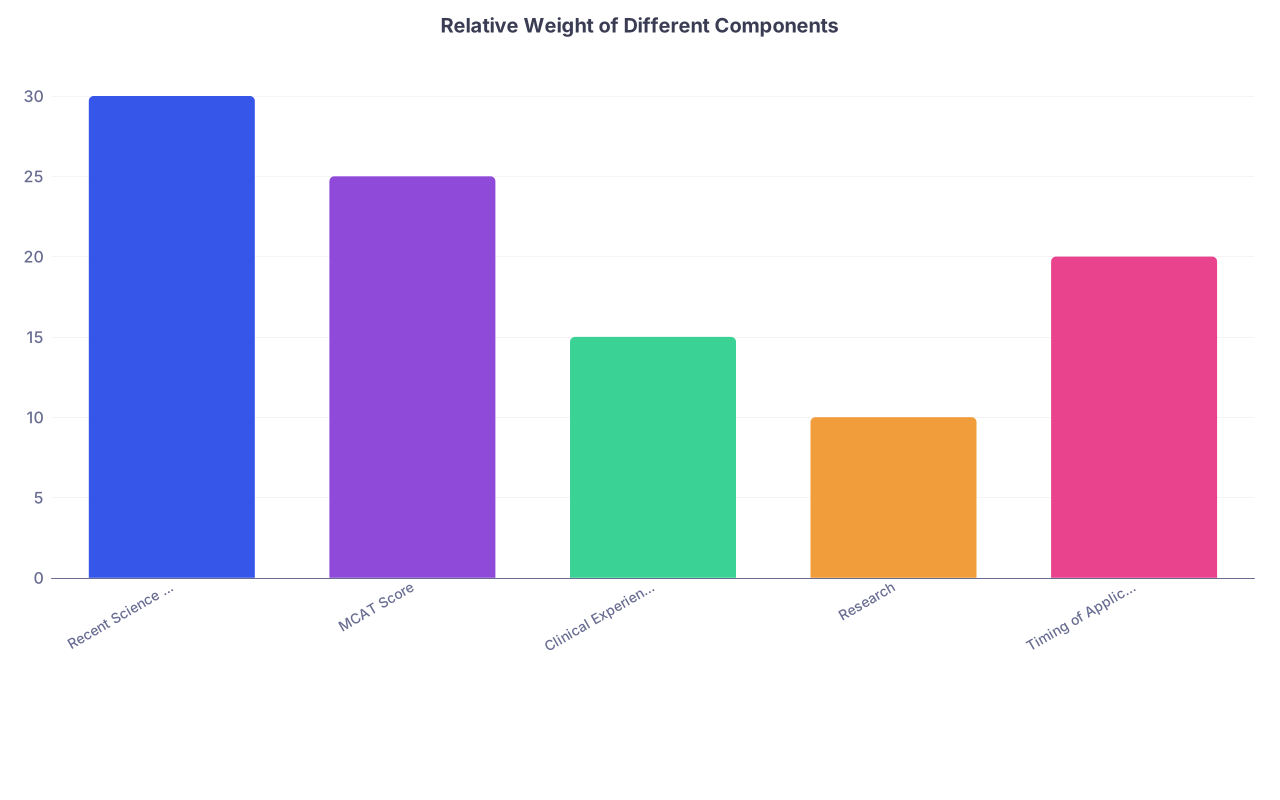
| Category | Value |
|---|---|
| Recent Science GPA | 30 |
| MCAT Score | 25 |
| Clinical Experience | 15 |
| Research | 10 |
| Timing of Application | 20 |
Post-bacc year:
- Main signal: Can you handle rigorous science now?
- Secondary signals: consistency, maturity, work-life balance.
Application year:
- Main signal: Are you ready and organized enough to manage MCAT, writing, and deadlines?
- Plus: how you present your story, professionalism, follow-through.
If your post-bacc year is a mess but your application year is polished, schools still see a red flag. Reverse is better: strong post-bacc and a slightly imperfect-but-early application usually wins.
Putting It All Together: Example Two-Year Sequence
Let’s build a clean, realistic example for someone starting post-bacc Fall 2025 and wanting to apply in 2027:
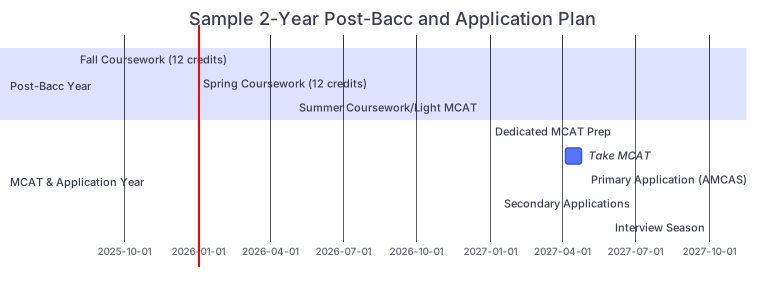
| Task | Details |
|---|---|
| Post-Bacc Year: Fall Coursework (12 credits) | a1, 2025-08, 4m |
| Post-Bacc Year: Spring Coursework (12 credits) | a2, 2026-01, 4m |
| Post-Bacc Year: Summer Coursework/Light MCAT | a3, 2026-05, 3m |
| MCAT & Application Year: Dedicated MCAT Prep | b1, 2027-01, 4m |
| MCAT & Application Year: Take MCAT | milestone, b2, 2027-04-15, 1d |
| MCAT & Application Year: Primary Application (AMCAS) | b3, 2027-05, 2m |
| MCAT & Application Year: Secondary Applications | b4, 2027-07, 3m |
| MCAT & Application Year: Interview Season | b5, 2027-10, 6m |
That’s what a sane, strong timeline looks like. Not glamorous. Very effective.
FAQ (Exactly 2 Questions)
1. Should I ever apply during my post-bacc year instead of waiting a cycle?
Sometimes, but only if all of these are true:
- You already completed most prereqs before post-bacc.
- Your MCAT is already taken and competitive, or you’re prepared to nail it early in the cycle.
- Your GPA trend was already improving before the post-bacc, and the post-bacc is just extra confirmation. If you’re using post-bacc as serious academic repair, applying while the repair is half-finished usually weakens your case.
2. Is it better to take the MCAT during my post-bacc or in the gap before application year?
If you’re still learning core content (chem, orgo, physics, biochem), it’s smarter to take the MCAT after your post-bacc or toward the very end of it, ideally during a lighter term or early in the application year. Taking the MCAT while you’re buried in your heaviest science load often leads to mediocre performance in both. Protect your GPA first; then give the MCAT its own focused window.
Key points to walk away with:
- Treat post-bacc year as your GPA and academic credibility year. Application year comes after that, not during the chaos.
- Give the MCAT its own real window—don’t just bolt it onto a full post-bacc plus application load.
- Apply early in the cycle with your strongest, most complete academic story, even if that means starting med school one year later than your impatient side wants.