The biggest mistake post‑bacc students make is pretending the MCAT, coursework, and med school applications are separate projects. They are not. They are one two‑year campaign, and if you do not plan them together, something will crack—usually your MCAT score or your GPA.
You want a clean, efficient, two‑year plan that gets you from “starting post‑bacc” to “submitting a strong AMCAS/AACOMAS application” without panic semesters. Here is how that actually looks, month by month.
Assumptions:
- You are starting a post‑bacc in August Year 1
- You want to apply in June Year 2 (the earliest realistic strong cycle)
- You either need or benefit from significant new science coursework and/or GPA repair
(See also: Application Year vs Post-Bacc Year for insights on sequencing key milestones.)
Adjust +/- a few months if your calendar is different, but keep the structure.
Big-Picture Two-Year Timeline
First, see the whole thing laid out. Then we will drill down.
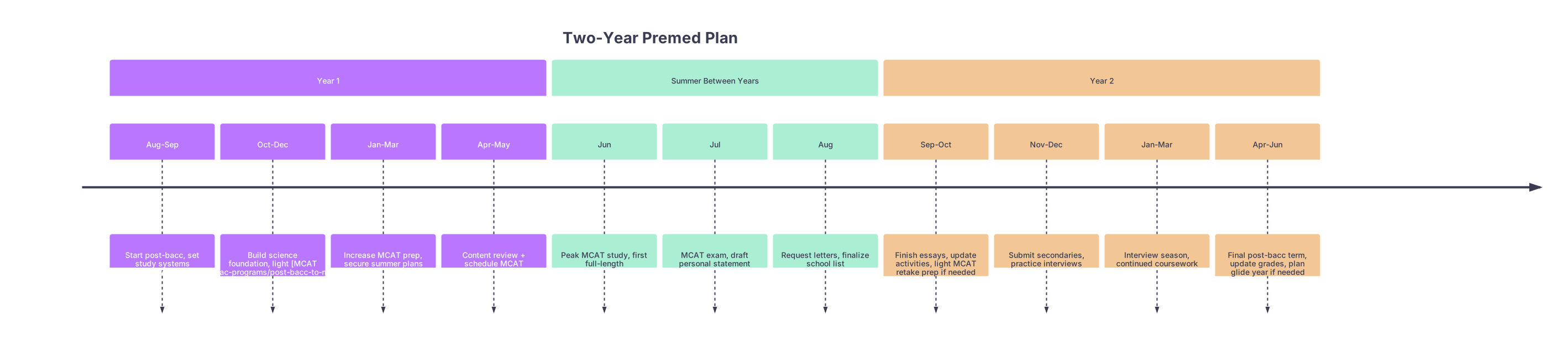
| Period | Event |
|---|---|
| Year 1 - Aug-Sep | Start post-bacc, set study systems |
| Year 1 - Oct-Dec | Build science foundation, light [MCAT exposure](https |
| Year 1 - Jan-Mar | Increase MCAT prep, secure summer plans |
| Year 1 - Apr-May | Content review + schedule MCAT |
| Summer Between Years - Jun | Peak MCAT study, first full-length |
| Summer Between Years - Jul | MCAT exam, draft personal statement |
| Summer Between Years - Aug | Request letters, finalize school list |
| Year 2 - Sep-Oct | Finish essays, update activities, light MCAT retake prep if needed |
| Year 2 - Nov-Dec | Submit secondaries, practice interviews |
| Year 2 - Jan-Mar | Interview season, continued coursework |
| Year 2 - Apr-Jun | Final post-bacc term, update grades, plan glide year if needed |
Now break it into phases.
- Phase 1 (Aug–Dec Year 1): Survive and excel in post‑bacc. Set MCAT foundation.
- Phase 2 (Jan–May Year 1): Heavier MCAT work + continue strong coursework.
- Phase 3 (Jun–Aug between years): MCAT execution + personal statement + core application.
- Phase 4 (Sep–Jun Year 2): Applications, interviews, and finishing the academic story.
Year 1, Fall: Build the Academic Engine (Aug–Dec)
At this point you are not “an applicant.” You are rebuilding or proving your academic capacity. Everything else is secondary.
August: Set the structure before the chaos
By the end of August you should:
Lock your course schedule:
- Aim for 2 hard sciences + 1 lighter course if you are working part‑time, or 3 sciences if academics are your only job and you have a solid background.
- Typical combos:
- Gen Chem I + Bio I + Psych
- Orgo I + Physics I + a writing/ethics course
Build your weekly template:
- 15–20 hours of focused study per week outside class
- Fixed blocks for:
- Class + lab
- Anki/flashcards (yes, start now)
- Review of each lecture within 24 hours
- A small placeholder for MCAT: 2–3 hours/week max
Choose your MCAT ecosystem:
- Pick one content source (Kaplan, Blueprint, TBR, Khan) and stick with it.
- Set up an Anki deck (e.g., Milesdown or JackSparrow) but do not drown in it yet.
September–October: Prove you can crush science now
At this point you should be:
Treating every exam as a rehearsal for med school exams:
- Active recall, not re-reading slides.
- Practice problems, not just “understanding.”
Doing light MCAT integration:
- 2–3 hours/week:
- Watch 1–2 content videos tied to what you study in class.
- Start MCAT-style questions for those topics (UWorld/NS/BP, whatever you choose).
- The goal is familiarity, not full MCAT prep.
- 2–3 hours/week:
Building relationships:
- Go to office hours at least once per course by October.
- You want future letter writers to know your face, your story, and your progress.
By end of October:
- You should know your approximate grade trajectory (A-/A range if you are doing this right).
- You should have 1–2 professors who have seen you in office hours.
November–December: Lock the GPA, preview the MCAT
This is where students screw up and cram for finals while MCAT anxiety eats their brain. Do not.
At this point you should:
Prioritize GPA over MCAT:
- Every marginal gain in coursework now is multiplied when adcoms see an upward trend.
- A 3.9 in your post‑bacc is more important than squeezing in a few extra MCAT videos.
Do targeted MCAT exposure:
- 1 day/week:
- Do 10–20 discrete MCAT questions in whichever science you are taking.
- Begin light CARS:
- 2–3 passages/week from AAMC Question Packs or a good CARS resource.
- This builds question tolerance without exhausting you.
- 1 day/week:
Start your experience log:
- Make a living document with:
- Volunteering dates, hours, specific tasks
- Shadowing: physicians, locations, specific patient encounters that stuck with you
- Research: projects, poster titles, abstracts
- You will use this for your activities section later. Do not trust memory.
- Make a living document with:
By winter break:
- You should have strong grades from Fall.
- You should not feel “in MCAT mode” yet. If you do, you overloaded.
Year 1, Spring: Shift into Real MCAT Prep (Jan–May)
This is your first real integration test: can you maintain performance in courses and ramp MCAT?
January: Decide your MCAT window and examine your load
At this point you should:
Set a target MCAT date range:
- Ideal for this 2‑year plan: late June–mid July between Year 1 and Year 2.
- That gives:
- Spring: content build
- Early summer: intensive review + full lengths
- Late summer: application writing
Adjust your course load if Fall was rough:
- If you were <3.5 GPA in Fall:
- Consider 2 sciences instead of 3.
- Fix your study system first. A bad study system plus more classes will not magically work.
- If you were <3.5 GPA in Fall:
Start formal MCAT content review:
- 5–7 hours/week total.
- Example week:
- 2 nights: 1.5 hrs each – video or book chapter review tied to your current classes.
- 1 longer block: 2–3 hrs – MCAT-style practice questions on content you have covered.
February–March: MCAT content ramp-up
By this point, you should be in a steady rhythm.
Weekly, you should:
Hit 8–10 hours of MCAT work:
- 4–6 hours content (video/book + notes)
- 3–4 hours questions (UWorld, NS, or other Qbanks)
Start routine CARS:
- 3–4 passages per sitting, 2–3 times/week.
- Same conditions every time:
- Timed.
- No phone.
- Review right after, focusing on why right answers are right.
Do a diagnostic or early full-length by end of March:
- If you have never done a full-length:
- Take a commercial FL exam under full test conditions.
- Do not obsess over the score. Look at:
- Timing problems?
- Whole-section fatigue?
- Specific weak areas (e.g., physics vs. biochem).
- If you have never done a full-length:
This early data will shape your April–June push.
April–May: Pre-exam runway
At this point you should be:
Approaching 10–12 hours/week MCAT:
- If your grades are solid and courses feel manageable.
- If your coursework is crushing you, protect GPA first but aim for at least 8 hours.
Doing your first AAMC material in May:
- AAMC Section Bank (especially Bio/Biochem and Chem/Phys) – brutal but gold.
- AAMC Question Packs for CARS and sciences.
Scheduling your MCAT:
- Lock in your late June–mid July date by early April.
- Choose a test center you can realistically get to calmly (no 90-minute nightmare commute).
By the end of May:
- You should have at least 1–2 full-lengths finished.
- You should have a tentative study schedule for June–July: which days, what materials, and when each FL will happen.
Summer Between Years: MCAT + Core Application Build (Jun–Aug)
This is where everything intersects. Do this badly and you repeat a cycle. Do this well and you buy yourself years.
June: Peak MCAT mode
At this point you should behave like MCAT is your full-time job (if you can).
Time commitment:
- 25–35 hours/week if not working.
- If you must work, then strong 15–20 focused hours/week at minimum.
Weekly structure:
- 1 full-length every 7–10 days.
- 2–3 days after each FL for deep review:
- Why each question was missed.
- Patterns in wrong answers (content gap vs. misreading vs. rushing).
- On non-FL days:
- 3–4 hrs/day of mixed practice:
- AAMC Section Bank
- Remaining Qbanks
- CARS passages nearly every day.
- 3–4 hrs/day of mixed practice:
Track your scores:
- Log each FL score by section.
- You want to see a trend.
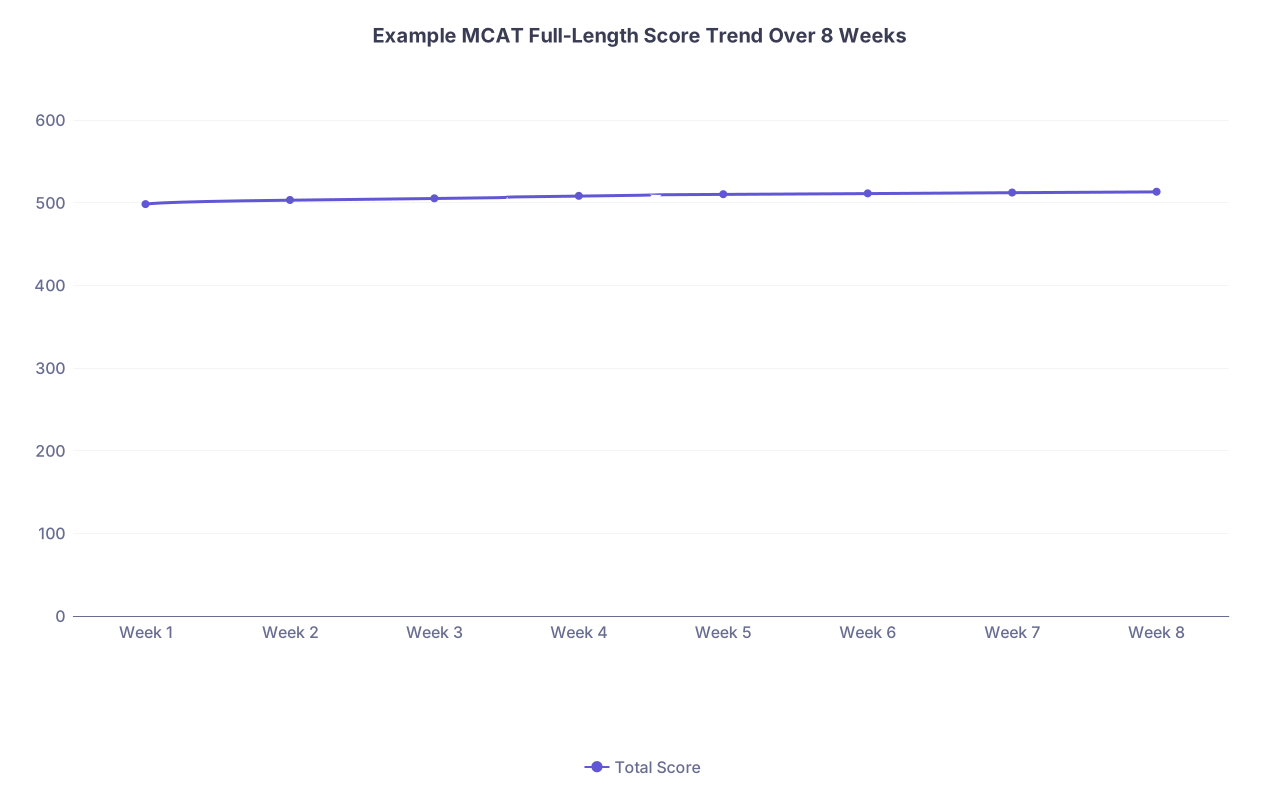
| Category | Total Score |
|---|---|
| Week 1 | 498 |
| Week 2 | 503 |
| Week 3 | 505 |
| Week 4 | 508 |
| Week 5 | 510 |
| Week 6 | 511 |
| Week 7 | 512 |
| Week 8 | 513 |
If you are not climbing into your target range (e.g., 510+ for MD, 505+ for DO, depending on your GPA and goals) by the last 2–3 practice tests, you reconsider your timeline. Not your self-worth. Your timeline.
July: Take the MCAT and pivot immediately
At this point you should:
- Sit for the MCAT early- to mid-July.
- Treat the week before the test like a taper:
- No new content 2 days before.
- Light review, sleep, food, movement.
Then, you must do something most people fail at: once the exam is done, you instantly shift gears into application mode. Do not spend 4 weeks spiraling about your performance.
The rest of July:
Personal statement:
- 2–3 weeks start to finish.
- Draft 1: brain dump why medicine + formative stories (not “I want to help people” fluff).
- Draft 2–3: structure, cut clichés, build a narrative arc.
- Get 1–2 real humans (advisor, physician, trusted mentor) to read it. Not 10. Too many cooks will wreck your voice.
Activities list skeleton:
- Choose your 15 most significant experiences.
- Write bullets first:
- What you did.
- Impact on others.
- Impact on you.
- Then convert bullets into concise narratives.
Identify letter writers:
- 2 science faculty (ideally from your post‑bacc).
- 1 non-science / PI / physician supervisor.
- Ask them now, not 3 days before you need them.
August: Build the application infrastructure
Even if you are not submitting until June next year, you want your foundation done while MCAT content is fresh and you are still in “applications mindset.”
At this point you should:
Create accounts:
- AMCAS, AACOMAS, TMDSAS (if Texas).
- Start filling in:
- Biographical info
- Coursework (you will update with Year 2 later)
- Early draft of the activities section
Build a preliminary school list:
- Use:
- MSAR (for MD schools)
- Choose DO Explorer / school websites for DO schools
- Filter by:
- Your state (always prioritize in-state).
- Median MCAT/GPA ranges that are realistically within reach based on your projected stats.
- Use:
Confirm letters:
- Provide:
- CV or resume
- Draft personal statement
- Talking points (your trajectory, strengths, particular experiences)
- Set a deadline 1–2 months earlier than you truly need them.
- Provide:
By end of August:
- Personal statement: at or near final draft.
- Activities list: at least 70–80% drafted.
- Letter writers: confirmed and started (or requested through a committee if applicable).
Year 2, Fall: Application Polish + Contingency Planning (Sep–Dec)
This is technically your “application year,” but you already did most of the heavy writing. That is the point.
September: Face your MCAT result and decide your path
At this point you should have your MCAT score back.
If it is within your target range:
- Lock in your school list more precisely.
- Adjust based on:
- Your GPA (cumulative and science).
- State residency.
- Mission fit (rural vs urban, research vs primary care).
If it is below-range but salvageable:
- Example: aiming MD 510, you got 506 but have 3.9 post‑bacc, strong story.
- Consider:
- Focusing more on DO and mid-range MD programs.
- Or scheduling a retake in Winter ONLY if:
- Your practice scores had been higher than your actual.
- You have clear reasons you underperformed (timing, anxiety, specific weak section) that you can realistically fix.
If it is significantly off (e.g., 495–500 when you need 508+):
- You extend your timeline. Hard truth.
- Use Year 2 for GPA, clinical depth, and MCAT rebuild.
- Plan to apply in June Year 3 instead and avoid burning a weak first application.
Assuming you are staying with the original two-year cycle:
October–November: Finalize core application content
At this point you should:
Polish:
- Personal statement final pass (tighten, cut fluff, fix transitions).
- Activities descriptions:
- Clarify roles and responsibilities.
- Emphasize impact and reflection (not “I shadowed 100 hours,” but what you learned and how it changed you).
Begin working on secondary essay templates:
- Common prompts:
- “Why our school?”
- “Describe a challenge or failure.”
- “How will you contribute to diversity?”
- “Describe a time you worked with someone different from you.”
- Write generic but adaptable versions now so you can plug and customize later.
- Common prompts:
Keep building your file:
- Continue clinical volunteering, shadowing, or research.
- Maintain your experience log with recent specifics.
December: Quiet consolidation
By end of the calendar year you should have:
- A nearly complete AMCAS draft minus Year 2 grades.
- A bank of 6–10 secondary essay templates.
- A stable academic performance in your post‑bacc (especially if this is still in progress).
Year 2, Spring and Early Summer: Submit and Survive (Jan–Jun)
This is where everything becomes real. Your job now is to execute cleanly, not reinvent.
January–March: Pre-launch position
At this point you should:
Confirm your coursework completion plan:
- Project exactly which courses you will finish before applications are verified.
- Highlight upper-level sciences that strengthen your narrative (e.g., Physiology, Biochemistry, Genetics).
Tune interview readiness:
- Start basic prep:
- “Why medicine?”
- “Tell me about yourself.”
- “Why our school?”
- Practice out loud with:
- A mentor.
- Your premed advisor.
- A friend who will not just say “that was fine.”
- Start basic prep:
MCAT retake (only if absolutely necessary and planned):
- If retaking, schedule it no later than March–April.
- Build a short, brutal 8–10 week plan around weaknesses identified from your first attempt.
April–May: Application pre-fill and last academic push
At this point you should:
Pre-fill your application platforms:
- AMCAS:
- Biographic info complete.
- Coursework entered up to the latest grades you have.
- Activities fully written.
- Personal statement pasted in final form.
- AACOMAS/TMDSAS if relevant: parallel structure.
- AMCAS:
Confirm letters have been:
- Uploaded to AMCAS/AACOMAS.
- Or sent to your prehealth committee if you have one.
Finish strong academically:
- Final term of your post‑bacc needs to match or exceed prior performance.
- Avoid senioritis. Committees look at your final semester.
June: Submit. Early and clean.
At this point you should:
Submit your primary applications:
- First 2 weeks of June is ideal.
- Do not wait to see final spring grades if your upward trend is already clear and you can update later.
Prepare your secondary response system:
- Create a simple strategy:
- 48–72 hour turnaround for each secondary.
- Use your pre-written templates and customize:
- Insert specific school programs, mission lines, geographic connections.
- Create a simple strategy:
Watch verification timelines:
- AMCAS can take weeks to verify in peak season.
- The earlier you submit in June, the faster you move to the interview pile.
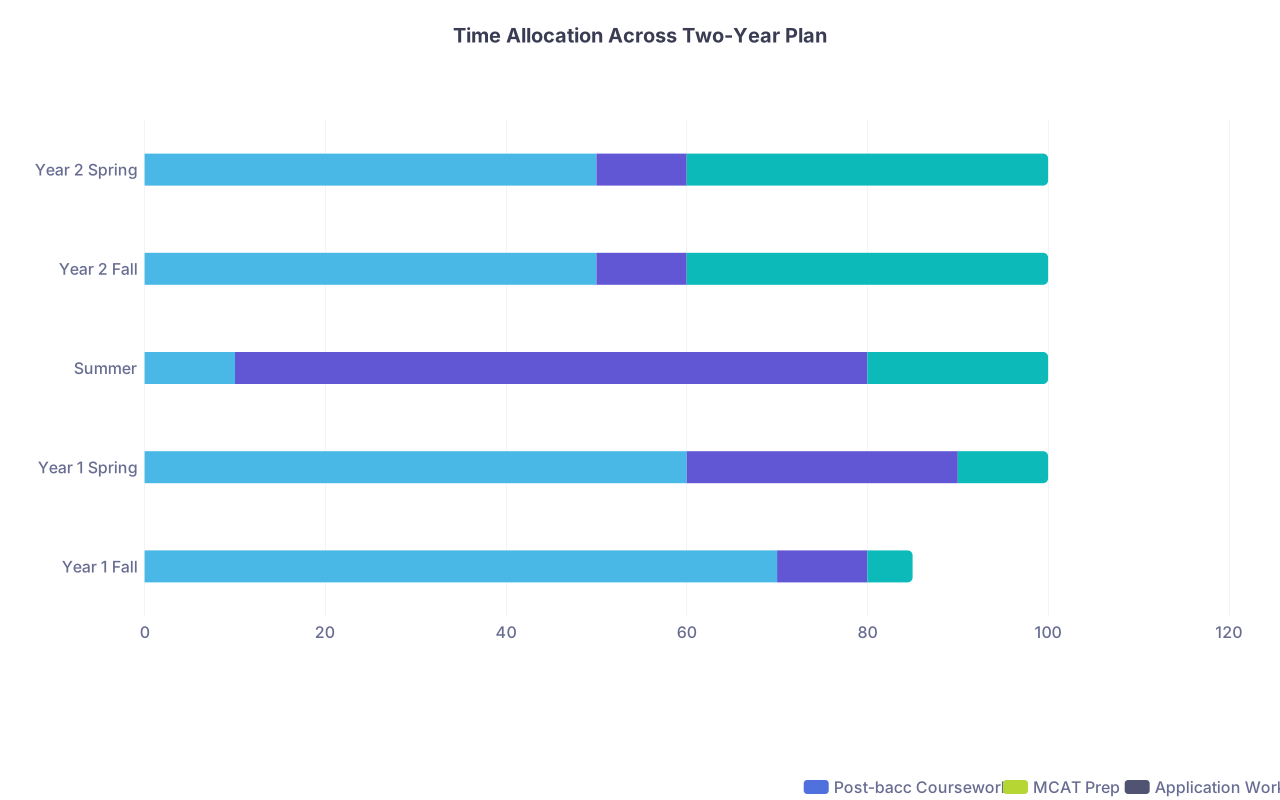
| Category | Post-bacc Coursework | MCAT Prep | Application Work |
|---|---|---|---|
| Year 1 Fall | 70 | 10 | 5 |
| Year 1 Spring | 60 | 30 | 10 |
| Summer | 10 | 70 | 20 |
| Year 2 Fall | 50 | 10 | 40 |
| Year 2 Spring | 50 | 10 | 40 |
The pattern is simple: coursework heavy early, MCAT heavy in the summer, application heavy in Year 2.
Integrating Clinical, Shadowing, and Life Without Burning Out
You noticed I have said almost nothing about “add more volunteering.” That is intentional. The two-year plan fails when people chase quantity over sanity.
At this point in the process, across both years, you should be aiming for:
Clinical exposure:
- 4–8 hours/week on average.
- Examples:
- ED volunteer.
- Medical assistant/scribe (if you have bandwidth).
- Hospice or clinic volunteer.
Shadowing:
- Concentrated bursts:
- 1–2 weeks full-time shadowing in breaks.
- Or 4–5 hrs/week over a few months.
- Try to see at least:
- Primary care.
- One specialty you think you like.
- Something very different from your assumed path (e.g., psychiatry if you are surgery-obsessed).
- Concentrated bursts:
Non-clinical service:
- Sustain 2–4 hours/week where you actually interact with people not like you:
- Tutoring underserved students.
- Homeless outreach.
- Food bank, legal aid, etc.
- Sustain 2–4 hours/week where you actually interact with people not like you:
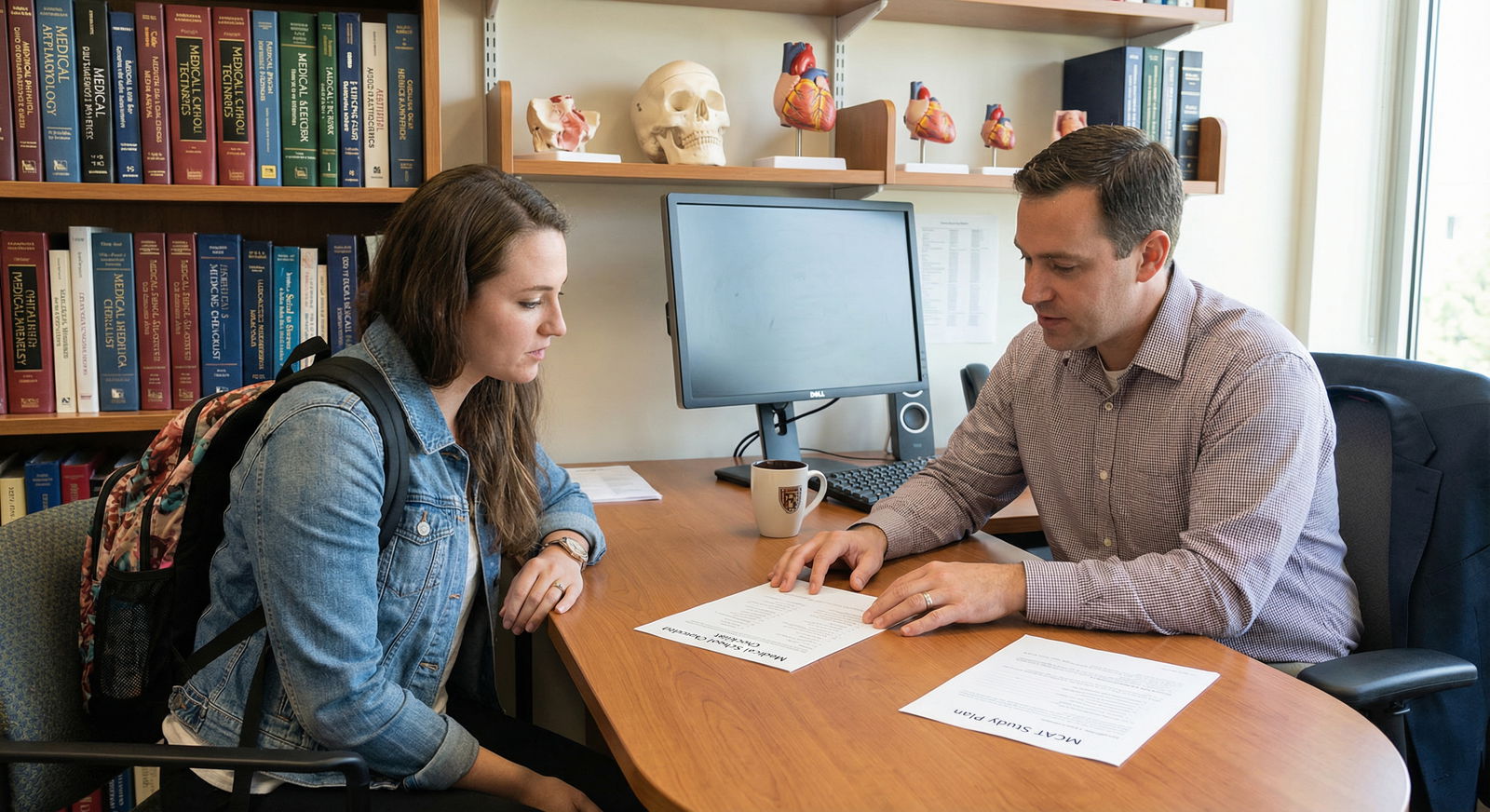
You weave these in slowly, not all at once:
Year 1 Fall:
- Light clinical (4 hrs/week max).
- Minimal non-clinical.
Year 1 Spring:
- Maintain or slightly increase clinical if grades are solid.
- Start consistent non-clinical if possible.
Summer:
- Increase shadowing intensity.
- Maintain at least some regular clinical.
Year 2:
- Keep everything stable; do not add brand new major commitments.
The Reality Check Moments
There are three checkpoints in this two-year plan where you must be brutally honest with yourself.
End of Year 1 Fall:
- Are your post‑bacc grades in the A-/A range?
- If not, your MCAT can wait. Fix your study approach, get tutoring, adjust course load.
Late Spring / Early Summer before MCAT:
- Are your practice FL scores within 3–4 points of your target?
- If not, consider pushing your test date into late summer or fall and delaying your application.
When MCAT score comes back:
- Does your MCAT+GPA combo put you in a realistic range for your target schools?
- If no, do not waste your “first shot” application. Extend your timeline, strengthen the weaknesses, re-attack later.

I have seen too many post‑bacc students rush into a June application with a shaky MCAT and then spend the next decade explaining a disastrous first cycle. Do not be that story.
Final Compressed Checklist
If you skimmed everything, here are the anchor points of the two-year integration:
Year 1 Fall:
- Crush your post‑bacc courses.
- Light MCAT exposure only.
- Start building relationships with professors and logging experiences.
Year 1 Spring → Early Summer:
- Ramp MCAT to 8–12 hrs/week, then 25–35 hrs/week in June.
- Take full-lengths regularly.
- Sit for MCAT late June–mid July if practice scores support it.
Summer → Year 2:
- Immediately pivot from MCAT to application writing.
- Draft personal statement and activities.
- Confirm letters.
- Build and refine school list after you see your MCAT score.
- Pre-fill AMCAS/AACOMAS and submit in early June Year 2.
Do this in order, at the right intensity at each phase, and you give yourself the one thing most premeds never get: a calm, coherent, and strategically timed path from post‑bacc to medical school.