| Category | Value |
|---|---|
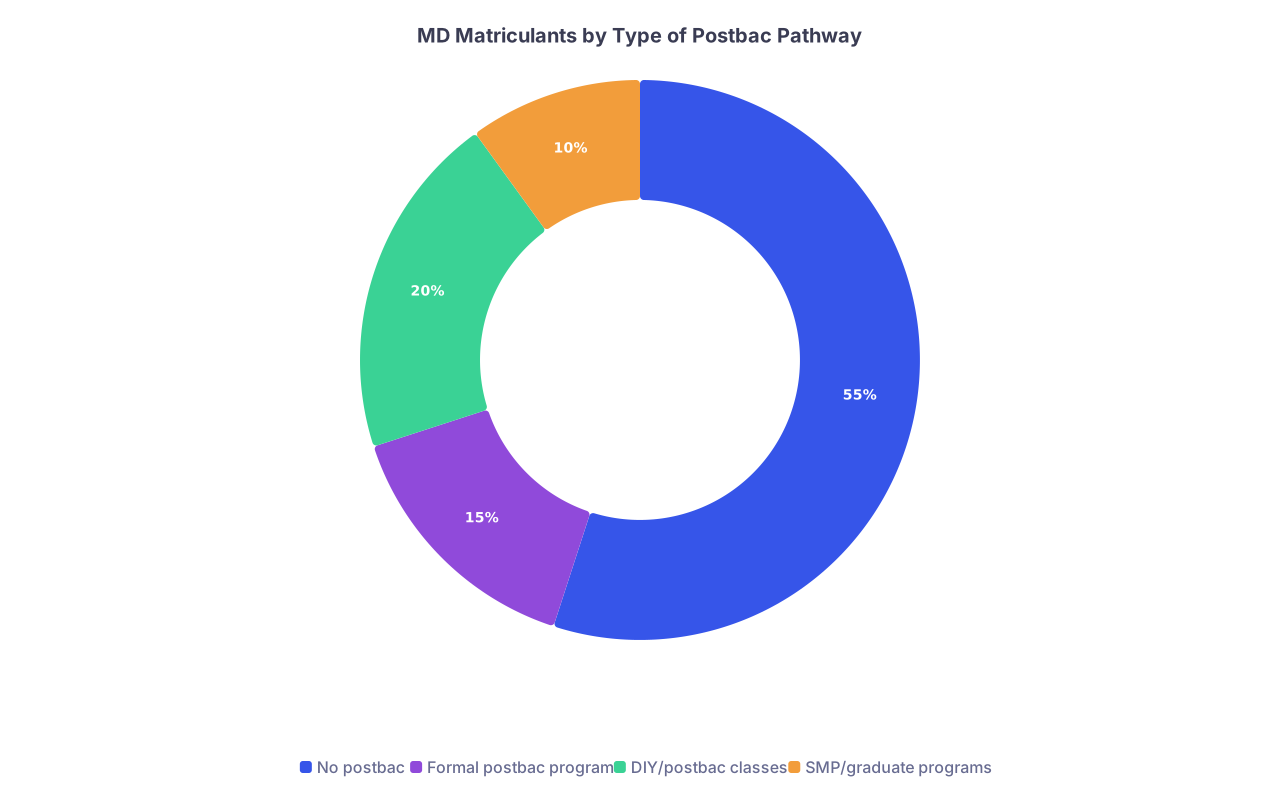
| No postbac | 55 |
| Formal postbac program | 15 |
| DIY/postbac classes | 20 |
| SMP/graduate programs | 10 |
You’re Staring at Your Transcript and Thinking: “Did I Screw This Up?”
It’s 11:47 p.m. You’ve got three browser tabs open: a fancy “official” post-bacc program at a big-name university, your community college portal, and an SDN thread from 2015 with people arguing about whether DIY post-baccs “count.”
You keep seeing phrases like “structured program,” “committee letter,” “cohesive curriculum,” and now this awful, sinking thought is looping in your head:
“I pieced mine together. I took classes at two different schools. No formal ‘program,’ no certificate. What if MD schools see this and think I’m not serious? What if it looks cheap? Disorganized? Not ‘real’?”
I’ve seen this exact panic a hundred times. It feels like everyone else has some glossy brochure-worthy “pre-med post-bacc” and you’ve just got…a pile of unofficial transcripts and a dream.
Let me cut right to it: a DIY post-bacc can absolutely be taken seriously by MD programs.
But only if it’s done right, and only if you explain it right.
Let’s talk through the part your brain is catastrophizing, the part adcoms actually care about, and what you can still fix starting now.
What Adcoms Actually See When They Look at a “DIY” Post-Bacc

You’re imagining some dean sitting there saying, “Hmm, this isn’t from Columbia’s formal post-bacc, REJECT.” That’s not how this works.
They’re not grading the branding of your post-bacc. They’re grading the signal your coursework sends.
Things they actually care about when they look at your DIY:
- Did you take upper-division, rigorous science?
- Did you show an upward trend if your undergrad GPA was rough?
- Were you working while taking classes, or just casually sprinkling in 1–2 credits per term?
- Did you perform consistently, or are there more random Bs/Cs sprinkled in?
- Does the timeline make sense with the story you’re telling in your application?
They don’t care if it’s called a “post-baccalaureate program” on the school’s website.
I’ve seen people with a 3.1 undergrad, then a DIY at a state school with 35+ credits of As in bio/chem/phys/biochem, walk straight into MD programs. No “official program.” No certificate. Just clean, strong, recent science.
And I’ve seen people in expensive, “elite” post-bacc programs scrape by with Bs, withdraw from orgo, have no clinical experience, and then wonder why nobody’s calling them.
The unromantic truth: adcoms are practical. They care about evidence you can survive M1. If your DIY does that, it’s legitimate. Period.
The Ugly Doubts You’re Probably Having (And What’s Actually True)
Let’s drag the specific fears into daylight. They sound something like:
“Med schools won’t take community college credits seriously.”
“I took classes at multiple schools; it looks chaotic.”
“I don’t have a certificate or ‘program’ name. It won’t count as a post-bacc.”
“Everyone else in official programs gets committee letters and advising. I look DIY = low effort.”
Some of this has a grain of truth. Most of it is your brain turning the volume up to 11.
“I Don’t Have an Official Post-Bacc Program Name”
Nobody on an adcom is looking for a line on your application that literally says “post-baccalaureate program” with a trademark symbol.
On AMCAS, it’s all just coursework. You label your status (post-bacc undergrad, graduate, etc.), and they look at:
- Institution
- Course level
- Grade
- Trend
- Total credit hours
If you’ve taken, say, 24–40 credits of upper-division science after graduation, that’s a post-bacc. Whether your registrar markets it as such or not.
Where the “official program” label helps is mostly packaging: built-in advising, cohort, maybe a linked committee letter. Nice-to-haves. Not must-haves.
“I Split Classes Between Two (or Three) Schools”
This is where people start spiraling: “I did gen chem at community college, orgo at a state school at night, biochem at a different campus. It looks like I just ran around chasing easy As.”
I’m not going to lie: too much hopping around with no context can look flaky.
But there’s a difference between flaky and understandable life logistics.
If your pattern is:
- Worked full-time → took night classes at local CC
- Moved back home → took more classes at nearby state university
- Then settled and finished upper-division science at one main institution
That’s fine. You can explain that. In your personal statement or secondaries, you can literally say:
“While working full-time to support myself, I completed prerequisites at the institutions available to me, prioritizing schedule and affordability. Once more stable, I enrolled at X University to complete advanced science coursework in a more rigorous setting.”
That sounds intentional. Responsible. Like an adult who lives in the real world.
Where it looks worse is if you:
- Took bio at random online school
- Dropped out mid-semester somewhere else
- Have a string of Ws and part-time dabbling for five years with no full-time commitments to balance that
Even then, it’s not automatically fatal. It just means you need a period of clean, consistent, higher-level coursework to reset the narrative. Which you can still do.
Does a DIY Post-Bacc “Count Less” Than a Formal One?
| Category | Value |
|---|---|
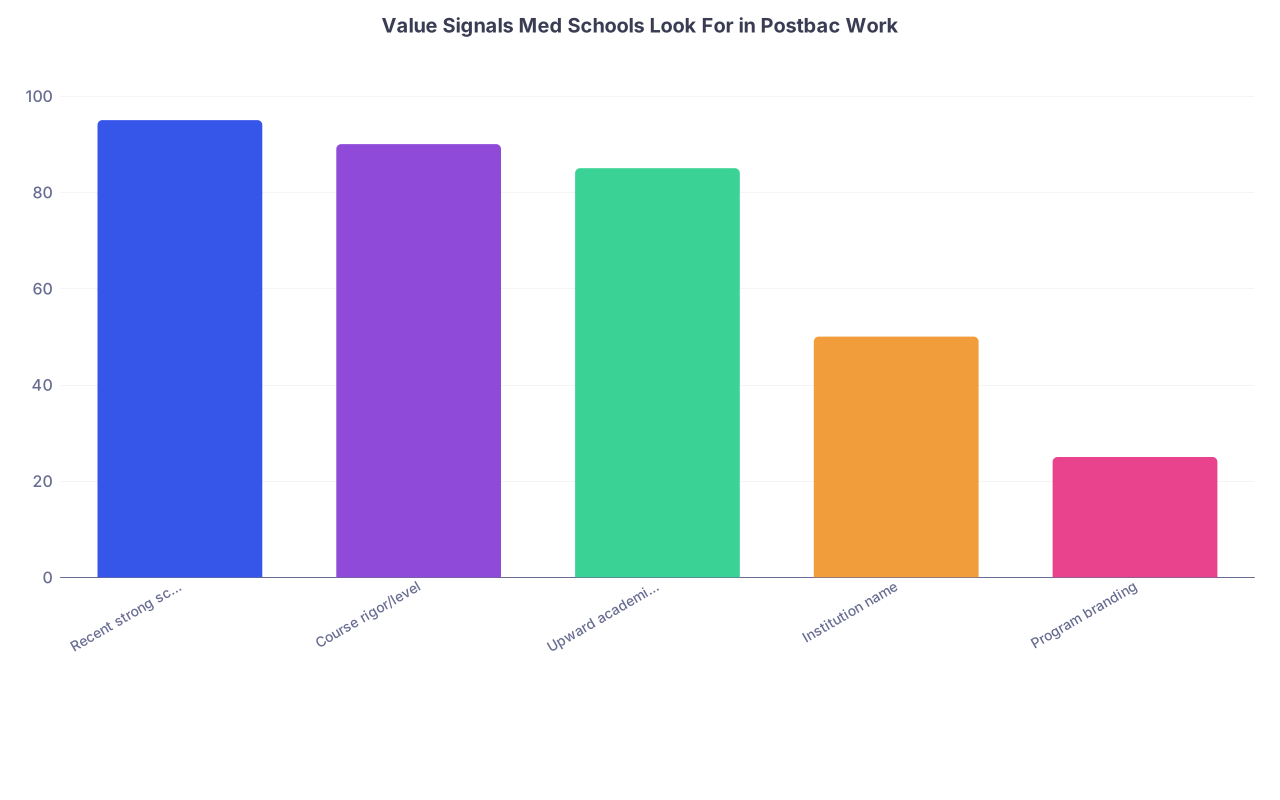
| Recent strong science GPA | 95 |
| Course rigor/level | 90 |
| Upward academic trend | 85 |
| Institution name | 50 |
| Program branding | 25 |
Here’s the uncomfortable truth nobody in marketing for formal programs will tell you:
Most MD schools don’t give special bonus points for the phrase “formal post-baccalaureate program.”
They care about:
- Recency – last 1–3 years of science work
- Rigor – upper-division courses, lab-based, not fluff
- Performance – mostly As, minimal noise
- Context – what were you balancing? Work? Caregiving?
A formal program can offer structure and that can help you perform well. But the performance is the part that counts.
If your DIY looks like:
- 28 post-bacc credits
- All at a 4-year institution
- Classes like: Cell Bio, Physiology, Biochem, Genetics, Microbio
- 3.8+ in that block
That absolutely stands toe-to-toe with many formal programs. And I’d argue it’s more impressive if you pulled it off while working, commuting, or handling real life.
What doesn’t help you is:
- 8–12 random credits of intro-level stuff
- Repeated dips back into part-time school with long breaks
- Taking mostly easy, non-science electives and calling it “post-bacc”
If you’re worried yours looks more like the second category, this is your wake-up call: you probably need more.
Not more branding. More good, upper-division science grades.
How to Make Your DIY Post-Bacc Look More “Official” and Coherent

| Step | Description |
|---|---|
| Step 1 | Current DIY coursework |
| Step 2 | Add 12-20 more upper-division sciences |
| Step 3 | Secure letters from science faculty |
| Step 4 | Explain path in personal statement/secondaries |
| Step 5 | Apply to MD/DO with clarified narrative |
| Step 6 | Enough credits & rigor? |
| Step 7 | Recent strong GPA? |
If you’re still in the middle of your classes, you’ve got room to tighten this up.
Think about four buckets:
Rigor
If most of your DIY so far is intro-level or at a community college, your next moves matter. Consider:- Taking upper-division courses at a 4-year institution if at all possible
- Prioritizing classes med schools actually respect: Physiology, Biochem, Genetics, Micro, Immunology
No, that doesn’t mean CC is trash. But if your entire post-bacc is CC intro sciences and your undergrad GPA was weak, some adcoms will quietly wonder, “Can they handle M1-level rigor?” Upper-division work at a 4-year helps close that question.
Consistency
You want at least 2–3 consecutive semesters of strong performance. Not:- One semester of A’s → 1 year gap → another random semester → more gaps
If you can still do this: stack 12–15 credits of solid science for at least two terms. Show them you can handle a med-school-ish course load.
Letters of Recommendation
DIY students get wrecked here sometimes. They just quietly go to class, never talk, never go to office hours, and then at app time…no one knows them.Fix that:
- Pick 1–2 professors (especially science) and actually commit to being visible
- Go to office hours, ask for help, ask about their work, let them see your growth
- By the time you ask for a letter, they should be able to say more than “Got an A, showed up”
A strong letter saying, “I watched this student return to school and absolutely dominate advanced coursework while working 30 hours a week” does a lot of the talking for you.
Narrative
DIY looks sketchy when there’s no story. Admissions people have to guess. You don’t want them guessing.You need a clear, simple arc like:
- “My undergrad performance didn’t reflect my current capabilities. After graduating, I returned to school while working to systematically rebuild my science foundation. Over X semesters, I completed Y credits of advanced coursework with a Z GPA, confirming my readiness for medical school.”
That shows ownership without whining. No excuses. Just: “Here’s what I did to fix it, here’s what the evidence shows now.”
What If I Already Finished My DIY and It’s…Not Perfect?
This is the real fear, isn’t it? That the thing is already baked and you can’t change it. So you’re stuck with this half-impressive, half-messy trail.
You look at it and see:
- A few Bs in key classes
- Maybe one C
- Scattered course load
- Some CC, some 4-year school, maybe an online class in the mix
So what now?
You have three levers:
Time + More Coursework
If your post-bacc is under ~25–30 credits or the trend is mixed, you can extend it.That might look like:
- One more academic year of focused, upper-division science with a 3.7–4.0
- Taking a heavier load to mimic med school pace
- Buckling down on study habits instead of “seeing how it goes”
Is it annoying to keep going? Yes. But if you want MD and your current record doesn’t clearly shout “ready,” this is often the cleanest way to fix it.
MCAT
A strong MCAT doesn’t erase a bad GPA, but it does help argue: “Yes, I can handle the material.”
If your MCAT is weak and your DIY is messy, that’s a double problem. One of those has to improve.School List Strategy
If you’re in the gray zone, you might need to:- Be realistic and include DO schools
- Target MD programs that are known to be more forgiving / holistic
- Consider in-state publics where you have some baked-in advantage
This is not defeat. It’s strategy. MD vs DO is not a moral ranking. It’s branding.
How to Talk About Your DIY Post-Bacc Without Sounding Defensive
You don’t want to sound like:
“I couldn’t afford a real program, so I kind of pieced stuff together, but I promise I worked really hard.”
You want something like:
“After college, I realized my academic record didn’t reflect my potential. Working 30 hours a week, I enrolled in post-bacc coursework at institutions that fit my schedule and finances. Over the next two years, I completed 32 credits of upper-division biology and chemistry with a 3.8 GPA. This process didn’t just strengthen my science foundation; it proved to me that I could sustain rigorous work while managing other responsibilities.”
Firm. Honest. No self-pity. Uses your DIY path as evidence of resilience and planning instead of something you’re apologizing for.
What You Can Do Today to Make This Less Terrifying

You can’t retroactively turn your DIY post-bacc into a branded program with a brochure and a cohort. But you can absolutely:
- Print or pull up your unofficial transcripts. Circle every science course you’ve taken after graduation.
- Count the total post-bacc science credits, the GPA in those, and look at the trend semester by semester.
- Ask: “If I were an adcom, would this look like a decisive, upward, consistent rebuild…or scattered experiments?”
If it’s the first, your DIY is fine. Your job now is to package it clearly in your personal statement, secondaries, and interviews.
If it’s the second, your panic is your gut telling you something useful: you’re not done yet. Add another year or two of purposeful, high-level coursework and make that part of your story.
Either way, the fix is not some magical label that says “official post-bacc.” The fix is what you do next and how you present what you’ve already done.
FAQ (Exactly What You’re Too Afraid to Ask Out Loud)
1. Do MD programs secretly prefer formal post-baccs over DIY?
Not in any systematic, universal way. They prefer strong, recent academic performance. Formal programs might attract motivated students and provide structure, but if your grades and course rigor are equivalent, a well-executed DIY is not second-class. I’ve seen plenty of DIY people get MD acceptances, including to mid- and upper-tier schools, because their numbers and story lined up.
2. Is community college coursework going to tank my chances?
Some adcoms don’t love seeing only CC science, especially if your undergrad GPA was weak, because it doesn’t fully answer the “med-school-level rigor” question. But CC work combined with later upper-division classes at a 4-year institution can absolutely work. If CC is what you could afford or access, say that once, briefly, then let your performance do the heavy lifting.
3. How many post-bacc credits do I need for MD schools to “take it seriously”?
There’s no magic number, but if you’re trying to rehab a weak undergrad record, I’d say aim for 25–35+ credits of solid, mostly upper-division science over at least 2–3 consecutive terms. If your undergrad was already decent and you’re just finishing prereqs, fewer may be fine. But if you’re asking this question with a 2.9 science GPA behind you, you probably need more, not less.
4. I already applied once with my DIY post-bacc and didn’t get in. Does that mean it’s not good enough?
Not necessarily. Rejections are often a mix of things: late application, weak school list, mediocre MCAT, flat personal statement, lack of clinical work, or just random competition that year. But if you were rejected everywhere, you should assume your academic record wasn’t clearly convincing. That usually means: improve something measurable (more A-level coursework, higher MCAT) before reapplying. “Trying again with the same stats” is how people burn cycles.
5. How do I label my DIY post-bacc on AMCAS so schools know it’s post-bacc?
On AMCAS, you mark your coursework as “Post-baccalaureate undergraduate” for any undergrad-level classes taken after your first bachelor’s degree. That’s all you need. In your activities, you can mention “post-baccalaureate coursework” as part of your academic narrative, but you don’t need an official program name. The pattern of grades speaks louder than whatever you call it.
Open your transcript (yes, right now) and list your post-bacc science classes with semester, credits, and grades. Look at that list and ask yourself, out loud: “If this belonged to another applicant, would I believe they’re ready for M1?” If the answer is no, your next step is obvious: plan the next 2–3 semesters that would make you say yes.