Last week, a student showed me her transcript on her laptop with her hands literally shaking. “I got a B+ in biochem. That’s it, right? Med schools are going to see I’m not perfect.” She’d pulled herself from a 2.8 undergrad GPA to a 3.6 in a post-bacc—and all she could see was that missing 4.0.
If your stomach drops every time you think about that one B, or that 3.5 instead of 3.9, you’re not alone. Let’s talk about how ugly this really looks to admissions… and how much you’re probably blowing it up in your head.
First: No, You Didn’t “Ruin” Your Post-Bacc By Not Getting a 4.0
Let me just say the thing you’re too scared to believe:
Most adcoms are not sitting there with a ruler measuring whether your post-bacc is a 3.95 vs 4.0. They care about patterns, direction, and context way more than perfection.
Here’s how your brain is framing it:
- “If it’s not a 4.0, it’s a failure.”
- “They’ll compare me to the perfect 4.0 post-bacc people and I’ll lose.”
- “This just confirms I’m not smart enough for med school.”
Here’s how they actually tend to see it:
- “Did this person show strong upward trend?”
- “Did they handle rigorous science coursework well?”
- “Is there enough proof they can survive our curriculum?”
If you went from:
- 2.7–3.0 undergrad → 3.5–3.8+ post-bacc with real upper-level sciences
that’s not a red flag. That’s usually exactly what they wanted to see.
A 4.0 is nice. It’s clean. It’s simple. But a 3.6–3.9 in a solid post-bacc, with a packed schedule, while working or fixing previous academic issues? That’s often more than enough to check the “academic readiness” box for a lot of schools—especially DO and many MDs that are mission-driven or more holistic.
Is it going to erase a 2.4 undergrad GPA by itself? No. But it’s absolutely not “pointless” because it’s not perfect.
How Med Schools Actually Read a Post-Bacc Transcript
Here’s what people imagine:
Some committee member opens your transcript, sees a B+ in organic chemistry, and says, “Reject. Weak.”
That’s… not how it looks in the room.
They look at several things in order of importance (for post-bacc students, especially career changers or reinvention folks):
Trend
Did your grades go:- From scattered → consistent?
- From low → higher?
- From passable → strong?
Upward trend is gold. One B in a sea of As isn’t ruining anything.
Rigor of coursework
They’re asking:- Did you take real, upper-level sciences? (Biochem, physiology, micro, genetics, etc.)
- Was it full-time or a scattered single-class-each-semester thing?
- Was it at a credible institution—not some random, questionable online-only setup?
Volume of recent science
They’re trying to see: “Do we have enough recent data to trust this person can handle med school?”
25–32+ credits of strong, recent science is usually persuasive.
A 4.0 with only two or three classes? Less persuasive.Consistency
A transcript that looks like:- A, A-, B+, A, A, B+ is honestly fine. That doesn’t scream “unstable.”
A transcript that looks like:
- A, C, W, A, B-, drop, A raises more questions—what happened there? Life? Burnout? Chaos?
So a 3.7 in a demanding, full-time post-bacc with real sciences? Often reads as:
“Solid. Reliable. Probably fine academically.”
Not: “Why didn’t they get a 4.0 like robots do?”
The Numbers: Where Does a Non-4.0 Post-Bacc Fit?
Let’s put the paranoia next to reality for a second.
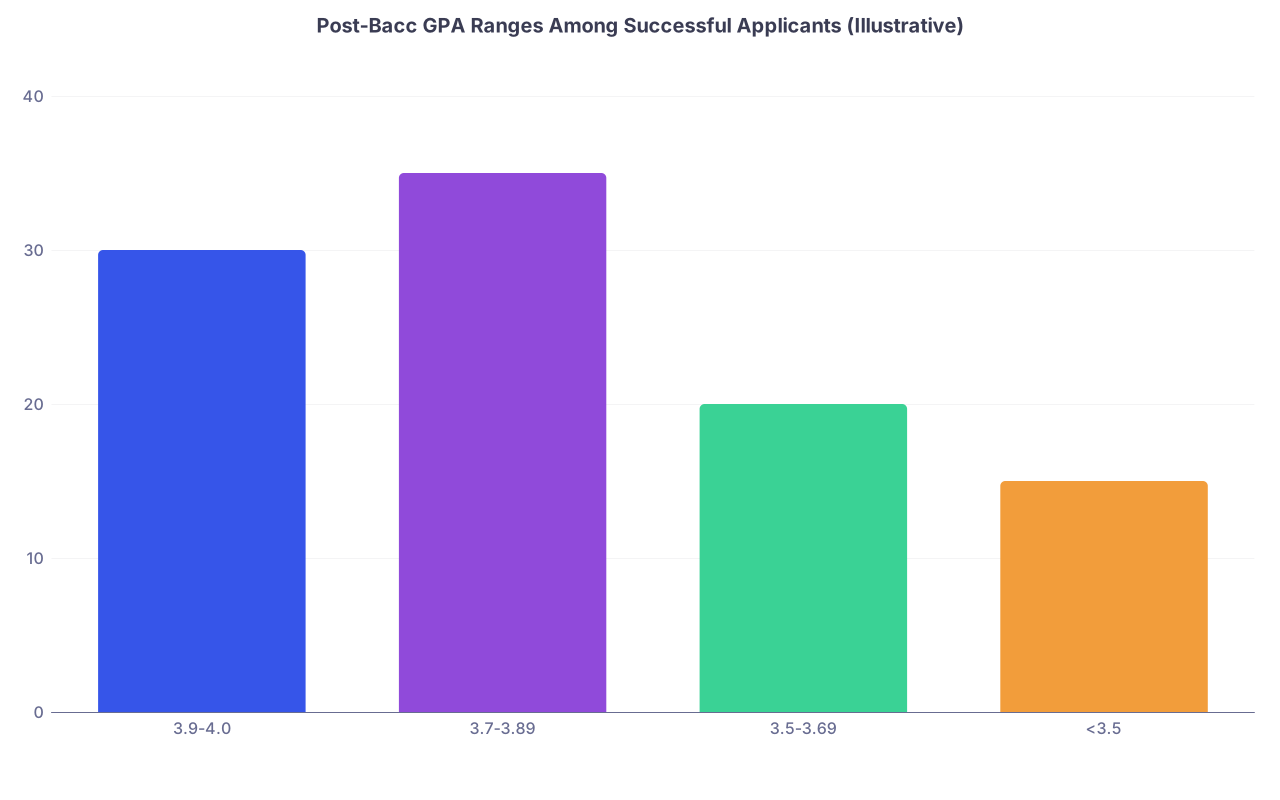
| Category | Value |
|---|---|
| 3.9-4.0 | 30 |
| 3.7-3.89 | 35 |
| 3.5-3.69 | 20 |
| <3.5 | 15 |
This is illustrative, not exact AMCAS data, but it matches what I keep seeing: lots of successful applicants are living in that 3.6–3.8 post-bacc zone. Not all of them are 4.0 machines.
Who tends to have a 4.0?
- People who took fewer classes at a time
- People who are naturally strong test-takers
- People who had less chaos outside school during that period
Who tends to have a 3.5–3.8?
- People working part-time or full-time
- People doing heavier loads to “prove” themselves
- People juggling family, health, or other responsibilities
Adcoms are not stupid. They know that context matters. A 3.7 in 30 credits of upper-level science while working 20 hours a week can be more impressive than a 4.0 in 12 credits with nothing else going on.
When a Non-4.0 Post-Bacc Might Actually Be a Problem
Let’s not sugarcoat it. There are situations where a “good but not great” post-bacc GPA is an issue. You’re not crazy to worry; you just need to worry about the right things.
Watch out for these scenarios:
The post-bacc is only slightly higher than a weak undergrad GPA
Example:- Undergrad cGPA: 2.7
- Post-bacc: 3.2 in 18 credits of science
That doesn’t scream “academic transformation.” It feels like small improvement, not real reinforcement.
You have multiple Cs or lower in post-bacc science courses
One C in orgo or physics? Survivable with explanation.
Several Cs in a small number of post-bacc classes? That’s harder to spin as “I’m now ready for a brutal medical curriculum.”Almost all A’s… but in low-rigor classes
4.0 in:- Intro bio for non-majors
- Online nutrition
- Psychology 101
- “Science of Exercise”
That doesn’t carry much weight if they’re trying to predict performance in M1 physiology, biochem, anatomy.
No real upward trend
If your transcript looks like:- Undergrad: mostly Bs and Cs
- Post-bacc: mostly Bs and Cs
That suggests you might simply be a consistent B-/C+ student, which is a risk for med school.
If any of that stings a little, it doesn’t mean you’re doomed. It means your post-bacc alone might not be enough “proof.” You’d need:
- Strong MCAT (especially in BB/CP sections)
- More targeted coursework
- Possibly SMP or grad-level work at a med-school-affiliated program
But just not being a 4.0? That alone isn’t usually the make-or-break factor.
How Much Does the MCAT Bail Out a Non-Perfect Post-Bacc?
Here’s what adcoms do in their heads, even if they don’t say it this bluntly:
- Decent GPA + Strong MCAT → “Okay, brain works, discipline is there.”
- Strong GPA + Decent MCAT → “Probably fine, but what happened with standardized tests?”
- Meh GPA + Meh MCAT → “Risky.”
If your post-bacc is not a 4.0, the MCAT becomes even more important as backup evidence.
Think of it like this:
- 3.6–3.7 post-bacc + 515 MCAT = “This person can handle the work.”
- 3.6–3.7 post-bacc + 501 MCAT = “We’re not fully convinced.”
So if you’re sitting with a 3.6 post-bacc and spiraling because you’re not at 4.0…but you also punch a 512–516 MCAT? You’re in a significantly better place than your anxiety is willing to admit.
How to Explain a Less-Than-Perfect Post-Bacc (Without Sounding Pathetic)
You don’t need to write a sob story about every B+. But if there’s a pattern—like one rocky semester, or a dip in grades—you can shape that narrative.
Avoid:
- “I was just overwhelmed.”
- “The professor was unfair.”
- “The material was really hard.”
Those sound like excuses. And they make them worry about how you’ll handle Step exams, night float, life in general.
Better framing sounds like:
- “My first semester back, I overestimated how many credits I could handle while working. I adjusted my schedule, reduced work hours, and my grades improved from B-range to consistent As afterward.”
- “During my post-bacc, a family health crisis pulled my attention away briefly. My performance dipped, but I sought support, stabilized things, and my subsequent semesters reflect my true capability.”
You’re not trying to convince them that your B+ is actually an A. You’re trying to show:
- Self-awareness
- Course correction
- Upward trajectory
That’s what matters.
MD vs DO: How Forgiving Are They Really?
This is where your worst-case thinking tends to go wild: “MD schools will never forgive anything below a 3.9. I guess I’ll just do DO. Or nothing.”
Reality is more nuanced:
MD schools
Yes, on average, they’re more stats-sensitive. But not all MD programs are the same. Some:- Love reinvention stories (especially state schools and mid-tier programs)
- Look hard at recent performance and MCAT
- Are willing to accept a post-bacc 3.5–3.7 if the trend and MCAT support you
DO schools
Generally more forgiving of lower undergrad GPAs, especially with:- Solid post-bacc or SMP performance
- Decent MCAT (505+; higher for more competitive DOs)
A non-4.0 post-bacc with:
- Strong upward trend
- Solid number of credits
- Good MCAT can absolutely get MD attention. And for DO schools, it can make you very competitive.
The bigger issue isn’t “not a 4.0.” It’s:
- Not enough coursework
- Weak MCAT
- No compelling story or clinical experience to balance the stats
If You’re Mid-Post-Bacc and Worried You’re “Messing It Up”
Here’s what you actually have control over going forward:
Lock in consistency over perfection
Aim for a wall of A’s. If a B slips in, fine. Protect the rest like your life depends on it.Don’t overload to “prove” yourself
Taking 20 credits and getting mixed B/C grades is worse than 12–15 well-executed credits of A/A- work. They’re not impressed that you nearly burned out.Choose courses strategically
Load up on:- Biochem
- Physiology
- Microbiology
- Genetics
- Upper-level cell/molecular bio
These mirror med school content and carry more weight in their mental calculation.
Plan the MCAT around your strongest academic window
Don’t take the MCAT while drowning in coursework if you know you’re already stretched thin. One solid MCAT later is better than a rushed, low score now.Stop talking about your GPA like it’s a crime
Don’t sabotage yourself in interviews by saying things like:- “I know my 3.6 isn’t that impressive…”
- “I really tried for a 4.0 but I failed.”
You’re handing them a negative frame. Present your post-bacc as what it is: evidence of readiness.
Quick Reality Checks (For When You’re Spiraling at 2 a.m.)
- A post-bacc 3.6–3.8 in solid science courses is usually good. Not disqualifying.
- One or two B’s don’t matter nearly as much as your brain thinks they do.
- A 4.0 doesn’t magically erase other weaknesses (bad MCAT, no clinical, no story).
- A non-4.0 doesn’t erase your shot if the overall picture is strong and trending upward.
Your brain is zoomed in on a single decimal place. Adcoms are zoomed out, looking at the whole arc: where you started, what changed, what you sustained, and whether you look like someone who can survive M1 without imploding.
FAQ (Exactly 4 Questions)
1. Is a 3.5 post-bacc GPA too low to help my low undergrad GPA?
It depends how low “low” is and what else you have. If your undergrad is, say, 2.6–2.8 and your post-bacc is a 3.5 with 25–30+ credits of solid science, that’s better than nothing, but it’s not the slam-dunk reinvention some adcoms look for. You may still be competitive for some DO schools, especially with a decent MCAT (505+), but MD will be tougher unless your MCAT is strong and you have a powerful narrative plus strong recent performance.
If your undergrad was around 3.0–3.2, then a 3.5 post-bacc can help a lot more—especially if your MCAT backs it up. The closer your post-bacc is to the 3.6–3.8+ range, the more comfortable schools feel trusting it as evidence that you’re academically ready.
2. I got a C in one post-bacc class. Am I done?
No, one C doesn’t kill you. It’s not ideal, but it’s not a death sentence. What matters is:
- Was it early in the program, and did you improve afterward?
- Did you retake it (if appropriate) and do much better?
- Is the rest of your record much stronger (mostly As)?
If it’s a lone C in a sea of mostly As and a few Bs, you can usually move on. If your post-bacc is small and that C is 1 of 6 science classes, then yeah, it hurts more. But “done”? No. It just means you need to crush everything else and have a decent MCAT to compensate.
3. Will top-tier MD schools care that my post-bacc isn’t a 4.0?
Yes, they’ll care more. The more elite the school, the more they like clean, stellar numbers—because they can. They have insane applicant volume. If you’re aiming at places like Harvard / UCSF / Penn, then a non-4.0 post-bacc puts you at a disadvantage unless the rest of your application is extraordinary (MCAT, research, story, impact).
But most people reading this are not in an all-or-nothing “Harvard or bust” game. For many mid-tier MD and DO schools, a 3.6–3.8 post-bacc with a strong MCAT and good experiences is very workable. Your mental cutoff (“if it’s not perfect, it’s worthless”) is harsher than most admissions committees.
4. Should I extend my post-bacc another semester to try to raise my GPA closer to 4.0?
Maybe—but not always. Extending just to chase perfection sometimes backfires:
- More time = more chance of burnout, mistakes, another B that frustrates you
- Extra tuition and delayed MCAT/applications may not change your odds much if you’re already in a strong range
It’s usually worth extending if:
- You currently have a small sample size of science courses
- You’re below ~3.4–3.5 and can realistically pull several As
- You need more upper-level sciences to show rigor
It’s less worth it if:
- You’re already at ~3.6–3.8 with plenty of credits
- The main issue is your MCAT (study that instead)
- You’re just perfectionistically chasing a 4.0 to calm your anxiety
End of the day, here’s what actually matters: strong upward trend, enough recent rigorous science, a solid MCAT, and not falling apart the first time you’re not perfect. A non-4.0 post-bacc can absolutely be part of a successful med school story. It just won’t feel that way when you’re staring at that one B at 1 a.m.—and that’s your anxiety talking, not the adcom.