Most admissions committees are not impressed that you took “upper-division biology” in a post-bacc. They are impressed when that coursework answers very specific questions about your academic story.
Let me break this down specifically, because this is where a lot of post-bacc students fool themselves.
You see students say things like:
“I’m doing a post-bacc with a lot of upper-division bio — that’ll show I’m ready for med school.”
That is half true at best.
For adcoms, upper-division biology is not a trophy line on a CV. It is diagnostic data. They interpret it through the lens of:
- What problem were you trying to fix? and
- Did this coursework convincingly fix it?
(See also: Committee Letters from Post-Baccs for more details.)
If you do not understand what those “problems” look like from their side of the table, your post-bacc plan becomes random noise.
How Adcoms Actually Look at Post-Bacc Transcripts
Adcoms do not read your transcript like you do. You think: “Wow, Immunology, Neurobiology, Cancer Biology — that’s rigorous.”
They think in a much more algorithmic way:
- What was the academic concern?
- Did they take appropriately challenging, relevant courses?
- Did they sustain performance over time?
- Does the pattern match someone who can survive (and preferably excel) in a medical curriculum?
The Three Big “Problems” Upper-Div Bio Is Supposed To Address
Upper-division biology in a post-bacc is mainly used by adcoms to answer three questions:
Can this student handle medical-level conceptual density?
Translation: Can you manage complex, layered content that is closer to systems/pathophysiology than “intro bio facts”?Does this student have sustained academic maturity, or did they just have one lucky semester?
They are allergic to one-off flukes. They want to see a run of high-level work.Did this student repair a damaged academic record in an honest, challenging way — or hide in fluff?
A 3.9 in “Fun Topics in Biology” or easy-online courses does not convince anyone who has actually reviewed thousands of files.
Upper-division biology is particularly interesting to them because it approximates the style of learning needed for medical school: layered concepts, applied thinking, cumulative complexity.
But the key word is approximates. It is still not medical school.
What Counts as “Upper-Division Biology” To Adcoms
Students often misunderstand what rigor looks like from the committee chair’s perspective. Not all 300/400-level biology courses are created equal.
There are essentially four tiers, from adcom eyes.
Tier 1: Medically-Relevant, Content-Dense, Clearly Rigorous
These courses almost always help you, if done at a solid 3.7+ level:
- Biochemistry (especially if not watered-down “survey”)
- Cell Biology
- Molecular Biology
- Genetics
- Physiology (human or advanced vertebrate)
- Microbiology
- Immunology
- Neurobiology / Neuroscience
- Cancer Biology / Pathophysiology-like courses
- Pharmacology (true upper-level, not “for non-majors”)
These courses map fairly cleanly onto medical curriculum domains. When you crush these, the committee thinks:
“OK, this person can handle hard, clinically-adjacent material.”
Tier 2: Legitimate Upper-Level Bio, Slightly Less Directly Clinical
Still helpful, still respectable, just slightly less directly predictive:
- Developmental Biology
- Endocrinology
- Virology
- Advanced Anatomy
- Systems Biology
- Advanced Ecology with strong quantitative components
- Advanced Genetics (population, quantitative)
These courses strengthen the narrative but do not carry quite the same punch if the problem was “this person bombed core premed sciences”.
Tier 3: Soft or Niche Biology That Can Look Like Evasion
These are the ones that make adcoms raise an eyebrow, depending on the rest of the record:
- “Biology of Sex” / “Biology of Aging” / “Nutrition and Health” (if obviously easier at your institution)
- Popular, lightly quantitative “cool” classes that undergrads take for GPA padding
- Environmental Topics in Biology with minimal depth
- Wildlife Biology / Intro Conservation (at some schools; at others these are hard — context matters)
These are not terrible, but if your main post-bacc repair story is made of these, some committees will quietly conclude:
“They chose lighter upper-levels when they should have tested themselves in true med-adjacent content.”
Tier 4: Dubious Online / For-Non-Majors Upper-Level Work
Things that really do not rescue a damaged academic record:
- “For non-majors” upper-division biology
- Entirely asynchronous, open-book online biology courses from institutions known locally to be easy-A factories
- Post-bacc certificates where everyone gets a 3.9 and the curve is basically “show up and pass”
Adcoms know which programs and which campuses do this. Faculty talk. Pre-health advisors talk. Students talk. If it is widely understood locally that “everyone gets an A in that class,” trust me — that reputation reaches committees.
How Upper-Div Bio Is Interpreted in Different Applicant Profiles
Upper-division biology does not mean the same thing for every applicant. Adcoms interpret it against your backstory.
Let’s go through the main archetypes.
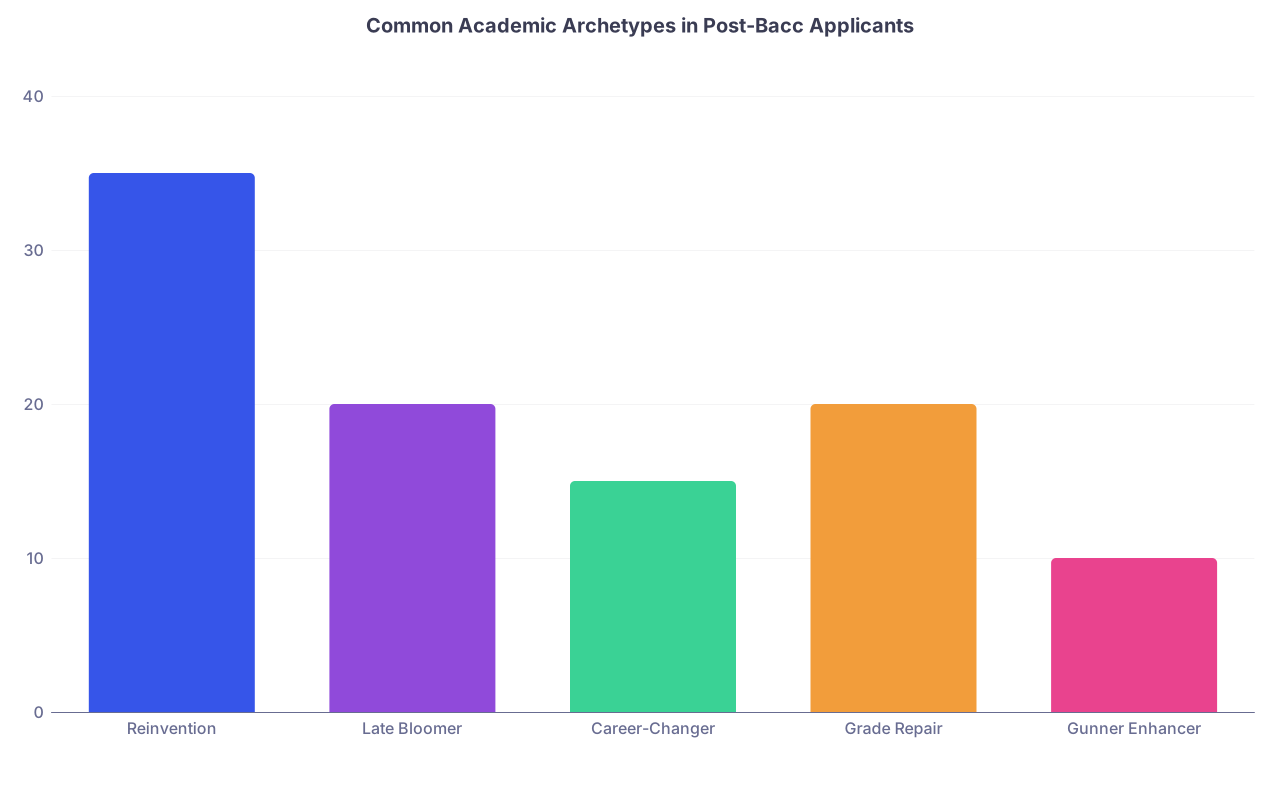
| Category | Value |
|---|---|
| Reinvention | 35 |
| Late Bloomer | 20 |
| Career-Changer | 15 |
| Grade Repair | 20 |
| Gunner Enhancer | 10 |
1. The Reinvention Candidate (Low Original GPA, Strong Post-Bacc)
Profile:
- Undergrad science GPA: 2.7–3.0
- Early Cs in Gen Chem, Orgo, maybe some Fs or withdrawals
- Post-bacc: 30–45 credits of upper-level biology + missing prereqs, all in the A-/A range
- Strong MCAT: 512–518+
How adcoms read the upper-division biology:
- They look at density and duration. Was this one good year or three consecutive strong terms?
- They look at course choice. Did this person go straight at Biochem, Physiology, Cell Bio, Micro, Immunology, etc., or dodge them?
- They look at alignment with MCAT. High MCAT + strong upper-div biology = genuine cognitive upgrade, not just grade inflation.
Best case interpretation:
“This applicant was immature at 19, but has clearly retooled. Their upper-division biology work, in volume and rigor, looks like early med school performance in miniature.”
Worst case:
“Transcript shows damage. Post-bacc is modest (12–16 credits), light in rigor, and not enough to override the original pattern. We do not fully trust their academic turnaround.”
For reinvention, upper-division biology is not optional. It is the core evidence that the old GPA does not predict the future anymore.
2. The Career-Changer (Non-Science Background, All Prereqs in Post-Bacc)
Profile:
- BA in English, Economics, Art, etc.
- Almost no original science coursework
- Does a structured post-bacc: Gen Chem, Orgo, Physics, Bio, maybe Biochem and Physiology
How adcoms interpret upper-division biology here is different.
They ask:
- Did this person just complete the bare minimum, or did they push into at least one or two hard upper-levels?
- Does their performance in upper-division work corroborate a strong MCAT?
For career-changers, the need for tons of upper-level biology is actually less intense than for reinvention candidates. But strategically, taking:
- Biochemistry
- Physiology or Cell/Molecular
and doing very well is powerful.
It answers:
“OK, they did not just memorize their way through intro Bio 1–2. They can chew on complex biological systems.”
If a career-changer does only intro-level sciences, with no upper-division at all, committees may be a little more cautious, especially at more academic programs. They might still admit you, but the file reads: “Solid prereqs, strong MCAT, but limited sampling of advanced content.”
3. The Grade-Repair Traditional Premed (Science Major, Rough Early Years)
Profile:
- BS in Biology or related
- Wrecked freshman/sophomore year (C/D/F in Orgo, Physics, early Bio)
- Junior/senior year improved somewhat
- After graduation, they do 12–30 more credits of advanced bio in a post-bacc or as non-degree seeking
Here, upper-division biology is scrutinized carefully.
Adcoms ask:
- Are these truly new, challenging courses, or just retakes and random leftovers?
- Did they string together multiple high-credit, difficult terms without falling apart?
- Were these courses taken at equal or greater institutional rigor than the original degree, or did they drop to an easier campus?
If someone had a 2.8 science GPA, then posts two years of steady 3.8+ in Biochem, Cell Bio, Physio, Micro, Immunology, etc., adcoms often will say:
“Yes, the overall GPA is 3.2–3.3, but the recent work is excellent. Let us look closer.”
If instead they scatter a few light upper-division courses over three years, one per term, mostly 3-credit lecture-only classes, adcoms smell tactical avoidance of stress and full-time load. That weakens the impact.
4. The “Gunner” With Already-Good Stats
Profile:
- Science GPA: 3.6–3.8
- Decent MCAT 510–516
- Does a few upper-level biology courses in a gap year “to show I can handle more”
For this group, upper-division biology is mildly additive, but not transformative.
Interpretation:
- If the courses are rigorous and they excel: “Consistent strength, reassuring.”
- If they stumble (B– or C in Biochem or Physio): “Red flag; maybe their prior GPA came from a softer curriculum.”
Upper-division biology does not save or sink them in the same way, but it can downgrade the impression if they underperform.
Patterns That Impress vs Patterns That Hurt
It is not just which courses you take. It is how you take them.
Patterns That Impress Adcoms
Full-time, high-volume, high-rigor terms
Example:- Fall: Biochemistry, Cell Biology, Physiology (+ maybe a small seminar)
- Spring: Microbiology, Immunology, Neurobiology
With A and A-/A-level grades across the board. That looks like the tempo of med school lite.
Logical sequencing toward increasing complexity
They like to see Biochem after finishing Gen Chem and Orgo, Cell Bio after intro Bio, Physiology after some foundational work. It shows you are not just randomly shopping.Consistency across different styles of courses
Not just lectures. Labs, problem sets, memorization, conceptual integration. Strong across formats signals robust learning ability.Alignment with MCAT performance
If you crush upper-div bio and then pull a 508 MCAT with weak BB/CP sections, that disconnect raises questions. When both line up, your story is coherent.
Patterns That Quietly Hurt You
One “hero” semester followed by a normal or weak one
Example:- Fall: A in Biochem, A in Cell Bio
- Spring: B– in Physio, B in Micro, and you drop Immunology
That looks like you ran out of steam as soon as the stress resembled med school pace.
Only taking one upper-division course at a time
A single 3-credit advanced bio with all your time dedicated to it is less impressive than three stacked together during a busy term. Committees understand life constraints, but from a pure academic-readiness standpoint, load matters.A pattern of interesting but soft courses
“Biology of Nutrition,” “Aging and Society,” “Exercise Physiology for Non-Majors,” all As. If you have a troubled record behind you, this screams avoidance.Taking rigorous courses at a markedly easier institution without a good reason
They notice when you go from a competitive 4-year university to an unselective, low-rigor place for all your “upper-level” rescue work. That does not automatically disqualify you, but it dampens enthusiasm.
How Different Types of Programs View Upper-Division Biology
Not all med schools weigh this the same way. But there are recognisable trends.

| Step | Description |
|---|---|
| Step 1 | Upper-Division Biology Record |
| Step 2 | Research-Heavy MD Programs |
| Step 3 | Mid-Tier MD Programs |
| Step 4 | State MD Schools |
| Step 5 | DO Schools |
| Step 6 | Emphasis on Rigor + Trend |
| Step 7 | Balanced View with MCAT |
| Step 8 | Strong Focus on Recent Trend |
| Step 9 | Holistic, Big on Reinvention |
Research-Heavy MD Programs (Top 20–30 Style)
They scrutinise:
- Institutional rigor
- Exact course titles and numbers
- Depth and load (how many upper-division credits, how fast)
They are happy to see advanced biology such as:
- Molecular genetics
- Cellular signaling
- Advanced neurobiology
- Systems physiology
- High-level biochemistry
But they also somewhat expect your original undergrad performance to be strong. Upper-division post-bacc biology here is supporting evidence, not the main argument, unless you are a truly exceptional reinvention case with a top-tier MCAT.
Mid-Tier MD Programs
These schools often use upper-division biology as a key lens for late bloomers.
They will:
- Give real weight to a strong 30–40 credit post-bacc of rigorous upper-div biology
- Look kindly at clear upward trends, even if cumulative GPA is 3.2–3.4
- Combine this understanding with MCAT for a pragmatic read: “Can this person handle our curriculum?”
For many reinvention applicants, this is the realistic sweet spot where upper-division biology can actually change outcomes.
State MD Schools
States vary, but a common pattern:
- Strong preference for in-state students
- Very attentive to recent, local academic work
- Often know their state universities’ course rigor inside and out
Here, if you did rigorous upper-div biology at a known in-state campus — say, advanced physiology and micro at your state flagship with A-level work — you get real credit. They know exactly what those courses are like.
DO Schools
Osteopathic schools tend to be the most forgiving of earlier missteps but still very serious about recent science performance.
Upper-division biology is:
- Often a major part of the “reinvention” narrative they are willing to buy
- Seen as directly predictive of success in their curriculum
- Weighed heavily alongside grade trend and MCAT
A 2.8 starting GPA followed by a rock-solid 3.8 in upper-division biology plus a decent MCAT (505–510) can absolutely get traction at DO programs.
Strategic Course Selection: What You Should Actually Take
If you are using a post-bacc to prove readiness, your upper-division biology menu should not be random. You pick courses with a purpose.
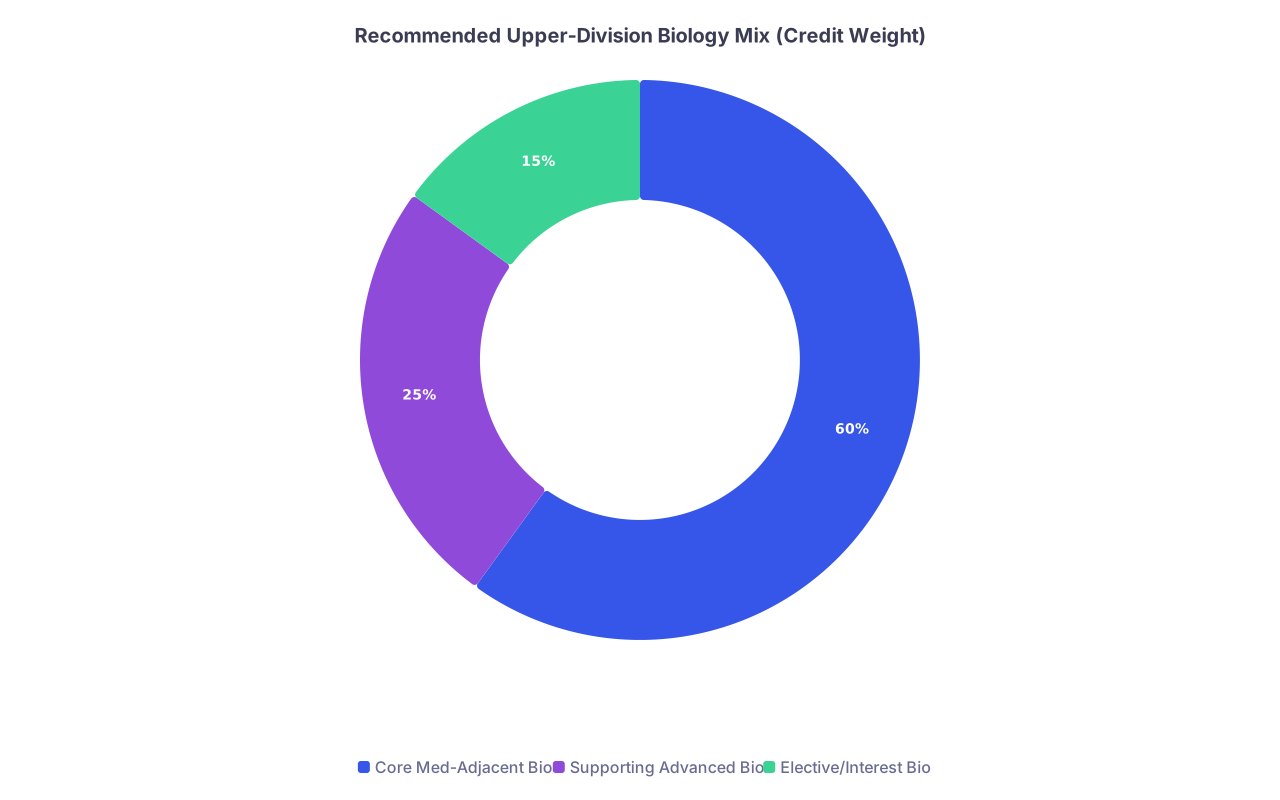
| Category | Value |
|---|---|
| Core Med-Adjacent Bio | 60 |
| Supporting Advanced Bio | 25 |
| Elective/Interest Bio | 15 |
Core Med-Adjacent Biology (Non-Negotiable for Repair)
Aim to include at least 3–5 of these, if you have the runway:
- Biochemistry (often the single most scrutinised upper-div course)
- Physiology
- Cell Biology
- Molecular Biology
- Microbiology
- Immunology
- Neurobiology (if you are at all neuro/psych-interested)
If you can only do 2–3 because of time or institutional limits, prioritise:
- Biochemistry
- Physiology
- Cell or Molecular Biology
Supporting Advanced Biology
Add depth and show genuine interest:
- Genetics (if not already done at high level)
- Developmental Biology
- Virology
- Endocrinology
- Advanced Anatomy
- Cancer Biology
These give your transcript shape — a flavor that fits your story. For example, someone interested in oncology doing Biochem + Cell + Cancer Bio + Immunology looks coherent and serious.
Elective/Interest Biology
You can have some “softer” or interdisciplinary courses, but they should not dominate the repair pattern.
- One or two lighter upper-division bio electives are fine on top of the core group.
- They become a problem only when they are doing the heavy lifting for your GPA.
How Much Upper-Division Biology Is “Enough”?
Students love asking for a number. There is no universal cutoff, but there are practical ranges.
Very rough, but realistic:
Career-changer with no prior science:
8–12 credits of serious upper-div bio (Biochem + Physio + maybe one more) is usually enough if the prereq performance and MCAT are strong.Mild repair (from 3.1–3.3 upward trend already visible):
15–25 credits of upper-div bio with 3.7+ recent GPA can solidify the narrative.Heavy reinvention (sub-3.0, early disaster):
Often 30–45 credits of upper-div + repeated or fresh prereqs, sustained over 1.5–2 years, are needed to persuade skeptical committees.
The “volume” is less important than the combination of rigor + trend + consistency under load. But yes, if you only have 9 credits of upper-div after a wrecked undergrad, most serious adcoms will say: “Promising, but incomplete.”
How Adcoms Tie Upper-Div Bio to MCAT and Letters
Upper-division biology does not live in isolation. It interacts with other parts of your file.
With the MCAT
Typical interpretations:
Strong upper-div bio + strong MCAT (especially BB and CP):
“Clear academic readiness. Green light.”Strong upper-div bio + mediocre MCAT:
“Either they test poorly or their coursework was less rigorous than it appears.” Mixed signals.Middling upper-div bio (B-range) + strong MCAT:
“They can test but may not thrive in day-to-day coursework.” Raises concerns about work habits, consistency, or environment.
With Letters of Recommendation
Adcoms love when upper-division biology is backed by specific faculty commentary:
- “This student handled graduate-level content in my Biochemistry course alongside our MS students.”
- “Top 5% of students in my advanced Physiology course in the last five years.”
- “Came to office hours with research-level questions about signaling pathways.”
If you are using upper-division biology as your central academic argument, you should absolutely secure at least one letter from a professor who taught you in those courses.
The Ugly Truth: When Upper-Div Bio Is Ignored or Discounted
Not all upper-division biology efforts are rewarded equally. A few scenarios where committees mentally underweight your post-bacc:
- Scattered, part-time, low-credit, low-rigor mix with no sustained full-time term
- Courses mostly at institutions with a known reputation for easy As, with minimal context to explain the choice
- Long gaps between courses, making your “recent trend” less persuasive
- A pattern of withdrawals, incompletes, or last-minute drops in challenging upper-levels
This does not mean you are doomed. But it means your upper-division biology will not magically erase old damage. You will need a stronger MCAT, more explanation, or both.
FAQs
1. Do adcoms care if my upper-division biology is at a community college?
For true upper-division biology (300/400-level), most community colleges in the United States simply do not offer many options. When they do, adcoms are cautious. Some DO schools may be more flexible, but many MD programs prefer upper-level work to be done at a 4-year institution. If community college is your only option, make sure you combine that work with a strong MCAT and, if possible, at least a few upper-division courses at a 4-year campus to demonstrate performance in a more traditional environment.
2. Is it better to retake old C grades in core sciences or move on to upper-division biology?
If you earned a C in a foundational prerequisite (like General Chemistry I or Organic I), most schools want to see mastery of that core content, either through a retake or through subsequent performance that clearly depends on it (for example, excelling in Biochemistry after a C in Organic). If the grade is a D or F, a retake is usually non-negotiable. For Cs, a balanced approach is best: retake the true disasters, then prove your new level with strong upper-division biology that builds on that content.
3. Does an A in Biochemistry “count more” than an A in something like Developmental Biology?
Informally, yes. Biochemistry is heavily weighted because it is universally considered a difficult, high-yield, med-adjacent course. Many medical schools even require or strongly recommend it. Developmental Biology can still be rigorous and helpful, but if you have limited bandwidth, Biochemistry carries more predictive value and more signaling power, especially if your academic record has question marks.
4. If my upper-division biology grades are mostly A– and a few Bs, is that enough to show readiness?
Usually yes, especially if the Bs are in genuinely hard courses taken in a full-time load. A transcript that shows A/A– in Biochem, A– in Physio, B+ in Micro, A in Cell Bio, all in dense terms, will still read as strong. One or two B-range grades will not sink you. What hurts more is a pattern of B–/C+ in that set of courses or a clearly weaker final semester, which can suggest that you hit your ceiling under stress.
5. How recent should my upper-division biology be for adcoms to care?
Within the last 3–5 years is ideal. Beyond 5 years, especially if you have not been in a rigorous academic or scientific environment, committees get less confident that your current abilities match your old performance. If your last serious biology coursework is 7–10 years old, even if the grades were strong, you may need some fresh upper-division work or a strong MCAT to reassure them that your skills are not rusty.
You now understand why “I took upper-division biology” is not a magic phrase. It is a piece of a narrative: about repair, readiness, and who you are now, not who you were at 19.
If you choose your courses thoughtfully, stack them intelligently, and back them up with performance and testing, those upper-division lines on your transcript stop being decoration. They become hard evidence.
Once that foundation is real, the next challenge is turning it into a coherent application story — in your personal statement, secondaries, and letters. That is where you make committees not only trust your numbers, but want you in their class. But that is a story for another day.