
The biggest lie premeds believe is that “a 4.0 in my post‑bacc will erase my bad undergrad GPA.”
It will not. But it can completely change how admissions algorithms treat you — especially MD vs DO.
Let me break this down specifically, the way committees and software actually look at you, not the way Reddit tells the story.
(See also: Committee Letters from Post-Baccs for insights on how letters can impact your application.)
How MD and DO Schools Actually Process Your Numbers
Forget the fantasy that an adcom sits down, reads your transcript line by line, and has an emotional revelation about your “growth.”
Most schools start with numbers and sorting rules. Only after that do humans intervene.
There are three distinct layers:
- Primary screener / algorithmic pass
- Secondary review (often still structured, with scoring rubrics)
- Committee discussion (holistic, but biased by everything above)
Your post‑bacc performance plugs into each layer differently for MD vs DO.
Two key realities:
- AMCAS (MD) and AACOMAS (DO) calculate and present your GPAs differently
- MD schools and DO schools weight grade trends and reinvention differently in their internal logic
If you do not understand those mechanics, you will pick the wrong kind of post‑bacc, expect the wrong payoff, and misapply.
The Transcript Math: AMCAS vs AACOMAS and Where Post‑Bacc Lives
1. How your GPA is actually built
On both applications, your post‑bacc hours do not float in a vacuum. They sit inside the overall and science GPA stacks.
But AMCAS and AACOMAS differ in three crucial ways:
- How they group academic levels
- How they handle repeats
- How transparently they show trends in their GPA summary tables
AMCAS (MD) structure
AMCAS splits your work into:
- BCPM GPA (Biology, Chemistry, Physics, Math)
- AO GPA (All Other)
- Total GPA
Then by academic level:
- Freshman, Sophomore, Junior, Senior
- Postbaccalaureate Undergraduate
- Graduate
Your post‑bacc science A’s go into:
- BCPM GPA
- Postbaccalaureate GPA (subsection)
- Overall GPA
Important detail: AMCAS does not replace old grades with new ones. Every C, D, and F from undergrad lives forever. Your post‑bacc A’s raise the average but do not “erase” anything numerically.
Adcoms see:
- Your cumulative GPA trend across years
- A distinct “Postbaccalaureate” line often much higher than undergrad
- The course list with dates and grades
The algorithm part:
- Many MD schools have hard or semi‑hard screens at various GPA cutoffs (e.g., 3.0 absolute floor, 3.2–3.3 likely filter, 3.5+ competitive)
- Some screens use weighted recent GPA or last X credits, but that is school‑specific and opaque
So if your undergrad GPA is a 2.8 and your post‑bacc is a 4.0 over 30 credits, your cumulative might still sit near 3.1–3.2. That may or may not clear an MD screen, depending on the school.
AACOMAS (DO) structure
AACOMAS also calculates:
- Science GPA
- Non‑science GPA
- Cumulative GPA
It also separates academic levels (undergrad, post‑bacc, grad), but the historical difference is grade replacement.
For years, DO schools fully replaced old grades with new ones for retaken classes. That made DO an extremely friendly path for reinvention. Now, AACOMAS no longer does full grade replacement; it averages like AMCAS.
However, DO culture and institutional memory still lean heavily toward:
- Emphasizing upward trend
- Viewing post‑bacc performance as strong evidence of change
- Being more forgiving of rocky early transcripts if recent work is excellent
DO schools also tend to:
- Use more flexible or contextual screens (e.g., “3.2 overall but strong last 40 credits? Review manually”)
- Pay close attention to post‑bacc BCPM GPA as a proxy for current academic ability
So numerically, both systems now treat grades similarly. Culturally, they do not.
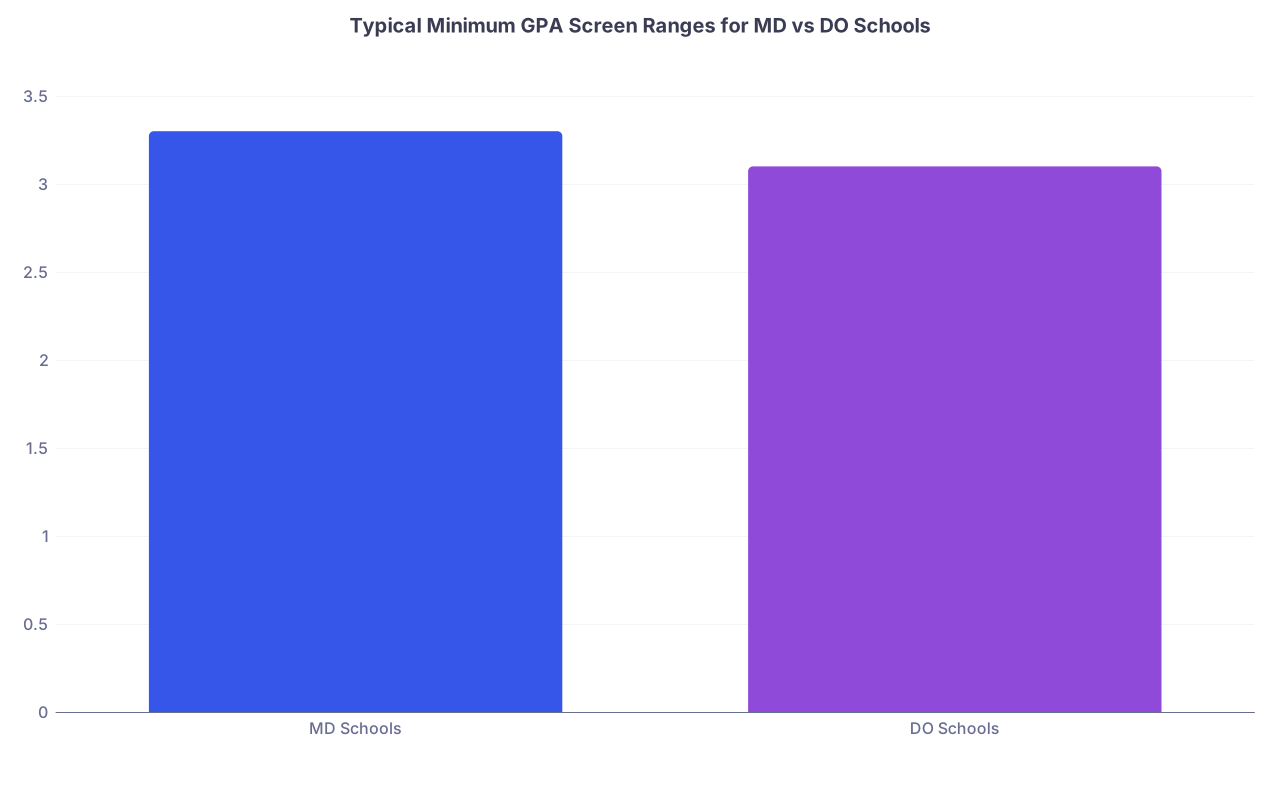
| Category | Value |
|---|---|
| MD Schools | 3.3 |
| DO Schools | 3.1 |
What “Counts” as Post‑Bacc — And What Committees Infer From It
People throw around “post‑bacc” like it is one thing. It is not. The type of post‑bacc changes how MD vs DO algorithms interpret your performance.
You are usually in one of these buckets:
- Informal post‑bacc (courses as non‑degree student at a local 4‑year)
- Formal undergraduate‑level post‑bacc (career changer or academic enhancer)
- Special Master’s Program (SMP) or other graduate‑level program
- DIY community college classes
The same A in organic chemistry is not read the same way from each.
1. Informal or DIY 4‑year post‑bacc
This is you registering as a non‑degree student (or second bachelor’s) at a 4‑year university and hammering out upper‑division science: biochem, physiology, genetics, cell bio, etc.
How MD schools read this:
Strongly positive if:
- The school is reasonably rigorous
- You are taking real upper‑division courses, not just redoing intro labs
- You carry full-time or near full-time loads (≥ 12 credits/term) with A/A‑ performance
Less impressive if:
- You cherry‑pick only one or two easier courses per term
- You avoid the harder content areas
- The institution is known locally as “lightweight” academically
How DO schools read this:
- Generally very favorable if:
- Your science GPA in the last 30–40 credits is high (3.7–4.0)
- You show sustained, recent, consistent performance
DO programs, in my experience, will sometimes explicitly say in committee: “Undergrad is rough, but look at his last 36 science credits at State U: 3.9. He can handle it now.”
2. Formal post‑bacc programs (academic enhancer)
These are usually branded programs with structured curricula for premeds, often with advising and linkage options.
MD admissions algorithms like them because:
- They are standardized; schools know the rigor level over time
- There is clear peer comparison (your performance vs a known cohort)
- Some have history with their own medical school’s admissions office
The internal reality:
- A 3.8+ in a well‑regarded academic‑enhancer post‑bacc at a 4‑year institution, with solid MCAT and consistent recent coursework, does move you out of the “auto‑screen reject” bucket at some MD schools, even if your original GPA was terrible.
DO schools:
- Treat them very favorably, often comparable to SMPs for predictive value, especially if medically aligned and heavy on biomedical coursework
- Sometimes have informal or formal preferences for certain feeder post‑baccs
If you are a classic “2.6–2.8 undergrad but older, motivated, focused now” candidate, a strong formal post‑bacc puts you squarely into competitive DO territory and borderline MD at some schools, assuming the MCAT cooperates.
3. Special Master’s Programs (SMPs)
SMPs are their own beast. Graduate‑level, often affiliated with a med school, sometimes with shared courses with M1s.
For MD schools:
- These programs sometimes have direct linkage or “conditional acceptance” models
- The internal algorithm may:
- Still screen you based on GPA initially
- Then add a manual override pathway: “If SMP X GPA ≥ 3.6 and no C’s, send for faculty review regardless of undergrad GPA”
Translation: strong SMP performance can partially bypass rigid undergrad‑GPA screens at the linked MD school.
For other MD schools (non‑linked):
- SMP performance is very helpful, but not magical
- Some committees look at SMP GPAs and say, “Impressive, but his undergrad 2.5 from ten years ago plus a 507 MCAT is still tough for us.”
For DO schools:
- SMPs are seen as excellent evidence of readiness
- However, if the SMP looks like a “paid rescue mission,” they will scrutinize:
- Course rigor
- Class rank vs peers
- Whether grades are inflated
Bottom line: SMP success helps both MD and DO, but the primary algorithmic gate (undergrad GPA) is stricter on the MD side.
4. Community college post‑bacc
This is where people get misled.
Reality:
DO schools are generally more open to CC coursework as part of a reinvention story, especially for:
- Non‑trads
- Working students
- People geographically constrained
Many MD schools implicitly (or explicitly) penalize or discount:
- Upper‑division‑equivalent courses taken at CC
- Heavy CC loads when a 4‑year option was available
So if your “post‑bacc” is 40 credits of science at a community college with straight A’s, a DO school may say, “Promising, let us see MCAT.”
An MD school may say, “We need stronger evidence at a 4‑year to believe this.”
How Post‑Bacc Performance Enters MD Admissions Algorithms
Let us go inside a generic MD school’s process. Obviously, this varies by institution, but the patterns are consistent.
Phase 1: Primary Screen
Many MD schools have at least one of these automated or semi‑automated screens:
- Hard floor cumulative GPA (e.g., 3.0)
- Hard floor BCPM GPA (e.g., 3.0–3.2)
- MCAT minimum (e.g., 498 or 500 floor)
- Combined index thresholds (e.g., 10 × GPA + MCAT ≥ some number)
Where does post‑bacc show up?
- It raises your cumulative GPA and BCPM GPA
- If you transition from 2.7 → 3.2 over multiple post‑bacc semesters, that may get you barely over certain cutoffs
But here is the harsh truth:
If your undergrad GPA is below about 2.7, even a stellar post‑bacc often does not push your cumulative high enough for many MD filters, unless you do a lot of credits.
From what I have seen:
- 30 credits of 4.0 post‑bacc moves a 2.7 cumulative to around 2.9–3.0
- 45–60 credits can push you to low 3’s
- Once you cross ~3.3–3.4 cumulative, more MD doors open, assuming the MCAT is decent
But you are still fighting upstream against applicants who have 3.7+ from the start.
Some schools use a “last 20–30 credits” or “post‑bacc GPA emphasis” in secondary screening. You cannot bank on that unless the school explicitly says so.
Phase 2: Holistic Scoring / Secondary Review
Once you are through the numeric filter, the algorithm becomes more qualitative but still structured. Reviewers often score:
- Academic metrics (GPA, MCAT, rigor, trend)
- Experiences
- Attributes / mission fit
- Writing quality
Post‑bacc performance hits here in a few ways:
- Strong, recent A’s in biomedical sciences signal that:
- Your MCAT score is “real,” not a fluke
- You can survive a systems‑based M1 curriculum
- You have grown since your undergrad missteps
A lot of MD reviewers specifically look for:
- “Reinvention curve”: bad → OK → good → excellent trend
- Consistency: multiple semesters, not one fluke term
- Rigor: upper‑division, heavy course loads
If your application shows:
- 2.6 undergrad,
- 3.9 post‑bacc (40+ science credits at a decent 4‑year),
- 512+ MCAT,
then even MD schools that would not typically like a 2.6 will have internal discussions like: “He is a different student now. Are we willing to give him a shot?”
Many will still say no. Some will say yes. DO schools, by contrast, are much more likely to say yes.
Phase 3: Committee
At full committee, what matters from your post‑bacc is usually:
The narrative:
- Did you own your earlier failures?
- Did you explain clearly what changed?
- Is there a coherent life story, or just grade chasing?
The evidence:
- Concrete: multiple A’s in physiology, biochem, micro, etc.
- Clear time gap between old chaos and new stability
But you will not get to this phase at many MD programs unless the prior algorithmic gates are satisfied.
How Post‑Bacc Performance Enters DO Admissions Algorithms
Now, DO schools. The ethos is different.
Most DO schools, in my experience, lean heavily on:
- The last 30–60 credit trend, especially science
- MCAT as a reality check
- Evidence of maturity and professionalism
DO Screening
Typical DO patterns:
- Slightly lower hard GPA floors (e.g., 3.0 cumulative, sometimes even 2.8 with strong trend)
- More “soft” screening where borderline files are manually looked at if:
- Latest science GPA is very strong
- There is significant non‑traditional context
Post‑bacc performance helps you more directly:
- A 2.7 → 3.0 cumulative jump with a 3.9 last 45 credits can absolutely move you into “interviewable” at many DO schools
- AACOMAS GPA tables show your post‑bacc separately, making it easier for reviewers to argue: “Ignore the old mess; look at the recent excellence.”
DO committees often verbalize what MD committees think but rarely act on: “We care more about who you are now than at 19.”
DO Holistic Review
Once you clear the metric floor, DO schools tend to be more generous in:
- Accepting CC → 4‑year → post‑bacc trajectories
- Valuing clinical work and life experience alongside grades
- Giving weight to demonstrated improvement over total numeric GPA
But do not romanticize this. DO admissions is still competitive:
- A 2.5 undergrad with a 3.5 post‑bacc and 498 MCAT is not suddenly a strong DO applicant.
- You still need:
- High post‑bacc science GPA (ideally 3.6–4.0)
- Respectable MCAT (500–505+ is a much cleaner story; <500 becomes tough at many places)
Where DO schools often differ from MD schools is how they resolve marginal cases:
- MD: “Old GPA too low; post‑bacc good but not enough; many cleaner files available.”
- DO: “Old GPA bad, but last 50 credits and life story are strong; let us at least interview and see.”
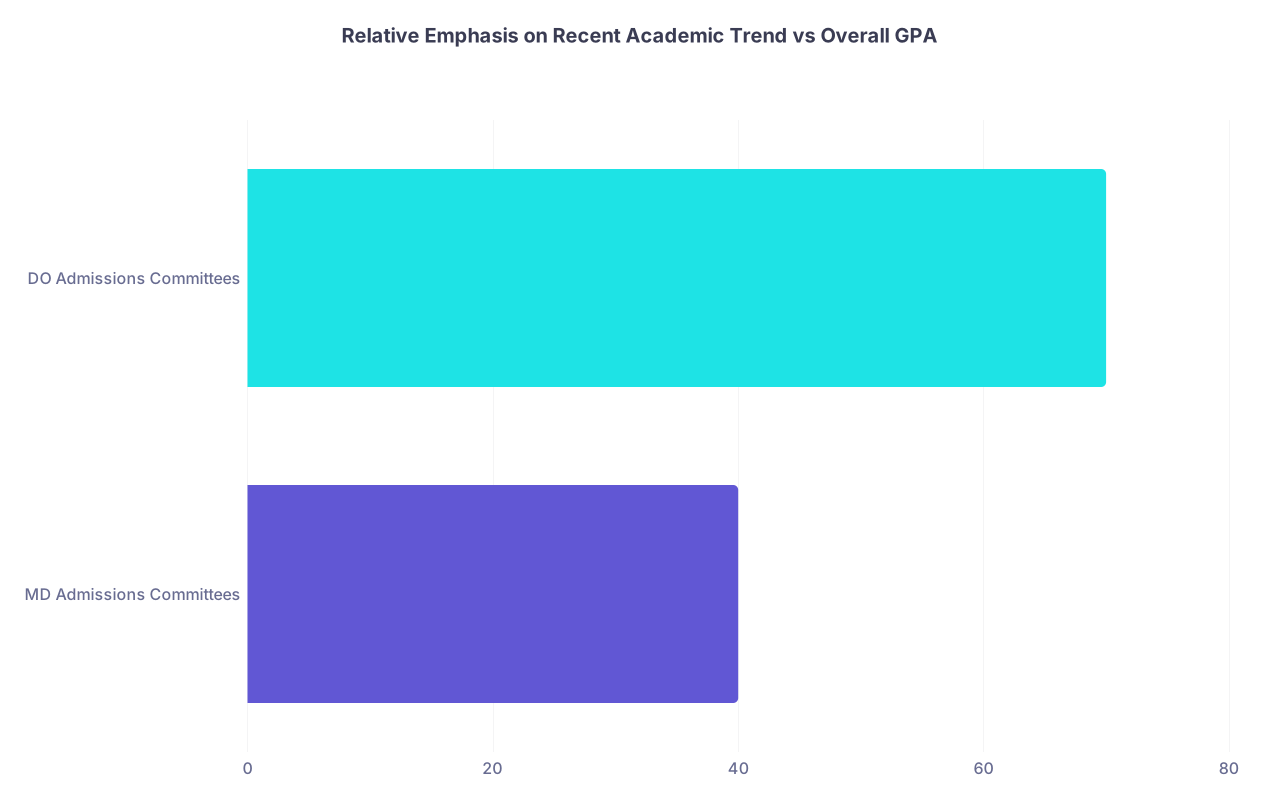
| Category | Value |
|---|---|
| MD Admissions Committees | 40 |
| DO Admissions Committees | 70 |
Strategic Post‑Bacc Planning: MD-Only vs DO-Open vs MD/DO-Realist
Let us make this concrete.
Scenario 1: You want MD only, no DO
You are allowed to be that stubborn. But the numbers have to justify the attitude.
If you are sitting at:
3.2–3.3 cGPA, 3.1–3.2 sGPA:
- A targeted post‑bacc with 24–36 credits of upper‑division science at A/A‑ level, plus a strong MCAT (510+), can:
- Push you into 3.4+ territory
- Make you viable at a decent subset of MD schools, especially less hyper‑selective ones, and state schools favoring residents
- A targeted post‑bacc with 24–36 credits of upper‑division science at A/A‑ level, plus a strong MCAT (510+), can:
2.8–3.1 cGPA:
- You are in true reinvention territory. For MD to be realistic:
- You likely need 40–60+ credits of strong post‑bacc
- Ideally at a 4‑year institution with rigorous courses
- Followed by a 510+ MCAT
- You are in true reinvention territory. For MD to be realistic:
Even then, you will remain shut out of many MD schools that never seriously consider applicants below ~3.3 original undergrad GPA.
The honest MD‑only algorithm truth:
Post‑bacc can make you viable but rarely truly “competitive” unless you bring something extraordinary (insane MCAT, huge research, URM status with mission fit, etc.).
Scenario 2: You are open to both MD and DO
This is where post‑bacc shines.
A realistic target if you reinvest properly:
- Undergrad: 2.7–3.1
- Post‑bacc: 3.7–4.0 in 36–45 credits of good science, mostly at a 4‑year
- MCAT: 505–510
What this likely does:
MD:
- Gives you a non‑zero shot at mid‑tier and some lower‑mid‑tier MD programs
- With better odds at your in‑state public schools
- But still a low yield; you might apply to 25+ and get 1–3 interviews
DO:
- Makes you a solid applicant at a wide range of DO schools
- With a structurally friendlier attitude toward your upward trend
In other words, post‑bacc performance gives you optionality. That is the real value.
Scenario 3: You are DO‑leaning from the start
If you are already philosophically fine with DO, your post‑bacc planning shifts slightly:
You can be a bit less obsessed with:
- Only taking courses at heavily ranked 4‑year institutions
- SMPs unless you truly need that extra layer
You should still:
- Prioritize rigorous science
- Avoid over‑reliance on community college for advanced topics
- Build a crystal‑clear upward trend
For DO, a very strong performance in a structured post‑bacc or a well‑executed DIY plan can absolutely rehabilitate a troubled academic past.
How Much Post‑Bacc Is “Enough” For the Algorithms To Notice?
The obsession with “how many credits” misses the point, but I know you still want a number.
Here is a blunt guideline based on what I have seen move the needle:
12–15 credits:
- Too small to convince anyone you are a different student
- Fine as a light “MCAT‑adjacent” science refresher, not reinvention
24–30 credits:
- Minimum zone where trends become believable
- If all A/A‑, you start to see modest shifts in cumulative GPA and strong trend impact
36–45 credits:
- The range where both MD and DO committees say, “This is sustained performance, not a fluke.”
- Strong enough to overcome a lot of skepticism, especially with upper‑division rigor
60+ credits:
- Necessary in some ultra‑low GPA situations (<2.7 undergrad) if you insist on chasing MD
- Very convincing for DO if coupled with a decent MCAT
But the distribution matters:
- 4 semesters of 9–12 credits each with A’s looks better than:
- 8 semesters of 4–5 credits, cherry‑picked and spaced out
Why? Because med school is full‑time, high‑intensity. They want to see that you can handle load + difficulty, not just one class at a time.

Common Misinterpretations That Derail Applicants
Let me quickly dismantle a few repeated myths.
“If I get a 4.0 in my post‑bacc, MD schools will ignore my undergrad.”
False. They may contextualize your undergrad, but the numeric damage remains. Some schools have hard GPA rules. Your 4.0 helps, but it does not erase.“An SMP guarantees med school acceptance if I get a 3.7+.”
Wrong. At the linked school, it may significantly boost your odds. At other MD programs, it helps but does not override every prior weakness. At DO schools, it is excellent but still needs a decent MCAT.“DO schools will take anyone who shows improvement.”
No. They are more forgiving, not blind. You still compete with people who have 3.5+ GPAs and decent MCATs.“Community college post‑bacc is just as good.”
Not usually. For DO schools, it can be acceptable when contextualized. For MD, it is often discounted relative to 4‑year work, especially for advanced science.“If I do a post‑bacc, I can get away with a lower MCAT.”
Dangerous thinking. For reinvention candidates, MCAT and post‑bacc have to co‑sign your story. High GPA + mediocre MCAT or vice versa keeps many committees on the fence.
How To Frame Your Post‑Bacc Story So Humans Override the Algorithm
The numbers get you in the door. The way you explain them determines whether someone goes to bat for you.
You need to present your post‑bacc not as a random extra, but as the central evidence that you are medically trainable now.
In your personal statement and secondaries, you should:
Own the past plainly:
- “During my first degree at X University, I struggled with time management and immaturity, leading to a cumulative GPA of 2.8.”
Clearly define the pivot:
- “Since 20XX, I have worked full-time as a scribe/MA, taken responsibility for my learning, and re‑entered the classroom to test whether I could perform at the level medicine demands.”
Present the data like a closing argument:
- “Over the last 42 credit hours of upper‑division biology and chemistry at Y University, I have earned a 3.9 GPA while maintaining 20 hours per week of clinical work. This includes A’s in biochemistry, physiology, microbiology, and genetics.”
Connect it to med school readiness:
- “These courses mirror the conceptual density and pace of preclinical training. They gave me evidence that my new study systems and discipline are robust.”
That kind of framing matters. It gives the human reviewers justification to say: “Our algorithm flags the low undergrad, but the recent record is compelling.”
For DO schools, this makes them even more comfortable leaning into their philosophy of second chances. For MD schools, it gives them political cover in committee to accept someone a little outside their usual GPA mold.

You are not going to trick an algorithm into believing your past never happened. But you can feed it enough clean, recent, high‑level data that the system has to pause and re‑evaluate who you are now.
That is what strong post‑bacc performance really does — especially in the MD vs DO landscape. It shifts you from “instantly filtered out” to “at least worth a look” on the MD side, and from “long shot” to “credible candidate” on the DO side.
Your next move is not to obsess over whether DO is “less than” MD. Your next move is to design a post‑bacc plan — credits, rigor, institution, timing — that gives you leverage with both systems and keeps your options open.
Once that foundation is in place, then we can talk about how to pair it with the right MCAT strategy and school list so you stop fighting the algorithm and start using it. But that is a story for another day.