Why Your GPA Isn’t the End: How Post-Baccalaureate Programs Can Revive Your Medical School Dream
Your undergraduate GPA can feel like a permanent label—especially when you start researching medical school admissions and see class profiles full of 3.7s and 3.8s. If your numbers don’t look like that, it’s easy to wonder if you’ve already missed your chance.
You haven’t.
Post-Baccalaureate Programs (often called “post-baccs”) exist precisely for students like you—students whose journey to medicine doesn’t follow a straight line. Whether you need GPA improvement, are making a career transition, or simply discovered your interest in healthcare later, a well-chosen post-bacc can be a powerful way to reshape your academic story and re-enter the path toward medical school and other healthcare professions.
This guide explains what post-baccalaureate programs are, how they work, and how to strategically use them to strengthen your application, even if your GPA isn’t where you want it to be.
Understanding Post-Baccalaureate Programs in Healthcare Education
Post-Baccalaureate Programs are formal programs for students who have already completed a bachelor’s degree and want to enhance their preparation for medical school or other healthcare graduate programs (e.g., dental, PA, DO, nursing, or public health). They sit at the intersection of GPA improvement, career transition, and advanced healthcare education.
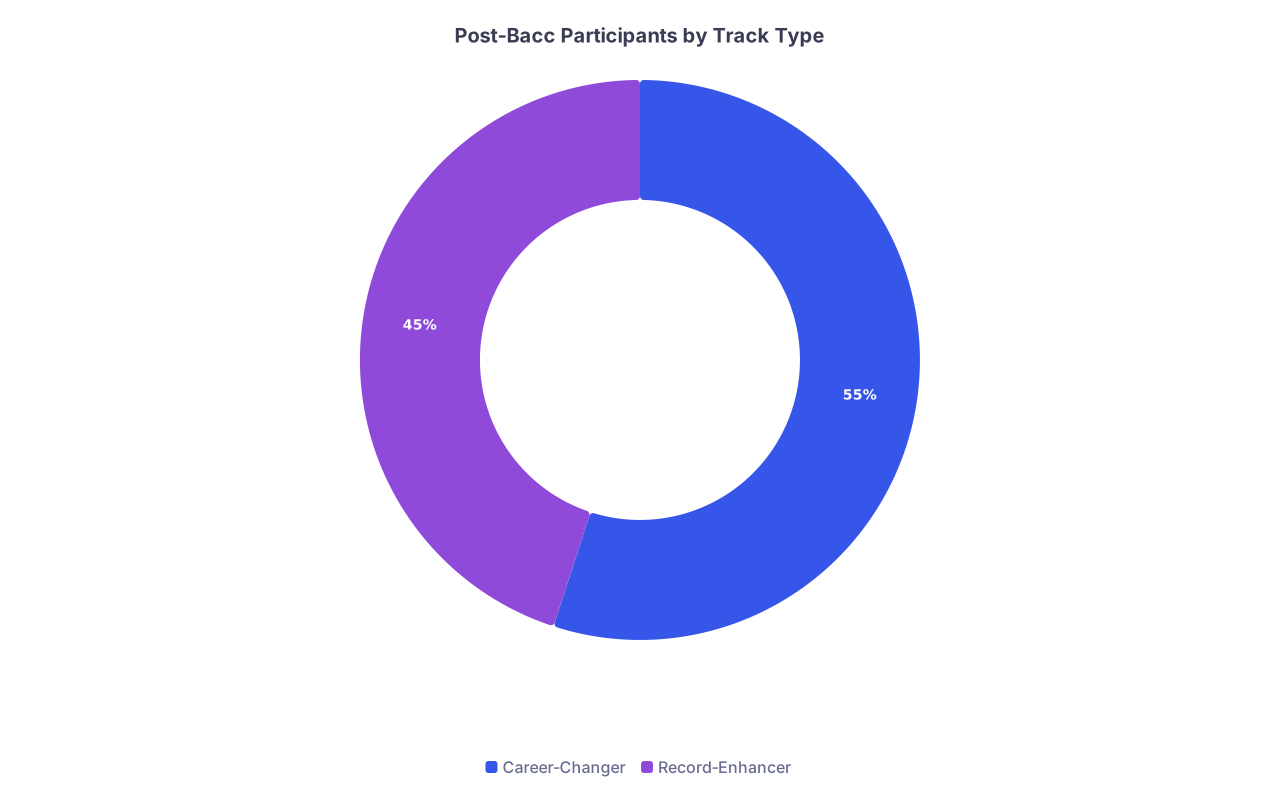
The Two Major Types of Post-Baccalaureate Programs
Most programs fall into one of two main categories, though some blend features of both:
1. Academic Record Enhancement Programs
These programs are geared toward applicants whose undergraduate GPAs are below the typical competitive range for medical school and who need clear, recent academic evidence that they can handle rigorous science coursework.
Common features:
- Focus on upper-level or repeat biology, chemistry, physics, and math courses
- Often housed within universities that already have strong premed or health science departments
- Sometimes offer graduate-level science courses (e.g., physiology, biochemistry, immunology)
- May be structured as:
- Non-degree certificate programs
- Second bachelor’s degree programs
- Special Master’s Programs (SMPs) with a heavy biomedical science emphasis
These are ideal if:
- Your science GPA or overall GPA is substantially below 3.4
- You have a pattern of poor academic performance that you need to actively correct
- You want to send a clear signal to admissions committees that you are academically ready for medical school
2. Career-Changer Post-Baccalaureate Programs
Career-changer programs are built for students who did not complete the prerequisite sciences during their original degree because they were on a different path—business, humanities, engineering, arts, etc.—and are now transitioning into healthcare.
Typical characteristics:
- Offer the full premed prerequisite sequence, such as:
- General Biology with labs
- General and Organic Chemistry with labs
- Physics with labs
- Biochemistry (in many programs)
- Sometimes statistics and psychology/sociology
- Designed with structured schedules and advising to keep you on track to apply
- Frequently integrate clinical exposure, shadowing, and MCAT preparation
- At some institutions, include “linkage agreements” with partner medical schools for streamlined application processes
These are ideal if:
- You decided on medicine after college
- Your undergraduate GPA may be decent, but you lack the necessary science background
- You want a structured, cohesive pathway into medical school or other healthcare degrees
Common Features Across Post-Baccalaureate Programs
Regardless of category, many programs provide:
- Dedicated premed advising and application strategy support
- Opportunities for clinical experience, volunteering, or shadowing
- Group orientation and a community of like-minded peers
- Workshops on study skills, test-taking, and professional development
- Access to letters of recommendation from faculty who know you in a rigorous context
In other words, a well-chosen post-bacc doesn’t just offer classes—it offers a support system.
Why a Low GPA Isn’t the End for Medical School Admissions
A disappointing GPA feels final because it’s a number you can’t erase from your transcript. But medical schools don’t evaluate GPAs in isolation. They look at context, trends, and more recent performance. Post-baccalaureate Programs can change how that story is read.
1. Holistic Admissions: More Than Numbers
Many MD and DO medical schools use a holistic review process. That means they consider:
- Academic metrics (GPA, science GPA, MCAT)
- Grade trends (upward vs. downward trajectory)
- Life experiences, work history, and resilience
- Personal statement and secondary essays
- Letters of recommendation
- Clinical and community service involvement
- Commitment to service, leadership, and diversity
A strong post-bacc performance can shift your academic narrative from “struggled” to “recovered and now performing at a high level.”
2. Demonstrating Academic Readiness Through GPA Improvement
If your undergraduate record is mixed—maybe you had a rough freshman year, life events that affected your grades, or a late discovery of your passion for medicine—post-bacc work becomes your most recent, most relevant body of evidence.
Admissions committees pay particular attention to:
- Post-bacc GPA (often calculated separately as “post-bacc” or “post-undergraduate” work)
- Performance in advanced biology and other upper-division sciences
- Ability to handle full-time (or near full-time) rigorous course loads
For example:
- An applicant with a 2.8 undergraduate GPA who completes a post-bacc with a 3.8 in upper-level science courses over 30–40 credits shows a clear upward trend and evidence of new study habits and maturity.
3. Strengthening Your Application with Clinical and Personal Growth
Academic redemption is only part of the picture. Medical schools need proof that you understand the realities of clinical work and are entering medicine for informed, sustainable reasons.
Many post-baccs build in:
- Shadowing experiences with physicians or advanced practice providers
- Hospital or clinic volunteer roles
- Patient-facing positions such as:
- Medical assistant
- Scribe
- EMT
- Phlebotomist
- Opportunities for community outreach and public health work
These experiences not only enhance your CV but also help you develop the emotional intelligence, communication skills, and professional identity that admissions committees look for.

Key Benefits of Post-Baccalaureate Programs for Aspiring Medical Students
Post-Baccalaureate Programs play a strategic role in healthcare education. Their benefits go far beyond simply adding courses to your transcript.
1. Rebuilding a Strong Academic Foundation
For many students, post-baccs are a structured second chance to master the sciences and prove readiness for medical school.
Ways they help with GPA improvement and academic performance:
- Repetition with deeper understanding: Retaking courses like General Chemistry or Organic Chemistry with a more mature approach and better study strategies.
- Exposure to advanced science: Courses such as molecular biology, genetics, or human physiology that mirror first-year medical school content.
- Improved study skills: Many programs explicitly teach:
- Active learning strategies
- Time management for heavy course loads
- How to learn from high-stakes exams and adjust quickly
Practical example:
If you earned a C in Organic Chemistry I and II as an undergraduate, repeating them in a structured post-bacc and earning A-level grades—especially alongside other demanding courses—demonstrates growth and readiness.
2. Building a Network in the Healthcare and Academic World
Medicine is a team profession. Your relationships matter.
During a post-bacc, you can develop:
- Faculty mentors who can write detailed, supportive letters of recommendation describing your work ethic, resilience, and improvement
- Advising relationships with prehealth advisors who can guide your school list, application timing, and overall strategy
- Peer networks of other post-bacc and premed students who share your goals and can offer accountability and support
Many programs also organize:
- Alumni panels featuring current medical students and residents
- Workshops with admissions officers or physicians who explain how applications are evaluated
- Research introductions, particularly at universities with strong biomedical departments
These relationships can open doors to shadowing, research, and insider advice that’s hard to get alone.
3. Enriching Your Personal Statement and Application Narrative
A good post-bacc experience gives you more than better grades—it gives you substance for your story.
You can use your post-bacc journey to:
- Explain what changed in your approach to academics
- Show how you developed resilience and self-awareness
- Demonstrate your capacity for growth after setbacks
- Describe meaningful interactions with patients, mentors, and peers
Admissions committees often value applicants who can clearly articulate:
- Why they struggled in the past
- What they did to address those weaknesses
- How that process has prepared them to handle the rigors of medical training
Your narrative might shift from “I had a low GPA” to “I faced academic challenges, took responsibility, sought out structured help through a post-bacc, and now have a proven track record of success in rigorous science courses.”
4. Gaining Clinical Exposure and Confirming Your Career Choice
A post-bacc is an excellent environment to confirm that medicine is truly the right path for you.
Through clinical experiences embedded in many programs, you can:
- Observe how physicians interact with patients and the healthcare team
- Reflect on what aspects of medicine resonate with you (e.g., patient advocacy, problem-solving, longitudinal care)
- Understand the emotional realities of illness, suffering, and recovery
- Learn how different healthcare roles—nurses, PAs, social workers, pharmacists, therapists—contribute to patient care
These experiences don’t just look good on your application. They help you make an informed, grounded decision about committing to a long, demanding training path.
Real-World Success Stories: Transformations Through Post-Baccalaureate Programs
Stories from real applicants show how transformative a post-bacc can be.
Jamie’s Journey: From 2.9 to Medical Student
Jamie graduated with a 2.9 GPA after struggling with time management and personal challenges during college. She worried that medical school was no longer realistic.
Her next steps:
- She researched academic record enhancement programs and chose a one-year structured post-bacc that emphasized upper-level sciences.
- She committed to new study habits: daily review, small study groups, and regular office hours with professors.
- She balanced a full-time course load with one consistent volunteer role in a local clinic.
Results:
- Jamie earned a 3.8 post-bacc GPA across 36 credits of advanced biology and physiology.
- Faculty who saw her transformation wrote strong letters describing her work ethic and maturity.
- Her MCAT score improved significantly after studying with a stronger science foundation.
- She was accepted to multiple MD and DO programs and is now training at a reputable medical school.
Jamie’s original GPA didn’t vanish—but admissions committees saw her upward trend and believed in her demonstrated capabilities.
Mark’s Transformation: Career Transition Through a Post-Bacc
Mark majored in economics and worked in consulting for several years. His GPA was decent but his file contained almost no science coursework. After volunteering at a free clinic, he realized he wanted a career that involved more direct service and patient contact.
His approach:
- Mark enrolled in a career-changer post-bacc that offered all the core prerequisites in a structured, lockstep format.
- The program included:
- Weekly clinical shadowing
- MCAT preparation
- Group advising for medical school applications
Outcomes:
- He completed the prerequisites with a 3.9 science GPA, discovering that he truly enjoyed the analytical and problem-solving side of biology and chemistry.
- Through shadowing, he confirmed that he thrived in patient-facing roles.
- His program had a linkage agreement with a nearby medical school. After meeting their GPA and MCAT criteria, he applied through that pathway and received an early acceptance.
Mark’s story shows how post-baccalaureate programs don’t just fix GPAs—they enable thoughtful career transitions into medicine and healthcare.
Choosing the Right Post-Baccalaureate Program for Your Goals
With dozens of options in the U.S. and abroad, selecting the right program is a strategic decision. You want a program that matches your academic needs, financial situation, and timeline for medical school.
1. Clarify Your Primary Goal
Ask yourself:
- Is my main need GPA improvement and academic redemption?
- Or is it a career transition, completing prerequisites I never took?
- Do I need a formal program, or could I do a DIY post-bacc (independent coursework) at a local university or community college?
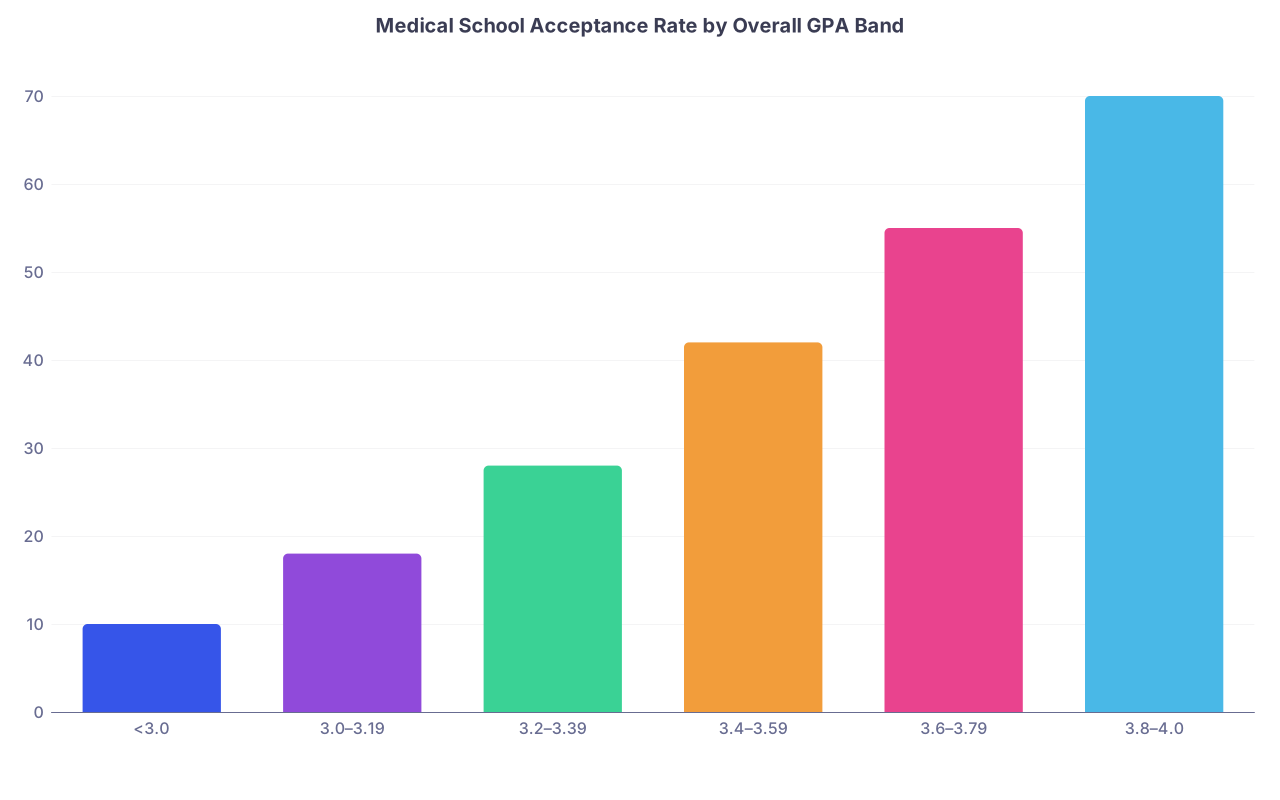
If your undergraduate GPA is significantly low (e.g., below ~3.2), a formal, structured record-enhancer or Special Master’s Program may be more appropriate. If your GPA is decent but you’re missing prerequisites, a career-changer program or well-planned DIY option might work.
2. Evaluate Program Structure and Support
Consider:
- Length and intensity: One-year full-time, two-year part-time, or flexible pacing?
- Type of courses: Undergraduate, graduate, or a mix? Are they sufficiently rigorous and relevant?
- Advising quality: Is there dedicated premed advising? Help with personal statements, school selection, and mock interviews?
- MCAT integration: Does the program support MCAT timing and preparation?
Look for programs that align with when you hope to apply to medical school and how quickly you can realistically handle a heavy course load.
3. Investigate Linkages and Outcomes
Some post-baccs advertise:
- Linkage agreements with specific MD or DO schools (often conditional on GPA and MCAT cutoffs)
- Strong historical acceptance rates to medical schools and other healthcare degrees
- Support for applying to multiple types of programs (e.g., MD, DO, dental, PA, nursing)
While no program can guarantee admission, a solid track record and clear linkage options can be valuable.
4. Consider Cost, Location, and Flexibility
Post-Baccalaureate Programs can be expensive, and financial planning is crucial.
Factors to weigh:
- Tuition and fees (public vs. private institutions)
- Availability of federal financial aid or institutional scholarships
- Cost of living in the program’s city
- Ability to work part-time while enrolled (and whether that’s advisable given the course load)
- Proximity to hospitals and clinics for clinical exposure
Sometimes a more affordable local program or DIY approach, strategically designed, can be just as effective as a high-profile program—especially if you stay disciplined and seek advising support.

Frequently Asked Questions About Post-Baccalaureate Programs and Medical School
1. How long do Post-Baccalaureate Programs usually take?
Most structured Post-Baccalaureate Programs last 1–2 years:
- Career-changer programs often span 12–24 months, depending on whether you attend full-time and how many prerequisites you need.
- Academic record enhancement programs may be as short as 1 year of full-time study or longer if you attend part-time.
If you design a DIY post-bacc by taking courses at a local university or community college, the timeline is more flexible—but you must plan carefully so your coursework finishes in time for your intended application cycle.
2. Are post-baccs only for students with low GPAs?
No. While many students use them for GPA improvement, post-baccs also serve:
- Career changers who lack science prerequisites
- Students seeking more advanced science preparation before MD, DO, dental, PA, or other health professional programs
- Applicants who want stronger letters of recommendation from science faculty
- Individuals returning to school after a long break who need recent coursework to demonstrate current readiness
That said, if your GPA is already very competitive and you have the prerequisites, a post-bacc may not significantly benefit you; you might be better off focusing on clinical experience, MCAT prep, and application strategy.
3. Will completing a Post-Baccalaureate Program guarantee my admission to medical school?
No program can guarantee admission. Medical schools consider a broad range of factors, including:
- Overall and science GPA (including post-bacc)
- MCAT score
- Clinical, research, and service experiences
- Personal statement and interviews
- Letters of recommendation
However, a strong performance in a reputable post-bacc—especially with an upward trend and clear evidence of growth—can substantially improve your competitiveness and open doors that were previously closed.
4. Are Post-Baccalaureate Programs expensive, and how can I afford one?
Costs vary widely:
- Public universities are often more affordable, especially for in-state residents.
- Private institutions and specialized programs can be significantly more expensive.
To finance your post-bacc, you can:
- Apply for federal financial aid (if the program is eligible)
- Explore institutional scholarships or tuition discounts
- Consider part-time work, though balance this carefully against course rigor
- Look into employer tuition benefits if you’re currently working in healthcare or education
When planning, remember to factor in living expenses, textbooks, and costs related to the MCAT and application process.
5. How do I know if I should do a formal post-bacc program or a DIY route?
A formal Post-Baccalaureate Program may be better if:
- You need structured advising and accountability
- You want access to program-specific linkages or partnerships with medical schools
- You prefer being part of a defined cohort of premed students
A DIY post-bacc might be sufficient if:
- You are highly self-directed and comfortable planning your own coursework
- You have access to quality science classes at a local college or university
- You primarily need a limited number of targeted courses, rather than a full structured program
In either case, try to connect with a premed advisor (through a university, post-bacc, or a professional organization) to review your full academic history and design an appropriate plan.
Your undergraduate GPA is a piece of your story—not the final chapter. Post-Baccalaureate Programs in healthcare education exist to give motivated, reflective students a path forward: to repair past academic missteps, to transition thoughtfully into medicine, and to show admissions committees who they really are now.
If you’re willing to be honest about your starting point, strategic about your next steps, and disciplined in your effort, a post-bacc can be the bridge between where you are and the medical career you envision.