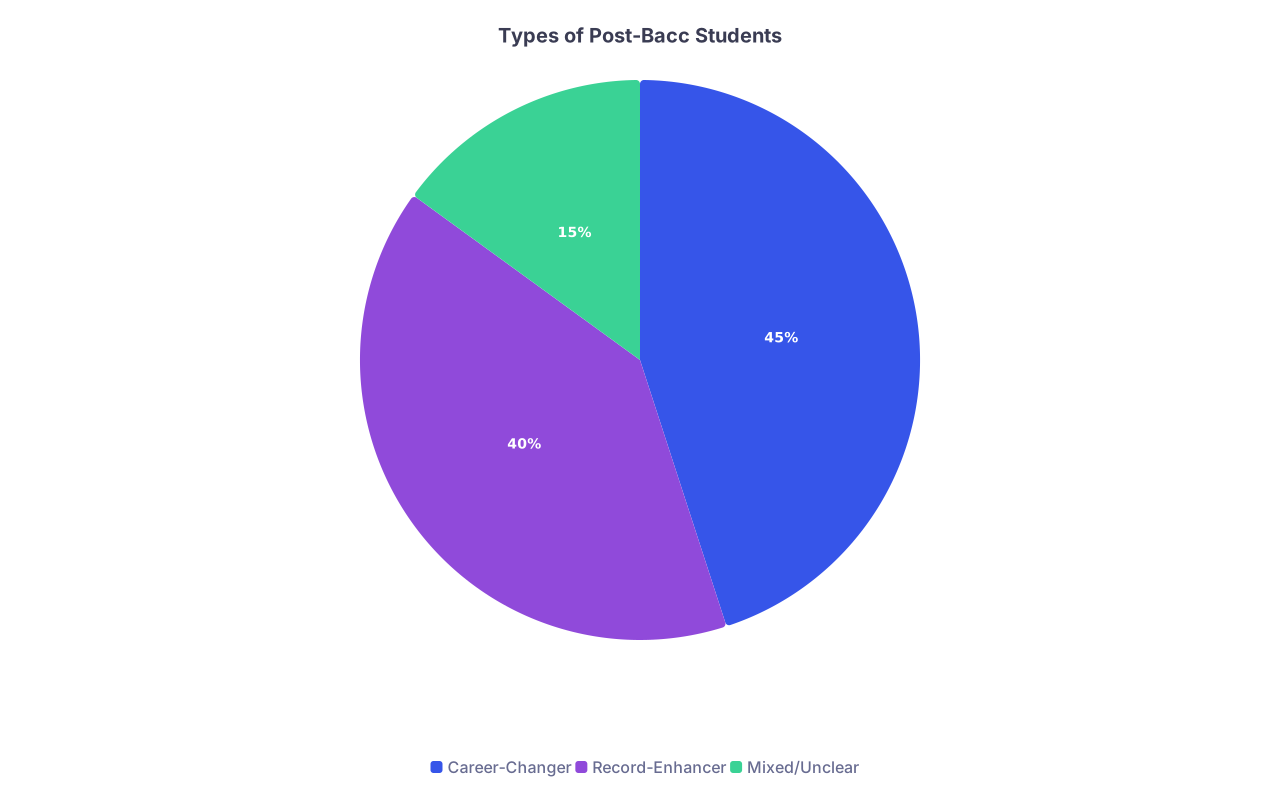
| Category | Value |
|---|---|
| Career-Changer | 45 |
| Record-Enhancer | 40 |
| Mixed/Unclear | 15 |
You are two browser tabs deep into post‑bacc program websites. One says “Career-Changer Track.” Another says “Academic Enhancer Track.” The course lists look similar. The marketing blurbs sound identical. But you know picking the wrong track can waste a year and thousands of dollars, or worse, leave you exactly where you started.
Let me break this down specifically.
This is the core distinction:
- Career-changer post‑bacc = for people who have NOT completed the core premed sciences.
- Record-enhancer post‑bacc = for people who HAVE completed the core premed sciences but need to improve grades, test scores, or overall competitiveness.
That sounds simple. In practice, programs blur lines, students misclassify themselves, and advisors give vague advice. I have seen students with a 3.8 in business and no orgo pick a record‑enhancer program because “it looked more competitive.” Wrong choice. I have seen science majors with a 2.8 retake Gen Chem in a career‑changer cohort because “it was structured.” Also wrong.
You need to understand how these tracks differ structurally, strategically, and in how adcoms interpret them.
1. Core Definitions: Who Actually Belongs in Each Track
Career-Changer Track: The “New to Science” Path
This track exists for people who are late to the medicine party.
You are a career-changer candidate if most of the following are true:
- Your major was non-science: English, economics, music, political science, history, business, engineering without full premed sequence, etc.
- You have not completed the full core premed requirements:
- 2 semesters Gen Chem with lab
- 2 semesters Organic Chem with lab (or Orgo + Biochem variant)
- 2 semesters Physics with lab
- 2 semesters Biology (with labs, ideally)
- Statistics and/or Calculus (depends on target schools)
- Some upper-level biology is a bonus, not a requirement
- Your existing GPA may actually be solid (3.4–3.9) but in non-science.
- You are early in science exposure but serious about medicine.
Who this is not for: someone who already did the full premed sequence and bombed it. That person is misusing a career‑changer track as a “do‑over.” Medical schools do not see it that way.
Record-Enhancer Track: The “Fix or Boost the Record” Path
This track exists for people whose academic record in the sciences is either:
- Weak (low GPA, inconsistent performance, big red flags), or
- Adequate but not competitive for the type of schools / specialties they want.
You are a record-enhancer candidate if most of the following are true:
- You have completed the core premed sequence.
- Your science GPA (sGPA) is below 3.5, sometimes below 3.2 or even 3.0.
- You might have:
- Withdrawals, repeats, or failures in key courses.
- Early bad semesters you are trying to counterbalance.
- An upward trend that is not yet strong enough.
- Or, you are “borderline competitive” (e.g., 3.5–3.6 with a 508 MCAT) aiming for more selective MD options and want a stronger academic signal.
Who this is not for: someone who has barely taken any science and wants structure. That person belongs in a career‑changer track.
2. Admissions Profile: Who Gets Into Which Track (Honestly)
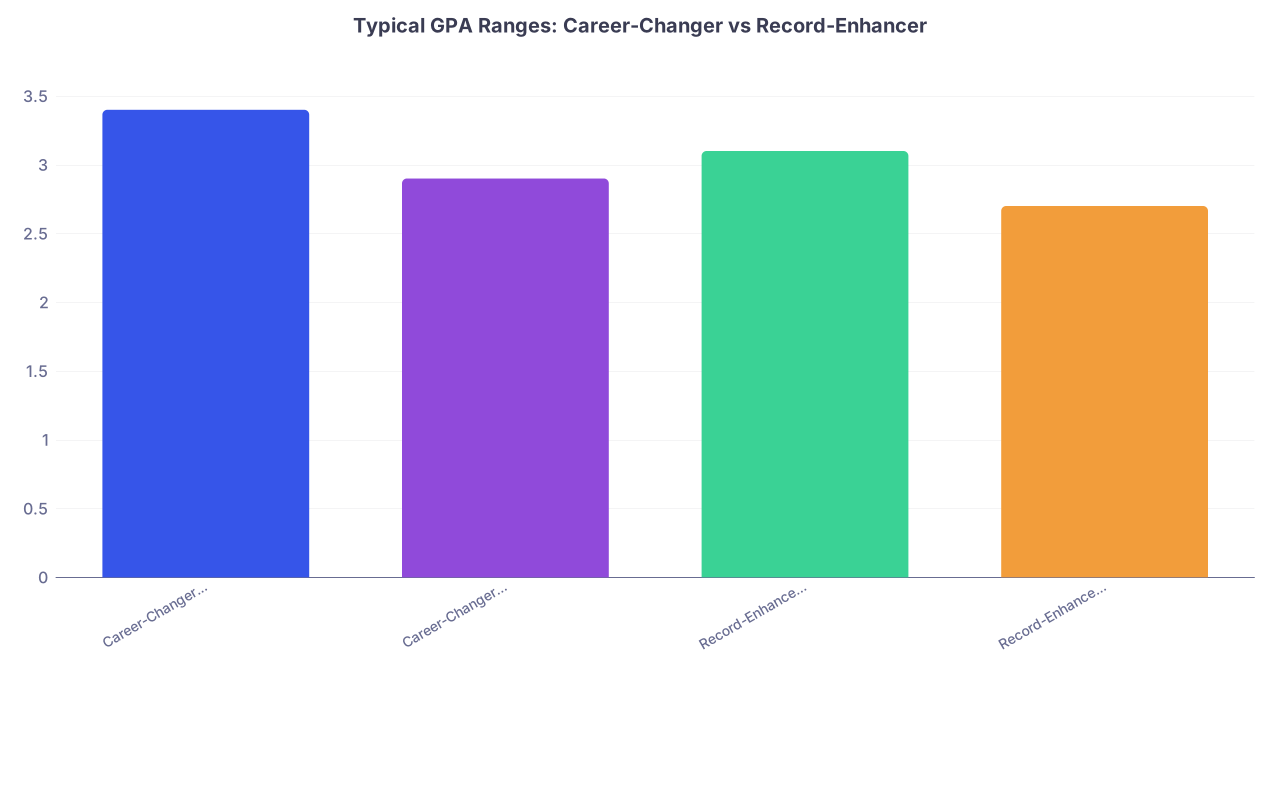
| Category | Value |
|---|---|
| Career-Changer Overall GPA | 3.4 |
| Career-Changer Science GPA | 2.9 |
| Record-Enhancer Overall GPA | 3.1 |
| Record-Enhancer Science GPA | 2.7 |
Career-Changer Post‑Bacc Admissions
These programs care far more about:
- Overall academic ability (any discipline)
- Evidence you can handle rigorous coursework
- Motivation and clarity of interest in medicine
Typical patterns:
- Overall GPA: 3.3–3.7 is common, but I have seen people with 3.0–3.1 and a strong narrative get in.
- Science background: minimal. Maybe a random Bio 101 or Chem 1.
- MCAT: not required. You have not taken it.
- Work history: often strong. Teaching, business, engineering, finance, tech, arts, etc. Healthcare exposure may be recent or minimal but should be present by the time you apply to med school.
These programs are often more “holistic” in the true sense: they believe they can build the science foundation from scratch if you’ve proven success elsewhere.
Record-Enhancer Post‑Bacc / Special Master’s (SMP) Admissions
These programs are not evaluating “can you handle college” anymore. They are asking, “Can you handle med‑school‑level or near‑med‑school‑level science now?”
Typical patterns:
- Overall GPA: 2.7–3.4 common for enhancer tracks; 3.0+ cutoffs are standard; SMPs often want 3.0+ minimum.
- Science GPA: sometimes lower than overall. Often the main problem.
- Prereqs: completed, sometimes specific minimum grades required.
- MCAT: occasionally required or recommended for SMPs; 500–508 can be common ranges, depending on program.
Here, you are already “known” to be a problem in science courses. The program is gambling that you have matured, fixed your habits, and can now perform like a different student.
3. Curriculum: What You Actually Study in Each Track
This is where the functional difference is clearest.
Career-Changer Curriculum: Building the Foundation
You can think of this as compressed, structured premed.
Typical course sequence over 1–2 years:
Year 1:
- General Chemistry I & II with labs
- General Biology I & II with labs
- Possibly Physics I
- Maybe an intro or bridge course (e.g., “Intro to Biomedical Sciences”)
Year 2:
- Organic Chemistry I & II with labs (or Orgo + Biochem)
- Physics I & II with labs
- Biochemistry (often in year 2)
- Statistics or upper-level bio (Genetics, Physiology) at some programs
Programs like:
- Bryn Mawr, Goucher, Scripps, Columbia’s career‑changer, Johns Hopkins post‑bacc (not SMP) are classic examples: tight cohort, fixed schedule, usually one major intake per year.
The emphasis is on:
- Cohort consistency
- Integration of advising + MCAT timing
- Building a transcript that looks like a strong traditional premed, just compressed.
Record-Enhancer Curriculum: Proving “New You”
This can look very different by program. Roughly three models:
Upper-Level Undergraduate Sciences (Classic Enhancer)
- Courses like:
- Cell Biology
- Molecular Biology
- Human Physiology
- Microbiology
- Immunology
- Anatomy
- Advanced Biochemistry
- Goal: Show A-level performance in rigorous, med‑relevant coursework.
- Courses like:
Graduate Certificate / Non‑Thesis Master’s in Biomedical Sciences
- More advanced material, often overlapping with first-year med school content.
- Courses like:
- Medical Physiology
- Systems Neuroscience
- Pathophysiology
- Pharmacology
- Grading is often pass/fail or letter-graded with strict curves. A 3.7+ in these programs is a strong positive signal.
True SMP (Special Master’s Program) Co‑enrolled with Med Students
- You share some or many classes with MS1s.
- Your performance is directly compared to actual med students.
- Some have conditional acceptance agreements: “If you maintain X GPA and score ≥ Y on the MCAT, you will receive an interview or acceptance at our med school.”
These programs are not about checking boxes. They are about generating a specific data point: recent, high‑level science performance that overwrites your prior mediocrity.
4. Timeline, MCAT, and Application Strategy
This is where people mess themselves up with poor sequencing.
Career-Changer: When to Take the MCAT?
Standard efficient path (for a 1‑year intensive program):
Year of post‑bacc:
- Complete all or almost all science prereqs.
- Start structured MCAT prep in the second half of the year.
MCAT timing:
- Late spring / early summer immediately after finishing Orgo, Physics, Biochem.
- Apply to med school that June.
- If linked program: some allow conditional acceptance and very structured MCAT timing.
If you are doing a 2‑year part‑time career‑changer:
- Take MCAT after completing:
- Gen Chem, Orgo, Physics, Biochem, and at least core Bio.
- For most students: end of Year 2 → apply in that summer.
You are sequence-limited. Taking the MCAT before you have the core content is a bad idea.
Record-Enhancer: How the MCAT Fits
You usually fall into one of three categories:
- You have taken the MCAT and did poorly (e.g., <500 or significantly below target).
- You have not taken it yet and your GPA is already a problem.
- You have a decent MCAT (e.g., 510) but a poor GPA.
Different strategies:
If MCAT is weak and GPA is weak:
- Fix GPA first (enhancer/SMP), then retake MCAT with a stronger science base and more mature study structure.
- Applying with both a weak MCAT and weak GPA, then doing SMP later, drags your timeline and burns application capital.
If MCAT not taken:
- Complete at least a year of strong, upper-level science before MCAT.
- Use improved study skills and your new academic momentum while prepping.
If MCAT is solid but GPA weak:
- Do enhancer/SMP, then apply with existing MCAT if it is still within the acceptable age window (usually 2–3 years for most MD schools, some allow longer).
- No need to retake MCAT solely because of GPA issues, unless your score is clearly below school medians you care about.
5. Cost, Length, and Opportunity Cost
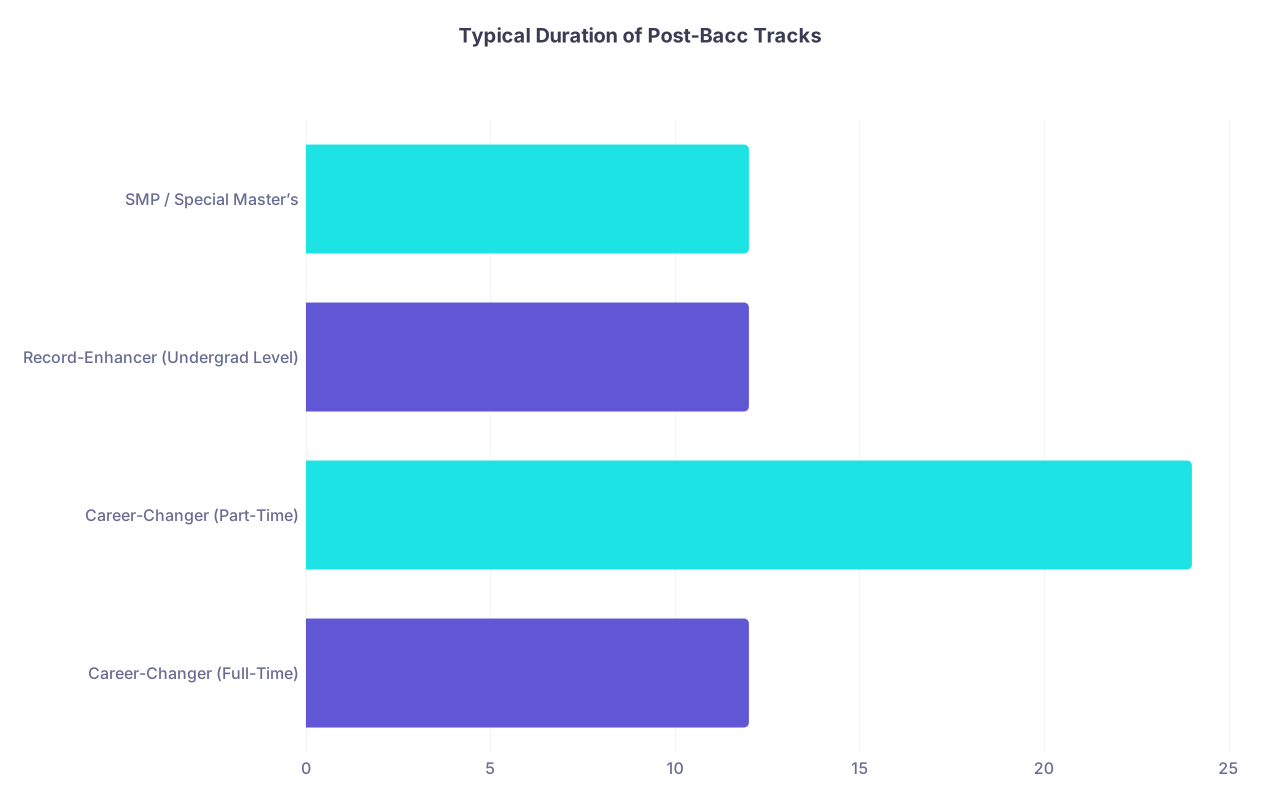
| Category | Value |
|---|---|
| Career-Changer (Full-Time) | 12 |
| Career-Changer (Part-Time) | 24 |
| Record-Enhancer (Undergrad Level) | 12 |
| SMP / Special Master’s | 12 |
Career-Changer Programs
Typical characteristics:
Length:
- 1 year full-time intensive (classics like Bryn Mawr, Goucher).
- 18–24 months part-time (university extension or evening programs).
Cost:
- Private, structured programs: $35,000–$60,000+ all-in for tuition alone.
- State/university extension: cheaper, sometimes $15,000–$30,000 range depending on credit load and residency.
Opportunity cost:
- Many students quit full‑time jobs to attend intensive programs.
- You lose 1–2 years of full-time income, but you also compress your route to application.
Career-changer route is expensive, but if you do it right, you go from “no science” to “full med school applicant” in 1–2 years.
Record-Enhancer / SMP Programs
Length:
- Undergrad‑level enhancer: 1–2 years, depending on credit needs.
- SMP: typically 1 intensive academic year, sometimes plus a research or thesis year.
Cost:
- SMPs: often $25,000–$60,000 for the year, very similar to private med school tuition pro‑rated.
- Undergraduate enhancer: could be cheaper, especially at a state school. But you may end up taking more credits over a longer period.
Opportunity cost:
- You are delaying matriculation another application cycle at least.
- However, applying before fixing your record often means reapplication down the line, which is worse.
Harsh truth: if your record is significantly below MD norms, not spending the money on an enhancer or SMP and “hoping” is how people end up in multi‑year limbo.
6. How Med Schools Interpret Each Track
This is the part few people think through clearly.
How Adcoms View a Career-Changer Post‑Bacc
When done well:
- Strong performance (mostly A’s) in a rigorous, known program =
“This person can handle science. Their non-science background is not a concern.” - A structured, well-regarded program signals:
- Curated advising
- Intentional career change
- Serious commitment, not a whim
Combined with:
- Solid MCAT
- Meaningful clinical exposure and shadowing
- A coherent narrative of career transition
You are not penalized for starting late. Many med schools like these applicants for maturity and diverse backgrounds.
When done poorly:
- B-/C+ average in core career‑changer science =
“This is probably who they are in science.” There is no earlier science to blame. - Weak MCAT on top of mediocre post‑bacc grades is basically disqualifying for MD and tough even for DO.
Career-changer track is your first science record. You do not get to say “but I was not serious the first time.”
How Adcoms View a Record-Enhancer / SMP
They already have your earlier poor performance on file. You are trying to argue:
“I used to underperform due to X, Y, Z. Now I am different, and here is hard, recent data to prove it.”
Strong enhancer/SMP outcome:
- 3.7+ in upper-level science or graduate/SMP courses.
- Clear upward trend.
- Sometimes with direct comparison to med students (SMP).
Adcom interpretation:
- “They turned it around. We can trust current trajectory. Risk reduced.”
Mediocre enhancer/SMP outcome:
- 3.1–3.3 (or lower).
- Mixed grades in key med‑relevant courses.
Adcom interpretation:
- “They tried to prove themselves and did not change the outcome. This is their ceiling.”
In other words: enhancer/SMP magnifies who you are academically. It is not neutral. Doing it and doing average can close more doors than if you had never done it.
7. Linkage, Glide Years, and Realistic Planning
Linkage in Career-Changer Programs
Some high‑end career‑changer post‑baccs have formal “linkage” agreements with specific med schools. Example patterns:
- If you maintain GPA ≥ 3.6 and MCAT ≥ X, with strong professionalism and advising support:
- You may apply early and skip the glide year.
- You interview during or immediately after your post‑bacc.
- You start med school the following fall with no gap.
Downside:
- Less time to build clinical experience and a richer extracurricular profile.
- Fewer schools considered (only linkage partners).
- Requires very strong performance and no missteps.
If you want linkage, pick a career‑changer program explicitly designed for that and actually read the fine print.
Record-Enhancer and Glide Years
Most record-enhancer/SMP plans look like:
- Year 0: Last undergrad year (often poor grades).
- Year 1: Enhancer/SMP. Focus on A’s and (if needed) MCAT.
- Year 2: Apply to med school in June; interview that year.
- Year 3: Matriculate.
You almost always have at least one “glide” year because adcoms want to see your completed enhancer/SMP grades before admitting you. Some SMPs tie their master’s directly to a guaranteed med school interview or conditional acceptance the following year. But you still apply on a delay.
8. Mistakes: Misclassifying Yourself and Picking the Wrong Track
Here are scenarios I have seen repeatedly.
Mistake 1: Using Career-Changer as a GPA Repair Tool
Profile:
- Biology major, 2.7 sGPA, completed all premed courses 3 years ago with lots of C’s.
- Enrolls in a career-changer type program at a new institution, “retakes” Gen Chem, Bio, Orgo.
Problem:
- AMCAS and AACOMAS average all attempts. Original C’s do not disappear.
- Med schools see:
- Weak original record.
- You retook basic courses instead of moving forward to higher difficulty material.
- It looks like you repeated high school instead of taking college.
You needed an enhancer or SMP with upper-level coursework, not a redo of introductory classes.
Mistake 2: Doing an Enhancer When You Still Lack Core Requirements
Profile:
- English major, overall 3.8.
- Has only taken Bio 1 and Chem 1 (A/A-).
- Jumps into “Biomedical Sciences MS” thinking it is impressive.
Problem:
- Many med schools expect undergraduate prereqs regardless of graduate work.
- You can end up with a master’s and still be missing basic undergrad requirements.
- Also, MCAT prep is fragile if you have never systematically gone through core content.
You needed a structured career-changer path first, then possibly an enhancer if undergrad performance was average.
Mistake 3: Underestimating SMP Risk
Profile:
- 2.9 sGPA, some C’s in Org and Physics, older nontraditional student.
- Joins a big‑name SMP co‑taking courses with med students.
- Ends up with a 3.1 in the SMP.
Result:
- You now have two science records that say “borderline” at best.
- SMPs are high‑risk, high‑reward. They are not just another year of college.
Sometimes a slower, cheaper, upper-level undergraduate enhancer year at a state school is safer and more effective.
9. How to Decide: Career-Changer vs Record-Enhancer in 4 Questions

| Step | Description |
|---|---|
| Step 1 | Start |
| Step 2 | Career-Changer Track |
| Step 3 | Probably no formal post-bacc needed |
| Step 4 | Record-Enhancer / SMP Track |
| Step 5 | Consider DIY enhancers or DO focus |
| Step 6 | Have you completed full premed prereqs? |
| Step 7 | Science GPA < 3.5 or major red flags? |
| Step 8 | Need MD-level competitiveness or repair pattern? |
Ask yourself, bluntly:
Have I completed the full standard premed sequence?
- No → You are fundamentally a career‑changer.
- Yes → Keep going.
Are my science grades already strong (mostly A/A‑, minimal B’s, no C’s)?
- Yes → You probably do not need a formal post‑bacc. Focus on MCAT and experience.
- No → You are in record‑enhancer territory.
Is my main problem “no exposure” or “bad performance”?
- No exposure → Career‑changer.
- Bad performance → Record‑enhancer/SMP.
Am I prepared for a high‑stakes, high‑pressure environment where mediocre performance is worse than not doing it?
- If not, avoid aggressive SMPs.
- Consider a more controlled enhancer environment first.
10. Summary: How Each Track Changes Your Story
Career-changer post‑bacc:
- Story: “I discovered medicine later and built the entire scientific foundation quickly and successfully.”
- Who it is for: minimal prior science, often from non‑science backgrounds, aiming to compress prerequisites and demonstrate capability.
- Success signal: A‑level performance across core sciences + solid MCAT = green light.
Record-enhancer / SMP:
- Story: “I used to underperform academically. I fixed it. Here is current, rigorous proof.”
- Who it is for: people with completed prereqs and suboptimal science GPA or trend who need a convincing recent record.
- Success signal: 3.6–3.8+ in upper‑level or graduate science, preferably in known rigorous settings.
If you choose the wrong lane, you either waste time and money or fail to change the narrative that med schools care about. The track itself is not what matters. The coherence between your background, your chosen program, and the story your transcript now tells—that is what gets read.
FAQ (Exactly 5 Questions)
1. Can I switch from a career-changer post‑bacc to a record-enhancer program later?
Yes. In fact, many nontraditional students do exactly this: complete a 1‑year career‑changer program, apply, and if they do not get acceptable offers, they add a subsequent record‑enhancer year or SMP. But you should not plan on needing both unless your career‑changer grades end up mediocre or your target schools are extremely selective.
2. Do DO schools care less about record-enhancer vs career-changer distinctions?
They still see the same transcripts, but DO schools are generally more forgiving of earlier academic missteps, especially if you show a clear upward trend and strong recent performance. For some applicants with significant GPA problems, a modest enhancer year plus a strong MCAT can be enough for DO, whereas MD might still require a more formal SMP‑level performance.
3. Is a DIY post‑bacc at a local state university acceptable for either track?
Yes, if you choose coursework strategically and perform well. For career‑changers, a structured cohort program has advantages (advising, linkage, schedule), but a DIY approach can still work if you systematically complete prereqs with strong grades. For record enhancement, a DIY set of upper-level sciences at a state school is often more cost‑effective and lower risk than jumping straight into an SMP, as long as the rigor is clear and your grades are excellent.
4. If my overall GPA is high but my science GPA is low, which track should I pick?
You are a record‑enhancer, not a career‑changer. Med schools look closely at science GPA and trend. You already proved you can do well in non‑science classes; they are specifically doubting your performance in scientific coursework. You need upper-level sciences or an SMP to show you can now thrive in that domain. Retaking intro sciences in a career‑changer setup will not fix the core concern.
5. Do I ever need both a record-enhancer and an SMP?
Occasionally, for very damaged transcripts. Example: early undergrad 2.3 with F’s and withdrawals, followed by a late 3.4 upswing that still leaves your cumulative numbers low. In that situation, a strong undergraduate enhancer year (or two) to establish a solid upward trend, followed by a high‑performance SMP, can construct a compelling redemption arc. But this is expensive and demanding. For most applicants, one well-chosen, well-executed program is enough—if you do not treat it like a warm‑up.
Key points to end on: know whether your problem is “no science” or “poor science,” pick the track that directly addresses that problem, and understand that post‑bacc work is not a soft reset. It is an audition, and it will be read that way.