The myth that a great post-bacc magically erases a mediocre MCAT is dangerous—and it’s probably fueling your anxiety right now.
You did the “right” thing. Went back, crushed a post-bacc or SMP, proved you can handle real medical-school-level work. Maybe a 3.8–4.0 in upper-division sciences. And yet the MCAT… still won’t cooperate.
Now your brain is doing that 2 a.m. spiral:
- “Did I just waste years and thousands of dollars?”
- “Are adcoms going to think I’m dumb even though I just did well in biochem and physiology?”
- “What if this is my ceiling? What if I literally can’t score higher?”
Let’s walk through this like someone who’s seen both sides: the person with the shiny post-bacc transcript and the MCAT score they’re low‑key ashamed to say out loud.
(See also: Is It Too Late to Start a Post-Bacc If I Already Graduated Years Ago? for more details.)
What Adcoms Actually See When Your MCAT Lags Behind Your Post‑Bacc
Here’s the harsh part first: the MCAT is not optional. Even with a strong post-bacc.
Schools don’t just “override” a weak MCAT because of a 4.0 in post-bacc classes. They look at both, together, and then try to answer a few specific questions:
Can you handle med school content?
Your post-bacc screams “yes.”Can you handle standardized exams?
Your MCAT is…raising some eyebrows.Are you trending up or stuck in the same range?
That trend matters more than people admit.
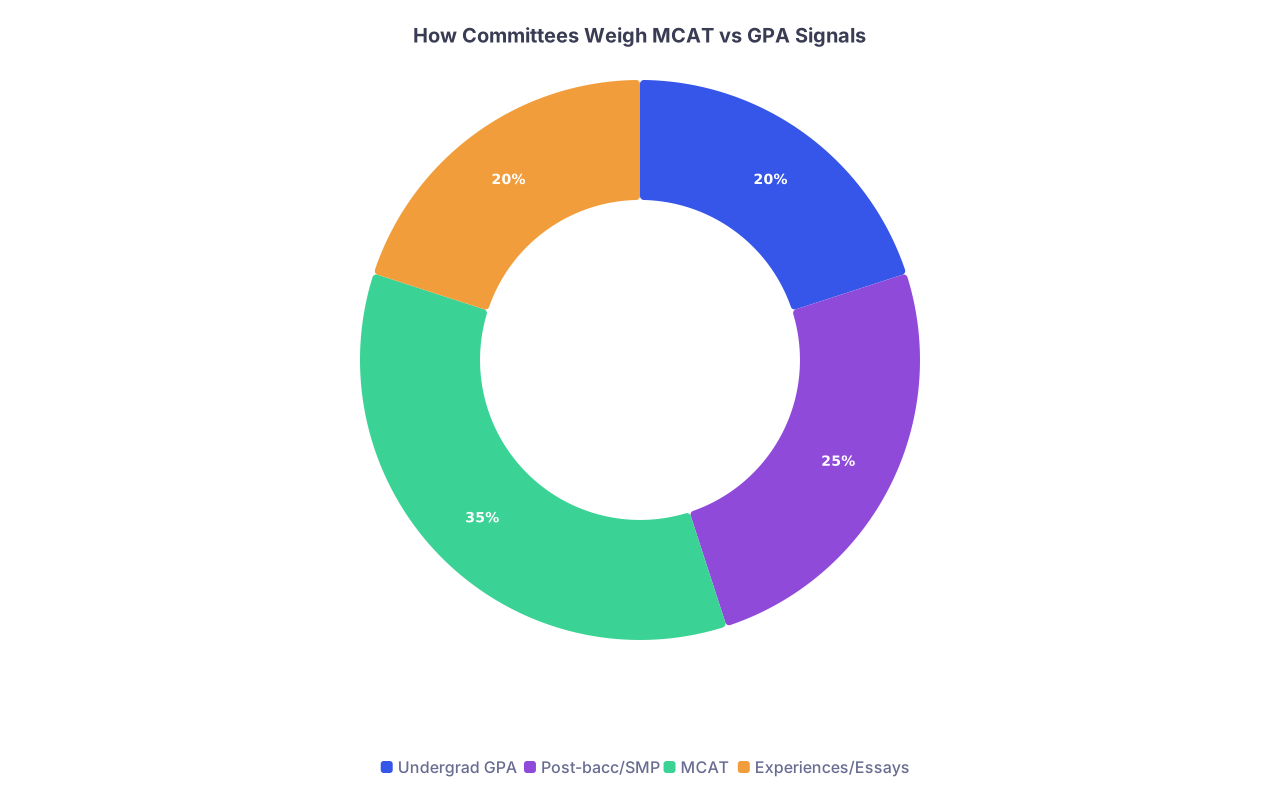
| Category | Value |
|---|---|
| Undergrad GPA | 20 |
| Post-bacc/SMP | 25 |
| MCAT | 35 |
| Experiences/Essays | 20 |
If your story is:
- Undergrad: spotty
- Post-bacc: strong
- MCAT: better than your first try, but still below averages
that’s actually a coherent story. It says: “Academic maturity improved. Test‑taking is still catching up.”
What makes committees nervous is:
- No MCAT improvement across multiple attempts, and
- Scores well below their floor (like 498–502 for MD, 492–496 for DO at many places)
They’re not thinking, “This person is hopeless.” They’re thinking, “Is this a risk for Step exams and board pass rates?” Schools get judged by those numbers. That’s the ugly truth.
So no, your post-bacc doesn’t magically erase the MCAT. But it’s also not wasted. It changes how your whole profile is interpreted.
“What If This MCAT Is As Good As I Get?”
This is the fear under everything, right? That you’ve hit your ceiling.
Let me be blunt: people routinely break through “ceilings” on their 2nd or 3rd attempt when:
- They change how they study, not just how long
- They stop mindlessly doing more practice blocks and start diagnosing patterns
- They treat MCAT like a reasoning test, not a content regurgitation exam
But here’s the other part people don’t say out loud:
Some ceilings are real. Not because you’re not smart enough. Because of:
- Chronic test anxiety
- ADHD that’s never actually been treated properly
- Working full‑time plus caregiving plus studying
- English as a second language and reading speed issues
- Burnout that makes your brain feel like wet cement
If your scores are:
- Practice exams stuck in the same 504–507 range despite months of work
- Official MCAT landing in that same range
- And your dream is a 517+ top‑20 MD
then yes, there may be some mismatch between goal and current reality. That’s not a moral failing. That’s just information.
The key is: don’t catastrophize a realistic reassessment. You’re not being “exposed” as incapable. You’re being nudged toward:
- Different school list strategy
- Maybe DO instead of MD
- Maybe a different timeline
- Or, for some, a different path altogether that still lets you work in healthcare
How Much Does a Strong Post‑Bacc Actually Help a Lagging MCAT?
Let’s strip away the fantasy version and look at actual patterns I’ve seen.
Scenario A: Post‑bacc 3.8+, MCAT 510–512
You’re over here panicking that 510 is “low” because Reddit lives in a 520+ bubble.
Reality:
- Many MD schools (especially mid‑tier and state) are fine with this.
- With a steep upward GPA trend and solid narrative, you’re competitive.
- If you’re ORM with no wow-factor extras, maybe not for top‑20, but very realistically for plenty of MD programs.
Your post‑bacc here is gold. It backs up that the MCAT isn’t a fluke.
Scenario B: Post‑bacc 3.8+, MCAT 505–507
This is where people start to sweat.
What this usually means:
- MD: you’ll need to be very strategic with your list (state schools, mission fit, lower-mid tier). Some schools will auto‑screen you out. Some won’t.
- DO: you’re in a much stronger position; your post‑bacc will really matter.
Your post‑bacc buys you:
- Proof of academic turnaround
- More generosity from DO programs
- A fair shot at some MDs that are big on “holistic review” or non‑traditional students
But it doesn’t erase that your MCAT is below the median for many MD schools.
Scenario C: Post‑bacc 3.8+, MCAT ≤ 502
Now we’re in harsh territory.
Pattern committees start seeing:
- Struggles with standardized testing that may translate into board exam risk
- If multiple MCAT attempts live in this range, that concern magnifies
Here:
- DO is much more realistic than MD for most applicants
- Your post‑bacc, again, is not wasted—it can be the difference between “no” and “wait, let’s look more closely” for DO schools
- You need ruthless self‑honesty about whether another retake will actually meaningfully move the needle
Do You Retake or Apply With What You’ve Got?
This is the decision that makes people sick to their stomach. Because there’s money, time, and emotional bandwidth at stake.
Use this mental flowchart:

| Step | Description |
|---|---|
| Step 1 | Current MCAT Score |
| Step 2 | Apply with Current Score |
| Step 3 | Adjust School List / Consider DO or Alternate Paths |
| Step 4 | Delay Application / Strengthen Other Areas |
| Step 5 | Retake with New Strategy |
| Step 6 | Within 3 points of target for realistic schools? |
| Step 7 | Can you realistically change your study approach? |
| Step 8 | Do you have 2-3 solid months to focus? |
Ask yourself, honestly:
- Is your current MCAT within ~3 points of the median for the schools you’re realistically aiming at?
- Have you already studied “as hard as possible” but maybe not “as smart as possible”?
- Do you have at least 2–3 months where MCAT can be priority #1 (not #5)?
If your answers look like:
- “No, I’m 6–10 points below most of my target schools”
- “I basically repeated the same study pattern twice and got the same score”
- “I’m working 40 hours and caregiving and barely sleeping”
then a heroic retake might not give you the miracle bump you’re fantasizing about.
You might be better served by:
- Building an MD/DO hybrid school list that matches your actual profile
- Or taking a year, fixing test anxiety/ADHD/whatever is sabotaging you, and then coming back with a true fresh strategy
But What If Admissions Think My MCAT Means I Can’t Handle Med School?
They don’t think that off one data point.
They think in patterns.
Someone with:
- 2.9 uGPA → 3.9 post‑bacc
- 503 → 507 MCAT retake
- Solid clinical, strong letters, good story of growth
is very different from:
- 3.7 stable GPA
- 2 MCATs at 503 and 504
- No other strong compensating factors
Your strong post-bacc breaks the “maybe they just can’t do hard science” narrative. It replaces it with:
- “They can do the work.”
- “But will they struggle with high‑stakes, timed exams?”
That second concern is fixable with:
- Better test‑taking strategy
- Diagnosed and treated learning differences
- Intentional Step exam prep later
What kills people is when there’s no data point suggesting you can handle upper‑level coursework. You already fixed that. That’s huge.
Fixing the MCAT Weak Spot Without Losing Your Mind
If you’re going to take one more shot, do it like you actually learned something from the last round.
Concrete changes that actually move scores:
Full autopsy of past performance
Not just “I’m bad at CARS.”
I mean:- Are you missing main idea questions or inference questions?
- Running out of time on last 5 questions every passage?
- Changing right answers to wrong?
Study fewer hours, but higher quality
8 hours of half‑awake Anki and YouTube is worse than 3 focused hours:- 1 hour reviewing mistakes from yesterday’s questions
- 1 hour timed passage practice
- 1 hour targeted content review on only your weak areas
Simulate actual test conditions
If your AAMC FLs are always “higher” than your actual score, are you:- Taking them at 2x speed?
- Pausing to think?
- Skipping breaks?
That inflates everything. You’re lying to yourself without realizing it.
Get outside feedback
You might not see your own blind spots.
A tutor, advisor, or even a brutally honest friend can help you see:- Are your notes uselessly long?
- Are you clinging to content and ignoring reasoning?
- Are you sabotaging yourself mentally halfway through the test?
When It’s Time To Pivot, Not Just Push Harder
This part sucks. But dodging it doesn’t make it less real.
Some signs it may be time to change the dream slightly:
You’ve taken the MCAT 3 times, with:
- Scores clustered within 1–2 points
- No upward trend despite different prep strategies
Thinking about another MCAT attempt makes you feel physically sick, not just nervous
Your life circumstances (money, caregiving, health) make sustained prep impossible for the foreseeable future
A pivot doesn’t automatically mean “don’t be a doctor.” It might mean:
- Focus on DO schools, where your stats align better and your post‑bacc is highly valued
- Consider Caribbean only after talking to actual grads and understanding match risk, and only if your MCAT is at least in a range they know can still succeed
- Or, yes, look at other clinical careers where you can still work closely with patients: PA, NP (with a BSN path), clinical psychology, etc.
People act like “anything but MD” is failure. It’s not. It’s ego. Ego doesn’t treat patients. You can.
Concrete Next Steps So You’re Not Just Spiraling
Here’s what I’d do if I were you, this week:
Pull your exact MCAT score and the MSAR (for MD) + CIB (for DO).
Make three columns:
- Schools where your MCAT is ≥ their 10th percentile
- Schools where your MCAT is between their 10th and 25th percentile
- Schools where your MCAT is below their 10th percentile
Be ruthless:
- First column: realistic
- Second: reach
- Third: fantasy land (for now)
Layer your post‑bacc on top:
- Did you take upper‑division sciences similar to M1 content?
- Are there schools known to like reinvention (many DOs, plus some MDs like RFU, EVMS, Wayne, etc.)?
Decide:
- Apply this cycle with strategic list?
- Or take 6–12 months, fix MCAT with a new plan, then apply?
You’re not stuck. You’re just at a fork in the road.
FAQ (Exactly 5 Questions)
1. Is it even worth applying MD with a strong post‑bacc but a 505–507 MCAT?
Yes, if you’re realistic. You’re not applying to UCSF and Hopkins with that. But if:
- Your post‑bacc is 3.7+ with solid rigor
- You have strong clinical experience and a coherent story
- You focus on state schools, mid‑tier MDs, and schools that talk openly about reinvention and holistic review
then you may absolutely land interviews. You should still apply broadly to DO. Don’t let pride cut your chances in half.
2. Will multiple MCAT attempts kill my chances even if my post‑bacc is great?
Multiple attempts alone don’t kill you. What hurts is:
- No improvement (e.g., 501 → 502 → 502)
- Or a downward trend
If you have a clear upward trajectory (499 → 505 → 508), schools often view that as persistence and growth, especially paired with a strong post‑bacc. Don’t keep retaking just to chase perfection. Three attempts is where committees start to wonder why you’re stuck.
3. Do SMPs or formal post‑baccs “override” a mediocre MCAT for admissions?
No. Not for most MD schools. An SMP with med‑school classes and a 3.7+ GPA can sometimes make committees more forgiving of a slightly lower MCAT (like 508 vs their 511 median). But if your MCAT is well below their usual range, even an amazing SMP won’t erase that. For DO programs, though, a strong SMP/post‑bacc plus a mid‑500s MCAT can be very compelling.
4. Should I wait to apply until I get a higher MCAT, or apply now and plan to retake?
Don’t apply planning to “fix” your app mid‑cycle. Most schools screen secondaries and interview invites off what they see now. If your current MCAT is clearly below the realistic range of your target schools, you’ll burn thousands of dollars and emotional energy. It’s usually smarter to:
- Either apply with the score you have and a realistic list
- Or wait, retake with a new strategy, and apply once that score is in your pocket
5. Does a strong post‑bacc help at all with Step exam risk, or do schools only look at MCAT for that?
Programs mostly use MCAT as the standardized test proxy. But a rigorous post‑bacc or SMP with exams similar to med school—especially if your letters mention your test performance—can reassure them a bit. It doesn’t fully replace MCAT as a predictor, but it can soften concerns: “They did fine in systems-based exams and cumulative finals, so maybe this MCAT underperforms their real ability.” That’s not nothing. It can be the difference between auto‑reject and “let’s read the file.”
Open your MCAT score report and your post‑bacc transcript side by side today. Then pull up a few schools in MSAR/CIB and ask: “Where does this version of me fit?” Not the imaginary 520 version. The real you, right now. That’s the starting point that actually gets you into a white coat.