It’s 11:47 p.m. You’re staring at your old college transcript on your laptop.
The date at the top hits you like a truck: Graduation: May 2016. Or 2012. Or 2008.
You’ve got a job. Maybe a partner. Maybe kids. Definitely some loans.
And now your brain won’t shut up about this one question:
“Is it too late to start a post-bacc? Like. Did I actually miss my chance to do medicine?”
Your friends from college are already attendings, or PGY-3s, or about to finish residency and buy houses and post those stupid white coat photos on Instagram. You’re over here Googling “post-bacc programs for older students” and “am I too old for med school at 30 / 35 / 40.”
(See also: What If My Post-Bacc GPA Isn’t a 4.0? for insights on GPA concerns.)
So yeah. I get why your stomach is in your throat right now.
Let me answer the scary part first:
No, it’s not too late to start a post-bacc just because you graduated years ago.
But there are strings attached. Tradeoffs. And some hard questions you actually have to confront instead of just doom-scrolling Student Doctor Network.
Let’s go through this like real people, not inspirational-poster nonsense.
The Age / Time Panic: “I’ll Be 40 Before I’m Done”
This is the soundtrack in your head:
- “If I start a post-bacc next year, that’s 1–2 years. Then MCAT. Then another year to apply. Then 4 years of med school. Then residency… I’ll be, like, ancient.”
- “Will schools even take someone who’s been out of school this long?”
- “Am I going to be that weird older person in the class who doesn’t get TikTok references?”
Here’s the blunt version:
Med schools absolutely accept people who’ve been out of undergrad for years.
I’ve seen people start med school at 30, 35, 40+. Adcoms call them “nontrads” and honestly, a lot of them like you because you look less likely to implode during M3 if you’ve actually paid rent and dealt with real life.What they don’t like is academic cobwebs with no recent proof you can still perform.
That’s why a post-bacc isn’t “too late” for you. It’s the thing that proves you’re not stuck in 2014 GPA land. It gives them:- Fresh science grades
- Proof you can handle upper-level work now
- A story that makes sense: “I pivoted, then I committed, here’s evidence”
The “I’ll be 40” argument is kind of a trap.
You’ll be 40 either way.
In 10 years, you can be:- 40 and a practicing physician
- 40 and still at the same desk, wondering if you should’ve tried
The real question isn’t “Will I be too old?” It’s:
“Do I want this badly enough to deal with a long, uncomfortable timeline?”
If the answer is yes, your graduation year is just… context. Not a death sentence.
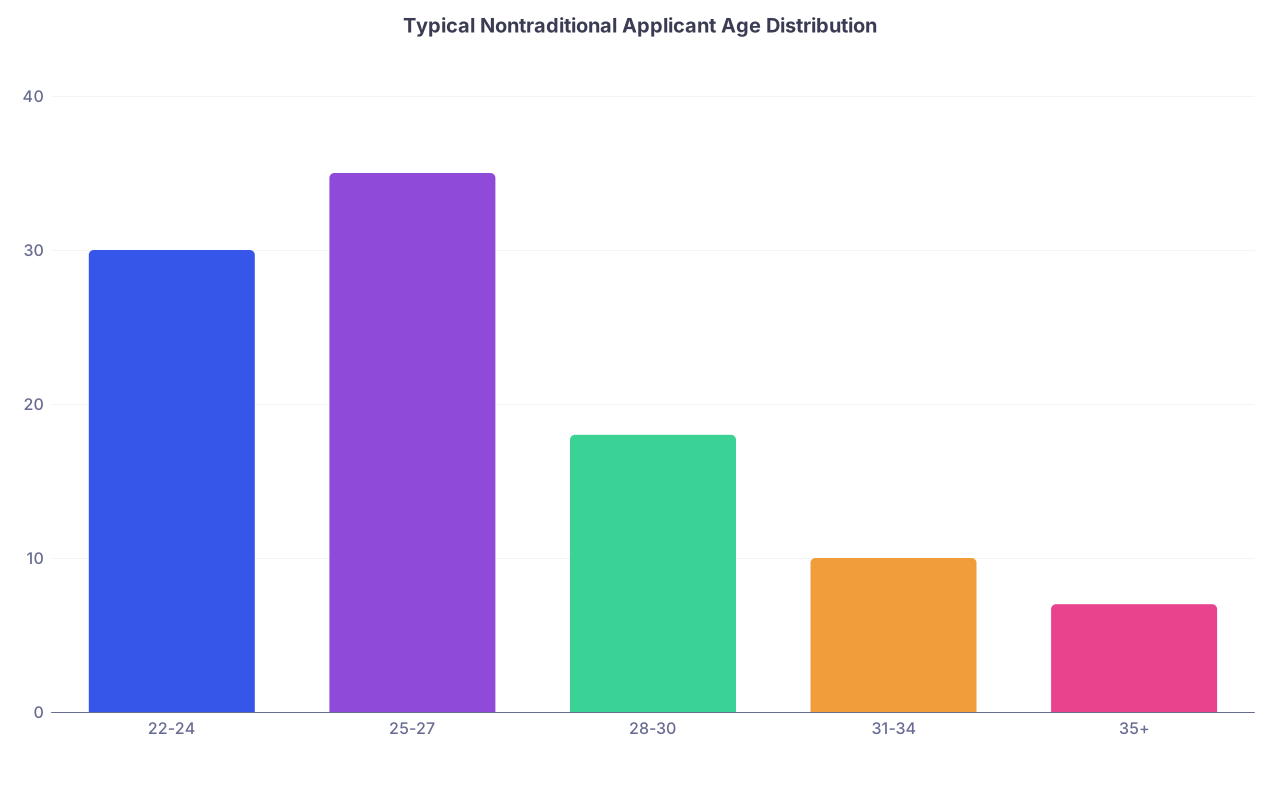
| Category | Value |
|---|---|
| 22-24 | 30 |
| 25-27 | 35 |
| 28-30 | 18 |
| 31-34 | 10 |
| 35+ | 7 |
(Those numbers aren’t from one specific study, but that shape? That’s what I keep seeing: a real chunk of applicants well past the “straight-through” age.)
The Academic Fear: “My Old GPA Is Garbage. Can a Post-Bacc Actually Fix It?”
This one stings the most. You pull up your transcript and see:
- Freshman Chem: B-
- Orgo I: C+
- Orgo II: withdrew
- Random semester with a 2.3 because life absolutely blew up
And now you’re wondering if doing a post-bacc years later is like putting a Band-Aid on a bullet wound.
Here’s the honest breakdown.
What med schools care about academically
They focus on:
- Cumulative GPA (cGPA) – everything
- Science GPA (sGPA) – all your BCPM (biology, chem, physics, math)
- Trends – did you get your act together later or not?
- Recency – can you still handle tough science now, not just 8 years ago?
If you’ve been out of school for a while, a good post-bacc gives you the one thing your old GPA can’t: a strong upward trend and recent proof of competence.
No, a post-bacc doesn’t technically “erase” your old GPA. The bad grades are still there. But I’ve seen:
- People go from ~2.8 uGPA → 3.3+ AMCAS after a very strong post-bacc
- sGPA climbing from low 3.0s into 3.6+ territory
- DO schools especially being forgiving when recent performance is strong
The worst thing you can do is nothing.
Because then the story is: “I did badly in undergrad, and then… that’s all the academic data we have forever.”
When a post-bacc works in your favor
You’re a good post-bacc candidate if:
- Your old GPA is meh or bad, but not utterly catastrophic
(like 2.0 with straight Ds in science is a harder road, not impossible, but brutal) - You haven’t taken all the prereqs / need to retake them properly
- You can realistically pull mostly As now if you’re all-in
If you crush 24–36 credits of upper-level science in a structured post-bacc—think A/A- across the board—that’s a huge signal.
Med schools see:
“Okay, they matured. They got their life together. This isn’t the same 20-year-old who blew off orgo.”
The “Years Out of School” Problem: Rusty, Out of Practice, Intimidated
Let’s not pretend: going back to school after years in the workforce is humbling.
You’re worrying about:
- “I don’t remember how to study anymore.”
- “I’ll be competing with 20-year-olds fresh out of orgo who still know what a sigma bond is.”
- “What if I actually can’t do this level of work anymore?”
I’ve watched this play out in real people. Here’s what tends to happen:
First semester back:
- You feel stupid for about 4 weeks.
- You over-highlight everything and retain nothing.
- Your first quiz goes worse than you hoped.
Second half of that first semester:
- Your brain starts remembering how to learn.
- You figure out what works now (spoiler: active recall, question banks, office hours).
- You realize your life skills actually help—time management, email etiquette, not panicking over every small thing.
By your second semester:
- You’re not the rusty old person. You’re just… a student again.
- And weirdly, you often do better than you did in undergrad because now you have a clear why.
So no, being years out doesn’t disqualify you.
But it does mean: you can’t just wing it. You’ll need a real plan for how to study like an adult who’s busy and tired.
Choosing the Right Kind of Post-Bacc (And Avoiding Traps)
This is where a lot of people screw themselves over, honestly. Not because they’re dumb, but because the post-bacc landscape is a mess and marketing is aggressive.
There are three big buckets:
- Career-changer post-baccs – for people who haven’t taken the prereqs
- Academic enhancer post-baccs – for people who have taken them but need better grades
- Formal vs informal – structured programs vs DIY at a local university / extension
If you graduated years ago, you’re probably in one of two camps:
“I never did premed stuff. I was an English major / business major / art history.”
→ You’re a career-changer. You need the full sequence: gen chem, bio, orgo, physics, maybe biochem.“I was premed but tanked my GPA or have big holes.”
→ You’re an academic enhancer. You need upper-level sciences and/or strategic retakes.

| Step | Description |
|---|---|
| Step 1 | Already graduated years ago |
| Step 2 | Career-Changer Post-Bacc |
| Step 3 | Academic-Enhancer Post-Bacc |
| Step 4 | Maybe DIY upper-levels or SMP if aiming high |
| Step 5 | Took core premed sciences? |
| Step 6 | GPA competitive? |
Watch out for:
- Programs that charge obscene tuition but offer zero linkage, zero advising, and zero MCAT support
- Programs that don’t let you take real upper-level sciences and just give a random mix of fluff
- Places where the premed advising is basically: “Here’s a generic checklist. Good luck.”
Not every “post-bacc” is created equal. Some are lifelines. Some are straight-up money pits.
If you’ve been out of school for years, I’d lean toward:
- A structured program or
- A very well-planned DIY using a local 4-year university or reputable extension program
Community college-only routes get tricky for med school, especially for your core prereqs, though they can sometimes be used strategically.
The Real Barriers: Money, Time, and Burnout Risk
Let’s be honest about the stuff no brochure wants to mention.
You’re not 20. You’ve probably got:
- Rent or a mortgage
- Maybe a partner who also has opinions about this detour
- Maybe kids
- Existing debt
- A job you can’t just casually quit without consequences
So when you think “post-bacc,” your brain also thinks:
- “How am I supposed to pay for this?”
- “Am I going to take on even more loans for something that isn’t guaranteed?”
- “What if I tank a class because I’m working and then I’ve just made my app worse?”
Those are valid fears. The question isn’t “Is it safe?” (it’s not).
The question is: Can you set it up so the risk is at least controlled and strategic?
Some things that actually help:
- Doing a part-time post-bacc while working, but being realistic about pace
- Cutting life overhead where possible before you start (subscriptions, fancy car, avoid lifestyle creep)
- Building a 3–6 month emergency fund if you’re going to scale back work
- Looking seriously at DO schools and not pretending MD is the only valid pathway
You don’t get to do this the way a 21-year-old can. You’re playing on “hard mode.”
But people do it every year. The difference is they treat it like a multi-year project, not a romantic impulse.
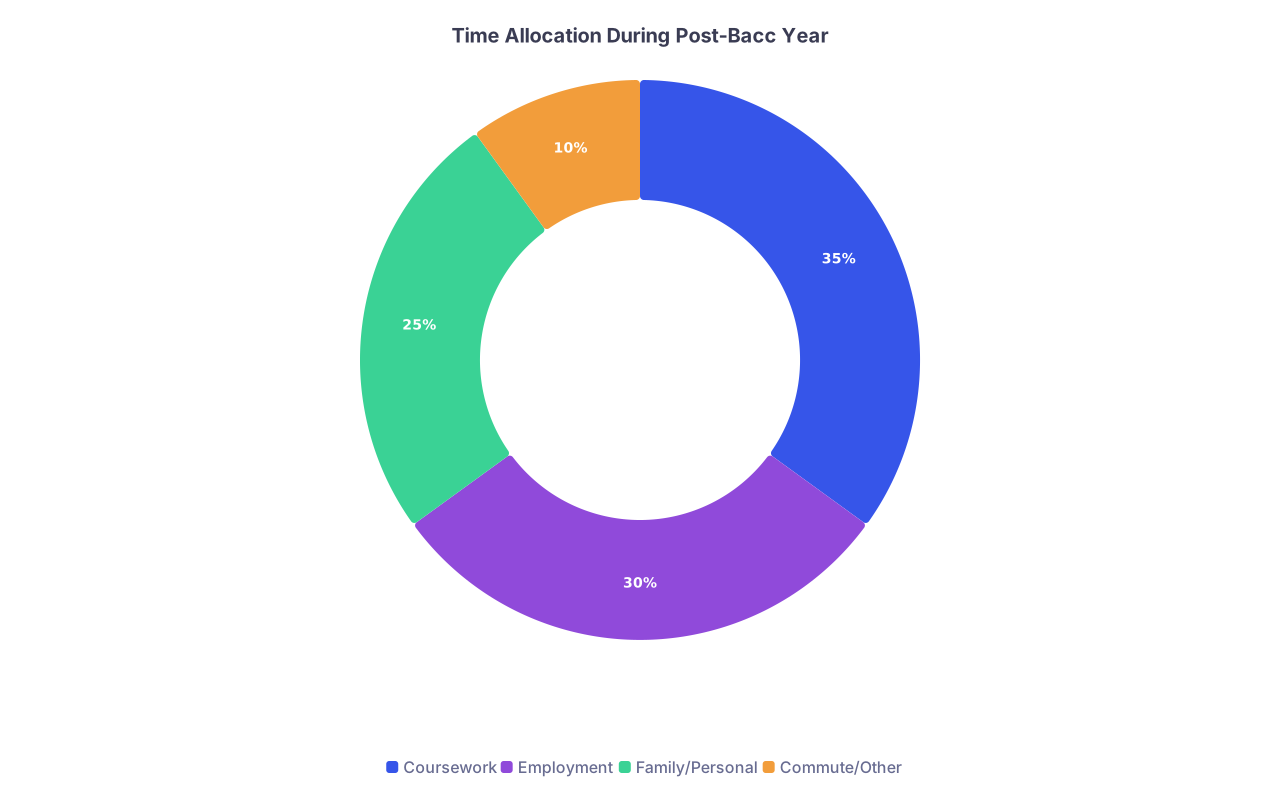
| Category | Value |
|---|---|
| Coursework | 35 |
| Employment | 30 |
| Family/Personal | 25 |
| Commute/Other | 10 |
That’s what your life starts to look like: every hour has a job.
The Emotional Side: Watching Everyone Else “Be Ahead”
This part sucks and no one talks about it enough.
You will have days where you:
- See your peers post “Attending life!” on Instagram and want to cry
- Wonder if you’re being irresponsible, selfish, unrealistic
- Feel like starting over in your late 20s / 30s / 40s means you’ve failed at adulthood
I’ve seen people quit—not because they couldn’t handle the science, but because the constant comparison just broke them down.
You need to decide early: whose timeline are you living on?
If you’re always measuring yourself against:
- The classmate who went straight through
- The cousin who’s already a cardiologist
- The friend who bragged about their Step scores at Thanksgiving
You will feel behind. Every. Single. Year.
Here’s the uncomfortable truth:
You’re not “behind.”
You’re just on a different route that takes longer. That’s it.
The post-bacc, years after graduation, is just you saying:
“I’m willing to redefine ‘on time’ based on what I actually want, not what 22-year-old me thought.”
That’s gutsy. It also hurts sometimes.
So… Is It Too Late For You?
Let’s strip all this down.
It’s not too late to start a post-bacc if:
- You’re willing to sacrifice a few years of comfort and predictability
- You can realistically perform at a high level academically now
- You’re okay not being the youngest in the room
- You’re ready to live with uncertainty for a long stretch
It might be the wrong move if:
- You secretly hope the post-bacc will be easy and “prove” you shouldn’t do medicine
- You’re financially underwater with no plan and hoping loans will magically fix everything
- You’re doing this mostly to escape a job you hate, not because you actually want medicine and all its ugly parts (nights, weekends, sick people, endless documentation)
Med schools will not care that you graduated “too long ago” if you show up now with:
- Strong recent science performance
- A coherent story
- A good MCAT
- Evidence you know what actual medicine looks like (shadowing, clinical work)
The calendar isn’t your enemy. Indecision is.
What You Can Do Today (Not in Six Months When You’ve Overthought It)
You don’t need a 10-year plan tonight. You need one tangible step.
Do this:
- Open your unofficial transcript.
- Write down three numbers on a piece of paper:
- Overall GPA (cGPA)
- Science GPA (sGPA) if you can calculate it
- Last 30–40 credits GPA
Then ask yourself, brutally:
- “If an adcom saw only these three numbers, would they think:
‘This person is absolutely ready for med school,’ or ‘We need more data’?”
If the answer is “they’d need more data,” that’s your sign:
You’re not too late for a post-bacc.
You’re exactly the kind of person it was built for.
So:
Tonight, pick one local university or one formal post-bacc program and bookmark their page.
Tomorrow, email their admissions or pre-health advisor and ask this specific question:
“I graduated in [year] with a [GPA]. I’m strongly considering medical school now. Would your program be appropriate for someone who needs [career-changer / GPA enhancement], and what outcomes have your students with similar stats had?”
Hit send.
That email is you moving from “Is it too late?” to “I’m actually doing something about it.”