
Worried I Picked the Wrong Post-Bacc: Can I Recover My Application?
What if the post-bacc you’re already in is actually hurting your chances instead of helping—and you’re realizing it too late?
That’s the thought, right?
You look around your program and think:
“Everyone else has linkage agreements.”
“My friends are in ‘top’ post-baccs with advisors who actually answer emails.”
“I picked the wrong thing. I ruined my chances before I even started.”
Let me say this clearly before your brain spirals any further:
Choosing a less-than-perfect post-bacc is not the thing that destroys your application. What you do inside and after that program matters way more than the brand name on your transcript.
But I get why you’re freaking out. Let’s pull this apart piece by piece.
First: Is Your Post-Bacc Actually “Wrong” or Just Not Fancy?
There’s a difference between:
- “I’m in a non-famous, kind of random program”
and - “This place is genuinely setting me up to fail”
Your anxiety is going to tell you it’s the second one. Every time. But admissions doesn’t think the way your 2 a.m. brain does.
Here’s what med schools actually care about from a post-bacc:
- Did you take the core hard sciences (or retake them) in a rigorous setting?
- Did you show an upward trend?
- Did you perform well relative to your past?
- Does your transcript look like: “This person is academically ready now.”
They don’t have a secret blacklist of “off-brand” post-baccs.
The “wrong” post-bacc only truly becomes a problem if things like this are happening:
- Classes are so disorganized that everyone’s struggling just to pass
- The program isn’t offering the core prerequisites you actually need
- Grading is bizarre and inconsistent (like everyone getting Cs, no curve, no explanations)
- Zero access to any advising, committee letter, or even basic help
- You’re in an online-only setup when your record really needed in-person, rigorous coursework
If your program is just… not elite? Not a big-name SMP? Not linked to a med school?
That’s not fatal. That’s normal.
The Nightmare Scenario in Your Head vs Reality
Your brain’s version of the story:
“Admissions will see the name of my program, roll their eyes, toss my application in the trash, and say I should’ve known better.”
Reality:
They’ll see:
- Your GPA trend
- The difficulty and level of courses
- How recent these grades are
- MCAT score (or potential) in context of these grades
- How your story ties it together
I’ve seen people get in from:
- Local state university evening post-baccs
- Patchwork DIY post-baccs at community colleges plus state schools
- Programs that don’t even call themselves “post-bacc,” just “non-degree enrollment”
You know who med schools reject? People with:
- Mediocre or flat GPAs despite extra chances
- No explanation, no growth, no reflection
- A “fancy” program but average or worse grades
The program doesn’t carry you. Your performance does.
The brutal part:
You’re probably not really asking, “Is my program wrong?”
You’re asking, “Did I already screw this up beyond repair?”
Let’s talk about that.
If Your Grades Aren’t Great Right Now
Here’s the fear:
“I picked a weaker program AND I’m not even crushing it. That’s it. I’m done.”
No. You’re not.
But you do have to stop pretending a vague “upward trend” will magically appear. You have to engineer one.
Ask yourself, and answer honestly:
- What’s my post-bacc GPA right now (science and overall)?
- How many credits of recent science do I have?
- Is there a clear, sustained pattern of improvement, or just random OK semesters?
Med schools want to see a runway of recent success. For someone with a shaky undergrad, that often means:
- 24–32+ credits of strong (like 3.6–3.8+) upper-division science
- Not one good semester, then one crash-and-burn
- A story of “I figured it out, and I kept it together”
If you’re mid-program and your grades so far are meh, your job is not to withdraw in shame. It’s to course-correct now, while you still have time to build that runway.
That might mean:
- Dropping to a slightly lighter load so you can actually get As
- Retaking a disaster course where you got a C– or below
- Prioritizing fewer, harder classes and accepting that this might take longer
The question isn’t “Did I start at the perfect place?”
It’s: “Can I create a stretch of time where I actually look like the student I want them to see?”
You still can.
How To “Recover” If Your Post-Bacc Choice Feels Off
You don’t fix this by rage-enrolling in another expensive program just because it has “Special Masters” in the title.
You fix this by being strategic. Relentlessly.

| Step | Description |
|---|---|
| Step 1 | Realize Current Program May Not Be Ideal |
| Step 2 | Clarify Academic Record |
| Step 3 | Plan Extra Rigorous Coursework |
| Step 4 | Strengthen Narrative and Experiences |
| Step 5 | Consider Additional Post-bacc or SMP |
| Step 6 | Focus on High Performance |
| Step 7 | Build Clinical, Shadowing, and Volunteering |
| Step 8 | Apply with Improved Trend |
| Step 9 | Recent Science GPA Strong? |
Here’s what “recovery” actually looks like in real life:
1. Get painfully clear on your numbers
No more vibes-based thinking.
Pull everything:
- Undergrad GPA (overall and science)
- Post-bacc GPA (overall and science)
- Total number of post-bacc science credits
Then categorize yourself:
If your post-bacc science GPA is ≥ 3.6 with at least ~24 credits:
Your “wrong program” fear is probably more emotional than real. You might not need another formal program. You might need a good MCAT and a strong narrative.If your post-bacc science GPA is < 3.4 or credits are < 20:
You likely need more coursework and stronger performance before applying. Not because your program is bad, but because your record isn’t convincingly “fixed” yet.
2. Decide: Do you stay, stack, or pivot?
You’ve got three basic options:
- Stay and finish stronger in your current program
- Stack more classes at a different institution after this
- Pivot to a different kind of program (like an SMP) later
You don’t need to decide today “I must transfer or I’m doomed.” Sometimes, the best move is:
“Finish this year. Crush remaining classes. Then add 1–2 more semesters of upper-level science at a stronger or more reputable institution if needed.”
Admissions doesn’t care if your post-bacc is spread over two schools. They care if the pattern is real and recent.
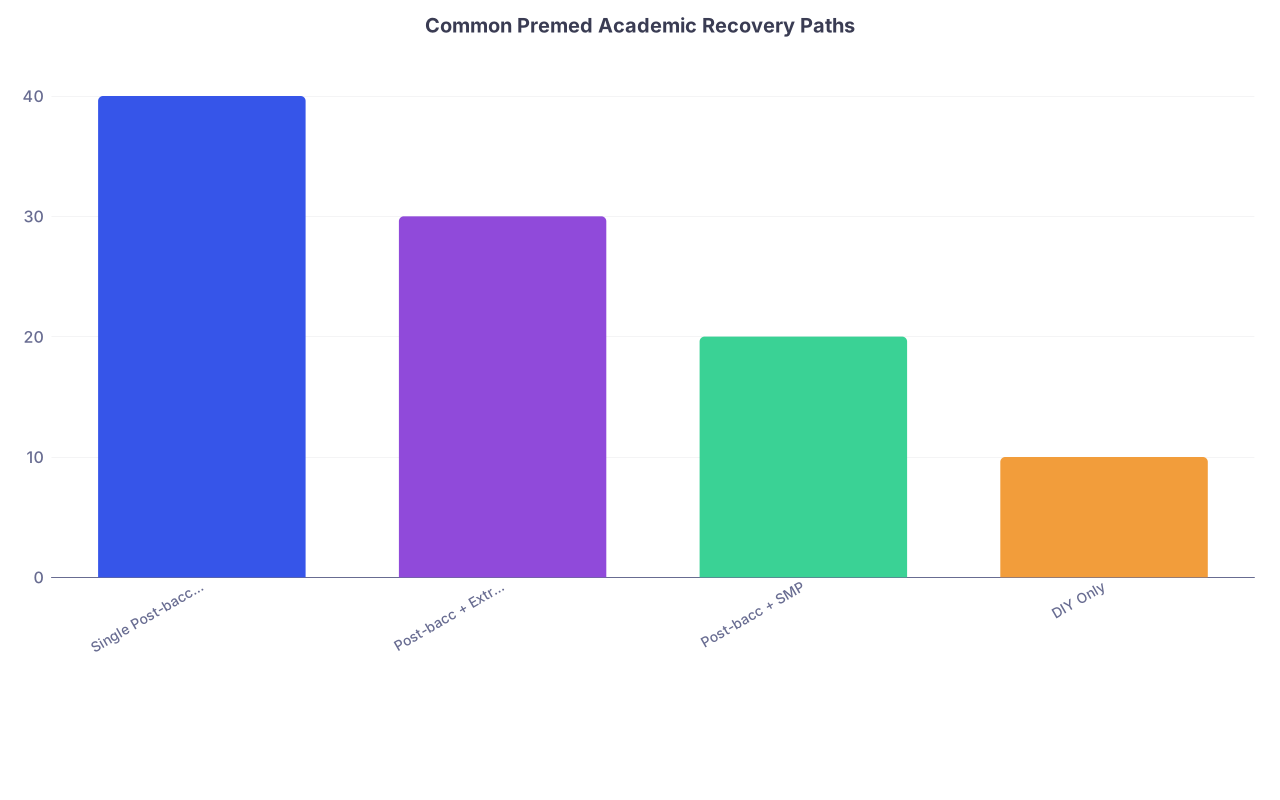
| Category | Value |
|---|---|
| Single Post-bacc Only | 40 |
| Post-bacc + Extra University Credits | 30 |
| Post-bacc + SMP | 20 |
| DIY Only | 10 |
(This kind of split-path story is very common, by the way. You’re not some outlier freak show if you end up doing a “patchwork” route.)
3. Fix what’s actually missing
Ask yourself honestly:
- Is the problem the program name on paper?
- Or is the problem: not enough upper-division science, weak MCAT, thin clinical experience, or no coherent story?
Because I’ve seen people obsess over “wrong post-bacc” while:
- They haven’t taken biochem yet
- They’re sitting on a 505 MCAT after a 3.3 GPA
- They’ve shadowed a doctor exactly twice
If your record is academically fine but you’re panicking about prestige, stop trying to repair something that isn’t broken and look at the rest of your application.
“Will Med Schools Judge Me for This Program?”
They’re going to judge:
- Your performance in context
- Your pattern of growth
- Your ability to explain your path like a coherent adult, not like someone flailing in every direction
You can say something like this in your application:
“After college, I enrolled in a local post-bacc program to rebuild my academic foundation while working part-time. Although this program wasn’t affiliated with a medical school, it allowed me to retake core sciences and add upper-division coursework. Over the last X credits, I’ve maintained a [3.7] science GPA, which more accurately reflects my current ability and discipline.”
That doesn’t scream “wrong choice.” That screams “real life, real growth.”
You know what does look bad?
“I bounced between three different programs, didn’t commit fully to any of them, never really improved my GPA, but I’m applying anyway because I’m tired of waiting.”
The issue isn’t that you changed paths. It’s that there’s no through line.
If You’re Tempted to Abandon Ship Right Now
I know the urge: “If I just get into a better post-bacc/SMP, I can erase this mistake.”
Be very careful here.
Transferring or jumping programs can help only if it leads to:
- Stronger performance
- More rigorous, relevant coursework
- A clearer story
But if you’re struggling because of time, burnout, mental health, or foundational gaps… those won’t magically fix themselves at a fancier program. They’ll just get more expensive and more high-stakes.
Sometimes the bravest, smartest thing is not to “start over,” but to slow down:
- Fewer courses per term so you can get As, not survive Bs
- Extra time reviewing basics you should’ve mastered before
- One more year than you planned, but with grades you’re proud of
Extended timeline > permanent mediocre trend.
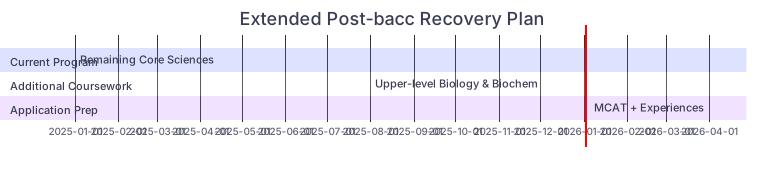
| Task | Details |
|---|---|
| Current Program: Remaining Core Sciences | a1, 2025-01, 6m |
| Additional Coursework: Upper-level Biology & Biochem | a2, 2025-08, 8m |
| Application Prep: MCAT + Experiences | a3, 2026-04, 8m |
What You Can Do This Week to Start Fixing This
Not in theory. Not someday. This week.
Book a meeting with someone who can pull your transcript and be brutally honest.
Pre-health advisor, trusted faculty, even a competent tutor who knows premed patterns. Tell them, “I need to know what my numbers actually say about my readiness.”Map out your next 2–3 semesters on paper.
List: courses, credit load, and the GPA you’d need each semester to hit a believable upward trend. If the numbers don’t work, adjust sooner, not later.Audit your weaknesses.
- If it’s study strategy: get help now, not after another B–.
- If it’s time management: cut something before it cuts your GPA for you.
- If it’s mental health: talk to someone real. Burnout tanks more GPAs than “bad programs” ever will.
Start drafting how you’ll explain your path in your personal statement/secondaries.
Not in a defensive, apologetic way. In a “this is the path I took, this is what I learned, here’s how it changed me” way.
You’re not trying to erase your current post-bacc. You’re trying to contextualize it and then outgrow it with performance.
The Truth You Don’t Want but Need
Yes, some programs give you nicer advising, built-in committee letters, formal linkages. That helps. I won’t pretend it doesn’t.
But I’ve also watched:
- People in “top” post-baccs get rejected everywhere because their performance was mid
- People from random regional state schools walk into MD/DO acceptances with a rock-solid trend and story
You did not permanently destroy your application the day you picked this post-bacc.
You’ll only destroy it if you use that choice as an excuse to give up, go autopilot, and hope that “trying hard” is enough.
Med schools respond to data, not drama.
Create better data.