
You close the email and just stare at the wall. You did the post-bacc, you raised your GPA, you wrote the “I turned it around” narrative everyone said adcoms love—and…nothing. Or worse than nothing: a clean row of rejections and maybe one waitlist that’s been silent for months.
You’re sitting there thinking, “So I did all that…for this?” And the awful follow‑up: “What if this was my shot and I already blew it?”
First: No, your post‑bacc wasn’t “for nothing”
Let me start with the fear that’s probably screaming the loudest: “I finished a post‑bacc and still got rejected…does that mean it didn’t work? That I’m just not cut out for this?”
I get why your brain goes there. You did what people told you to do: fix your GPA, take upper‑level science, show an upward trend. You probably imagined this neat story arc: struggled early, matured, did a rigorous post‑bacc, then boom—interviews, acceptances, happy ending.
Real life is messier. And admissions are much more brutal than the brochure version.
Here’s the ugly truth I’ve seen over and over: a post‑bacc is foundation, not magic. It’s the “ok, now they’ll actually read your file” step. It doesn’t guarantee they’ll like what they see once they do.
Your post‑bacc did at least three things:
- It proved you can handle medical‑school‑style science now. That matters. A lot.
- It keeps doors open that would’ve been slammed with your old GPA.
- It gives you a story of growth. But that story has to be told well—and backed up with everything else in your app.
If you finished a post‑bacc with, say, a 3.7+ in your new coursework and you’re still staring at rejections, that doesn’t mean the post‑bacc “failed.” It usually means something like:
- Your overall GPA is still below what the schools you applied to like to see.
- Your MCAT is dragging you down.
- Your school list was unrealistic or way too top-heavy.
- Your essays and letters didn’t match your stats story.
- You applied too late or too narrowly.
- Or some painful combo of all of the above.
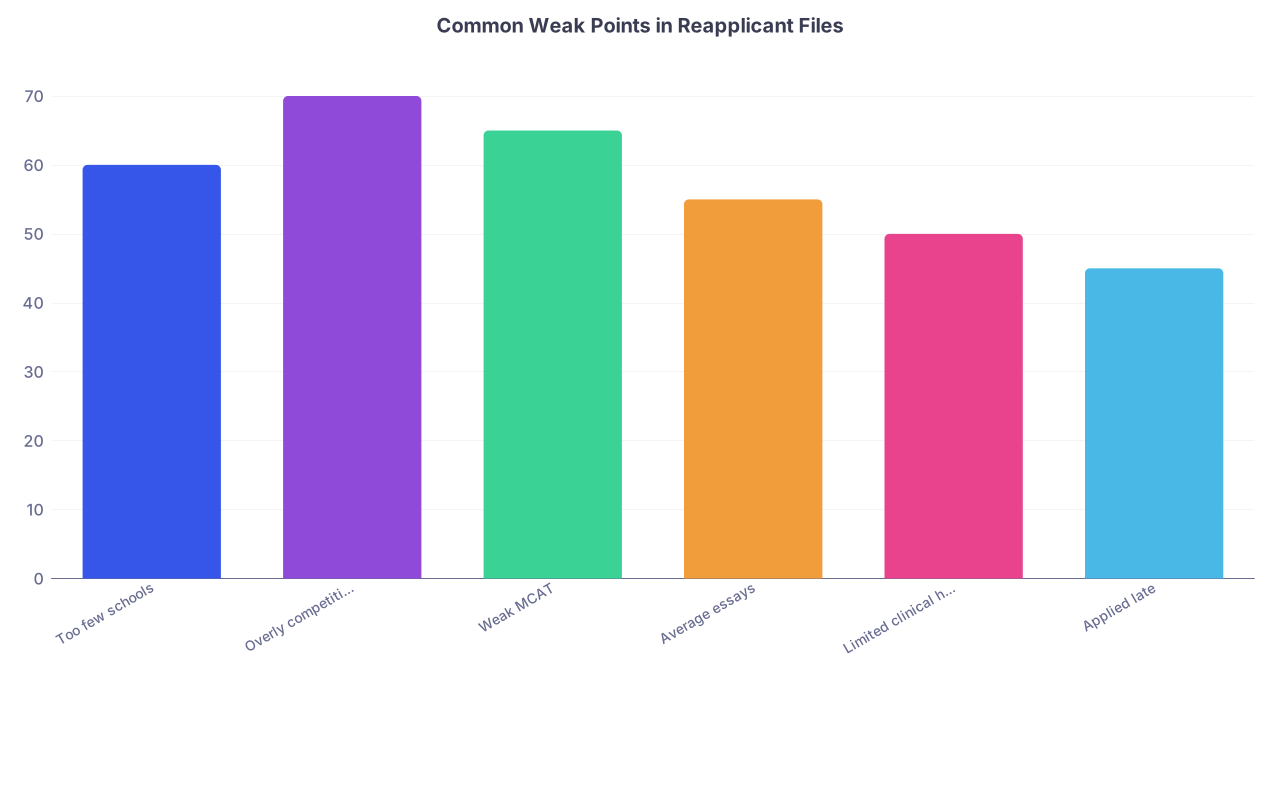
| Category | Value |
|---|---|
| Too few schools | 60 |
| Overly competitive schools | 70 |
| Weak MCAT | 65 |
| Average essays | 55 |
| Limited clinical hours | 50 |
| Applied late | 45 |
So no, the post‑bacc wasn’t a waste. But it was only one piece of a much bigger puzzle. And right now you’re just seeing that puzzle for what it actually is—soul‑sucking and unforgiving.
Step one: Stop guessing. Get brutal, objective feedback.
Your brain is already doing the worst-case thing: “I’m doomed, I’ll never get in, everyone else’s post‑bacc worked but mine didn’t.” The way you fight that is not with vibes or optimism. It’s with data. Cold, depressing, clarifying data.
You need to put your application under a microscope. Not emotionally. Clinically.
Here’s what that actually looks like (not the fluffy “just reflect” advice):
- Pull your full stats: cumulative GPA, science GPA, post‑bacc GPA, MCAT breakdown.
- List every school you applied to and their actual median stats for accepted students, not just “range.”
- Note your timeline: when primaries were submitted, when secondaries were returned, when your letters were in.
Then ask, one by one:
- Were my numbers within the typical accepted range for most schools I applied to—or consistently below?
- Did I have at least a handful of schools where my stats were actually above their medians? Or was I always trying to “punch up”?
- Did my MCAT match my new academic story, or did it subtly undermine it?
And then the part no one wants to hear: you need someone else to rip your app apart.
Not your friend. Not your mom. Not the well‑meaning attending who says “you’ll be fine.” Someone who actually sees hundreds of applications.
If your post‑bacc had a premed committee or advisor, you go back there. If not, you find:
- A prehealth advisor at your undergrad or post‑bacc.
- A physician who’s on an admissions committee or has been involved with one.
- Or, if you can afford it, a reputable admissions consultant who will be honest, not a cheerleader.
You tell them: “I finished a post‑bacc, didn’t get in, and I want the unfiltered version of what’s holding me back.”
If they come back with, “Honestly, your school list was unrealistic but your profile is solid,” that’s one type of problem. If they say, “You’re 10+ points below MCAT medians and your clinical work is thin,” that’s another.
You can’t fix what you won’t look at directly. Right now your anxiety is filling in the blanks with the worst possible story. Replace that with actual reasons.
The big fork in the road: am I reapplying or walking away?
This is the part no one wants to say out loud. You have to decide: is this a “regroup and try again smarter” situation, or is this the moment you pivot?
And no, the answer isn’t always “keep applying until the sun burns out.” That’s how people end up broke, exhausted, and still not in med school.
Here’s how I’ve seen it break down.
If most of these are true:
- Your post‑bacc GPA is strong (3.6–3.8+).
- Your MCAT is at least within striking range (for MD, usually 510+; for DO, mid‑500s+).
- You applied late or to the wrong mix of schools.
- Your essays and narrative only halfway told your story.
- Your clinical/volunteering is ok but not amazing.
Then you’re probably in the “reapply, but smarter and more targeted” category.
If instead:
- Your post‑bacc GPA is mediocre (below ~3.3) and your overall is low.
- Your MCAT is significantly below most schools you chose (e.g., 500 with mostly MD applications).
- You’ve already applied more than once with minimal changes.
- You’re drowning in debt and can’t afford more years of limbo.
- You’re not sure you even want to do this anymore—you just don’t want to feel like you “failed.”
Then you’re in tougher territory. Not impossible, but you’re fighting both the numbers and your own burnout. In that case, I’d seriously consider:
- DO schools (if you focused only on MD).
- Caribbean/foreign schools—but only after a very honest risk/benefit talk with someone who’ll tell you the non-sugarcoated reality.
- Or pivoting to another health field where your post‑bacc still helps you: PA, NP (with a nursing transition), clinical psychology, PT, etc.
This isn’t me saying “give up.” It’s me saying: if you’re going to keep going, you deserve to know the actual odds and the true cost.

| Step | Description |
|---|---|
| Step 1 | Finished Post-Bacc, Got Rejections |
| Step 2 | Consider DO, SMP, or alternate paths |
| Step 3 | Reapply with better strategy |
| Step 4 | Focus on MCAT + limited reapplication |
| Step 5 | Post-Bacc GPA ≥ 3.6? |
| Step 6 | MCAT near medians? |
If you reapply: what actually needs to change?
Reapplying with the same application plus a new date stamp is useless. Schools hate that. They want to see clear, concrete growth.
Think of it this way: if an adcom member from last year opened your file again, what would make them say, “Oh, this is a different candidate now”?
A few big levers you can pull:
1. Fix the numbers you still can fix
GPA after a post‑bacc is hard to move significantly—your denominator is huge now. But you can:
- Add a few upper‑level sciences and get A’s to protect the “upward trend” narrative.
- Go for a Special Master’s Program (SMP) if your GPA is still a massive liability and you’re willing to take on more risk and cost.
The easier (but brutal) lever is MCAT. If your MCAT doesn’t match your post‑bacc, that’s often the first fix.
I know, the thought of another MCAT round probably makes you want to throw your laptop. But be honest: if you have a 3.7 post‑bacc and a 503 MCAT, adcoms are thinking, “Can they handle standardized exams?” That question can absolutely kill you.
If you retake, it can’t be “I’ll just try again and hope.” It has to be a different approach: practice-test heavy, targeted reviewing of weaknesses, maybe a course or tutor if that’s an option.
2. Rewrite your story from the ground up
Your personal statement after a post‑bacc can’t just be “I struggled, then I did a post‑bacc, now I’m ready.” Everyone is saying that.
You need:
- A clear, specific why medicine that doesn’t sound like you copied it from Reddit.
- Concrete, reflective discussion of your post‑bacc: how you changed your study methods, your habits, your mindset.
- Evidence across your activities that this isn’t just academic rehab—you actually understand patient care, teams, systems, limitations.
And your secondaries? They can’t be rushed, generic copy‑paste jobs. Those get insta‑binned at some places. I’ve seen apps where the person clearly wrote all 20 school essays in a weekend. Adcoms can smell that from space.
3. Fix the gaps in experience
A lot of post‑bacc students get laser‑focused on GPA and forget they also need to show they’ve lived in clinical spaces.
If your clinical exposure is an anemic 80–150 hours, most schools will hesitate. Shadowing helps, but they want genuine, longitudinal patient contact:
- Working as a scribe, MA, CNA, EMT.
- Hospice volunteering, ED volunteering, free clinic work.
- Anything where a human being is trusting you in vulnerable moments.
If all your hours are 2–3 month spurts and then nothing—that’s a pattern: dabbling. You want depth and consistency.
Same thing with service. If all your “volunteering” is medically adjacent and short‑term, it can look like checkbox behavior. Year‑long commitments in non‑medical service (teaching, shelters, crisis lines) help show you care about more than your own resume.

4. Fix your school list like your future depends on it (because it does)
People massively underestimate how much the school list can sink them.
If you finished a post‑bacc and only applied to:
- A couple of state MDs with crazy in‑state competition.
- A bunch of mid‑tier MDs with medians well above your stats.
- Maybe one or two DOs thrown in as “backups.”
Then yeah, rejection city.
You need a mix that includes:
- Multiple DO programs if you’re truly committed to becoming a physician.
- State schools where you actually match their published stats.
- Some “safer” MD options if your MCAT/GPA combo allows for it.
- A strong emphasis on mission fit: schools that value non‑traditional, reinvention, underserved work.
You’re not trying to impress other applicants on SDN. You’re trying to get an acceptance. You only need one.
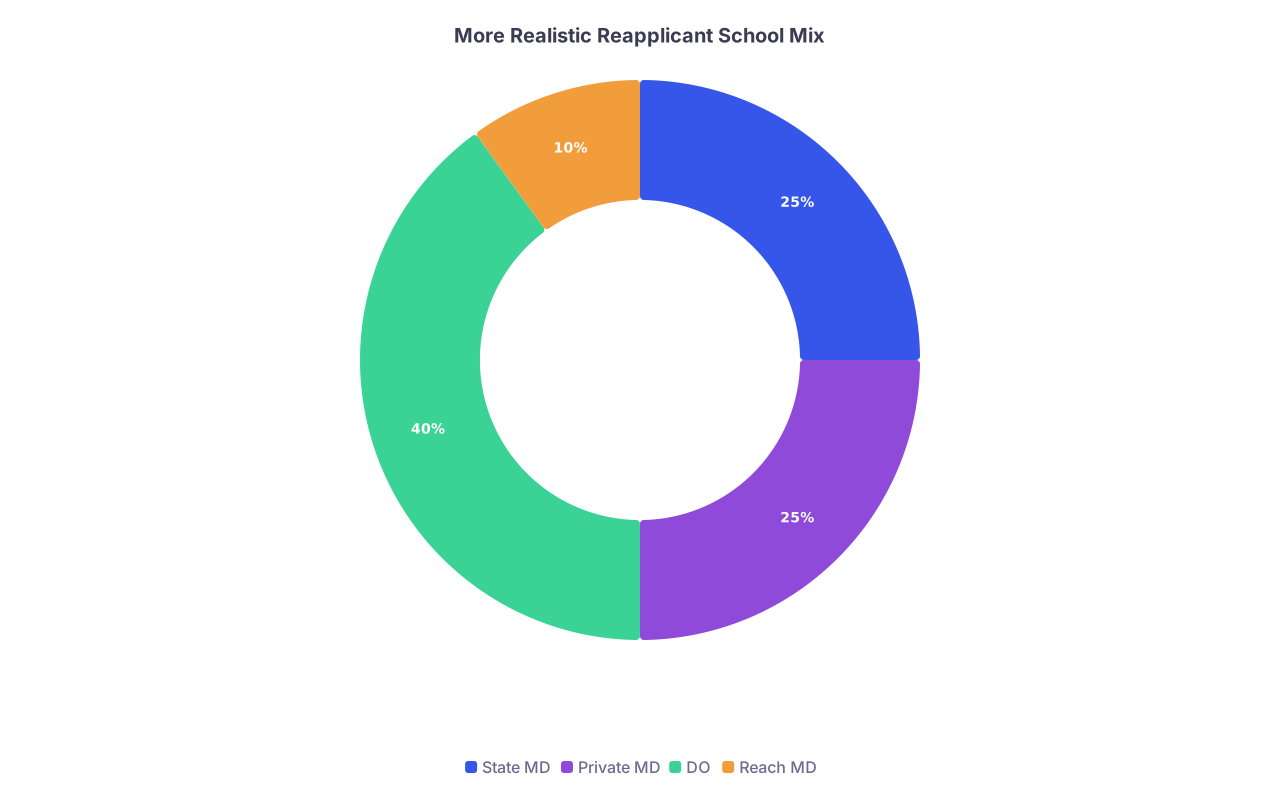
| Category | Value |
|---|---|
| State MD | 25 |
| Private MD | 25 |
| DO | 40 |
| Reach MD | 10 |
What if you’re just…tired?
Let’s be honest. Sometimes the loudest thought isn’t “How do I keep going?” It’s “I don’t know if I can keep living like this.”
The endless grind. The feeling of your life being on hold. Watching friends move on—residency, other careers, getting paid—and you’re still counting shadowing hours and rewriting personal statements.
So here’s the part I want you to hear very clearly:
You are allowed to stop.
You are allowed to pivot.
You are not a failure if you decide this path isn’t worth the cost anymore.
Your post‑bacc isn’t wasted even if you never step foot in an MD/DO program. You’ve proven you can master complex material, manage heavy workloads, and reinvent yourself academically. That translates to a lot of fields.
I’ve seen people after post‑bacc rejections go on to:
- PA school, where their clinical focus actually fit them better.
- Nursing and then NP, with more patient contact and shorter training.
- Public health, health policy, hospital administration.
- Totally different careers where they’re relieved they didn’t keep grinding out med school apps.
You don’t have to decide that today. But you do need to accept this: continuing on autopilot “because I already invested so much” is a trap. That’s sunk‑cost thinking. It’ll keep you stuck and miserable.

What you can actually do today
Here’s the concrete, non‑theoretical part.
Today—not next month, not “when I feel better”—do this:
- Pull up your AMCAS/AACOMAS summary and your MCAT score report.
- Open a blank document and write out:
- cGPA, sGPA, post‑bacc GPA
- MCAT total + section scores
- Number and types of schools you applied to
- Number of interviews, waitlists, rejections
- Email one person who can give you real feedback:
- Subject line: “Honest feedback on my unsuccessful application?”
- Attach your stats and school list.
- Ask: “If you had to guess, what are the top 2–3 reasons I didn’t get in, and what would you change first before I reapply?”
That’s it. Not your whole life plan. Just that.
Because right now your brain is running on “I finished a post‑bacc and still got rejected, so I’m doomed.” Replacing that vague doom with specific problems is how you get your power back.
Open your MCAT score report and your GPA breakdown right now. Look at them without flinching. That’s the first step out of this fog.