It’s August 15th. You just got your post-bacc welcome email and your schedule is finally set: Gen Chem I with lab, Bio I, maybe a night physics class. You’re excited and slightly nauseous. Because in the back of your mind is the real clock: “When do I actually apply to med school?”
This is the piece nobody explains clearly. The post-bacc year and the application year overlap. If you do this wrong, your classes, MCAT, letters, and AMCAS submission drift out of sync. Then you’re delayed a full cycle. I’ve watched people realize in March they’re actually two years away from med school, not one. Ugly moment.
So here’s the blunt version: I’m going to walk you month-by-month, starting from the day you start your post-bacc, all the way to clicking “Submit” on AMCAS. I’ll assume this timeline:
- You start your post-bacc in August Year 0
- You apply in June Year 1
- You hope to start med school in August Year 2
(See also: Glide Year Planning for structuring your year after post-bacc.)
Big Picture: How Your Months Actually Break Down
Before we zoom into each month, see the whole arc.
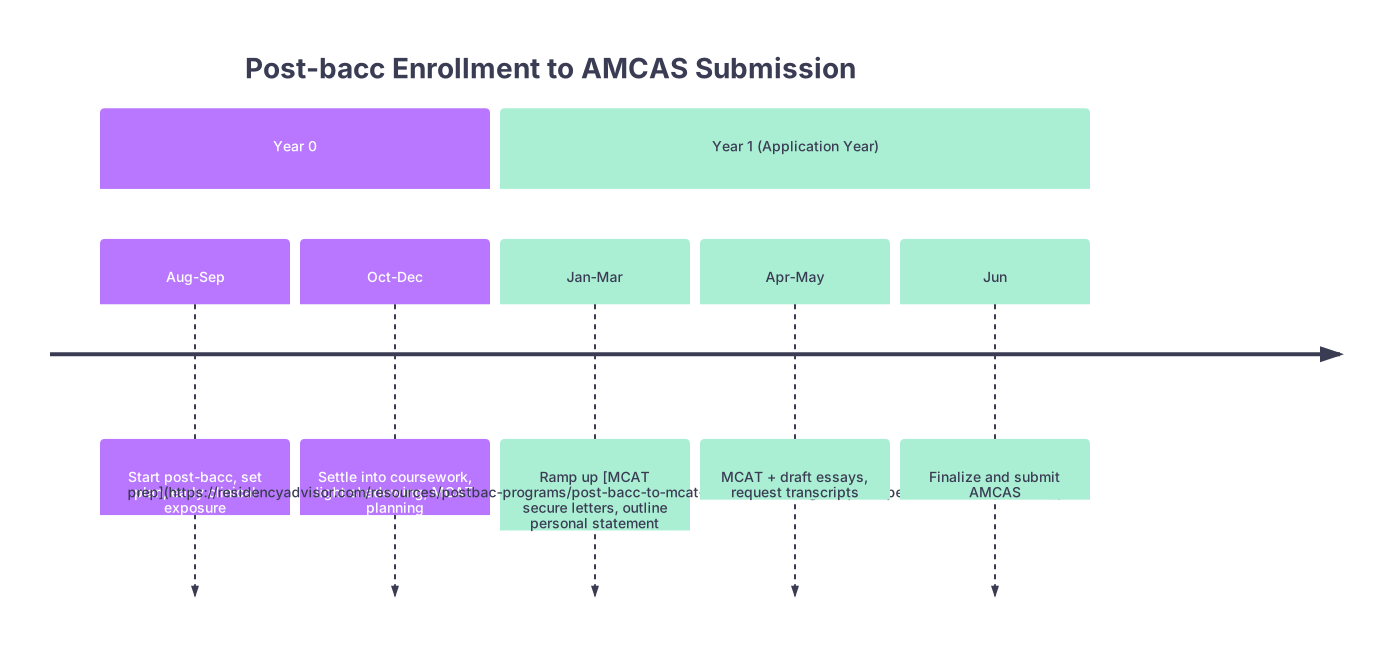
| Period | Event |
|---|---|
| Year 0 - Aug-Sep | Start post-bacc, set plan, early clinical exposure |
| Year 0 - Oct-Dec | Settle into coursework, light shadowing, MCAT planning |
| Year 1 (Application Year) - Jan-Mar | Ramp up [MCAT prep](https |
| Year 1 (Application Year) - Apr-May | MCAT + draft essays, request transcripts |
| Year 1 (Application Year) - Jun | Finalize and submit AMCAS |
Now let’s walk it out in order. Month by month. What you should actually be doing.
August (Year 0): Enrollment + Reality Check Month
You’re just starting the post-bacc. At this point you should:
Lock down your long-range plan
- Clarify: Are you on a 1-year academic plan (heavy course load) or 2-year?
- Decide which cycle you’re targeting:
- If you want to start med school right after your post-bacc (no gap year), you’re already too late. A true no-gap path requires prereqs mostly done before post-bacc.
- Most post-bacc students are on the +1 gap year path:
- Year 0: Start post-bacc
- Year 1: Finish post-bacc + apply
- Year 2: Start med school
Meet your premed advisor early
- Ask very specific questions:
- “When do your committee letters go out?”
- “What’s the deadline to be eligible for a committee letter?”
- “What percentage of students from this program apply at the end of year one vs year two?”
- Get a written outline (email follow-up) of:
- Required courses
- Recommended upper-levels
- Typical MCAT timing for your program’s students
- Ask very specific questions:
Set up your semester infrastructure
- At this point you should:
- Build one master calendar (Google Calendar, Notion, whatever) with:
- All exam dates
- All lab reports / major assignments
- Weekly blocks for review
- Add MCAT placeholder blocks starting January. Future you will thank you.
- Build one master calendar (Google Calendar, Notion, whatever) with:
- Identify 1–2 professors now you might want letters from:
- Sit front-ish
- Go to office hours in the first 2–3 weeks
- Let them see you as a person, not just “Student #47 in Bio 101”
- At this point you should:
September (Year 0): Academic Foundation + Light Exposure
The adrenaline is wearing off. Now it’s about consistency.
At this point you should:
Prove you can handle the workload
- First exam in Gen Chem or Bio is coming. Do not treat it as “just the first one.” Adcoms love to see strong starts.
- Study like you need an A on every exam. Because you do.
- Tighten your system:
- Weekly content review
- Anki or similar for high-yield concepts
- Problem sets spaced through the week, not crammed the night before
Start minimal clinical exposure
- If you have zero clinical history:
- Find a 3–4 hour/week gig:
- Hospital volunteer
- Clinic volunteer
- Scribe (if you can get trained quickly)
- The goal now: show consistent involvement across the year, not “heroics” later.
- Find a 3–4 hour/week gig:
- If you already have robust clinical experience from before:
- You can be slower here. Maybe start new shadowing later, but don’t ignore medicine completely.
- If you have zero clinical history:
Shadowing: one toe in the water
- Aim for 1–2 shadowing days this month or next:
- Primary care, IM, or EM are easy entry points.
- Ask: “Can I come back once a month?”
- You’re not stockpiling hours yet. You’re establishing connections.
- Aim for 1–2 shadowing days this month or next:
October (Year 0): Academic Momentum + MCAT Reality Check
Midterms are either happening or just hit you.
At this point you should:
Evaluate your performance honestly
- Look at your grades:
- If you’re below B+ in a science class, you need to change something. Immediately.
- Shift work hours if you’re working too much.
- Drop extracurriculars that are eating your time without major value.
- Talk to the professor of any borderline class. Not to argue points—just to ask:
- “What do high-performing students in this class typically do?”
- “What commonly trips people up on exams?”
- Look at your grades:
Do a MCAT baseline check (low-stress)
- You’re not studying seriously yet. But:
- Do a short diagnostic (even a free 1–2 hour sample or section).
- You just want to see:
- Reading speed
- Stamina
- How foreign the passages feel
- This will tell you how aggressive your prep timeline needs to be.
- You’re not studying seriously yet. But:
Tighten clinical + nonclinical service
- At this point you should:
- Be doing something that looks like helping humans, not just chasing a title:
- Free clinic
- Food pantry
- Crisis line (training might start now, shifts later)
- Be doing something that looks like helping humans, not just chasing a title:
- Aim for:
- 3–5 hours/week total volunteering (clinical + nonclinical combined) that you can sustain for 12+ months.
- At this point you should:
November (Year 0): Positioning for Letters + Spring Planning
This is where future letters of rec are built.
At this point you should:
Solidify relationships with 1–2 professors
- Go to office hours with a purpose:
- Ask about content you struggled with.
- Ask about their path into science or medicine-adjacent fields.
- You’re paving the way so that in March/April, you’re not a stranger asking for a strong letter.
- Go to office hours with a purpose:
Plan your Spring semester strategically
- Schedule Spring courses with:
- Balance (no triple-lab suicide unless you have no choice)
- MCAT in mind:
- If you plan a March–April MCAT, do not overload yourself.
- Optimize:
- Consider pushing a heavy elective to summer if possible.
- If you need Physics II or Orgo II for the MCAT, make sure those end before test day or early enough.
- Schedule Spring courses with:
MCAT strategy decision
- Pick a likely test window:
- Most post-baccs target March–April of Year 1.
- Rough rule:
- If you’ve never seen Orgo/Physics before, anything earlier than March is usually a mistake.
- Pick a likely test window:
December (Year 0): Finals + Quiet MCAT Setup
End of semester chaos. Don’t overcomplicate this month.
At this point you should:
Crush finals. GPA comes first.
- This is not negotiable. A pretty MCAT with a weak post-bacc GPA is not impressive.
- Clear weak spots now so you walk into Spring with confidence.
Light MCAT housekeeping over winter break
- After finals, in the lull:
- Buy or borrow a reputable MCAT prep set (Kaplan, TPR, Blueprint, etc.).
- Make your MCAT study skeleton:
- Which months = content review
- Which months = heavy practice
- Tentative full-length exam dates
- If you’re testing March/April, you’ll be in full swing by late January. Prep your schedule now.
- After finals, in the lull:
Reflect on your narrative
- Take a couple hours and write bullet points on:
- Why medicine? (real reasons, not slogans)
- What moments pushed you toward this?
- What doubts you’ve had and how you resolved them.
- This becomes raw material for your personal statement later.
- Take a couple hours and write bullet points on:
January (Year 1): Spring Start + MCAT Ramp-Up
New semester. New stakes. The application cycle is coming fast.
At this point you should:
Start structured MCAT prep (light-to-moderate)
- Time horizon:
- January → March test date: heavy ramp.
- January → May/June test date: moderate ramp.
- At minimum:
- 8–10 hours/week MCAT now (if March/April test)
- 5–7 hours/week if later test date
- Time horizon:
Reconfirm your target application year with advising
- Meet your advisor again:
- “With my current grades and course load, does applying this June make sense?”
- “Are there institutional deadlines I’m missing for committee letters or evaluation packets?”
- If they strongly advise waiting a year:
- Listen. But also ask why specifically. Weak GPA? Thin experiences? Not enough coursework?
- Meet your advisor again:
Step up responsibility in activities
- Update your clinical and nonclinical roles:
- Start taking more responsibility if you’ve been in a place for a while (training new volunteers, taking on recurring shifts).
- You want clear, longitudinal experiences when AMCAS opens.
- Update your clinical and nonclinical roles:
February (Year 1): MCAT Serious Mode + Letter Setup
You’re near mid-semester. No more pretending the MCAT is just “future you’s problem.”
At this point you should:
Tighten MCAT prep and assess
- Take a first full-length exam if your content base is reasonable.
- Doesn’t matter if the score is ugly.
- You need data: timing issues, sections that are disasters, endurance.
- Based on that:
- If you’re 10–15 points below your target, fine.
- If you’re 20+ points away and test is in 4–6 weeks, you might need to shift your test date.
- Take a first full-length exam if your content base is reasonable.
Identify your letter writers concretely
- Target:
- 2 science faculty (from post-bacc ideally)
- 1 additional (non-science, PI, supervisor, or committee letter depending on your program)
- At this point you should:
- Tell them explicitly: “I plan to apply this June and would be honored if you could write a strong letter when the time comes. I’ll follow up in April with details.”
- Ask what they need from you:
- CV
- Draft of personal statement (later)
- Transcript or grade summary
- Target:
Outline your personal statement
- Not a draft. Just an outline:
- Hook moment (not some cheesy “Since I was four…”)
- 2–3 key experiences: clinical, service, personal challenge
- Closing arc: how your post-bacc fits into your path
- The outline will save you weeks later.
- Not a draft. Just an outline:
March (Year 1): MCAT Peak + Application Skeleton
This is one of the heaviest months. Academics + MCAT + pre-application work.
At this point you should:
Hit peak MCAT effort
- If you’re testing late March/early April:
- 15–20 hours/week MCAT.
- Weekly full-lengths for last 3–4 weeks.
- If testing later (May/June):
- Build to 10–15 hours/week and start periodic full-lengths.
- If you’re testing late March/early April:
Start building your activities list
- Open a blank doc and create your AMCAS activities skeleton:
- List every relevant thing from the last ~5–7 years:
- Clinical experiences
- Shadowing
- Research
- Nonclinical service
- Teaching/tutoring
- Leadership
- Honors/awards
- List every relevant thing from the last ~5–7 years:
- For each, add:
- Name, organization, start/end dates, approximate hours
- 3–5 bullet points of what you actually did
- Identify your future “Most Meaningful” 2–3 experiences. Flag them now.
- Open a blank doc and create your AMCAS activities skeleton:
Confirm committee letter logistics
- At this point you should:
- Know exactly how letters will be sent to AMCAS:
- Committee packet vs individual letters
- Internal deadlines (many programs require your requests by March/April)
- Start any internal forms your program requires.
- Know exactly how letters will be sent to AMCAS:
- At this point you should:
April (Year 1): MCAT + Drafting Essays
The bandwidth squeeze is real here. You may be taking the MCAT this month. Either way, application writing starts now.
At this point you should:
Take the MCAT (for many of you)
- If your test is in April:
- Protect the 7–10 days before your exam as much as possible.
- Trim shifts.
- Delay optional events.
- Protect the 7–10 days before your exam as much as possible.
- After the exam:
- Take 2–3 days off from everything MCAT-related.
- Then shift mental energy to AMCAS.
- If your test is in April:
Write your first full personal statement draft
- Use the outline from February/March.
- Get a complete, ugly draft on the page:
- 1 clear core story
- 2–3 supporting experiences
- A conclusion that shows growth, not just “I know I want to be a doctor.”
- Then:
- Get 1–2 trusted readers (advisor, mentor, maybe one friend who writes well).
- Not ten people. Too many cooks ruins good essays.
Begin polishing your activities descriptions
- AMCAS activities = 15 max, with short character counts.
- At this point you should:
- Turn your earlier bullets into short, specific 1–2 sentence descriptions.
- For “Most Meaningful”:
- Add the reflection piece: what changed in you, not just what you did.
Formally request letters of recommendation
- Email your letter writers:
- Attach:
- CV
- Draft PS (if you’re not horrified to share)
- Unofficial transcript
- Brief summary of what you did in their class or under their supervision
- Give a clear deadline:
- “AMCAS opens in late May; I plan to submit in early June. Could you submit your letter by [date ~mid-late May]?”
- Attach:
- Email your letter writers:
May (Year 1): Final Assembly Before AMCAS Opens
AMCAS typically opens in late May. You’re in pre-launch mode now.
At this point you should:
Finish Spring semester strong
- Don’t let grades slip because you’re obsessed with essays.
- A bad semester right before you apply sends exactly the wrong message.
Refine and lock your personal statement
- Go through 2–3 thoughtful revisions. That’s usually enough.
- Avoid over-editing into robotic nonsense.
- By mid–late May, your PS should be:
- Clear
- Personal
- Error-free
- Then stop fussing with it.
Polish activities and finalize your list
- Cut any weak, filler items if you’re near 15 but stretching.
- Prioritize:
- Longitudinal experiences
- Roles with responsibility
- Make sure hours and dates are realistic and non-inflated. Adcoms can smell nonsense.
Do the annoying administrative work
- At this point you should:
- Request all official transcripts (post-bacc + undergrad + any community college courses).
- Do this as soon as AMCAS opens and your school can send to the correct cycle.
- Create your AMCAS account if you haven’t already.
- Start filling in:
- Biographical info
- Schools attended
- Coursework entry (this takes longer than you think)
- Request all official transcripts (post-bacc + undergrad + any community college courses).
- At this point you should:
Check letter status
- Gently follow up with any letter writer who hasn’t submitted:
- “Just checking in to see if you need anything else from me for the letter. My goal is to submit my primary application in early June.”
- Gently follow up with any letter writer who hasn’t submitted:
June (Year 1): AMCAS Submission Month
This is the month everything converges.
At this point you should:
Complete AMCAS data entry
- Double-check:
- Every course, grade, and credit hour matches your transcript.
- Activities entries are clean and typo-free.
- Your personal statement is pasted correctly (no weird formatting).
- Use at least 1–2 days between “I’m done” and actually submitting to catch small errors.
- Double-check:
Have your schools list reasonably solid
- Build a balanced list:
- A mix of:
- State schools (especially your in-state)
- Regionals where your stats are in range
- A few reaches, if your profile justifies them
- A mix of:
- You can tweak later, but don’t hit submit with a lazy, random list.
- Build a balanced list:
Verify letters and transcripts are inbound
- Your application can be submitted even if letters aren’t all in yet, but:
- Transcripts must be received for AMCAS to verify your app.
- Log into AMCAS:
- Check each transcript shows as “Received.”
- Confirm letter requests are correctly matched to the right med schools.
- Your application can be submitted even if letters aren’t all in yet, but:
Submit early, not perfect
- Target:
- Early to mid-June submission is ideal for most applicants.
- Don’t wait until everything in your life feels polished. That day won’t come.
- Make sure:
- No fatal errors
- No gaping holes in the app
- Then click submit.
- Target:
Immediately pivot to secondaries prep
- Once AMCAS is in:
- Pre-write common secondary essays (most schools recycle themes: “Why us?”, diversity, adversity, service).
- Build a document with:
- Your short bio paragraph
- Key stories you can reuse in different prompts
- Once AMCAS is in:
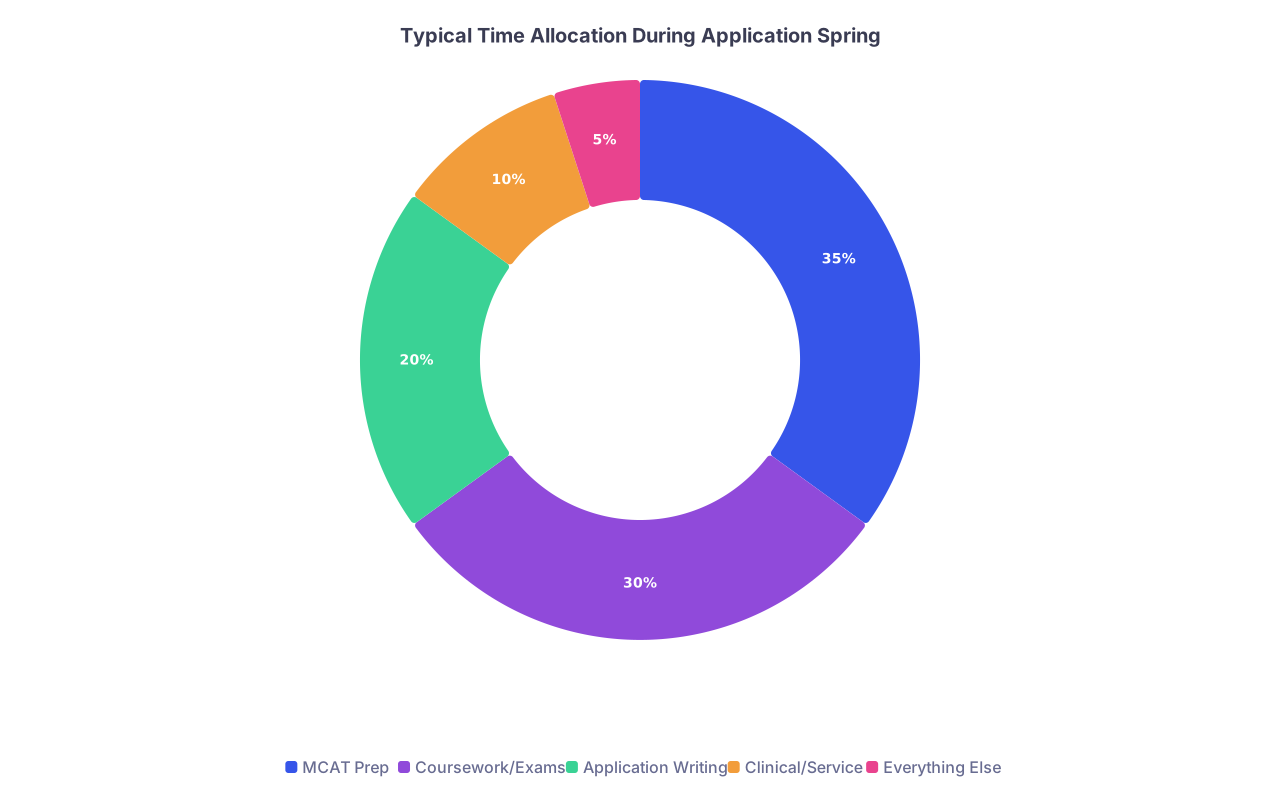
| Category | Value |
|---|---|
| MCAT Prep | 35 |
| Coursework/Exams | 30 |
| Application Writing | 20 |
| Clinical/Service | 10 |
| Everything Else | 5 |
If You’re Running Behind This Timeline
Quick reality check. If by:
- February/March you:
- Have shaky grades
- Haven’t started MCAT prep
- Have thin clinical/service exposure
…you may be better off delaying a cycle. I’ve seen people force a June app with a May MCAT they aren’t ready for and a scrambled personal statement. Most end up reapplying. That’s a much more painful delay than just planning one clean cycle later.
If you push your application to the next year:
- Use that extra year to:
- Strengthen GPA with more upper-level sciences
- Build substantial, longitudinal clinical and nonclinical work
- Take the MCAT in a calm, well-prepared window

Final 3 Things to Keep Straight
GPA first, always. A great MCAT cannot fix a sloppy post-bacc transcript. The months from August to May are about proving academic excellence.
MCAT and AMCAS overlap by design. Don’t wait for your MCAT to be done before starting essays and activities. If you do, you’ll be late.
Early, clean submission beats “perfect but late.” A solid application in mid-June almost always beats a marginally better one in August.
Follow the month-by-month checkpoints, and you’ll get to June with an application you’re not ashamed of—and a real shot at that next acceptance email.