The biggest mistake post-bacc students make with letters of recommendation is timing. Not content. Not writer choice. Timing.
You wait too long, or you ask too early with nothing to write about, and your “strong” letter turns into a generic paragraph that adcoms skim and forget. You’re in a compressed, high‑stakes window as a post-bacc; your timing has to be deliberate.
Here’s how to do it—month-by-month, then week-by-week—so those post-bacc LORs actually hit hard in AMCAS.
Big Picture: Where Post-Bacc LORs Fit in the AMCAS Timeline
At this point, you should zoom out and understand the whole year.
You’re juggling:
- Post-bacc coursework (often 1–2 intense semesters)
- MCAT prep
- Clinical/volunteering
- AMCAS timing (June submission, July–Aug secondaries, fall interviews)
Your letters sit right in the middle of that mess.
For a traditional premed, letters often come from undergrad over 2–3 years. For you, the post-bacc is a short, high-yield proving ground. That means:
- You need at least one strong science LOR from your post-bacc. Two is better.
- You need your letters uploaded to AMCAS by late June–July to avoid delays on secondaries review.
- You have only a few months with each professor to show who you are.
So the central rule:
Request letters 6–10 weeks before you need them submitted, and after you’ve already shown strong performance and engagement in that course or program.
Let’s break that down chronologically.
Timeline Overview: From Start of Post-Bacc to AMCAS Submission
Assume:
- You start your post-bacc in August (Fall start)
- You plan to submit AMCAS the following June
Adjust forward or back a few months if your start date is different; the logic is the same.
Year Timeline at a Glance
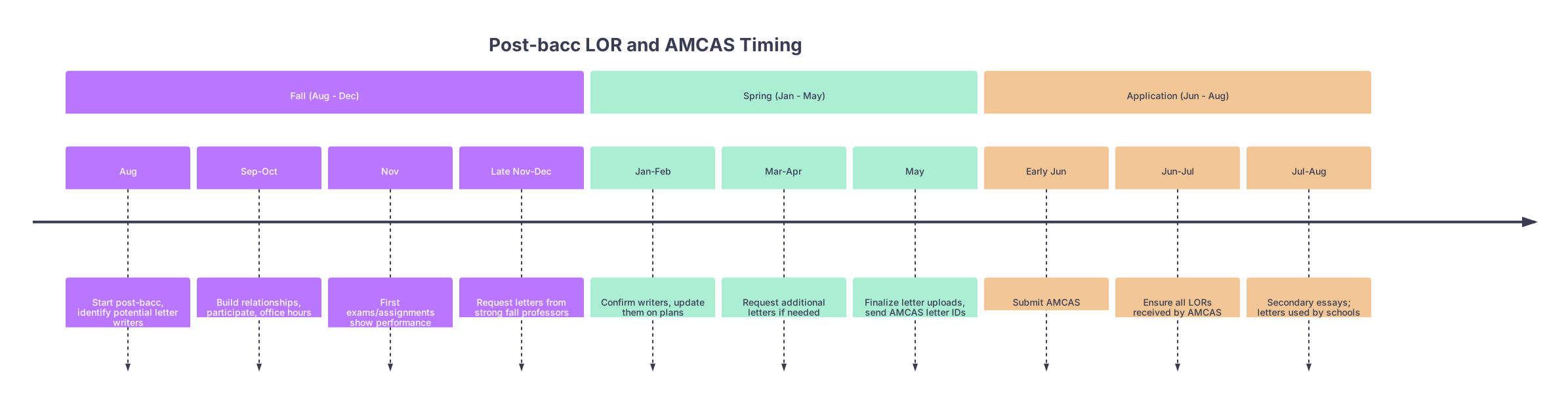
| Period | Event |
|---|---|
| Fall (Aug - Dec) - Aug | Start post-bacc, identify potential letter writers |
| Fall (Aug - Dec) - Sep-Oct | Build relationships, participate, office hours |
| Fall (Aug - Dec) - Nov | First exams/assignments show performance |
| Fall (Aug - Dec) - Late Nov-Dec | Request letters from strong fall professors |
| Spring (Jan - May) - Jan-Feb | Confirm writers, update them on plans |
| Spring (Jan - May) - Mar-Apr | Request additional letters if needed |
| Spring (Jan - May) - May | Finalize letter uploads, send AMCAS letter IDs |
| Application (Jun - Aug) - Early Jun | Submit AMCAS |
| Application (Jun - Aug) - Jun-Jul | Ensure all LORs received by AMCAS |
| Application (Jun - Aug) - Jul-Aug | Secondary essays; letters used by schools |
Now we go phase by phase.
Phase 1: First 4–6 Weeks of Your Post-Bacc – Do Not Request Yet
At this point (Weeks 1–4), you should not be asking for letters. You’re a name on a roster. That’s it.
Your only job right now is to earn the right to request a LOR later.
Weeks 1–2: Set Yourself Up
You should:
- Sit in the front third of the room. Be visible.
- Introduce yourself after the first or second class:
- Name, post-bacc status, brief goal: “I’m doing the post-bacc to apply to med school next cycle.”
- Go to office hours once early even if you don’t “need” help—come with a question about the material or the syllabus.
Your goal: by the end of Week 2, the professor can recognize you without checking the roster.
Weeks 3–6: Build a Real Relationship
By this point, you should:
- Have taken at least one quiz/exam or submitted assignments.
- Know your approximate standing in the class.
You should be:
- Asking thoughtful questions in class occasionally.
- Going to office hours a couple more times—once to review graded work, once to clarify concepts.
- Showing reliability: on-time, engaged, no drama.
Still do not request a letter yet. Why?
Because a good LOR needs:
- Evidence of your academic performance (ideally A-level work, or obvious improvement).
- Specific examples of your character, work ethic, or resilience.
That evidence doesn’t exist at Week 4. Give it a few more weeks.
Phase 2: Mid-Semester – The First Real Window to Request
At this point (Weeks 7–10 of the semester), you should be thinking about who and when.
You’ve probably had:
- One or two major exams
- Several quizzes/assignments
- Some office-hour interactions
Now we’re in decision territory.
When You Can Request: The Minimum Threshold
You’re ready to ask a professor for a post-bacc LOR when:
- You’ve completed at least one major exam or graded assignment in the course.
- You know you’re likely to earn an A or strong A- (or you’re clearly trending up and can explain it).
- The professor has seen you in office hours more than once.
- You’ve participated or engaged enough that they remember your name and story.
For a Fall semester starting late August:
- This moment usually lands late October to mid-November.
For a Spring semester:
- Think late March to mid-April if you’re applying that June.
Ideal Window for Maximum Impact
For AMCAS applications the following June, the highest-yield window to request post-bacc letters is:
- Late November–December (for Fall professors)
and - March–April (for Spring professors)
Why that window works:
- Professors have enough data to write meaningful comments.
- You give them 6–10 weeks before you’re actually depending on the letter being uploaded.
- They can mention midterm performance and progress, not just vibes.
If you’re in a one-year post-bacc finishing in May and applying the same cycle, your letters from Spring courses may be more general (based on early performance). That’s still better than having no post-bacc letters at all.
Month-by-Month Breakdown: August–August
Let’s zoom tighter and walk through your actual calendar.
August–September: Foundation, No Requests Yet
At this point, you should:
- Identify 2–3 potential science LOR writers:
- Core sciences: Gen Chem, Org, Bio, Physics, Biochem.
- Lab instructors can count if they’ve seen you work up close.
- Show up as the student who:
- Turns work in early or on time.
- Asks questions that show preparation.
- Talks briefly after class when appropriate.
Do not:
- Email asking for a letter “for the future.”
- Ask in Week 2 because you’re anxious. That reads desperate and premature.
October: Evaluate and Shortlist
By mid–late October, you should:
- Have at least one exam/quiz grade in each course.
- Know where you’re likely to earn A or high A-.
At this point, you should:
- Decide which 1–2 Fall professors you’ll likely ask.
- Intensify your engagement with those professors:
- Go to office hours after each major assessment.
- Ask for feedback on how to improve.
- Mention your trajectory: “I’m planning to apply to medical school in June; this class is a key part of my post-bacc.”
Still usually a bit early to actually request, but you’re close.
November: Prime Time to Ask Fall Professors
Late October to mid-November is where the real action is.
If:
- You’re clearly performing well (or improving strongly), and
- The professor knows who you are and what you’re aiming for,
then you can and should ask around this time.
You say something like (in person or by email if necessary, but in person is better):
“I’m planning to apply to medical school this coming June and would really value a strong letter of recommendation from someone who’s seen me in a rigorous science course as a post-bacc. Based on my performance so far in your class, would you feel comfortable writing a strong letter on my behalf?”
Key phrase: “strong letter”. You want honesty. If they hesitate, pivot to another professor.
When you ask in November:
- They can start drafting while your performance is fresh.
- They can submit any time from December through May.
- You’re giving them months of lead time before AMCAS opens.
December–January: Lock in Commitments, Provide Materials
By this point, you should:
- Have asked your Fall professor(s) for letters.
- Gotten clear yes/no answers.
- Provided them with a mini packet:
- Draft of your personal statement or a short career-goals paragraph
- Unofficial transcript or grade breakdown
- Resume/CV
- A short bullet list of things you hope they might highlight (e.g., “improvement from first midterm to second,” “managing heavy course load while working part-time”)
You’re not nagging for submission yet. Just setting them up to succeed.
If your application year is still a bit far (e.g., you’re doing a 2-year post-bacc), the same pattern holds; you just shift the AMCAS part one year later.
Spring Semester: Second Wave of Requests (and Final Prep)
Now assume you’re in January–May, the semester right before you apply in June.
January–February: Confirm and Reaffirm
At this point, you should:
- Gently confirm your Fall letter writers:
- A quick email: “Just checking in to confirm you’re still comfortable writing that letter for my medical school application this June. I’ll send you my AMCAS letter ID as soon as I have it.”
- Start building a relationship with at least one Spring science professor, especially if:
- You want one more LOR, or
- You didn’t get strong LOR options in the Fall.
March–April: Final Requests Before AMCAS Opens
If you need a Spring LOR (common for one-year post-baccs or for people redeeming a weak undergrad record), March–early April is your window.
At this point, you should:
- Have at least one exam or major assignment graded.
- Be confident you’re doing well or clearly showing strong improvement.
Then you ask, same phrasing:
“I’m applying this June to medical school and my post-bacc work is critical to my application. Would you feel comfortable writing a strong letter of recommendation based on my work in your class so far?”
Is it ideal that they’ve only known you for a couple of months? No. But admissions committees understand this in formal post-baccs and one-year programs. They know the timelines are tight.
AMCAS-Specific Timing: When Letters Actually Need to Be In
Now we match your post-bacc LOR timing with AMCAS reality.
Early June: AMCAS Opens for Submission
At this point, you should:
- Have already:
- Asked your writers (months ago).
- Confirmed they’re on board.
- Provided them with background materials.
When you create your AMCAS letter entries, you’ll get:
- Letter ID numbers for each letter.
Then you:
- Send each writer:
- Their specific Letter ID
- Your AAMC ID
- Submission instructions (AMCAS letter service, Interfolio, or your post-bacc’s committee process)
Important: AMCAS does not need letters in to let you submit. You can submit your primary without any letters attached. But schools won’t review you fully—and certainly won’t invite interviews—without them.
June–July: The Real LOR Deadline (That Nobody States Clearly)
Here’s what actually happens in the real world:
- You submit AMCAS in early June.
- AMCAS verifies your application in about 2–4 weeks.
- Schools start sending secondaries quickly, often automatically.
- Admissions committees start reviewing completed files July–August.
A “completed” file usually means:
- Verified AMCAS primary
- Secondary essays submitted
- All required letters of recommendation received
So for maximum impact (i.e., to be in the early group fully ready for review), your post-bacc letters should be received by AMCAS no later than mid-July, ideally earlier.
That means you should tell your writers:
“My application will be ready for review in July. It would help me a lot if your letter could be submitted by July 1–10.”
Count backwards:
- If you want letters in by early July, you should have:
- Asked in November–April
- Sent all AMCAS IDs and formal instructions by early June
- Reminded once in late June if it’s still not showing as received
You are not asking for letters in June. You’re just closing the loop.
Week-by-Week in the Final Stretch (April–July)
Let’s get painfully specific.
April
At this point, you should:
- Have all letter writers confirmed (Fall + Spring).
- Know exactly who is writing:
- At least one science post-bacc professor
- Possibly a second science professor or PI
- Maybe a non-science or clinical supervisor if relevant
You email each:
- Thanking them again
- Letting them know your exact AMCAS submission month (June)
May
You’re wrapping courses, prepping for finals, and probably juggling MCAT or secondaries outlines.
You should:
- Finish strong academically to match the story your letters will tell.
- Prepare:
- Updated CV
- Final personal statement draft
- Any transcript updates
Have these ready to send when AMCAS opens.
Early June (Week 1–2 After AMCAS Opens for Submission)
To do:
- Create your AMCAS letter entries.
- Generate Letter IDs.
- Email each writer:
- Letter ID
- AAMC ID
- Deadline request: “If possible, by July 1–10.”
- Attach updated personal statement and CV.
Late June
At this point, you should:
- Have submitted AMCAS (early is best).
- Log into AMCAS and check which letters are “Received”.
If a letter is missing:
- Send one polite reminder:
- “Just a quick check-in to see if you might be able to submit by July 10. I really appreciate your support.”
No weekly nagging. One reminder is enough.
July
By mid-July:
- Your goal is to have:
- AMCAS verified
- Secondaries mostly or fully submitted
- All letters marked “Received”
That’s when you’re truly “complete” and in the early applicant pool at most schools.
Red Flags and Bad Timing Moves to Avoid
At this point, you should know what not to do:
Asking in Week 1–3 of the course
- They don’t know you.
- The letter will say nothing meaningful.
Waiting until May of your application year to ask
- Professors are slammed with finals and graduation.
- You’ll get rushed, shallow letters (or a flat “no”).
Not asking for a “strong” letter explicitly
- You risk getting a neutral or even subtly negative letter.
Relying only on old undergrad letters when you have a fresh post-bacc
- Admissions committees want recent, rigorous academic evidence.
- A 2018 letter from a humanities prof doesn’t fix a 2.9 science GPA without current proof.
Letting your program’s committee letter timeline surprise you
- Many formal post-baccs have internal deadlines (often Feb–Mar) for letter collection. Miss those and you’re in trouble.
Final Checkpoints: Are You On Track?
By now, you should be able to answer:
- Do I have at least one post-bacc science professor committed to writing a strong LOR?
- Did I ask them after they had real evidence of my performance (exams, assignments, office hours)?
- Will my letters be in AMCAS by early–mid July at the latest?
If those are all yes, your timing is solid.
Key takeaways:
- Ask post-bacc professors for LORs after they’ve seen real work from you—usually late in the semester, not at the start.
- Lock in commitments months before AMCAS opens and aim for letters to arrive by early July for full early-cycle impact.
- Treat timing as strategy: your compressed post-bacc window can work for you, but only if you plan your asks and reminders as deliberately as your MCAT and coursework.