You’re six months from finishing your post-bacc. Your organic grade just posted, you’re finally convincing yourself you can actually do this… and now you’re staring at MCAT test dates, class schedules, and everyone’s “perfect” study plan on Reddit.
You’re asking the right question: When should you take the MCAT, and how do you schedule it around a post-bacc so you actually peak—mentally and score-wise—on test day instead of crawling in half-burned-out?
(See also: Month-by-Month Timeline: From Post-Bacc Enrollment to AMCAS Submission for a detailed guide on planning your post-bacc journey.)
Let’s walk this chronologically. I’ll assume you’re a typical post-bacc student:
- Doing a 1–2 year career-changer or academic enhancer program
- Balancing heavy science coursework (chem, orgo, bio, physics)
- Planning to apply in an upcoming cycle (or debating whether to delay)
Adjust specifics a bit for your situation, but the framework stays the same.
Big Picture Timeline: From First Post-Bacc Semester to MCAT
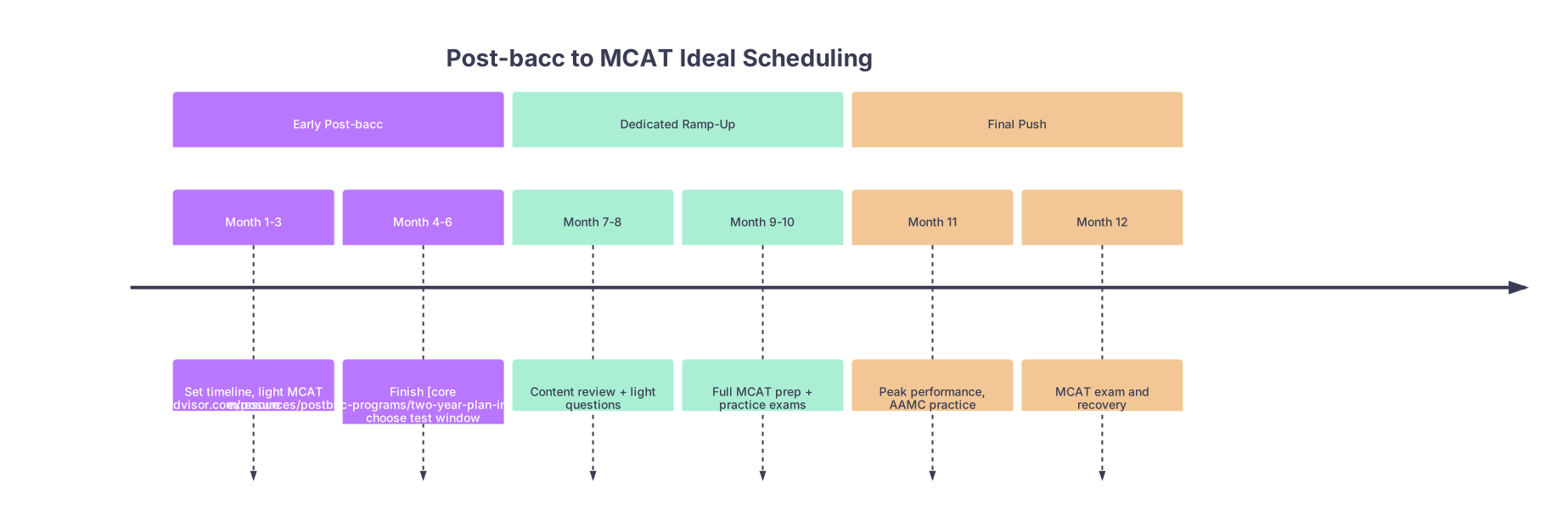
| Period | Event |
|---|---|
| Early Post-bacc - Month 1-3 | Set timeline, light MCAT exposure |
| Early Post-bacc - Month 4-6 | Finish [core sciences](https |
| Dedicated Ramp-Up - Month 7-8 | Content review + light questions |
| Dedicated Ramp-Up - Month 9-10 | Full MCAT prep + practice exams |
| Final Push - Month 11 | Peak performance, AAMC practice |
| Final Push - Month 12 | MCAT exam and recovery |
Here’s the blunt truth: most post-baccs screw up not by “studying wrong” but by timing wrong. They either:
- Take the MCAT while drowning in upper-level classes… or
- Wait too long, forget content, and drag out the misery
Your goal is simple:
- Finish the core sciences before the exam (or as close as humanly possible)
- Give yourself 8–12 weeks of structured prep where the MCAT is a primary priority
- Align your test date with your application cycle so scores are ready when schools start looking
Now let’s zoom in.
Phase 1: First Post-Bacc Semester – Set the Timeline, Don’t Overcommit
You are here: Just starting or in your first semester of post-bacc. No MCAT scheduled yet. Do not buy the 17-book prep set and pretend you’ll “study a little each night.” You won’t. And you shouldn’t.
Months 1–3: Foundation + Planning (Not Full MCAT Studying)
At this point you should:
Map your coursework vs MCAT content
- Make a simple grid:
- General Chem I/II
- Organic I/II
- Physics I/II
- Bio I/II
- Biochem
- Psych/Soc
- Mark when each will be (or was) completed.
- Make a simple grid:
Decide your application year first, then back-calculate MCAT
- If you want to apply this upcoming cycle:
- Aim for MCAT by April–May of that year.
- If you’re applying next year:
- You can push the MCAT into late summer or fall, but earlier is usually better.
- If you want to apply this upcoming cycle:
Get light exposure to the exam
- Take one full-length diagnostic (Kaplan, Blueprint, or AAMC FL1 if you’re okay “using” a real one early).
- Don’t obsess over the score. Just understand the beast:
- 7.5 hours
- Four sections
- The reading burden (CARS shocks people who live in Anki).
Protect future dedicated time
- Look ahead 6–12 months and identify:
- Which semester is lighter
- When you can afford 10–15 fewer work hours per week
- Where a 10–12 week MCAT-heavy block could realistically exist
- Look ahead 6–12 months and identify:
If you’re working full-time and doing a full course load, you’re not going to “squeeze in” MCAT mastery. You need to deliberately carve space later. Now is when you plan that.
Phase 2: Core Sciences Nearly Done – Choose the Actual Test Window
You are here: You’ve done at least a semester, maybe two. You’ve taken (or are in) orgo and physics. You’re starting to feel the MCAT breathing down your neck.
This is where timing decisions matter the most.
When to Schedule the Test: 3–6 Months Before Your Exam
At this point you should:
- Check your prerequisites status
You want, ideally, done or in-progress by MCAT day:
- Gen Chem I/II
- Org Chem I/II
- Physics I/II
- Bio I/II
- Biochem
- Intro Psych + Intro Soc (or self-study)
If you’re missing multiple of those, you probably should not be testing in 3 months.
Pick the test month based on your actual life, not fantasy-you
- Heavy spring semester? Don’t test in March.
- Clinical job that explodes in summer? Maybe avoid June–July.
- Applying in the upcoming cycle? January–May is your realistic window.
Rough rule of thumb for post-bacc students
- Classic 1-year post-bacc, applying immediately after:
- MCAT around April of your post-bacc year
- 2-year post-bacc, applying during/after year 2:
- MCAT between January–June of year 2
- Career-changer who needs more content review:
- Lean toward late spring or early summer for extra ramp-up.
- Classic 1-year post-bacc, applying immediately after:
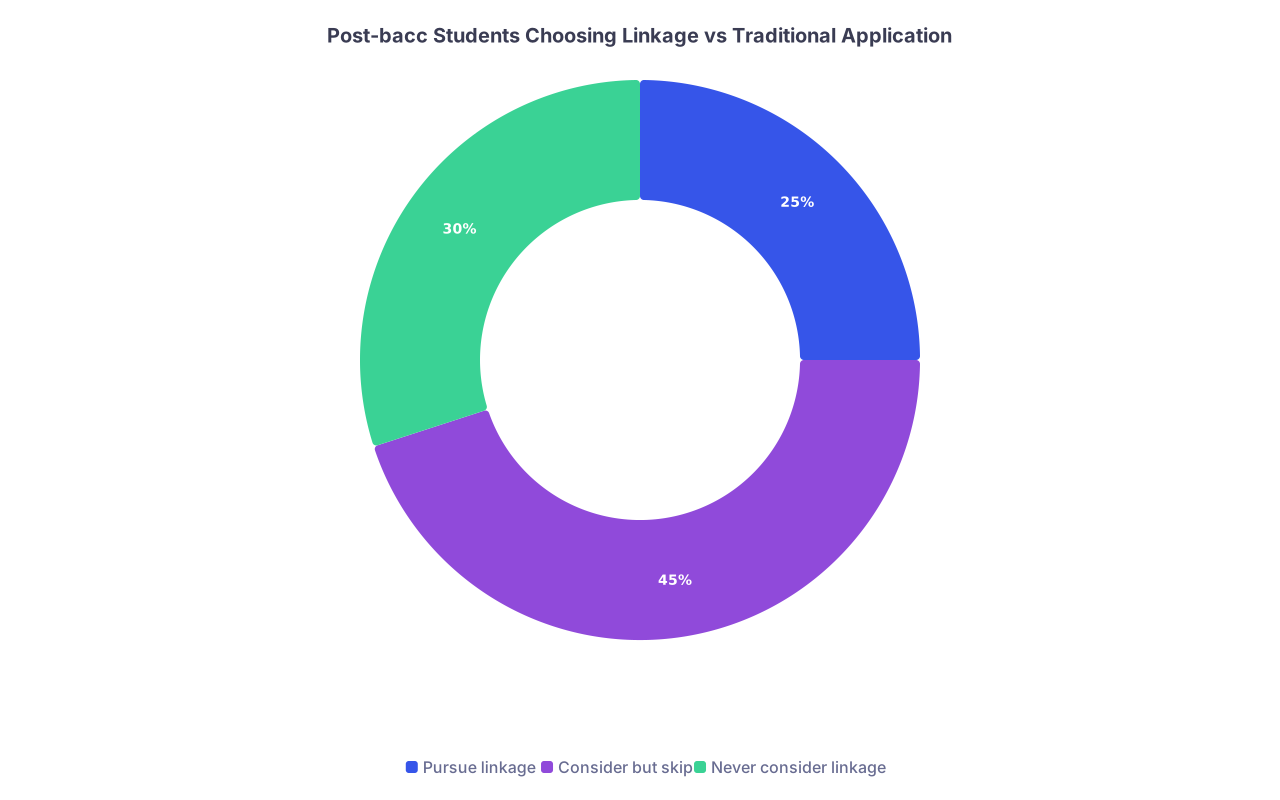
That chart is roughly what I see: April and May are peak. January is mostly for people who prepped the previous fall or took a gap period.
- Once you pick a month, book the date.
Not “when I feel ready.” Book it. That date becomes the axis you build your next 4–6 months around.
Phase 3: The Semester Before the Exam – The Ramp-Up (8–16 Weeks Out)
Now we get more granular. Let’s say you scheduled an early May MCAT. Here’s how I’d structure the months leading in.
You can adjust the calendar, but keep the intervals.
16–12 Weeks Out: Light but Consistent MCAT Layer
Example: MCAT in early May → This is mid-January to mid-February.
At this point you should:
- Be in a regular semester (12–16 credits max; if you’re above this, you’re crippling yourself).
- Commit 8–10 hours/week to MCAT, no more.
Weekly structure:
- 2–3 days: Content review (Kaplan/Princeton/Berkeley/Anki)
- 2 days: Mixed practice (UWorld/BluePrint/Khan Passages)
- 1 day: CARS only (30–60 minutes, 3–4 passages)
The purpose here is not to “finish content.” It’s to:
- Build endurance
- Normalize passages
- Find weak areas early
12–8 Weeks Out: Turn the Dial Up
This is mid-February to mid-March for a May exam.
At this point you should:
- Increase to 12–15 hours/week.
- Shift from pure review to review + practice.
Weekly rough plan:
- 2 days: Focused review on weak content (e.g., electrochem, fluids, amino acids)
- 2 days: Timed practice sets (30–45 questions/day)
- 1 day: CARS practice (3–5 passages)
- 1 day: Longer block: two sections back-to-back (no full-length yet, but test your stamina)
If your grades are sliding during this phase, you’re either:
- Overcommitting to MCAT, or
- Taking too heavy a course load
Fix that now. Don’t destroy your post-bacc GPA to squeeze in one more practice set.
Phase 4: Dedicated MCAT Block – 6–0 Weeks Before Test Day
This is where post-bacc timing makes or breaks you. Ideally your heaviest prep overlaps with your lightest coursework period.
First, Decide Your Dedicated Strategy
Ask: do you have a true dedicated block or a quasi-dedicated?
True dedicated:
- 4–8 weeks
- No classes (between semesters, or you took a light/online-only term)
- 30–40 hours/week MCAT
Quasi-dedicated:
- 6–10 weeks
- Still in 1–2 classes or part-time work
- 15–25 hours/week MCAT
You do not need a 3-month monastic retreat. But you do need a continuous run of weeks where the MCAT is a top priority, not an afterthought.
6–4 Weeks Out: Full-Lengths Begin
At this point you should:
- Start weekly full-length exams (not all AAMC yet; save those).
- Devote one full day per week to the FL and 1–1.5 days to review.
Example weekly schedule (quasi-dedicated, 20 hrs/wk):
- Day 1 (5–7 hrs): Full-length exam (3 sections if truly pressed, but ideally all 4)
- Day 2 (3–4 hrs): Review C/P & CARS from that exam
- Day 3 (3–4 hrs): Review B/B & P/S from that exam
- Day 4 (3–4 hrs): Targeted content review of patterns (e.g., every optics question you missed, every endocrine pathway you butchered)
- Day 5 (3–4 hrs): Extra practice sets in your weakest section
Your goal during this two-week chunk:
- Normalize the pain of a 7.5 hour sitting
- Get your timing under control
- Clean up dumb mistakes and test-taking issues
4–2 Weeks Out: AAMC-Heavy, Peak Performance Build
Now the exam is finally close enough that you should feel some healthy pressure.
At this point you should:
- Switch to AAMC full-lengths if you haven’t already.
- Maintain 1 full-length per week.
- Taper random new content; focus on:
- AAMC question logic
- Pattern recognition
- Execution
Rough schedule:
- Week -4: AAMC FL1
- Week -3: AAMC FL2
- Week -2: AAMC FL3
(If you have more, you can mix them with some earlier.)
Everything now revolves around:
- Sleep schedule aligning with test time
- Stamina and mental resilience
- Quick recall of high-yield facts (amino acids, enzymes, experimental logic, graph reading)
Final 7 Days: No Heroics
You’re not cramming biochem in the last 3 nights. That’s how you walk in mentally cooked.
At this point you should:
- Take your last full-length 5–7 days before your exam.
- Spend days -6 to -2:
- Light review of notes/Anki
- Skim error logs
- A few short, timed sets (15–30 questions) to keep your brain warmed up
Day -1:
- 60–90 minutes, max.
- No full passages.
- Review simple lists: formulas, units, standard amino acid properties, etc.
- Lock your logistics: route, timing, snacks, layers, ID, confirmation email.
Common Timing Mistakes Post-Bacc Students Make (And When They Happen)
You’ll avoid a lot of pain by recognizing these patterns early.
Mistake 1: Testing While Still in Core Sciences, Not After
When it shows up:
- People schedule a March MCAT while in Physics II and Biochem, “to get it over with.”
What happens:
- You burn time trying to “self-teach” entire courses while also learning them in real time.
- Scores plateau because your foundation isn’t there yet.
Fix:
- Push the test to late spring or early summer when those classes are complete or almost complete.
- Use your courses as MCAT prep (especially biochem and physics)—but only if the test is after them.
Mistake 2: Zero Dedicated Time
When it shows up:
- You maintain a full post-bacc load + work + MCAT all at 100%.
What happens:
- Chronic fatigue, mediocre prep, mediocre grades.
- You never have a week to just focus on test-taking skills and actual practice.
Fix:
- From Month 1, pick your 6–10 week window and plan your semester loads around it.
- Say no to extra electives or extra shifts in that window.
Mistake 3: “I’ll Just Take It and Retake If Needed”
When it shows up:
- Someone registers for an April test “to see how it is,” planning a “real” attempt in August.
What happens:
- First score is lower than hoped.
- Now you’re applying with either:
- A mediocre score, or
- An application on hold waiting for a retake
- And you’re burned out.
Fix:
- Treat your first attempt as your only attempt.
- If your full-lengths 2–3 weeks before exam are nowhere near your target range, reschedule, don’t “wing it.”
Sample Timelines: How This Plays Out in Real Life
Let me walk you through two realistic post-bacc → MCAT setups.
Scenario A: 1-Year Career-Changer Post-Bacc, Applying Immediately
August–December (Fall)
- Courses: Gen Chem I, Bio I, maybe Psych
- MCAT: Diagnostic + extremely light exposure only
- Goal: Figure out if medicine is actually for you. Protect GPA.
January–May (Spring)
- Courses: Gen Chem II, Bio II, Org I, maybe Physics I
- January: Pick June or late May MCAT date
- February–March: 8–10 hrs/wk MCAT layered in
- April–May: Shift to 15–20 hrs/wk, 1 FL every 1–2 weeks beginning late April
May–June (Post-Semester) – Dedicated Block
- 4–6 weeks, 30+ hrs/wk if possible
- Weekly AAMC FLs, deep review
- MCAT late May/June, application primaries submitted in June
Scenario B: 2-Year Academic Enhancer, Applying After Program
Year 1: Heavy coursework, minimal MCAT (one diagnostic, maybe light content review in summer)
Fall Year 2:
- Courses: Upper-level bio/biochem, maybe Physics II
- MCAT prep: 5–8 hrs/wk starting October
- Choose January–March MCAT date based on when physics/biochem complete
Late December–February (between terms or light term):
- 8–10 week quasi-dedicated
- 15–25 hrs/wk MCAT, weekly full-lengths starting around 6 weeks out
- Take MCAT Jan/Feb/March
- Use spring to finish post-bacc strong and prep applications
This second route is usually calmer, higher-yield, and better for both GPA and MCAT—if you can afford the extra year.
Weekly Scheduling Templates by Phase
You’re a post-bacc; your schedule is already a mess. Let’s make it slightly less chaotic.
During Regular Semester (Ramp-Up Phase, 10–15 hrs/wk)
Example (with classes Mon/Wed/Fri):
- Monday: Class-heavy day – no MCAT
- Tuesday: 2 hrs C/P content review + 1 hr CARS (evening)
- Wednesday: Light or no MCAT (focus on exams/problem sets)
- Thursday: 2 hrs B/B content + 1 hr P/S
- Friday: Off or 1 hr review (Anki, notes)
- Saturday: 3–4 hrs timed practice (mixed sections)
- Sunday: 2–3 hrs reviewing Saturday questions
You’re threading the MCAT through the week but not letting it devour you.
During Dedicated Block (True or Quasi, 20–35 hrs/wk)
Example dedicated week:
- Day 1: Full-length (7–7.5 hrs)
- Day 2: Review C/P and CARS from FL (4–5 hrs) + light content review (1–2 hrs)
- Day 3: Review B/B and P/S from FL (4–5 hrs) + extra practice on big weak area
- Day 4: Targeted practice sets (3–4 blocks of 30 questions)
- Day 5: CARS-heavy day (5–6 passages) + error log review
- Day 6: Mixed review, flashcards, formula review, short passages
- Day 7: Half-day or off (burnout prevention)
One More Thing: Mental Peak vs. Calendar Peak
There’s a point in everyone’s prep when they are mentally at their best for this test: hungry, focused, but not yet fried. That’s usually around weeks 6–9 of real, consistent prep.
Push way beyond that without breaks, and your scores stop improving even if your “hours studied” keep climbing.
So:
- Build in 1 lighter day/week
- Do not cram the last 72 hours
- Adjust if you feel yourself checking out mentally during practice exams
You’re not a robot. The MCAT doesn’t care that you “put in 400 hours.” It only cares what you can execute on that specific morning.
Your Concrete Next Step (Today)
Open your calendar—physical, Google, whatever you actually use.
- Count 6–9 months from today.
- Pick a realistic 10–12 week window inside that range where:
- You won’t be in your heaviest class semester
- You can drop or reduce work/other obligations
- Tentatively slot:
- MCAT date near the end of that window
- One full-length mock 6 weeks before that
- Write it down. Not “maybe.” Actually block it.
Then tonight, schedule a single diagnostic full-length within the next 2 weeks. That will anchor your planning in reality instead of vibes.
From there, you’ll know exactly where you stand—and exactly how aggressively you need to use the timeline we just laid out.