The biggest lie about post‑baccs is that “as long as you trend upward, you’re fine.” No. The timing of that upward trend can make or break your application.
You’re not just trying to improve; you’re on a fixed clock. Committees look at when your GPA turns around relative to when you apply. That’s what most premeds miss.
(See also: Month-by-Month Timeline: From Post-Bacc Enrollment to AMCAS Submission for detailed guidance.)
Let’s walk it the way adcoms actually see it: semester by semester, then mapped to your application year.
Big Picture: The Windows That Actually Matter
Before we slice it into months and weeks, you need the macro view.
There are three critical checkpoints for your post‑bacc GPA:
Checkpoint 1 – End of First Term (Proof of Concept)
- When: End of your first post‑bacc semester or quarter
- What schools look for:
- Did you immediately break your old pattern?
- Are you in 3.5–3.7+ range at minimum?
- This is where you prove you’re not the same student who got the 2.8 in undergrad.
Checkpoint 2 – End of First Full Academic Year (Establishing the New You)
- When: After 2 semesters / 3 quarters
- What schools look for:
- At least 24–30 credits of solid work
- A strong B+/A- average (3.6–3.8+) in hard sciences
- This is the first point where a trend actually “counts” as credible.
Checkpoint 3 – Right Before You Submit AMCAS/AACOMAS (Your Snapshot)
- When: End of the spring before your June submission
- What schools see:
- Every official grade through that spring
- Your updated cGPA and sGPA, including post‑bacc
- This is the GPA picture they will use to decide whether you pass the screen.
Everything else? Noise. Nice for your ego. Less relevant for your application.
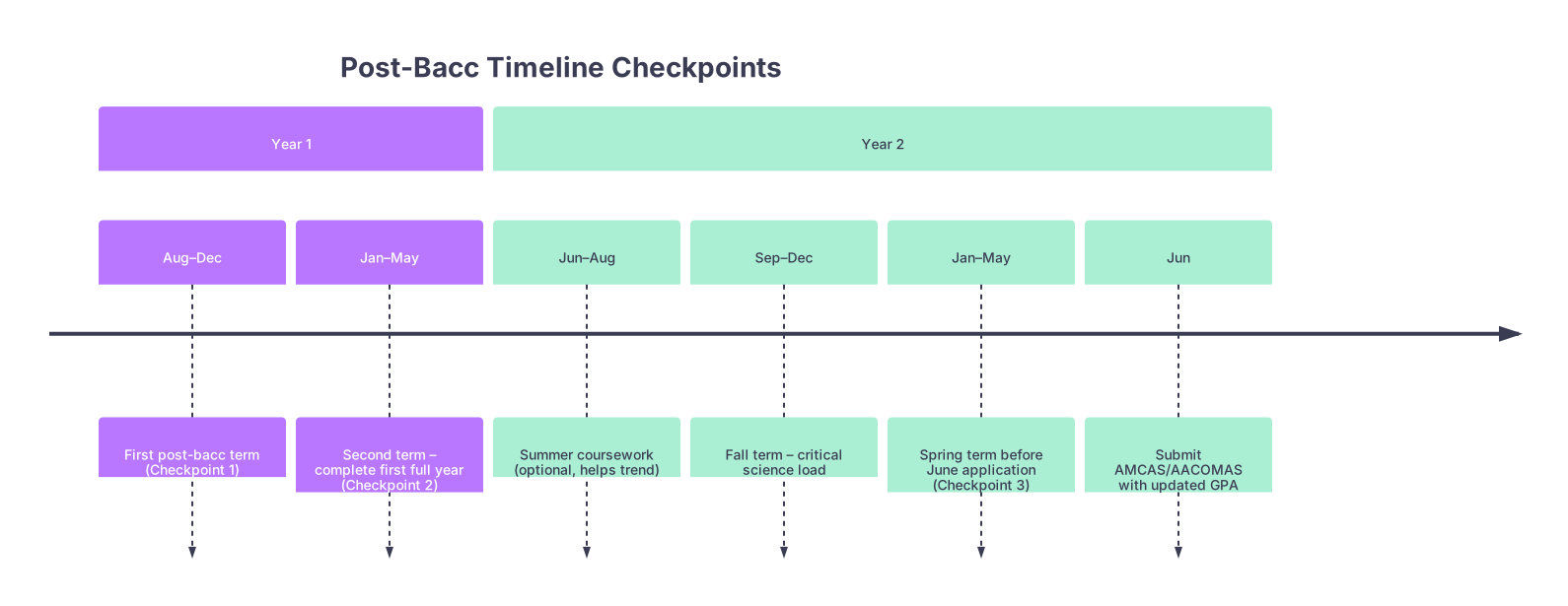
Here’s what that looks like across a typical two‑year post‑bacc tied to a June AMCAS submission:
| Period | Event |
|---|---|
| Year 1 - Aug–Dec | First post-bacc term (Checkpoint 1) |
| Year 1 - Jan–May | Second term – complete first full year (Checkpoint 2) |
| Year 2 - Jun–Aug | Summer coursework (optional, helps trend) |
| Year 2 - Sep–Dec | Fall term – critical science load |
| Year 2 - Jan–May | Spring term before June application (Checkpoint 3) |
| Year 2 - Jun | Submit AMCAS/AACOMAS with updated GPA |
Now let’s zoom in.
Before You Start: The Pre‑Post‑Bacc Reality Check (3–6 Months Out)
At this point you should stop guessing and get numbers.
3–6 Months Before Starting Your Post‑Bacc
You should:
- Pull every transcript you’ve ever generated
- Calculate:
- Overall cGPA
- Science GPA (sGPA): Bio, Chem, Phys, Math
- Identify your starting point:
- cGPA ≤ 3.0 → you’re in significant repair mode
- cGPA 3.0–3.3 → borderline, must show clear excellence now
- cGPA 3.3–3.5 → more flexibility, but your post‑bacc needs to be sharp
You’re not just asking “how can I improve;” you’re asking: “By when do I need to look credible?”
Roughly:
- Allopathic MD:
- Aim for post‑bacc 3.6–3.8+ with 30+ credits
- Osteopathic DO:
- A strong 3.4–3.6+ upward trend with recent A‑level work can work
If your projected improvement timeline can’t get you to something competitive by the spring before your application year, you either:
- Push your application back a year, or
- Redesign your plan (more credits, different program length, etc.)
Do this math before you enroll, not after your first C+ in orgo.
Year 1, Fall: First Term – The Shock and the Signal
This is Checkpoint 1. At this point you should be showing an abrupt break from your old performance.
Months 1–2 (Weeks 1–8)
Your GPA improvement is not visible yet. But the trajectory is already being set.
You should:
- Take 12–15 credits of serious coursework. No fluff.
- Examples: Gen Chem I + lab, Bio I + lab, maybe Psych or Math
- Treat this like an audition:
- Zero missed assignments
- Office hours by Week 2
- First exam prep starting 2 weeks out, not the night before
By mid‑term (Week 6–8), you should be:
- Scoring B+ or higher on major exams
- Already fixing whatever tanked your prior GPA (poor time management, working 40+ hours, never seeking help…)
If by mid‑term you’re sitting on C territory in multiple classes, that’s your alarm. Not in December. Now.
End of First Term: Checkpoint 1
By the end of this first term, adcoms want to see:
- Term GPA ≥ 3.5, ideally 3.7+
- In science classes, mostly A-/A and maybe a single B+ if the course is brutal
This is your “proof of concept” semester. One strong semester does not fix a 2.8 undergrad. But:
- A 3.8 in 14 credits of Bio/Chem/Stats says:
- Different maturity
- Different habits
- Different trajectory
If you end Fall with:
- < 3.3 → You need to reconsider timing. One more mediocre term and your trend is dead.
- 3.3–3.5 → Better, but not enough. You must crush the spring. No “finding your footing” excuses.
- 3.6–4.0 → Good. You’ve given yourself a real chance.
Year 1, Spring: First Full Academic Year – Checkpoint 2
Now the trend becomes real or collapses.
January–March (Weeks 1–10)
At this point you should:
- Be enrolled in another 12–15 credits:
- Gen Chem II + lab, Bio II + lab, maybe a stats/math/psych course
- Show consistency:
- Same or better performance than Fall
- No regression in difficulty (don’t dodge lab sciences in spring)
By mid‑spring:
- You should have:
- Two exam cycles behind you
- Grades in the B+/A- or better range
Ask yourself: “If the semester ended today, would my year‑long post‑bacc GPA be ≥ 3.6?”
If not, something changes now — tutoring, office hours, fewer work hours, different study structure.
End of Spring: Checkpoint 2 – First Full Year Completed
This is a major decision point.
By the end of your first full year (usually May):
- Total post‑bacc credits: 24–30
- Target post‑bacc GPA:
- MD‑aiming: ≥ 3.6, ideally 3.7–3.8
- DO‑aiming: ≥ 3.4, ideally 3.5–3.6+
Why this matters:
Adcoms don’t trust a “trend” based on 8–12 credits. Once you have ~30 credits, patterns harden.
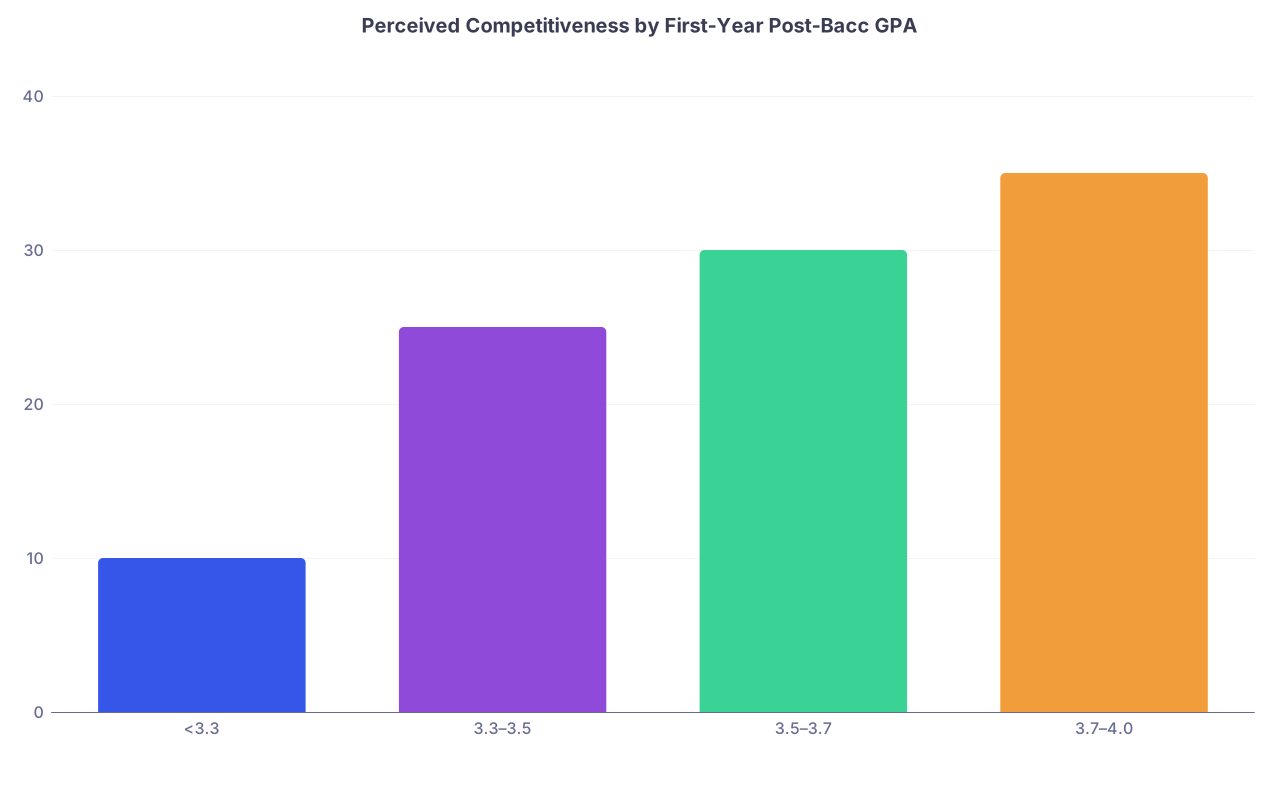
Here’s how committees implicitly categorize you:
| Category | Value |
|---|---|
| <3.3 | 10 |
| 3.3–3.5 | 25 |
| 3.5–3.7 | 30 |
| 3.7–4.0 | 35 |
Interpretation:
- < 3.3 – Still risky. You haven’t convincingly changed.
- 3.3–3.5 – Mixed. Better, but not eye‑catching, especially for MD.
- 3.5–3.7 – Respectable. Combined with good MCAT, this can work.
- 3.7–4.0 – Strong. This is the profile that really changes minds.
If you planned to apply in the upcoming cycle after just one year, this is where the timing question hits:
- If your one‑year post‑bacc GPA is below 3.5, applying that summer is usually premature.
- If it’s 3.6–3.8+, and your cGPA has climbed into a semi‑competitive range, you at least have a case.
Summer After Year 1: Optional, But Timing‑Sensitive
If you’re on a two‑year plan (most of you should be), summer can quietly strengthen your trend.
At this point you should:
- Decide whether to:
- Take 6–8 credits of upper‑division sciences (e.g., Physiology, Microbiology)
- Focus on MCAT prep if you’re applying next year
- Keep the bar the same:
- Summer is not the time to slack and pick up B‑s “because it’s compressed”
By the end of summer:
- If you add grades, they should reinforce your first‑year story:
- Another 6–8 credits of A/A- work
- If you don’t take summer, that’s fine. But your second‑year fall becomes even more critical.
Year 2, Fall: The Make‑or‑Break Semester Before MCAT & Applications
This is the semester most applicants underestimate. It’s the last full term that will be 100% visible and baked into your GPA by the time you’re writing your personal statement and school list.
August–October (Weeks 1–10)
At this point you should:
- Be enrolled in upper‑division sciences:
- Examples: Biochemistry, Genetics, Cell Bio, Physiology
- Maintain or increase rigor:
- If Year 1 was Gen Bio/Chem, Year 2 should not be Psych + Nutrition + easy electives
By mid‑fall:
- Your cumulative post‑bacc GPA should be:
- Still ≥ 3.6 if MD is on your radar
- No downward drift
If your fall midterm grades suggest you’re slipping (e.g., staring at C+ in Biochem):
- This isn’t just “a bad class.”
- This is your recency signal collapsing right before applications.
You may need to:
- Drop a class before it becomes a transcript wound
- Reconsider your application year
- Or massively restructure your time (I’ve watched people keep a pointless part‑time job and tank Biochem. Don’t be that story.)
December: End of Year 2 Fall
By the end of this term, you should be able to show:
- ~36–45 total post‑bacc credits
- An overall post‑bacc GPA:
- Strong MD hopeful: 3.7–3.8+
- DO or broader MD list: 3.5–3.7
This is often the GPA snapshot letter writers see. It also shapes how advisors answer:
“Should I apply this coming June?”
If you’re sitting at 3.2 after 40 post‑bacc credits, harsh truth: the trend window for this application cycle is probably gone. One more good semester won’t magically rewrite the story.
Year 2, Spring: Final Grades Before Submission – Checkpoint 3
This is the last set of grades most schools will see before they screen your application. These spring grades often hit right as AMCAS verifies.
January–March (Weeks 1–10)
At this point you should:
- Be in your final core post‑bacc courses:
- Maybe Orgo II, Biochem II, or remaining upper‑divisions
- Already considering:
- MCAT timing
- Letters of recommendation
- Application timeline
Your goal here is no drama:
- No new withdrawals
- No surprise C’s
- No major decrease in course load that looks like you backed away from rigor
May: End of Spring – Checkpoint 3
By late May:
- Your complete GPA picture (undergrad + post‑bacc) is basically done
- For a June AMCAS submission, schools see:
- Undergrad cGPA
- Post‑bacc GPA
- Combined updated cGPA and sGPA
At this point you should have:
- 45–60 post‑bacc credits (for a traditional 2‑year build)
- Post‑bacc GPA:
- MD: 3.6–3.8+ with clear upward trend
- DO: 3.4–3.6+ with clear upward trend
- A combined recent GPA (last 30–40 credits) that looks like:
- Mostly A/A- in hard sciences
Then you lock that in and submit in June.
If your improvement doesn’t really show until after this spring (e.g., you’re planning heroic grades in the summer after you apply), understand this:
- Many MD schools will not factor those later grades heavily into initial screening
- DO schools and some MD programs might look at updates, but you’re fighting uphill
Your improvement has to be visible by Checkpoint 3, not promised for some later semester.
What If Your Improvement Comes “Too Late”?
Let’s be blunt. There are three common late‑trend scenarios.
Scenario 1: Strong Spring, Weak Year 1
- Year 1: 3.1
- Year 2 Fall: 3.4
- Year 2 Spring: 3.8
You finally figured it out, but by Checkpoint 3 your overall post‑bacc GPA is maybe 3.4–3.5. That’s marginal for MD unless your MCAT is stellar and your original undergrad wasn’t a disaster.
Here the smarter move is often:
- Delay application by a year
- Add another 10–20 credits at your new strong performance level
- Let that higher‑level trend dominate your academic story
Scenario 2: Late Switch to Harder Courses
You crushed Psych, Nutrition, and easy A’s your first year, pulled a 3.9. Then you hit Orgo and Biochem in Year 2 and land B‑/C+.
Adcoms are not fooled by your timeline:
- They look at course rigor by term
- If your improvement stops the second material gets challenging, your “trend” evaporates
This isn’t about time. It’s about the wrong sequence. You improved early in low‑rigor classes when it doesn’t count as much.
Scenario 3: You Start Weak, Then Climb and Plateau
- First post‑bacc term: 3.0
- Second: 3.4
- Third and fourth: around 3.5
Is that an improvement? Yes.
Is it the kind of turnaround that overcomes a rough undergrad? Usually not for MD, possibly for DO depending on the full context.
In this case, you don’t have a timing problem. You have a ceiling problem. The “new you” tops out at B+/A‑ range with some inconsistency. That limits how persuasive any timeline looks.
Putting It All Together: A Year‑by‑Year Snapshot
Here’s how your checkpoints should roughly look if you’re doing this right on a 2‑year build:
Before Post‑Bacc Starts
- Know your numbers (cGPA, sGPA, target programs)
- Plan at least 30–45 post‑bacc credits
End of Year 1 (Checkpoint 2)
- Credits: 24–30
- Target post‑bacc GPA:
- MD track: 3.6–3.8+
- DO track: 3.4–3.6+
End of Year 2 Fall
- Credits: 36–45
- Trend: Stable or improving
- No new weak semesters
End of Year 2 Spring (Checkpoint 3)
- Credits: 45–60
- Post‑bacc GPA solidly in your target range
- Recent 30–40 credits: almost all A/A- in real sciences
At that point, your timing lines up: your transformation is visible, documented, and ready to be evaluated the same year you apply.
Final Takeaways
- Upward trend alone is overrated; you need that trend to peak by the spring before you apply, not sometime after.
- The three real checkpoints are: end of first term (proof of change), end of first full year (credible trend), and end of spring before submission (final snapshot).
- If your improvement shows up late or weak at those checkpoints, do not rush your application year; fix the timeline first, then apply.