The idea that “more science classes always help” is wrong. Advanced physiology and pathophysiology in post-bacc programs can either be a strong positive signal to MD programs—or a quiet red flag. Depends entirely on how, where, and why you take them.
Let me break this down specifically, because this is one of those topics that adcoms, advisors, and students all talk about, but rarely with precision. You are not just “taking more upper-division science.” You are sending a calibrated signal about readiness for medical school physiology, performance under graduate-level rigor, and whether your academic narrative is trending up or stagnating.
Why Advanced Physiology in a Post-Bacc Even Matters
Medical schools are drowning in applicants with 3.7+ GPAs, 510+ MCATs, and long lists of “upper-level biology.” So MD programs use a few silent filters:
(See also: Committee Letters from Post-Baccs for more details.)
- Can you handle medical-school-type content density?
- Can you synthesize systems instead of just memorizing pathways?
- Have you recovered from earlier academic weaknesses, or are you still fragile?
Advanced physiology and pathophysiology in a post-bacc touch all three.
These courses matter most in three scenarios:
- You had a weak or mediocre undergraduate science GPA (≤3.3 science).
- You are a career changer without a traditional biology major.
- You are reapplying and need to prove higher-level academic resilience.
Strong performance in advanced physiology/pathophys tells adcoms: “Give this person harder content, they rise to it.” Mediocre performance says: “Even with a hand-picked post-bacc, they are still just average.” And you absolutely do not want that second message.
What “Advanced Physiology” Actually Signals to MD Programs
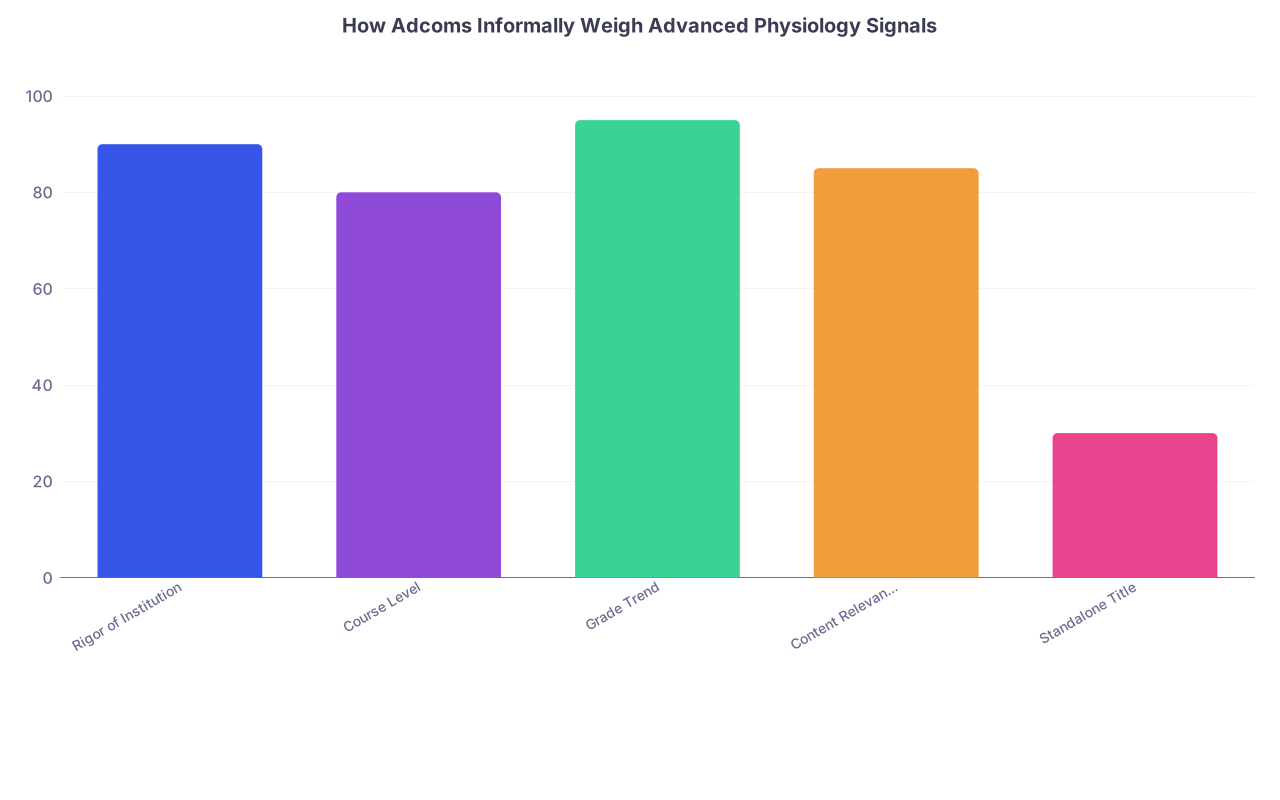
Adcoms are not impressed by course titles alone. “Advanced Physiology” at one place is “slightly harder A&P” at another. But there are patterns.
The signal they read is roughly this:
- Level: 300–400 level undergrad, or graduate-level (500+).
- Context: Part of a formal, structured post-bacc or taken ad hoc as non-degree.
- Institution: Rigorous 4-year university vs. random ungraded extension vs. community college.
- Trend: Upward trajectory in difficulty and performance.
- Relevance: Alignment with actual medical physiology content.
| Category | Value |
|---|---|
| Rigor of Institution | 90 |
| Course Level | 80 |
| Grade Trend | 95 |
| Content Relevance | 85 |
| Standalone Title | 30 |
They care much more about:
- Where you took the class
- When you took it relative to other coursework
- How you performed compared with earlier science
than about the exact name.
So if you want your advanced physiology to be a strong signal rather than noise, you aim for:
- A 300/400/graduate-level systemic physiology course with dense exams (not worksheet-based fluff).
- At a 4-year university, preferably with a decent prehealth/post-bacc reputation.
- Taken after or alongside other challenging courses, not as your only “hard” class.
Dissecting Types of Physiology / Pathophys Courses
Not all advanced physiology courses are created equal. MD adcoms do not sit down and memorize every course catalog, but patterns emerge when they see hundreds of transcripts a year.
1. Organ Systems Physiology (Gold Standard for Signal)
Typical titles:
“Human Physiology,” “Mammalian Physiology,” “Advanced Systems Physiology”
Core features:
- Structure by systems: cardiac, respiratory, renal, endocrine, neuro, GI.
- Heavy emphasis on mechanisms, regulation, and quantitative relationships (e.g., Starling forces, Fick principle, compliance curves).
- Exam questions requiring integration: “What happens to GFR, FF, and RBF if…?” rather than simple recall.
This is closest to medical school physiology. If you get A/A− in a rigorous systems physiology course at a solid institution, taken recently, MD programs see:
- Good: Ready to be thrown into first-year phys.
- Very good: If previous undergrad performance was mixed, this looks like academic redemption.
Weak grades here (B− or lower) in a post-bacc context have outsized negative impact. Because this is exactly the kind of class meant to reassure them.
2. Pathophysiology (High-Value but Double-Edged)
Typical titles:
“Advanced Human Pathophysiology,” “Clinical Pathophysiology,” “Medical Pathophysiology”
These sit in a tricky space. A few patterns I have seen:
- Nursing-focused pathophys: Sometimes lighter on mechanisms, more on clinical manifestations and nursing management.
- Graduate biomedical pathophys: Often dense, mechanism-heavy, and strongly predictive of med-school performance.
For MD programs, the signal depends on:
- Level: If it is a graduate (500+) course in a biomedical or health sciences department, and you earn an A, that is powerful.
- Rigor: Syllabus with disease mechanisms, molecular pathways, organ system integration, and exam-based evaluation.
Pathophysiology shines for applicants who:
- Already proved they can do basic physiology, and
- Want to show they can apply it to disease states.
But if your foundation is shaky, jumping straight into pathophys and pulling a B or B− is a net negative. It says you are already hitting your ceiling.
3. “Applied” or Mixed A&P (Low–Moderate Signal)
Typical titles:
“Anatomy and Physiology II,” “Human A&P for Health Professions,” “Exercise Physiology” (depending heavily on syllabus).
These often:
- Mix anatomy memorization with only superficial physiology.
- Use multiple-choice only, recall-heavy exams.
- Sit at 200-level and are designed for allied health programs.
For MD programs, this is basically neutral unless:
- You had terrible undergrad science grades and then pulled straight As in a package of these courses as part of a clear upward trend.
- Or the specific course is known at that institution to be rigorous, with MCAT-like or med-school-like expectations.
4. “Advanced Topics” Physiology (Neuro, CV, Renal Focused)
Typical titles:
“Cardiovascular Physiology,” “Cellular Neurophysiology,” “Renal and Body Fluids”
These can be extremely valuable, but only as part of a broader context.
Good scenario: You did poorly in undergrad, then:
- Took “Human Physiology” + “Cardiovascular Physiology” + “Neurophysiology”
- Got A/A− across the board at a strong institution
Now your signal is: “I can handle depth and complexity in multiple systems.” MD programs like this.
Bad scenario: You never took a solid broad human physiology, but jump into one obscure advanced topic, get a B+, and nothing else. That reads as unfocused and weak.
How Post-Bacc Structure Changes the Interpretation
MD programs absolutely differentiate between:
- Formal, structured post-bacc (e.g., Goucher, Bryn Mawr, Scripps, Temple ACMS, UC Irvine, etc.)
- DIY post-bacc at a 4-year institution
- Random collection of online/extension courses

| Step | Description |
|---|---|
| Step 1 | Transcript Review |
| Step 2 | Known rigor & structure |
| Step 3 | DIY but credible |
| Step 4 | Low-rigor / extension concern |
| Step 5 | Evaluate grades & trend |
| Step 6 | Use cautiously in academic assessment |
| Step 7 | Formal Post-bacc? |
| Step 8 | 4-year university? |
Formal Academic-Record-Enhancer Post-Baccs (GPA Repair)
Programs like Temple ACMS, BU MAMS, Cincinnati SMP, etc., sometimes include:
- Graduate-level medical physiology, often shared with MS or even med-student cohorts.
- Pathophysiology modules.
- Exams in NBME style, timed and integrated.
Here, advanced physiology is the core signal. An A here can partially offset a mediocre undergrad record. A B here is more damaging than a B in undergrad organic chemistry. Because now you are in an environment intentionally designed to simulate medical school.
Career-Changer Post-Baccs
Structured career-changer programs (Goucher, Bryn Mawr, etc.) are usually focused on core prereqs. Advanced physiology is optional or not offered.
If you are in a career-changer setup:
- MD programs already assume you will be strong if you perform well in the prereqs at those institutions.
- Adding advanced physiology on top (and acing it) can differentiate you in a crowded pool.
- But doing it and getting a B does not help. It just adds noise and stress.
Pure DIY Post-Bacc
This is most people.
Signals MD adcoms look for:
- Did you take advanced physiology at the same institution where you did your prereqs?
That shows continuity and familiarity with rigor. - Did you “shop” for easy online courses once things got hard?
That undercuts your credibility, fast.
Grade-wise, for a DIY post-bacc, the bar is clear: A or A− in advanced physiology or pathophys is beneficial. B or lower is neutral at best, negative if you are trying to prove you have changed.
Concrete Course Selection Strategy: What Actually Makes Sense
If you are trying to send the strongest signal, you need a strategy, not random course collecting.
If You Have a Weak or Mixed Science GPA
Target:
- Semester 1:
Biochemistry + Cell Biology (or Genetics) - Semester 2:
Advanced Human Physiology (systems-based) + another 300/400-level bio - Optional: Pathophysiology after a strong physiology performance
Physiology is not your first step. It is your proof that the earlier work was not a fluke.
If You Are a Career Changer with Strong Non-Science Background
You are not trying to “repair” GPA, you are trying to prove science readiness.
You do:
- Year 1: All core prereqs (Gen Chem, Bio, Physics, Orgo) with high grades.
- Then: One term or summer of Human Physiology at the same institution or a comparable 4-year university.
This tells MD programs: “I did the standard route and also sampled med-adjacent rigor. I was fine.”
You do not need pathophysiology. That is bonus, not requirement.
If You Are a Reapplicant / Borderline Profile
This is where advanced physiology really can change your outcome if you do it right.
Typical moves:
- Enroll in a structured academic enhancer or SMP with strong physiology content OR
- Build a tightly focused DIY post-bacc at a known institution.
You prioritize:
- Graduate medical physiology if you can access it and realistically earn an A.
- Or at least a high-level undergrad physiology plus one or two disease/applied courses.
You avoid:
- Scattershot online “Medical Physiology for Health Professionals” without strong grading standards.
- Any advanced course you are not willing to absolutely crush.
What Grades in Advanced Physiology Actually Mean to Adcoms
Let’s be blunt.
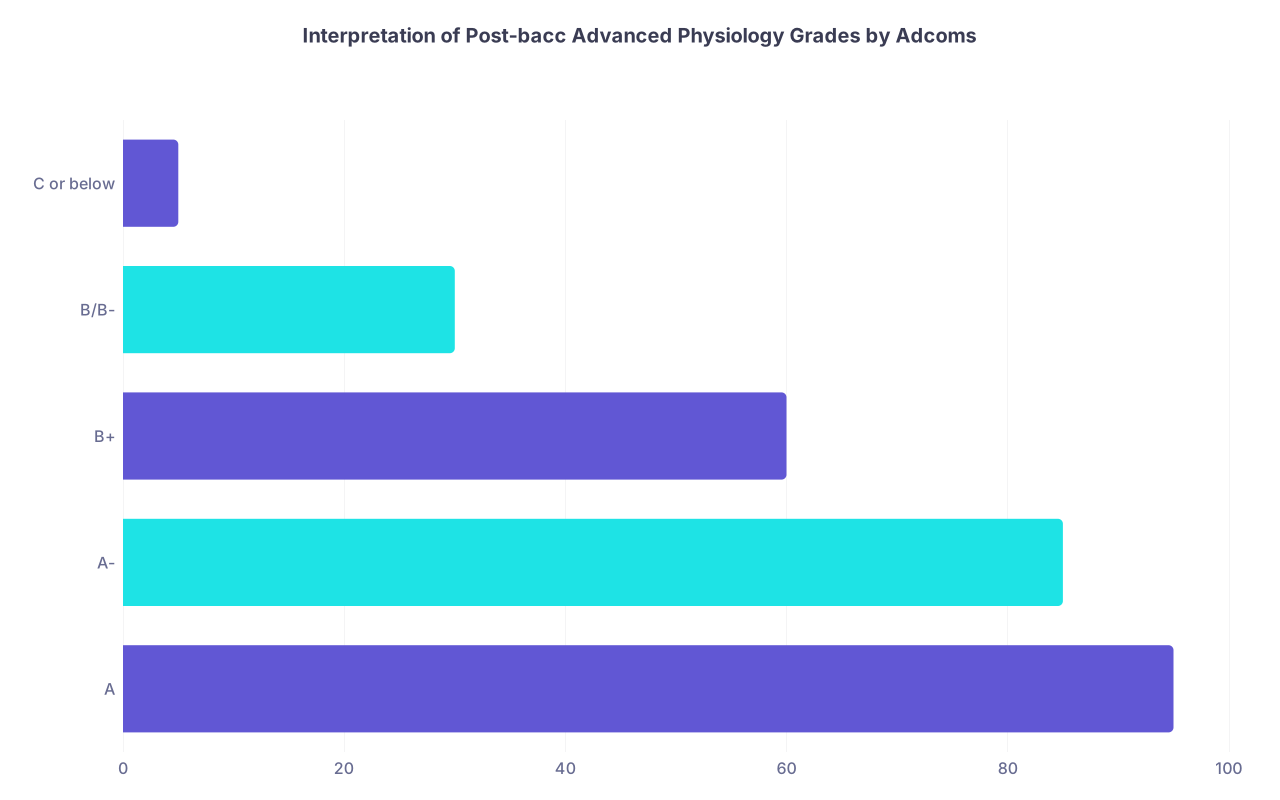
A in advanced physiology/pathophys (post-bacc context):
- Strong positive signal if:
- Prior GPA was weak and trend is clearly upward.
- Or you are in a rigorous formal post-bacc/SMP.
- Adds moderate value if:
- Your record was already strong; then it just confirms.
A−:
- Still good, especially in a rigorous program.
- If your earlier grades were C/B territory, A− is still redemption.
B+:
- Context-dependent.
- If everything else is A/A− in harder courses, one B+ is noise.
- If this is one of only a few upper-level sciences in your repair attempt, it looks like a ceiling.
B or below:
- In a formal academic enhancer/SMP: serious problem. Programs will hesitate to believe you can handle MS1.
- In a DIY post-bacc: neutral at best, often a quiet negative. You chose this course to prove something. You did not.
| Category | Value |
|---|---|
| A | 95 |
| A- | 85 |
| B+ | 60 |
| B/B- | 30 |
| C or below | 5 |
The main question they are asking: “If we gave this person our physiology block, would they be top third, middle, or struggling?” Your advanced physiology grade is one of the very few explicit datapoints that speak to that.
How to Choose Where to Take Advanced Physiology
This is where people get clever in the worst way possible—shopping for easy A’s online. MD programs see that pattern constantly.
Hierarchy of credibility (best to worst):
- Graduate-level physiology/pathophys at a medical school or biomedical sciences department.
- Advanced undergrad physiology at a respected 4-year university, in person.
- Advanced undergrad physiology at a regional 4-year, in person or synchronous.
- University extension with letter-graded, proctored exams and clear rigor.
- Community college or online-only allied health-style physiology for nurses/therapists.
If you are trying to repair GPA or show serious ability, you want to be in categories 1–3.
An online course is not automatically bad, but you should assume:
- It will be discounted compared to in-person.
- It will not rescue a weak pattern all by itself.
What MD Programs Learn About You Beyond the Grade
Physiology and pathophys are not just “more science”. They reveal habits and cognitive style in ways that intro bio never will.
From your transcript and performance, MD programs infer:
Can you integrate across organ systems?
Students who treat each lecture as separate often crash on integrative exams and, later, on Step exams.Do you handle quantitative reasoning?
Renal, respiratory, hemodynamics—these expose people who avoid math.Do you adapt to unfamiliar question styles?
Good physiology exams look like mini-board questions, not “define this term”.Can you sustain performance over a long, cumulative course?
Many physiology classes build relentlessly; a strong final exam matters.
In interviews, I have seen faculty ask directly:
- “Tell me about the most challenging science course you have taken recently.”
- “What did you learn from your physiology or pathophysiology coursework?”
- “How did your understanding of disease change after that class?”
If your answer is vague (“I learned how the body works more deeply”), it suggests you did not actually internalize much. If you can talk clearly about specific concepts—Frank-Starling, RAAS and heart failure, renal compensation in acid-base disorders—that is noticed.
How to Use Physiology to Strengthen Your Application Story
A lot of applicants treat transcripts and personal statements as separate universes. They are not. You can make your advanced physiology work for you twice: on paper and in narrative.
Tactically:
In your personal statement or secondary:
Briefly reference how advanced physiology changed the way you think about patients, not just that you “loved it.”
Example: connecting learning about preload/afterload to a shadowing experience in a cardiology clinic.In update letters (for reapplicants or late-cycle applicants):
Mention recent completion and grades in advanced physiology/pathophys with a one-line context: “This course used graduate-level exams modeled on medical physiology, and I finished with an A.”In interviews:
Be prepared to give one or two concrete examples of how physiology content affected your understanding of medicine or patient care.
This is how a simple line on your transcript becomes a thematic pillar: “Now I not only want to be a physician, I have begun to think like one at the systems level.”
Common Mistakes That Turn Physiology into a Weak Signal
I have watched people do this badly enough that it cost them cycles. You want to avoid:
Taking advanced physiology too early
Jumping into it while you are still shaky in basic chem/bio leads to middling performance. Better to build up first, then showcase.Overloading with 4–5 upper-level hard sciences at once
You are not in med school yet. If you tank the semester, the damage is permanent. Better: 2–3 high-yield upper-levels done extremely well.Chasing “easy A” online versions
Adcoms see patterns like: core prereqs at University X, then random one-off online advanced physiology from “Global Online Learning Institute.” This does not impress.Treating pathophys as a shortcut
Some think: “Pathophys looks more medical, that will impress them more.” Not if you get a B because you lacked physiology fundamentals. Pathophys is additive, not foundational.Ignoring the timing
Advanced physiology taken 6–8 years ago, with nothing scientific since, is weak. If you are applying now, you want recent (within 2–3 years) evidence.

Putting It Together: If You Are Deciding Right Now
If you are currently mid–post-bacc or planning one, ask yourself three blunt questions:
Do I need to repair my science record, or simply extend it?
- Repair = you must choose courses where you are extremely confident of getting A/A−, but they must also be clearly rigorous and med-adjacent.
- Extend = you are adding a few targeted upper-levels to an already solid record. Less risk, more optional.
Can I realistically earn an A in a solid physiology course given my current foundation?
If your Orgo, Biochem, and Cell Bio are B/B− territory, jumping into advanced physiology next term is gamble territory. Better to improve fundamentals first.Is the version I am considering going to be taken seriously by MD programs?
In-person, at a reputable 4-year or graduate program, with real exams and clear prerequisites? Good.
Self-paced, no-proctor online allied-health A&P for $299? That is a line item, not a signal.
If your answer to those three is coherent, advanced physiology or pathophysiology can be one of the most strategically valuable moves in your post-bacc arsenal.