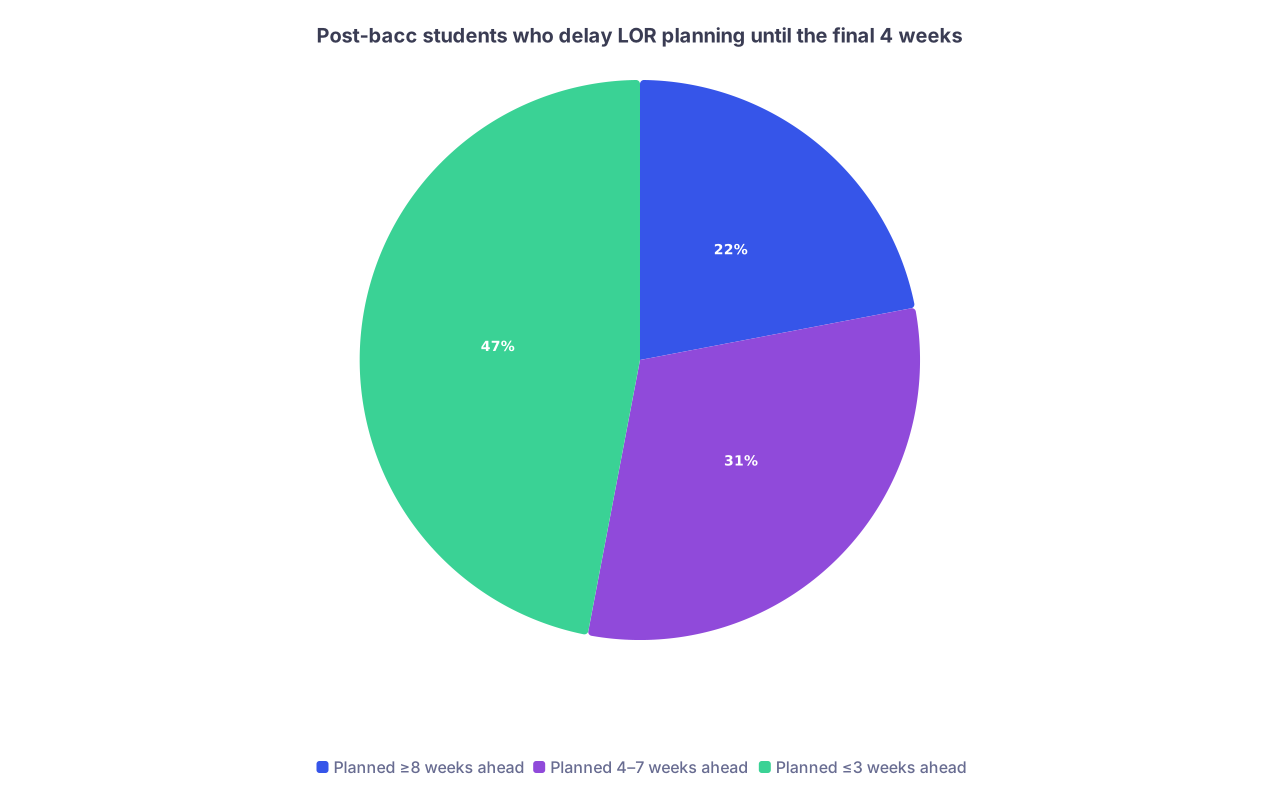
| Category | Value |
|---|---|
| Planned ≥8 weeks ahead | 22 |
| Planned 4–7 weeks ahead | 31 |
| Planned ≤3 weeks ahead | 47 |
Only 22% of post-bacc students lock in their strongest letter writers by the midpoint of their program. The rest scramble. And it shows in their applications.
You are in a very specific bind: short post-bacc, high stakes, limited face time with faculty, and a hard AMCAS / AACOMAS timeline. If you treat letters of recommendation (LORs) like an afterthought, you lose one of the very few “context” tools that can rescue a non-traditional transcript.
Let me break this down specifically for a short post-bacc (think 6–12 months, 1–3 semesters), where you do not have the luxury of slow relationship-building.
1. The Brutal Constraint: Short Program, Long Timeline
In a traditional 4‑year undergraduate path, a letter writer can know you for years. In a 9‑month post-bacc, you may see a professor 2–3 times a week for one semester, then you are gone. That compresses the relationship window and creates three overlapping timelines:
- The post-bacc academic calendar
- The med school application calendar
- The realistic LOR writing calendar (their time, not your fantasy version)
The mistake I see constantly: students time letters to their sense of “being ready” instead of to the professor’s bandwidth and the application cycle.
Let’s anchor the med school timing first.
- AMCAS opens: early May
- Submission allowed: late May / early June
- Verification backlog: weeks 1–8 of the cycle
- LORs must be in: ideally by the time your primary is verified and secondaries go out (June–July), absolutely by September for most MD/DO; earlier for rolling-heavy schools
Now overlay a one-year post-bacc that starts in late August and ends in May:
- Fall term: Aug–Dec
- Spring term: Jan–May
- You apply June after finishing, or sometimes during the spring if you are overlapping timelines
That means you do not have “years” to prove yourself. You have midterm 1, midterm 2, and a final. Maybe one project. That is it.
So here is the hard rule:
If a letter is not conceptually “secured” by halfway through the semester in which you want the professor to write for you, you are already behind.
You cannot fix a weak, vague, or late LOR with more email begging. You only fix it by structuring the semester deliberately from day one.
2. Who Should Write Your Letters in a Short Post-Bacc?
You are not building an abstract “committee” of respected names. You are building a small, strategically balanced set of advocates who can:
- Validate your academic repair trajectory
- Explain your non-traditional path without making excuses
- Speak to your current level (not your worst semester from 6 years ago)
- Map your performance to med school readiness
In a short post-bacc, your realistic LOR pool:
- Post-bacc science faculty
- Post-bacc program director or advisor
- Clinical supervisors (physician, PA, NP)
- Research PI (if you somehow grabbed a research spot quickly)
- Longstanding non-clinical supervisor or mentor (for character / work ethic)
If your prior undergrad record is weak or old, do not rely primarily on letters from that era. One polite, contextual letter from an undergrad mentor can be helpful; three undergrad letters and one fresh post-bacc letter is a red flag. It screams: “I did not stand out in the program that was supposed to fix my record.”
Aim for this core set for MD/DO:
- 2 strong science letters from your post-bacc (biology, chemistry, physics, or related)
- 1 clinically-oriented letter (physician or clinical supervisor)
- 1 “context” letter: program director/advisor or research mentor
If your program offers a committee letter, get it. But do not be naive: a committee letter built on weak underlying LORs is just a nicely formatted problem.
3. Exact Timeline: What to Do Week by Week
Let’s say you are in a 2‑semester post-bacc, starting in late August, planning to apply right after finishing in June. This is the scenario I see most.
Fall Semester (Primary LOR Foundation)
Weeks 1–2
Do not ask for letters. You are an unknown quantity. Instead:
- Sit in the front third of the class, consistently.
- Attend office hours at least once per week per key professor, even if briefly.
- Ask 1–2 specific content questions; avoid small talk that wastes their time.
- Make sure your name and face pair together in their mind. “The student who always asks about mechanisms, sits on the left, works full-time nights.”
Weeks 3–5
Now you are building signal.
- Perform on the first quiz / assignment. If you did poorly, fix it by exam 1.
- Use office hours to show how you think: walk through how you approached a problem, not just “what’s the answer?”
- Briefly mention your trajectory: “I am in this post-bacc to repair earlier grades and apply to medical school in [year]. This course is one of my key science courses.”
Still not asking for letters. You are demonstrating seriousness.
Weeks 6–8
By now you should have at least one graded exam under your belt.
If:
- You are scoring in the top ~10–20% of the class,
- You regularly engage in office hours, and
- The professor recognizes you without prompting,
then you can start laying groundwork for a future LOR, not yet formally requesting.
Example script at office hours:
“Dr. Lopez, I wanted to share that I am planning to apply to medical school after this post-bacc. One of my big goals here is to show I can handle upper-level science. If I continue to perform at this level, would you be comfortable considering a letter of recommendation later in the year, maybe after the final?”
You are not cornering them; you are testing the waters.
Watch their response very carefully:
- Enthusiastic: “Absolutely. Keep doing what you’re doing.” → Green light.
- Neutral / vague: “We can discuss that later.” → Yellow, may not yield a strong letter.
- Hesitant: “I typically only write for students I’ve known longer.” → Red. You pivot to other faculty.
Weeks 9–12
At this stage, you solidify.
- Continue the performance. High exam scores, strong participation if appropriate.
- Ask one or two professors explicitly by week 12 if they would be willing to write a strong letter for you for medical school.
Use that phrase: “strong letter.” It gives them an exit if they cannot.
Example email after a positive in-person conversation:
Subject: Request for Strong Letter of Recommendation – [Your Name], [Course, Term]
Dear Dr. Lopez,
Thank you for your mentorship in [Course]. I have really valued your feedback on my exams and our discussions in office hours.
I am applying to medical school in the upcoming cycle and would be honored if you would write a strong letter of recommendation on my behalf, reflecting my work in your course and my preparation for further study in the sciences.
If you are comfortable doing so, I would be happy to provide my CV, a brief summary of my academic history, and a draft of my personal statement once it is ready. Letters would be needed by early June, but I wanted to secure my writers early so you have plenty of notice.
Thank you for considering this.
Sincerely,
[Name]
[Program Name]
Note the timing: you are asking in November for a June letter. That is the correct degree of “early” for busy faculty.
Weeks 13–Finals
Once they have agreed:
- Confirm logistics: where it will be submitted (Interfolio, AMCAS letter ID, school-specific portal).
- Ask if they prefer a reminder closer to the due date. Many do.
- Keep working. A disaster on the final can undermine the letter content.
Spring Semester (Second Academic Letter + Context Letter)
You repeat the process with at least one new science professor in the spring. The goal:
- By week 8 of spring: you have at least one confirmed fall professor and one spring professor who has tentatively agreed.
For a program director/advisor letter:
- Meet them early in spring.
- Bring a one-page summary: prior GPA, post-bacc plan, MCAT plan, and target application year.
- Ask explicitly if part of their role includes writing letters for post-bacc students. You would be surprised how many students simply never ask.
By late March–April:
- Send all letter writers your updated CV, unofficial transcript showing your post-bacc performance, and a one-page “LOR packet” (more on this below).
- Provide letter submission deadlines that are 2–3 weeks earlier than your real “panic date.”
4. Structuring the Content: What Your Letters Must Actually Say
Here is where most guidance becomes vague. “Ask them to highlight your strengths.” Useless.
In a short post-bacc, letters must compensate for several predictable doubts admissions committees have about you:
- Can this person handle real medical school science now, or are they still the version who crashed in orgo at 19?
- Are their recent grades the product of easy coursework, grade inflation, or genuinely strong ability?
- Do they understand what clinical work and physician life look like, or are they romanticizing?
- Is there a coherent story from “old record” → “post-bacc performance” → “ready for training”?
Your letters should each carry specific roles.
Academic Letters (Post-bacc Science Faculty)
Your strongest academic LORs should include:
- Concrete performance metrics
- “Top 5 of 120 students.”
- “A on both midterms; highest score on final laboratory project.”
- Comparative language
- “Among the top 5–10% of students I have taught in the last five years.”
- “One of the few post-bacc students whose work was indistinguishable from my strongest traditional undergraduates.”
- Evidence of habits, not just grades
- “Attended every office hours with specific, thoughtful questions.”
- “Submitted drafts early and incorporated feedback thoroughly.”
- Commentary on trajectory and resilience
- “We discussed their prior academic difficulties; I have observed a marked difference in the maturity and consistency of their approach.”
What you give your letter writer is not a script (do not insult them) but a targeted memo.
Your “LOR packet” for academic writers should include:
- 1–2 paragraph academic narrative:
- Prior undergrad performance (briefly, without self-pity)
- Why you enrolled in the post-bacc
- What you are trying to demonstrate
- Bullet list (for them, not for copy-paste) of:
- Major assignments you completed in their class
- Any above-and-beyond work (optional presentations, tutoring peers, etc.)
- Specific instances that show your work habits (e.g., revising lab reports, coming to office hours after exams to understand errors)
You are making it very easy for them to remember you accurately and to write something granular instead of generic mush.
Program Director / Advisor Letter
This one should function as the “meta” letter that:
- Explains the structure and rigor of your post-bacc:
- “Formal 30-credit program designed for academic record enhancement, with upper-division biology and biochemistry.”
- Positions your performance against your peers:
- “Performed in the top quartile of our cohort based on GPA in core science courses.”
- Ties your story together:
- “Entering with a 2.8 undergraduate GPA, they completed our 24-credit sequence with a 3.8, while maintaining part-time clinical work.”
You help them by providing:
- A short table of your post-bacc coursework, credits, and grades
- Any program-specific benchmarks you hit (Dean’s list, honors, tutoring roles)
- A short explanation of your MCAT status (taken, score, or planned date)
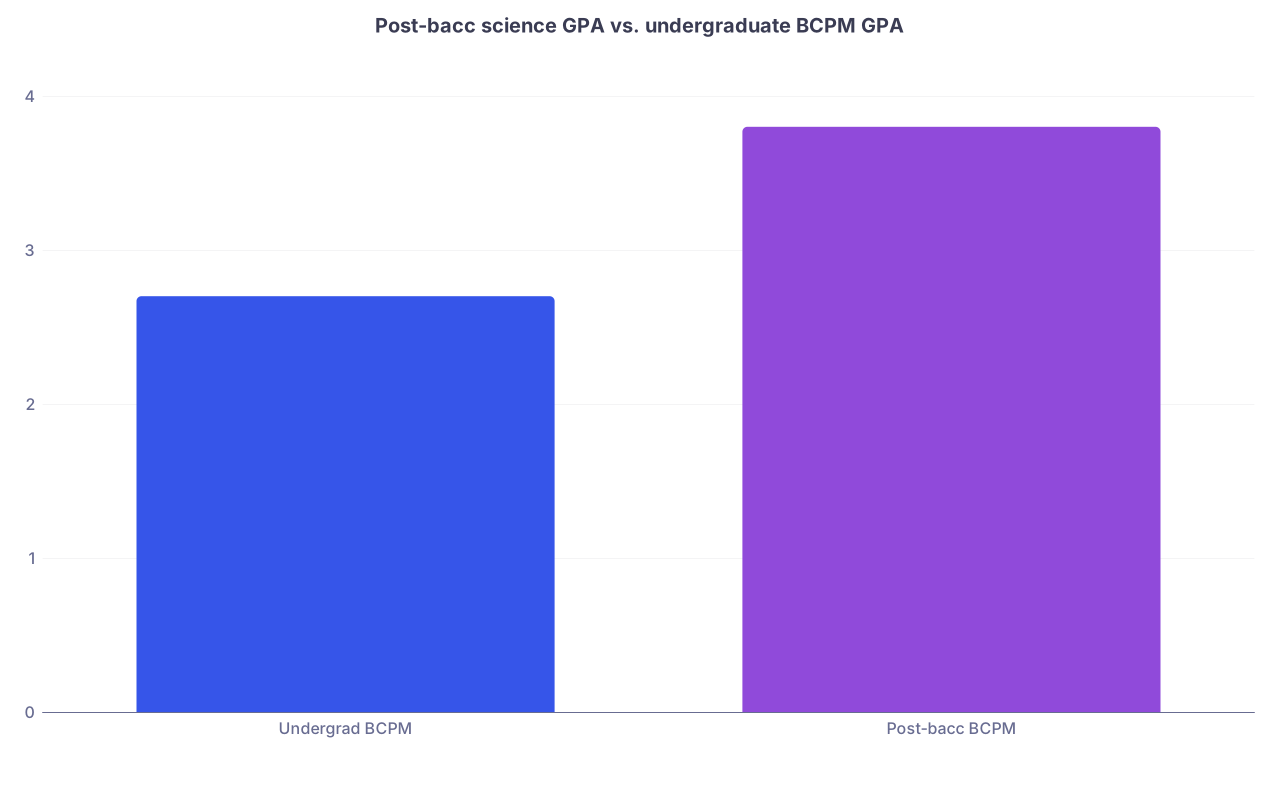
| Category | Value |
|---|---|
| Undergrad BCPM | 2.7 |
| Post-bacc BCPM | 3.8 |
If your post-bacc GPA is substantially higher than your old BCPM (biology/chem/physics/math) GPA, you want this letter to hammer that change hard.
Clinical Letter
The clinical letter must prove that you know what you are getting into, and that you function well around vulnerable people and tired clinicians.
Specific content that matters:
- Reliability: punctuality, willingness to do unglamorous tasks, minimal handholding
- Interpersonal skills: with patients, families, and the care team
- Ability to handle emotionally heavy situations without dramatizing everything
- Evidence that you ask good questions and seek feedback
You prime this letter by:
- Being excellent in the role for months, not two weekends
- Asking your supervisor if they would be willing to comment specifically on your suitability for a future physician role
- Providing them with concrete examples of your work: number of shifts, types of patients, any difficult situations you managed
If your clinical supervisor is not a physician, that is fine. A nurse who can describe your behavior on a busy med-surg floor is more valuable than a physician who saw you twice and barely remembers your name.
5. Using Interfolio and Centralized Systems Strategically
You should not have letters emailed directly to you. Use a third-party service:
- Interfolio (common, flexible)
- Or directly through AMCAS / AACOMAS letter ID systems if your writers are comfortable
Workflow that actually works in a short post-bacc:
- Set up Interfolio in the fall once your first professor says yes.
- Create separate requests for:
- “Dr. X – Post-bacc Biology LOR”
- “Dr. Y – Post-bacc Organic Chemistry LOR”
- “Ms. Z – Clinical Supervisor LOR”
- In each request,:
- Attach your CV and one-page LOR packet.
- Provide a target due date at least 2 weeks before you want all letters in AMCAS.
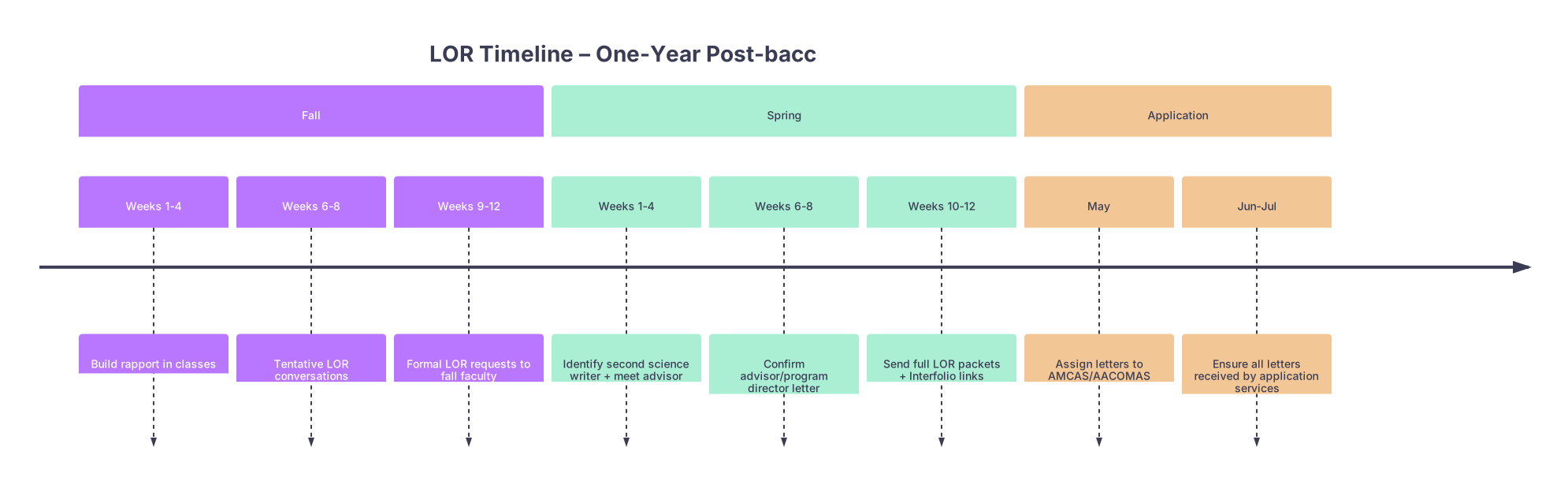
| Period | Event |
|---|---|
| Fall - Weeks 1-4 | Build rapport in classes |
| Fall - Weeks 6-8 | Tentative LOR conversations |
| Fall - Weeks 9-12 | Formal LOR requests to fall faculty |
| Spring - Weeks 1-4 | Identify second science writer + meet advisor |
| Spring - Weeks 6-8 | Confirm advisor/program director letter |
| Spring - Weeks 10-12 | Send full LOR packets + Interfolio links |
| Application - May | Assign letters to AMCAS/AACOMAS |
| Application - Jun-Jul | Ensure all letters received by application services |
Once letters are in Interfolio, you:
- Check they are marked as “Complete.”
- Assign them to your application services (AMCAS, AACOMAS, TMDSAS) with the correct letter types well before June.
The bottleneck each year is not students writing personal statements. It is letters that were “promised” but never uploaded because no one managed the logistics.
6. Common Failures I See in Short Post-Bacc LORs
These are patterns I’ve seen repeatedly in students from 1‑year or 8‑month post-baccs.
Failure 1: Waiting for Spring to “Prove” Yourself
You have a mediocre or old undergrad record, join a post-bacc in August, and decide:
“I will ask for letters after they see my whole year of performance, so they can comment more fully.”
Sounds reasonable. In reality:
- Your fall professor forgets half your details by June.
- Your spring professor barely has time to write before their own grading deadlines and summer commitments.
- You end up with rushed, generic letters.
You must lock in at least one fall letter by November–December, and one spring letter by March–April. Not negotiable.
Failure 2: Vague, Generic Letters from “Big Names”
A chairman’s letter that says “X took my advanced physiology course and did well” is useless.
A letter from a mid-level faculty member who actually knows you, with detailed commentary, carries more weight.

Do not chase prestige. Chase specificity.
Failure 3: Not Giving Writers Any Context
If you do not give your writer:
- Your academic history,
- Your goals, and
- A sense of what you hope they can speak to,
then you get the default “hardworking, polite, did well in my class” paragraph.
That reads like elevator music to admissions committees.
Failure 4: Letting Old, Mediocre Letters Stay in the File
If you have letters from five years ago from undergrad where you were an average B‑ student and the letter says exactly that, do not send them just to “add more letters.”
More letters are not better. Weak or lukewarm letters dilute a strong post-bacc story.
Your package should be tightly curated:
- 3–5 letters total for most MD schools
- 2–4 for most DO programs
- All should say something you would not be ashamed to read aloud to a committee
7. Special Scenarios and How to Handle Them
Very Short Program (One Semester Only)
If your post-bacc is literally one intensive semester:
- You need to move faster.
- Office hours from week 1.
- By week 4–5, ask about potential letters.
- By week 8, formalize requests.
You may need to combine:
- 1–2 letters from this short post-bacc
- 1 strong clinical letter
- 1 carefully selected older academic or professional letter that still reflects you well
In that case, lean on your program director or advisor heavily to frame the intensity of that semester and your performance under compression.
Remote / Online Post-bacc Courses
Hard mode, but not impossible.
You must:
- Use video office hours every week. Camera on.
- Post high-quality discussion board entries that your professor remembers.
- Ask about letters explicitly once you have 1–2 graded exams.
For content, have them emphasize:
- Your discipline in an asynchronous or hybrid context
- Turnaround time for assignments
- Quality and depth of written work, since that is often the main data point in online classes
Mildly Rocky Start in the Post-bacc
If you had a shaky first exam but improved:
- Aim for a letter writer who observed that trajectory.
- In your LOR packet, explain the adjustment period (work schedule, time since last science course) and how you corrected course.
Good professors understand improvement. Some will explicitly highlight it if you make the narrative clear.
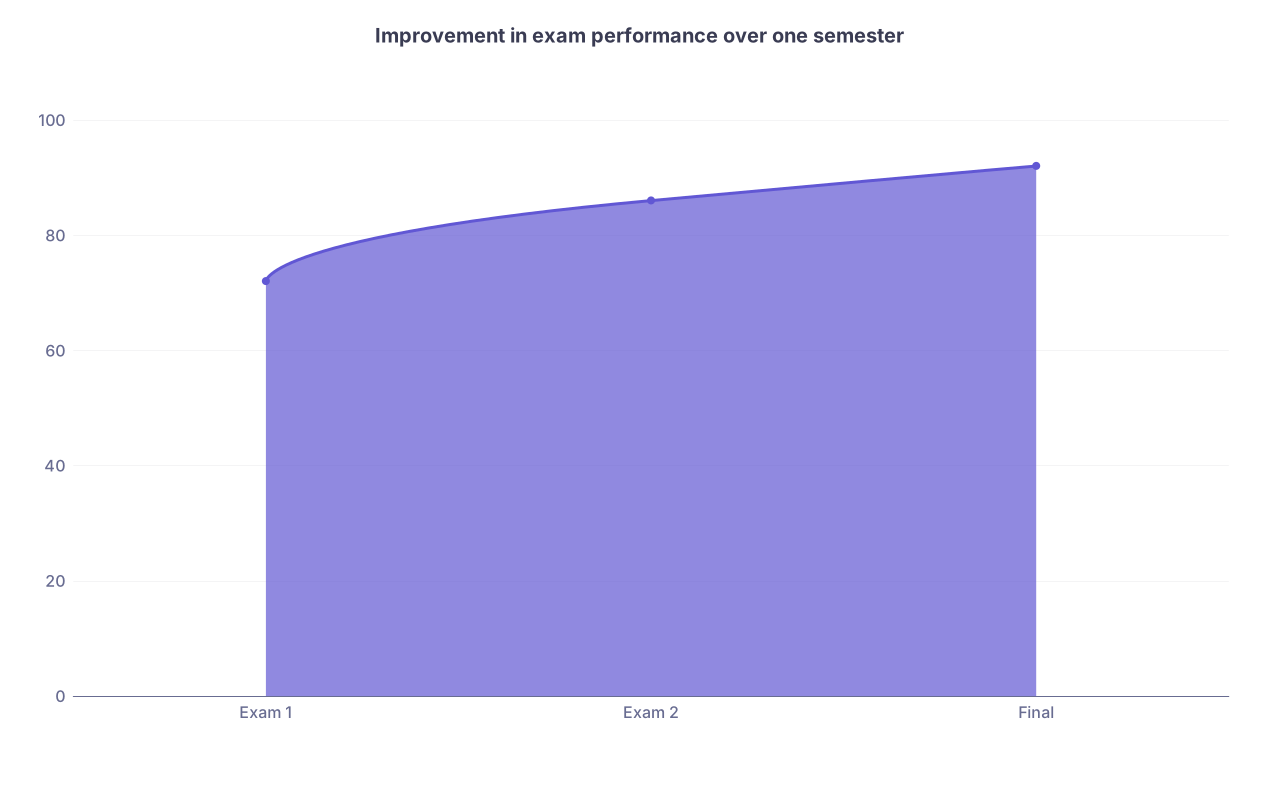
| Category | Value |
|---|---|
| Exam 1 | 72 |
| Exam 2 | 86 |
| Final | 92 |
I have seen very effective letters that say, essentially: “They started behind but outworked everyone and finished near the top.”
8. How To Ask Without Sounding Awkward or Desperate
The content of your ask matters almost as much as your timing.
In person script (once you have performance data):
“Dr. Patel, I wanted to ask you something. I am in this post-bacc because I am applying to medical school next cycle. Your course has been central to showing I can now handle rigorous science. Given my performance so far and our conversations in office hours, would you feel comfortable writing a strong letter of recommendation for my applications?”
Key elements:
- You anchor on performance + relationship.
- You specify “strong letter.”
- You invite an honest no.
If they hesitate or say something like “I can write a letter that says you did well in my class,” that is a polite signal that it may be generic. You still thank them, but you quietly prioritize other writers.
Follow-up email if they say yes should:
- Thank them specifically.
- Restate the rough timeline (e.g., “Letters would be most helpful if completed by early June.”)
- Promise to send a packet with CV, transcript, and personal statement draft when ready.
Your job after that is to:
- Send one courteous reminder 3–4 weeks before the due date.
- Another short reminder 1 week before if it is not in yet.
- Stop there. More pestering rarely improves the letter.
9. Quick Case Study: From Weak GPA to Strong LOR Portfolio
Student: 28‑year‑old career changer with a 2.9 undergrad GPA in a non-science major, no prior science coursework, 1‑year formal post-bacc at a mid-tier state university.
Moves they made right:
Fall:
- Identified two high-yield professors (Cell Bio and Gen Chem) by week 2.
- Office hours every week with both.
- Exam averages: 92+ in both classes.
- Asked for “strong LOR” by week 10; both said yes.
Spring:
- Took Orgo I and Physiology.
- Focused on Orgo professor as second science LOR, reinforced by tutoring peers informally (prof noticed).
- Met program director in week 3, shared a one-page transcript comparison: 2.9 old vs projected 3.8 post-bacc BCPM.
End result LOR set:
- Cell Bio professor: “Top 5% in class, consistently strong analytical thinking, improved from no science background to outstanding performance within one semester.”
- Orgo professor: “One of the few non-traditional students whose conceptual understanding matched or exceeded my best traditional majors; sought feedback relentlessly.”
- Program director: “Transformed academic profile in a structured program while working 20 hours/week in clinical support; clear upward trajectory and emotional maturity.”
- Clinical supervisor (ED tech): “Reliably handled difficult patient interactions, often first to volunteer for challenging tasks.”

Adcom reaction at one MD program (paraphrased from committee notes): “Old GPA concerning, but post-bacc letters unanimously describe top-tier current performance and maturity. MCAT consistent with recent work. Worth serious consideration.”
This is exactly what optimized LOR timing and content are supposed to do in a short post-bacc: overwrite old data with fresh, specific testimony.