International Citizen Planning U.S. MD: Strategic Use of Post-Bacc Study
It’s late at night. You’re in your home country (or working abroad), dozens of U.S. med school tabs open, and you keep seeing the same wall: “U.S. or Canadian bachelor’s degree preferred,” “significant U.S. coursework required,” “international applicants must have X years of study in the U.S.”
(See also: Reapplicant with Multiple Rejections: When a Post-Bacc Is the Right Reset for insights on resetting your application strategy.)
You’ve finished (or nearly finished) a non‑U.S. degree. You want a U.S. MD, not a Caribbean detour, not “maybe later.” But your GPA is in a different scale, your prerequisites do not line up perfectly, and every forum post about “post-bacc programs” seems written for U.S. citizens who already know the system.
Here’s the situation: you’re an international citizen planning for a U.S. MD, and you’re trying to figure out how to use post‑bacc study strategically—not randomly—to actually get you from where you are to sitting in a U.S. medical school classroom.
Let’s lay out what you’re up against and exactly how to use post‑bacc options to your advantage.
Step 1: Get Real About Your Starting Point
Before you look at a single program, you need to understand how U.S. med schools will see you.
There are four main variables that matter:
- Your existing degree
- Your science background
- Your academic record (in a U.S. context)
- Your immigration reality
1. Your existing degree
Questions you need to answer clearly:
- Do you already have a completed bachelor’s degree? If so, in what field?
- Is it from a 3‑year or 4‑year program? (Very common issue: UK, India, etc.)
- Is the institution reputable/recognized?
- Do you plan to stay in your home country for now or move to the U.S. for study?
Here’s the harsh part: some U.S. med schools quietly or explicitly prefer a U.S. or Canadian bachelor’s degree. A 3‑year degree from abroad can be a red flag for some, neutral for others, fully acceptable for a smaller subset.
You can’t change that. You can decide how to respond.
2. Your science background
You fall into one of these buckets:
- Non‑science degree with minimal science
- Science degree but not U.S.-style premed (e.g., MBBS prep track, engineering, pharmacy)
- Strong science background but not in U.S. system
This matters because it determines whether you need:
- A career‑changer post‑bacc (to get the prerequisites),
- An academic enhancer post‑bacc (to fix or prove your science ability),
- Or a formal SMP (Special Master’s Program) that mimics med school curriculum.
3. Your academic record
U.S. schools will not care about “First class with distinction” unless they can map it into something like a GPA narrative.
You need:
- A WES (or similar) evaluation of your degree for you, not for med schools. You want to understand how your performance roughly translates (e.g., “this would likely be considered a 3.3 vs 3.8 type record”).
- To check if your record is clearly strong (top 10–15% of class) or more like “average-good.”
If your existing record is borderline, you will almost certainly need strong U.S. coursework to prove you can handle the level.
4. Immigration reality
You cannot separate “post‑bacc choice” from visa reality. Period.
Ask yourself:
- Will you be on F‑1 student status?
- Are you currently in the U.S. on another visa (H‑4, L‑2, etc.)?
- Are you planning to immigrate (green card path) independently?
- Do you actually have enough funds to support U.S. tuition + living without U.S. loans?
Why this matters: some “post‑bacc” programs are non‑degree and do not support F‑1 visas. Others do. Some categorize you as non‑degree “visiting student” which can be problematic.
You need to target programs that are:
- SEVP‑certified (can issue I‑20)
- Clear about international student policies
- Transparent about whether you’ll be “degree-seeking” or “non-degree”

| Step | Description |
|---|---|
| Step 1 | International Bachelors Degree |
| Step 2 | Career-Changer Post-Bacc |
| Step 3 | Academic Enhancer Post-Bacc |
| Step 4 | Consider SMP or Direct Application |
| Step 5 | Complete U.S. Prereqs + Strong Grades |
| Step 6 | Target SMP with Med School Linkage |
| Step 7 | Apply Directly to U.S. MD/DO |
| Step 8 | Take MCAT with Competitive Score |
| Step 9 | Apply to International-Friendly U.S. Med Schools |
| Step 10 | Science background? |
| Step 11 | GPA / Academic Strength? |
| Step 12 | Need more proof? |
Step 2: Decide What You Actually Need From a Post‑Bacc
You’re not “doing a post‑bacc.” You’re solving specific problems.
Here are the main problems international applicants face, and which kind of program you should aim for.
Problem A: No U.S. coursework, no pre‑reqs
You did, say, economics in India or history in France. Maybe one random bio elective. That’s it.
Your goal:
Build a U.S. academic footprint + complete med school prerequisites.
You need:
- A career‑changer post‑bacc that:
- Allows international students
- Provides the full core sequence
Core usually means (in U.S. format):
- 2 semesters of General Chemistry with lab
- 2 semesters of Organic Chemistry with lab
- 2 semesters of Biology with lab
- 2 semesters of Physics with lab
- 2 semesters of English (writing-heavy)
- Statistics and/or Calculus (varies)
- Biochemistry (increasingly essential)
Your strategy:
Find a structured post‑bacc program that lets you do most of this in 12–24 months with solid advising and MCAT timing built in.
Problem B: Foreign science degree, unclear GPA, no U.S. proof
Example: You’re a top student from a medical college in Nigeria, or did a heavy pre-med track in Pakistan, but U.S. schools cannot easily judge you.
Your goal:
Show that you can crush rigorous science in the U.S. system.
You need:
- Either an academic enhancer post‑bacc (upper‑level undergrad sciences)
- Or an SMP (master’s level that mimics med school, often with med school linkage)
If your original grades were mediocre:
You probably start with upper‑level undergrad science at a U.S. university and aim for a 3.7–3.9+ in 30–40 credits. Do not jump straight to an SMP if you’re not certain you can perform. SMPs punish weak performance.
If your original record is already excellent:
You can consider a well‑chosen SMP with strong links to a med school that accepts international students.
Problem C: 3‑year degree that some schools don’t like
If your bachelor’s is 3 years (common in the UK, India, etc.), a smart move is:
- Do a formal post‑bacc or second bachelor’s in the U.S. that brings your total to a structure more familiar to U.S. schools.
This does two things:
- Gives you U.S. credits and grades.
- Reduces the number of schools that will filter you out based on “foreign/3‑year degree only.”
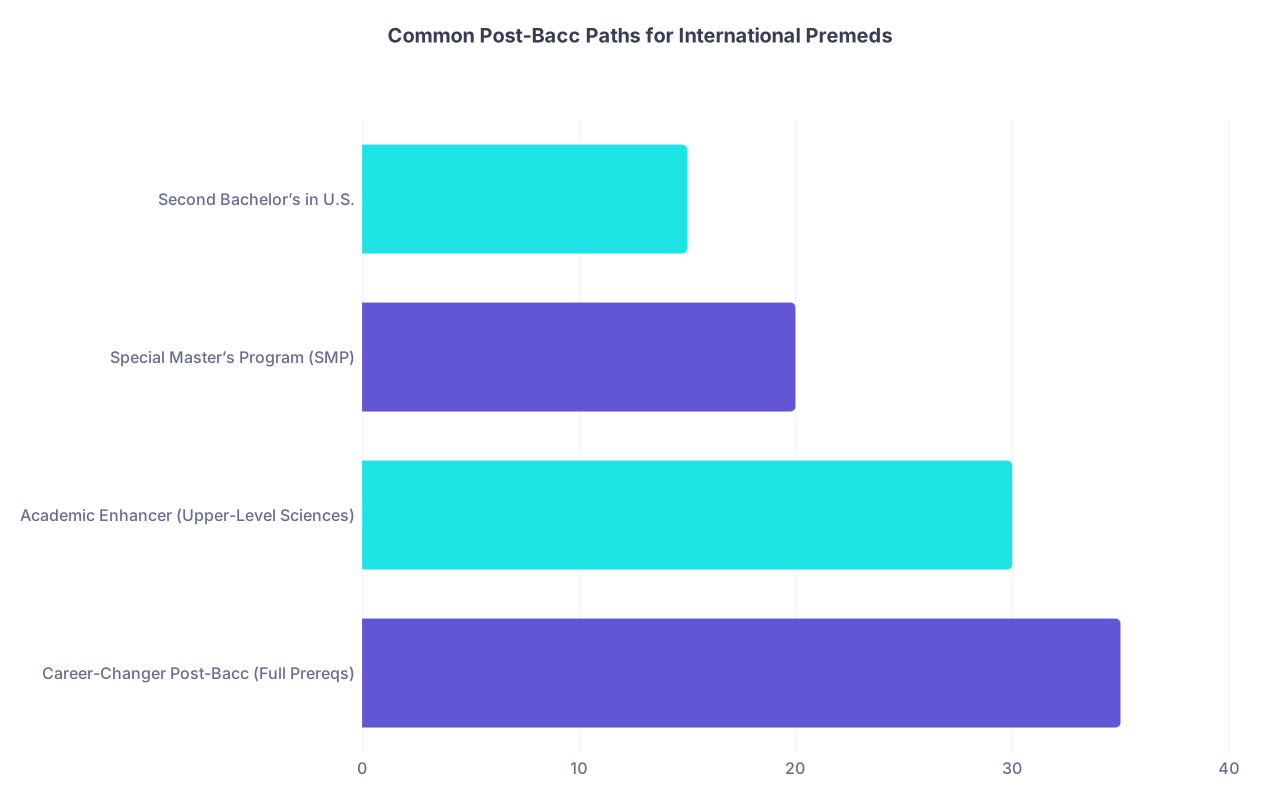
| Category | Value |
|---|---|
| Career-Changer Post-Bacc (Full Prereqs) | 35 |
| Academic Enhancer (Upper-Level Sciences) | 30 |
| Special Master’s Program (SMP) | 20 |
| Second Bachelor’s in U.S. | 15 |
Step 3: Pick the Right Type of Program (Not Just a Famous Name)
Do not pick a program because you’ve seen it name‑dropped on Reddit. Look at the fit for an international applicant. Different lens.
Here’s how I’d break it down.
A. Formal structured post‑baccs (university-branded programs)
Examples:
- Columbia, Harvard Extension, Johns Hopkins, UPenn, SFSU, Temple ACMS, etc.
Pros:
- Cohort, advising, committee letters
- Often marketed to “career changers”
- Some have formal linkages or guaranteed interviews (for eligible students)
Cons for internationals:
- Many do not sponsor visas
- Some are brutally expensive
- Their linkages sometimes exclude international citizens explicitly
- Capacity is limited; entry is selective
If you go this route, you ask up front:
- “Do you enroll F‑1 international students in this program?”
- “Is the program considered degree‑seeking for visa purposes?”
- “Do linkage agreements apply to international citizens?” (Often: no.)
B. DIY / informal post‑bacc (taking courses as non-degree student)
Example: Enrolling at a state university as a non-degree undergrad to take sciences.
Pros:
- Often cheaper
- Easier admission
- Flexible course selection
Cons:
- May not support international visas as non‑degree
- Less advising
- No formal committee letter
- You must be very disciplined with planning
This path can still work well if you:
- String together 30–40 credits of solid, rigorous science
- Excel (A/A‑minus average)
- Build relationships for letters
- Plan MCAT timing intelligently
C. Second bachelor’s degree
Example: Enrolling in a U.S. university for a second BS in Biology or similar.
Pros:
- Clear F‑1 visa support
- Full access to campus resources
- You look like a regular undergrad premed, which admissions understands easily
Cons:
- Time (2–3+ years)
- Cost is huge
- Some med schools will still count all undergraduate work (including foreign) when thinking about academic history, even if they only compute AMCAS GPA from U.S. work
This makes sense when:
- You’re early in your career (early 20s)
- You can fund multiple years without going broke
- You want maximum credibility in the U.S. system
D. Special Master’s Programs (SMPs)
These are not generic MS degrees. They’re med‑school‑style programs designed to prove you can handle M1 courses.
Pros:
- Directly relevant to med school rigor
- Often share courses with M1s
- Some have guaranteed interview pathways
Cons for internationals:
- Many SMPs with the best linkages are at schools that do not take many international med students
- Visa + funding again a big question
- A mediocre performance (say 3.1) can actually hurt you more than no SMP at all
Use SMPs if:
- Your science background is strong
- You’re confident you can be near the top of the class
- You’ve done your homework that the linked med school considers international applicants at all

Step 4: Make Immigration and Money Part of the Strategy (Not an Afterthought)
Here’s where many international applicants sabotage themselves: they treat immigration as a side detail to fix later. U.S. schools and programs do not.
You need to lock this down:
Visa type and program compatibility
Check:
- Is the program SEVP‑certified and can it issue an I‑20 for F‑1?
- Will your classification be:
- “Degree-seeking undergraduate/graduate” (good)
- “Non-degree / continuing education” (possible problem)
If the program cannot sponsor your visa, it’s not your program. No matter how prestigious.
Work options (or lack thereof)
As F‑1:
- On‑campus work: limited, competitive, low pay
- Off‑campus: only through CPT/OPT under specific rules
- You will not be “working your way” through a post‑bacc and MCAT and then med school. Plan as if part‑time work money is almost zero.
Funding reality
Medical school for internationals = usually no U.S. federal loans. Some private loans with U.S. co‑signer, or self-funding.
Strategic question:
Are you using post‑bacc study to:
- Strengthen your profile while you pursue a green card or permanent residency path?
- Or are you planning to apply as an international with full understanding of the financial burden?
If your funding plan is “I’ll figure it out later,” that’s not a plan. I’ve seen people invest three years in post‑bacc + MCAT only to realize they cannot fund the MD even if accepted.
Step 5: Build a Concrete 3–5 Year Plan
You don’t need 20‑year detail. You do need a realistic 3–5 year roadmap.
Let me sketch a sample for a typical scenario and then you can adapt.
Scenario: Non‑science international grad, 3‑year degree, wants U.S. MD
Year 0 (Now – 6 months):
- Get your foreign transcripts evaluated (WES or equivalent) so you know the approximate GPA story.
- Research 10–15 post‑bacc/second bachelor’s options that:
- Accept internationals
- Sponsor F‑1
- Offer full pre‑med sequence
- Email each program with three specific questions:
- “Do you enroll F‑1 students in this exact program?”
- “Will I be coded as degree‑seeking or non-degree?”
- “Do you have international students who went on to U.S. MD/DO from this program?”
Year 1:
- Start U.S. coursework (fall).
- Take Gen Chem 1, Bio 1, Calculus/Stats, and 1 non‑science writing-heavy course.
- Aim for straight As. No exceptions. This is your foundation.
- Start light MCAT exposure only if you have time, but do not tank grades. Grades first.
Year 2:
- Finish prereqs: Gen Chem 2, Org Chem 1–2, Bio 2, Physics 1–2, Biochem.
- Begin structured MCAT prep in the second half of Year 2 once you’ve had most content.
- Build relationships with 2–3 professors for letters.
Year 3:
- MCAT early (spring/summer). You’re aiming for a score that keeps you competitive as an international (think 515+ for MD; lower could be fine for DO but you’re trying to be above-average).
- Add upper‑level sciences (physiology, genetics, immunology).
- Application cycle to U.S. MD/DO schools that:
- Explicitly accept internationals
- Don’t require U.S. citizenship/permanent residency
- Parallel plan: consider Canadian schools if you have ties, or U.K./Ireland if relevant.
Scenario: Strong foreign science degree, great grades, no U.S. record
You might:
- Do 1–2 years of upper‑level U.S. science (post‑bacc) and then:
- Take MCAT and apply directly; or
- Add a targeted SMP if your goal is a particular school that is international‑friendly.
The difference is you’re not rebuilding the foundation—you’re proving equivalence at the top end.
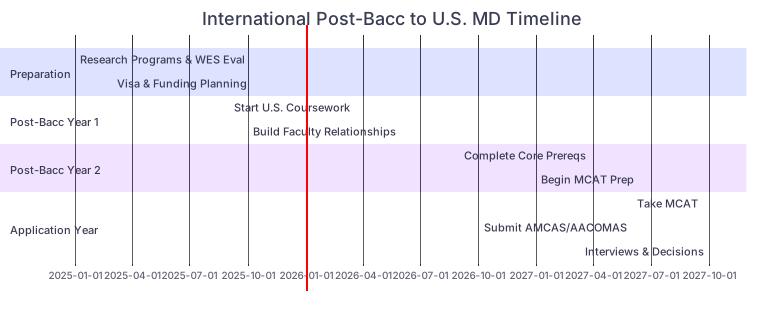
| Task | Details |
|---|---|
| Preparation: Research Programs & WES Eval | a1, 2025-01, 6m |
| Preparation: Visa & Funding Planning | a2, 2025-03, 4m |
| Post-Bacc Year 1: Start U.S. Coursework | b1, 2025-09, 9m |
| Post-Bacc Year 1: Build Faculty Relationships | b2, 2025-10, 9m |
| Post-Bacc Year 2: Complete Core Prereqs | c1, 2026-09, 9m |
| Post-Bacc Year 2: Begin MCAT Prep | c2, 2027-01, 6m |
| Application Year: Take MCAT | d1, 2027-06, 1m |
| Application Year: Submit AMCAS/AACOMAS | d2, 2027-06, 3m |
| Application Year: Interviews & Decisions | d3, 2027-10, 8m |
Step 6: Be Ruthless About School Lists and Expectations
Even with a brilliant post‑bacc, international applicants face:
- Fewer schools that actually consider them
- Tougher MCAT/GPA thresholds
- Financial bias (schools question: can you pay four years without federal loans?)
So your strategy has to be tighter.
You will:
- Build a spreadsheet of U.S. MD and DO schools.
- For each school, track:
- Do they consider international applicants at all?
- How many internationals are in recent classes?
- Any added requirements (e.g., X years in U.S., deposit sizes, proof of funds)?
- Filter ruthlessly. For many internationals, you go from ~150+ MD/DO schools down to maybe 25–40 realistic schools.
This is why your MCAT and U.S. GPA must be as high as you can push them. You’re playing a constrained game. You don’t have the margin U.S. citizens sometimes do with lower stats and broad school lists.

Step 7: How to Evaluate If Post‑Bacc Is Actually Working For You
You don’t want to spend three years just “being in the system.” You want measurable traction.
Here’s what I use as checkpoints:
Year 1 end:
- U.S. science GPA from post‑bacc ≥ 3.6
- At least one professor who knows you well enough to write about your work ethic and capability
- Clear understanding of your realistic MCAT goal (based on your performance)
Year 2 end:
- Cumulative U.S. science GPA trend is stable or rising
- You’ve handled at least one heavy semester (3+ hard sciences) without your grades dropping off a cliff
- Practice MCATs (later in Year 2) creeping into target range
Before applying:
- Verified that your visa status allows you to attend med school if accepted
- Solid MCAT score on the table, not “I’ll retake and surely do better” as your hope
- You can list clear examples of U.S. experiences: clinical exposure, volunteering, possibly research
If these are not happening, you don’t just blindly move forward. You pause and adjust: maybe extend post‑bacc by a year, reconsider SMP, or recalibrate goals (e.g., DO, Canada, or a different path).
FAQs (Exactly 5)
1. Do U.S. med schools count my foreign GPA in their calculations?
AMCAS (for MD) and AACOMAS (for DO) typically do not convert foreign coursework into a numeric GPA for the centralized application; they’ll usually list it separately. However, admissions committees still read your transcript and your WES‑type evaluation. They will form an opinion on your academic history even if only your U.S./Canadian coursework is in the calculated GPA boxes. So you can’t hide a weak foreign record, but you can override doubts with stellar U.S. performance.
2. Is a post‑bacc enough, or do I need an SMP as an international applicant?
Not everyone needs an SMP. If you complete 30–45 credits of rigorous upper‑level sciences in the U.S. with a 3.7+ GPA and a strong MCAT, that can be enough. SMP becomes useful when you:
- Already have strong foundational science,
- Need to prove you can handle near‑med‑school level work,
- Aim for a specific school with an SMP linkage that actually accepts internationals.
If your undergrad or post‑bacc grades are shaky, jumping into an SMP can backfire.
3. Can I do my post‑bacc part‑time while working in the U.S. on another visa?
Sometimes, yes. If you’re on an H‑4/L‑2/spousal visa or similar, a part‑time post‑bacc at a local state university can be a very smart and cost‑effective route. The key issues:
- Will the school let you enroll part‑time as a non‑degree or second‑degree student?
- Can you realistically maintain A‑level performance while working?
If you’re stretching yourself too thin and grades suffer, that kills the main purpose of the post‑bacc.
4. Should I retake basic sciences in the U.S. if I already took them abroad?
For many international students, yes. Retaking core prerequisites in the U.S. can help:
- Generate U.S. grades in courses with familiar names (Gen Chem, Org Chem, Bio, Physics),
- Give you fresher knowledge for the MCAT,
- Reassure committees who might not understand the rigor or content of your original courses.
If your prior foundation is genuinely excellent, you can sometimes skip straight to upper‑level sciences, but that’s a riskier play for internationals without any U.S. academic track record.
5. As an international, is DO (osteopathic) a realistic target or should I focus only on MD?
DO can absolutely be realistic for internationals, but with caveats. Fewer DO schools accept international students compared with MD schools, and some have more limited residency match patterns for non‑U.S. citizens. That said, DO can be strategically smart if:
- Your stats are solid but slightly below the ultra‑competitive MD range,
- You’re open to primary care or certain specialties that are DO‑friendly,
- You vet DO schools carefully for international acceptance and outcomes.
You don’t pick DO as “the consolation prize”; you choose it as a deliberate parallel track with eyes open.
Open a blank document and draft a 3‑year timeline for yourself right now: list months down the left side, and in each quarter, write exactly which courses you’d take, when you’d start MCAT prep, and when you’d apply. Then compare that draft against your visa, money, and academic reality. If it doesn’t line up, revise the plan before you commit to any post‑bacc program.