The idea that you can just “self-study a bit” when you took your prereqs 5–10 years ago is fantasy. If your science is rusty, you need structure. A post-bacc can save your MCAT—or waste your time. The difference is how you use it.
You’re not starting from zero. But you’re not “fine” either. You’re somewhere in that annoying middle zone: you passed gen chem and orgo back when people still used Facebook regularly, and now you’re staring at MCAT passages about enzyme kinetics thinking, “I sort of remember this…?”
Let’s get concrete about what to do.
Step 1: Be Honest About How Old Your Prereqs Really Are
“Years ago” is vague. AMCAS and admissions committees aren’t vague.
If you’re in one of these buckets, your situation changes:
- 3–5 years since prereqs
- 6–10 years
- 10+ years or career-change with no real science since
Most schools don’t have a hard cutoff date for prereqs, but plenty of them care when you last saw a lab or a differential equation. They just phrase it politely: “Recent science coursework is preferred.”
Translation: if your BCPM (biology/chem/physics/math) is from undergrad 8 years ago and nothing since, they’ll question whether you can handle med school pace.
Here’s the rough reality:
- 3–5 years out: You can usually get away with targeted refreshers plus strong MCAT. Formal post-bacc optional but can help.
- 6–10 years out: Strong case for some structured coursework. A post-bacc or at least upper-level sciences.
- 10+ years out: You’re basically a nontraditional rebooter. A formal or DIY post-bacc is almost mandatory if you want to be taken seriously.
So if you’re reading this because your prereqs are ancient, you’re in the right mindset already: you know just grinding Anki alone isn’t enough.
Step 2: Decide What You Actually Need from a Post-Bacc
Not all post-baccs are for the same thing.
You’re not the typical “career changer with zero prereqs.” You already did bio, chem, orgo, physics. Your problem is rust and credibility, not absence.
You probably need a post-bacc to do one or more of these:
- Rebuild content for the MCAT
- Show schools you can still crush science now, not just 8 years ago
- Fix a mediocre science GPA
- Create structure so you actually study instead of “planning to study”
So before you even Google “post-bacc near me,” write this down:
- My oldest prereq is from year: ______
- My last real science course was: ______
- My science GPA is roughly: ______
- My MCAT goal score is: ______
- My timeline to apply is: planning to apply in ______ cycle
If your science GPA is already solid (3.6+ recently), the priority is MCAT prep and strategic courses, not a full reinvention. If your GPA is weak or very old, the post-bacc has two jobs: help your MCAT and repair your academic story.
Step 3: Choose the Right Type of Post-Bacc for MCAT Refresh (Not Just for Optics)
There are three main options you’re realistically looking at.
1. Formal structured post-bacc (university-run, cohort-based)
Good for you if:
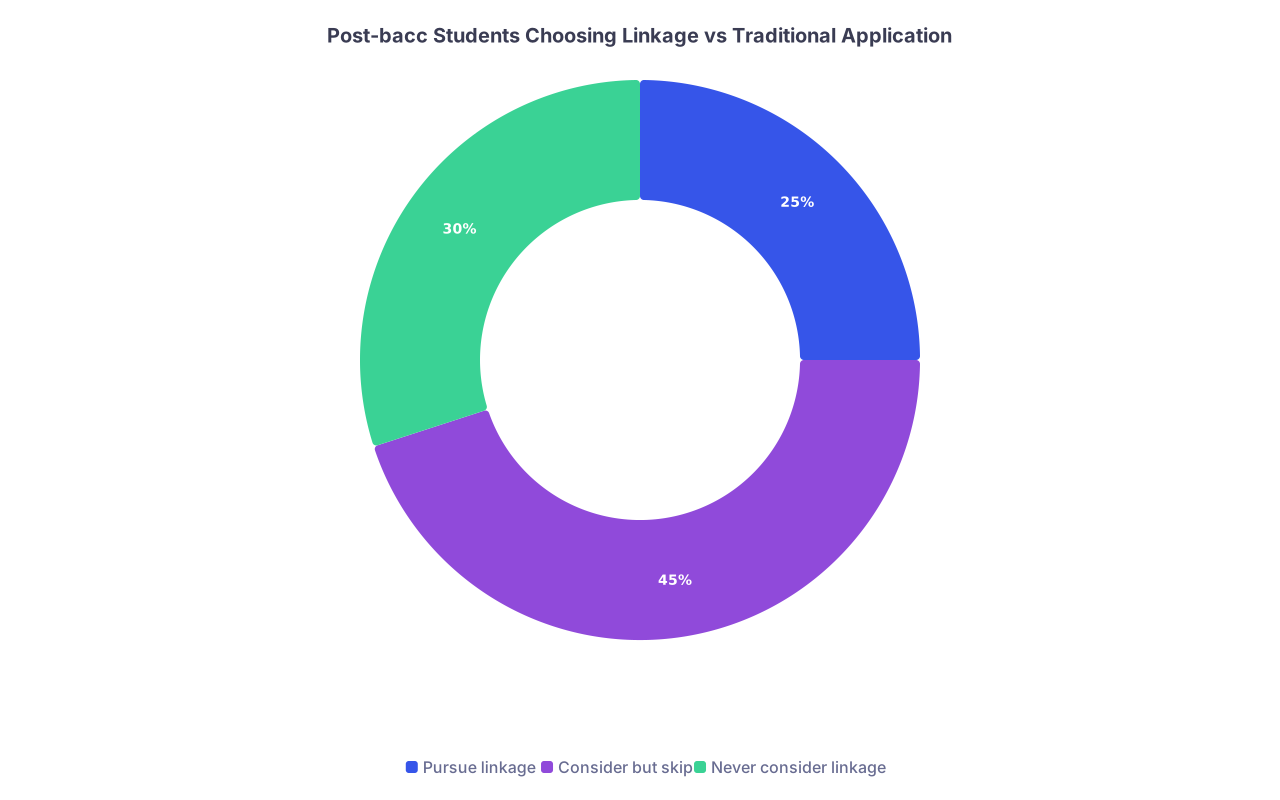
- You want hand-holding, advising, sometimes linkage options.
- You need a substantial GPA rescue AND MCAT refresh.
- You’re okay with higher cost in exchange for predictability and a premed-focused environment.
Typical structure:
- 1–2 years
- Mix of prereqs (retakes or new) + upper-level sciences
- Dedicated advising, committee letter, maybe MCAT prep resources
Catch:
These programs are not always optimized around the MCAT calendar. They’re built around course completion and med school applications, which is related but not identical.
So if you’re using it to refresh for the MCAT, you have to control when courses line up with your test date.
2. Extension / continuing education / DIY post-bacc (you piece it together)
This is often the best move for “took prereqs years ago” people.
You:
- Enroll as non-degree or second bachelors
- Pick the exact set of courses you need
- Control timing relative to your MCAT date
Ideal if:
- You’re working or have family responsibilities
- You already have all prereqs but they’re old
- You need a targeted refresh and maybe a GPA boost, not a full formal program
You can, for example, take:
- Biochemistry
- Physiology
- Cell biology or molecular biology
- A focused physics refresh
- Maybe statistics / psych if you never had modern versions
Then plan your MCAT for immediately after the heaviest MCAT-relevant terms.
3. SMPs (special master’s programs)
These are overkill if your main problem is “I forgot gen chem.” These are for:
- People with borderline GPAs who need medical-school-level proof
- Those aiming at DO/MD but needing major academic redemption
They also do very little for MCAT content. You’ll be doing med-level path and pharm, not exactly MCAT discrete questions. If your MCAT is still pending and your prereqs are ancient, I almost always recommend:
Undergrad-level post-bacc first. SMP later only if absolutely necessary.
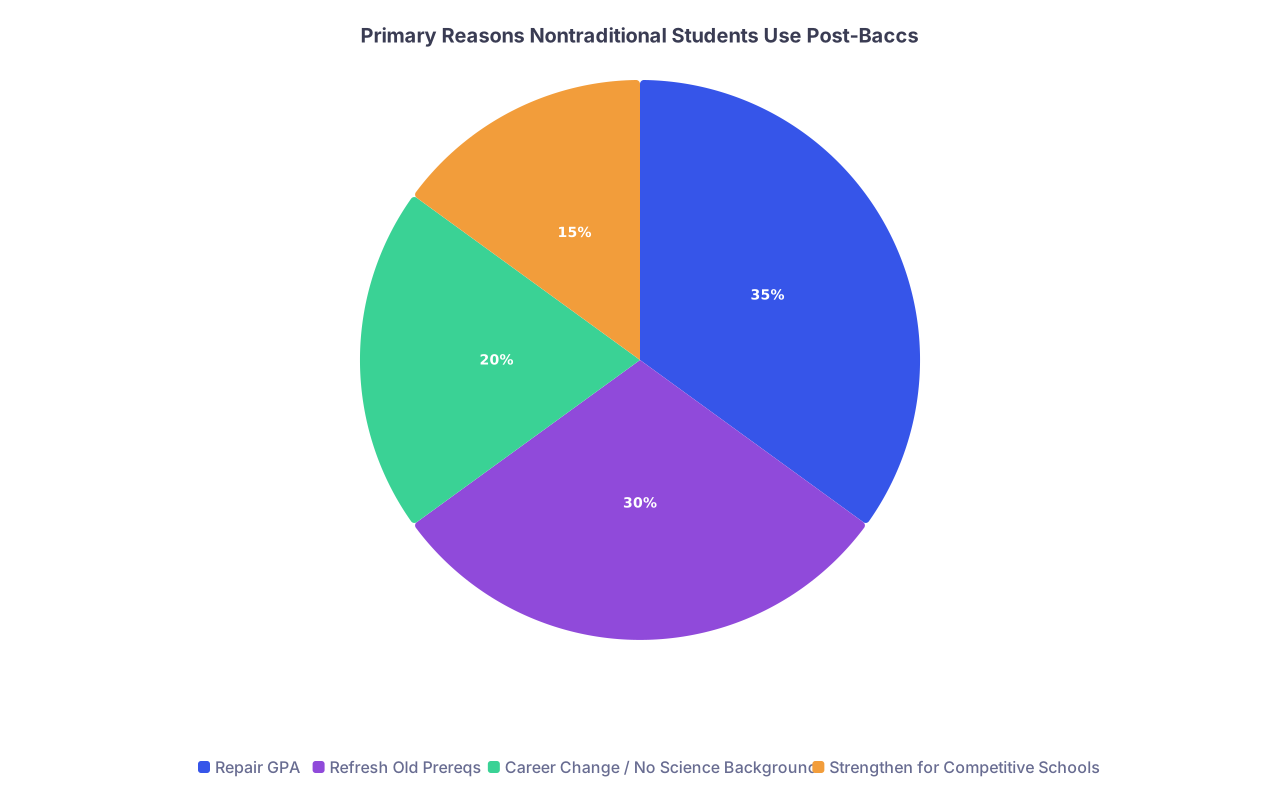
| Category | Value |
|---|---|
| Repair GPA | 35 |
| Refresh Old Prereqs | 30 |
| Career Change / No Science Background | 20 |
| Strengthen for Competitive Schools | 15 |
Step 4: Align Your Post-Bacc Timeline with Your MCAT Date (This Is Where People Screw Up)
If you ignore everything else, don’t ignore this.
Your MCAT should be taken while the material is still warm from your courses—not 18 months after your last science class.
General rule:
- Start post-bacc → Build foundation
- Hit core MCAT-related sciences within 12 months of test date
- Take MCAT within 0–3 months after finishing your key courses
Let’s do an example.
Say you’re starting Fall 2025 and aiming to apply 2027:
- Fall 2025: Biochem + cell biology
- Spring 2026: Physiology + psych/soc course
- Summer 2026: Dedicated MCAT prep 8–10 weeks
- Late July / early August 2026: Take MCAT
- 2026–27: Additional upper-level science as needed, clinical, apps
That’s a smart sequence. You finish biochem and physiology, roll straight into MCAT prep while it’s fresh, then test before the content leaks out of your head.
What people actually do (and regret):
- Take biochem in 2023
- Take random other courses in 2024
- Life gets in the way
- Finally start MCAT prep 2025
- Realize they’ve forgotten 75% of what they learned
You’re using the post-bacc to prime the MCAT. That only happens if the coursework and exam are within a year of each other, ideally less.
Step 5: Which Courses Actually Matter Most for Refreshing MCAT Content?
You don’t need to retake everything. You need to be strategic.
Here’s the course hierarchy for someone in your shoes.
Must-have (or must-know cold) for MCAT if rusty
- Biochemistry – non-negotiable. High-yield and heavily tested.
- Intro psychology – modern psych course hits a lot of MCAT psych/soc.
- Some form of modern biology – cell/molecular or general bio II with emphasis on genetics, molecular bio, physiology.
Strongly recommended if your originals are very old or weak
- Physiology – excellent for CARS-like reasoning applied to body systems.
- Refresher physics (algebra-based) – if you haven’t done projectiles, circuits, fluids in 7+ years, you will bleed time on the exam.
- General chemistry II (or at least tutoring/online course) – acid/base, equilibrium, kinetics matter.
Optional but helpful
- Statistics – helps for interpreting data-heavy passages and research methods.
- Sociology – if your undergrad psych/soc exposure is nonexistent.
What about retaking C– grades from undergrad?
If a key prereq is a C/C– from 9 years ago and you barely remember passing, I like retaking it in a post-bacc if:
- You believe you can get an A
- You need to raise GPA
- The school allows retakes and doesn’t average them in a way that kills you
If your old grades are already B+/A–, don’t waste time retaking the same course. Take higher-level versions instead.
Step 6: Use the Post-Bacc Classes as Built-In MCAT Content Review
Too many people wall off “school” and “MCAT prep” as separate lives. That’s dumb. If you’re in a class that maps directly to MCAT content, you should be using it as part of MCAT prep while the course is happening.
Here’s how.
During the course:
- For every new topic, find the corresponding section in an MCAT review book. Skim it that week.
- Do 5–10 MCAT-style questions on that topic, not just your class homework.
- Build Anki cards or a running formula/concept sheet with MCAT phrasing, not just your professor’s wording.
Example: in biochem when you cover Michaelis-Menten:
- That same week, open your MCAT biochem chapter on enzymes.
- Do a UWorld or AAMC question set on enzyme kinetics.
- Practice interpreting Vmax/Km questions in MCAT-style graphs, not just your graded problem set.
End of term, you’re not “starting MCAT prep.” You’ve already quietly banked 30–40% of your content review.
Step 7: Structure Your Dedicated MCAT Prep Around Your Post-Bacc Strengths and Weaknesses
Once you finish the main MCAT-relevant courses in your post-bacc, you’ll know where you’re strong and where you’re bluffing.
Basic structure for 8–12 weeks of focused MCAT prep after key coursework:
Weeks 1–2:
- Diagnostic exam (or your most recent FL)
- Targeted content patching in your worst two sections
- Daily practice passages, not just discretes
Weeks 3–6:
- Full-length practice every 7–10 days
- Review each exam in brutal detail (this is where most of the learning is)
- Map every missed question back to topic + reason for miss:
- Didn’t know content
- Knew content but misread
- Time pressure
- Got tricked by wording
Weeks 7–8 (or 9–12 if longer plan):
- Sharpen timing
- Focus on endurance (back-to-back sections)
- Light content review only where error log shows repeated gaps
Post-bacc advantage: most of the content shouldn’t feel completely new. If it does, you didn’t really learn it in class—or you took too long a gap between course and MCAT.
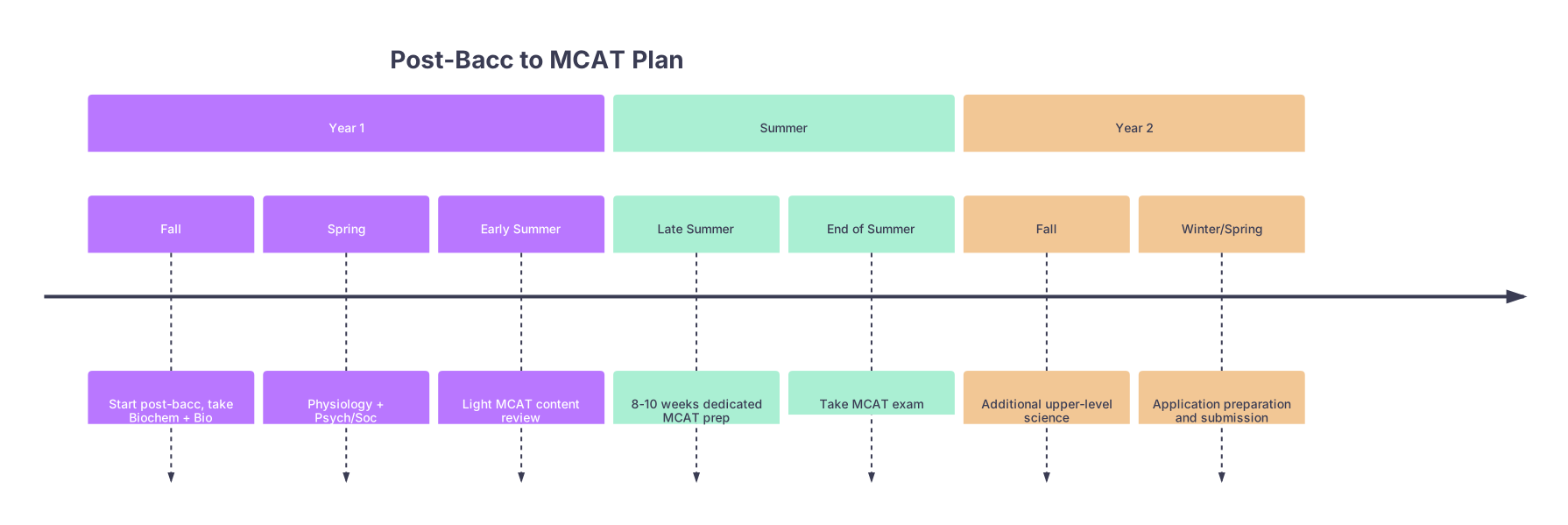
| Period | Event |
|---|---|
| Year 1 - Fall | Start post-bacc, take Biochem + Bio |
| Year 1 - Spring | Physiology + Psych/Soc |
| Year 1 - Early Summer | Light MCAT content review |
| Summer - Late Summer | 8-10 weeks dedicated MCAT prep |
| Summer - End of Summer | Take MCAT exam |
| Year 2 - Fall | Additional upper-level science |
| Year 2 - Winter/Spring | Application preparation and submission |
Step 8: Make Your “Old Prereqs + Post-Bacc” Story Work for Admissions
The application isn’t just numbers. It’s a narrative, even if you hate that word.
If your prereqs are old, schools will wonder:
- Can you still handle rigorous science?
- Why the gap?
- What changed to make this time different?
Your post-bacc should answer all three.
In your personal statement and secondaries, you should be able to say something like:
“Although I completed my core science prerequisites several years ago, I recognized the need to both refresh my scientific foundation and demonstrate current academic readiness. To do this, I enrolled in post-baccalaureate coursework in biochemistry, physiology, and cell biology while working part-time. These recent courses not only prepared me for the MCAT, where I scored a ___, but also confirmed that I thrive in intensive, science-focused environments.”
It’s clean. It’s logical. You show self-awareness and action.
GPA-wise, you want a clear upward trend in your post-bacc:
- Old undergrad: 3.2 science GPA from 2012, uneven grades
- Post-bacc 2024–2025: 3.8+ in serious science courses
That combination plus a solid MCAT says: “Yes, I grew up, and I can hang academically.”
Step 9: Common Screwups and How to Avoid Them
I’ve watched people do all of these. Learn from them.
Taking random easy classes “to boost GPA” and ignoring MCAT-relevant ones
Fix: Prioritize biochem, physiology, and MCAT-heavy content before niche electives.Letting 1–2 years pass between last science course and MCAT
Fix: Plan backwards. MCAT date should be within 12 months of your last heavy MCAT-related term.Assuming a post-bacc alone will magically produce a good MCAT score
Fix: Classes give you content. You still need exam-specific practice, strategy, and timed full-lengths.Ignoring CARS because “my post-bacc will show I can read well”
No it won’t. CARS is its own beast. You have to practice it, post-bacc or not.Overloading with work, full course load, and MCAT prep simultaneously
Recipe for burnout and mediocrity across the board. At some point you need 8–10 weeks where MCAT is a major priority, not a side hobby.
Step 10: Sanity Check – Is a Post-Bacc Actually the Right Move for You?
Ask yourself bluntly:
- If I took a full-length MCAT today, would I recognize most of the science but be fuzzy on details?
- Do I have proof within the last 3–5 years that I can excel in upper-level science?
- Am I someone who truly benefits from structure rather than pure self-study?
If your answers are:
- Yes, I’d be fuzzy
- No, my last A in science was years ago
- And yes, I do better with structure
Then using a post-bacc intentionally as your MCAT warmup is the smart play.
If, on the other hand:
- You took prereqs 4 years ago, remember a lot, already self-studied a ton, and just need targeted gaps closed
You might not need a full post-bacc. A couple of strategic courses plus a disciplined MCAT study plan could be enough.
You’re not trying to collect credits. You’re trying to build a coherent story:
Old prereqs → Real-life gap → Chosen post-bacc → Strong MCAT → Recent proof you’re ready.
Get that sequence right, and taking your prereqs years ago is no longer a liability. It’s just part of your path.
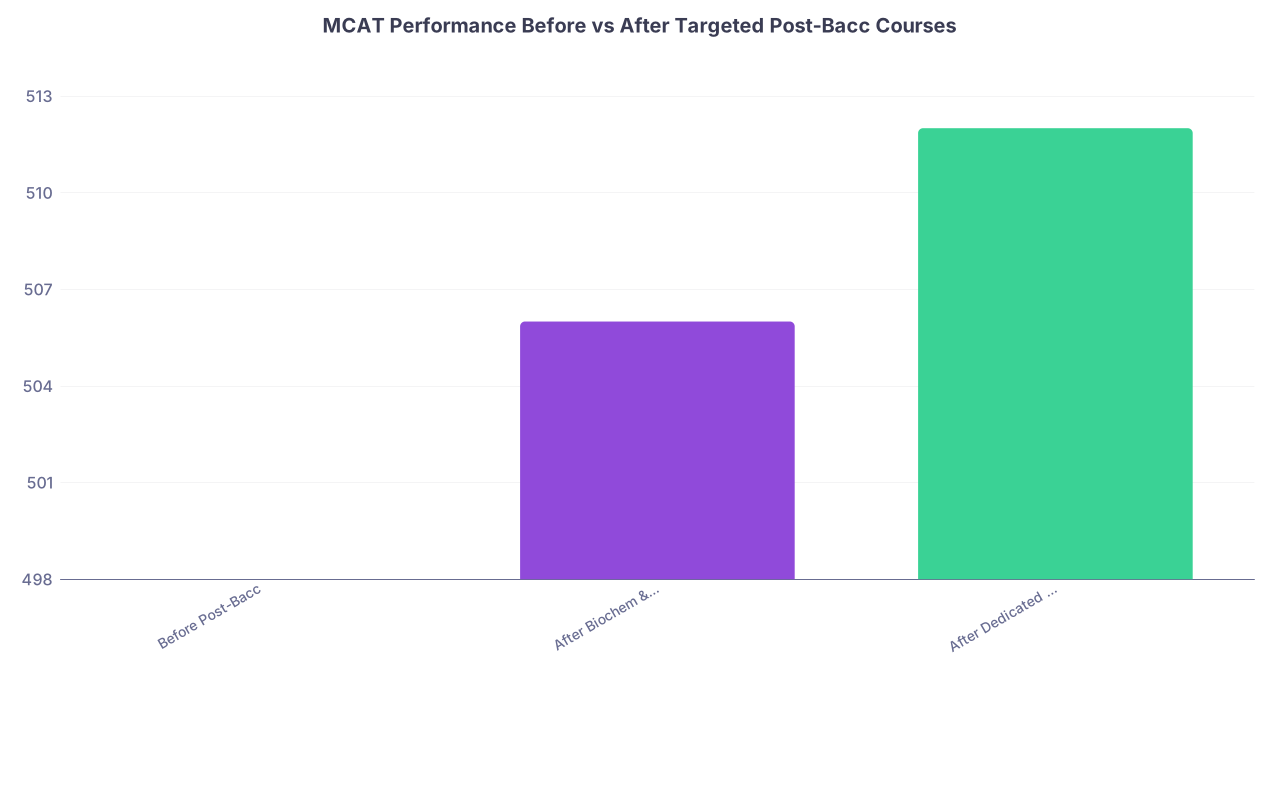
| Category | Value |
|---|---|
| Before Post-Bacc | 498 |
| After Biochem & Physiology | 506 |
| After Dedicated MCAT Prep | 512 |
With a clear plan, a post-bacc stops being a vague “maybe this will help” and becomes a specific tool to sharpen your MCAT and your application story. Use it deliberately, time it correctly, and it can erase years of academic dust.
You’re not done after the MCAT, obviously. Next up is building experiences, letters, and a school list that actually matches your profile. But that’s a fight for the next phase. Right now, your job is simple: pick the right courses, link them tightly to your MCAT timeline, and prove to yourself—and to admissions—that the science you learned years ago isn’t just still there. It’s stronger than ever.