You’re asking the wrong either-or question—and that’s exactly why people blow their post‑bacc year.
The real answer: during a post‑bacc, GPA usually comes first… but not in a vacuum. You need enough clinical experience to prove you understand medicine is messy, human, and not just an academic puzzle. If you sacrifice your GPA to chase “hours,” you’ve wasted the entire point of doing a post‑bacc. If you ace your classes but never touch a patient, you look like a controlled lab experiment, not a future physician.
Let me break this down cleanly.
Step 1: Be Honest About Why You’re Doing a Post‑Bacc
Post‑bacc motives are not all the same. And what you should prioritize depends a lot on which bucket you fall into.
Typical scenarios:
Career-changer, no science background
You have a decent prior GPA, maybe in something like history, business, or engineering. You’re doing a post‑bacc to get prerequisites and prove you can handle science rigor.GPA repair / academic redemption
Your earlier GPA is weak—low science GPA, bad freshman year, maybe a rough stretch with withdrawals and C’s in core sciences. You’re trying to show a new academic trend.Hybrid: some prereqs + need GPA repair
You’ve taken some sciences, they’re mixed, and you need both more coursework and better grades to be competitive.
If you’re in group 2 or 3 and you do not prioritize GPA, you have essentially misunderstood the assignment. Med schools use post‑bacc performance as a test: “Can this person handle high-volume, difficult science courses now?” If you screw that up because you were trying to hit 1,000 clinical hours as a scribe, that’s on you.
For career-changers with a decent prior GPA: you have a little more flexibility, but not much. Your science GPA is basically being written from scratch. That’s your spine. Clinical is muscle and skin. Spine wins.
Step 2: Understand What Medical Schools Actually Need to See
Medical schools don’t care about “balance” in some vague lifestyle-coach way. They care about evidence.
They want to see:
Academic readiness
Recent, strong performance in upper-level science. Think A/A- work in your post‑bacc, especially in the core courses: general chemistry, organic, biology, physics, biochem, physiology.Exposure to clinical reality
You’ve seen illness, vulnerability, death, busy overworked staff, and still want in. You understand what physicians actually do all day (not just “help people”).Commitment over time
Not a two-week shadowing blitz. Sustained involvement: several months or more of consistent, real clinical contact.
Post‑bacc is your best shot to upgrade the “academic readiness” box. That box lives or dies on GPA. You can build clinical experience in many seasons of your life; repairing GPA is far more constrained by time, money, and applicant cycles.
So the priority stack for most post‑bacc students looks like:
- Post‑bacc GPA (and MCAT prep if overlapping)
- Ongoing, meaningful clinical exposure
- Everything else (research, leadership, non-clinical volunteering, etc.)
Step 3: How Strong Does Post‑Bacc GPA Need To Be?
Let me be specific. A post‑bacc is not the place for “solid B+ work.” That might fly in undergrad; it does not scream “trust me with patients” when you already have grade baggage.
For most traditional MD applicants trying to repair or prove academics:
- Aim for: 3.6+ in your post‑bacc
- Stronger target: 3.7–3.8+ if your prior GPA was significantly weaker
- A string of A’s in hard sciences is worth more than one more clinical job on a busy CV
If your cumulative GPA from undergrad is low (say 2.9–3.2), your post‑bacc is basically your rebuttal: “Those weren’t my real abilities. This is.” That rebuttal has to be convincing. And convincing usually doesn’t look like “I got A’s when I took 9 credits, but dropped to B’s when I added a part-time clinical job.”
Med schools absolutely look at trends. I’ve watched committees literally run their finger along the transcript: “Okay, C+ in orgo back then, but now all A-/A in upper-level bio and biochem. Good.” Do not muddy that line with mediocre post‑bacc grades.
Step 4: Minimum Clinical Experience You Should Not Go Below
Here’s where people overcorrect. They hear “GPA first” and then decide to be a full-time hermit and never set foot in a hospital. That is also a mistake.
You don’t need 2,000 hours during your post‑bacc. But you do need enough that you sound like someone who has actually smelled a hospital, heard code blues called overhead, and talked to patients at their worst.
As a bare-bones target (for the post‑bacc year itself, not your entire premed life):
Consistent clinical involvement:
4–8 hours/week during school is usually the sweet spot.Time horizon:
6–12 months of continuity is far more valuable than three random bursts.
That typically lands you in the 150–400 hour range over a year. Fine. Respectable. Combined with prior or later experiences, that’s absolutely workable.
What counts here:
- Scribe (in ED, outpatient, inpatient)
- Medical assistant
- CNA/PCT
- ER tech
- Hospice volunteer with patient contact
- Hospital volunteering where you really interact (transport, unit helper, not just front desk staring at a phone)
Shadowing is supplemental. You need some (20–50 hours is usually enough), but it does not replace hands-on or at least patient-facing roles.
Step 5: Deciding Your Weekly Mix – A Practical Rule of Thumb
Most people are trying to juggle:
- 12–18 credits of post‑bacc science
- Clinical work or volunteering
- Some MCAT studying, depending on timing
- Possibly a part-time job for money
Here’s the simple rule I tell post‑bacc students:
If your GPA is not yet where it needs to be, build your week around classes. Then “fill the leftover space” with clinical, not the other way around.
Concrete example:
You’re taking 14 credits of heavy science (orgo, physics, and physiology). You have an opportunity to scribe 20 hours/week vs 8–10 hours/week.
If 20 hours means:
- You’re constantly behind reading
- You’re skimming problem sets at midnight
- You’re sliding from A to B/B- in key courses
Then it’s the wrong choice. Drop to 8–10 hours/week. Protect the GPA.
On the other hand, if you’ve settled into a sustainable rhythm, pulling A-/A grades and you’ve proven that across at least one full term, then sure—consider bumping clinical hours up slightly. But never at the expense of that clean academic story.
Step 6: Special Cases Where Clinical May Temporarily Take Priority
There are a few situations where I’d tell you to push clinical a bit harder, even during a post‑bacc—while still not torching your GPA.
You have almost zero clinical exposure
If you’re truly starting from zero (no prior volunteering, no shadowing, no patient contact), you need to fix that fast. I’d still keep coursework primary, but I’d be more aggressive about getting to at least 4–8 hours/week starting immediately.You’re clearly older / nontraditional, but no clinical
Admissions committees get wary if a 28- or 32-year-old applying to med school has huge career experience in something else but still minimal clinical. They start asking: “Why so little contact? How do they know this is right for them?”You’re targeting DO only, already have decent upward trend
DO schools often weigh clinical and “fit with osteopathic philosophy” more heavily, especially if your GPA story is already reasonably repaired. You still can’t bomb classes, but you might lean a bit more on hands-on patient interaction to stand out.
Even in these cases, the rule still stands: if you’re in a formal post‑bacc and your grades fall below that 3.5+ range because of clinical hours, your priorities are off.
Step 7: Planning Across Multiple Years, Not Just One
Your post‑bacc year is not your only window for clinical experience. This is where a lot of anxiety comes from: people think everything must be crammed into a single 9–12 month block.
A smarter approach:
Year 1 (early undergrad or early post‑bacc):
Light, consistent clinical volunteering, minimal but consistent shadowing.Post‑bacc year:
Heavy focus on courses, 4–8 hours/week of stable clinical. Build depth, not just raw hours.Gap year (if you take one, which many post‑baccs do):
This is where you can go big on clinical—full-time MA, scribe, CNA, hospice worker—without risking grades.
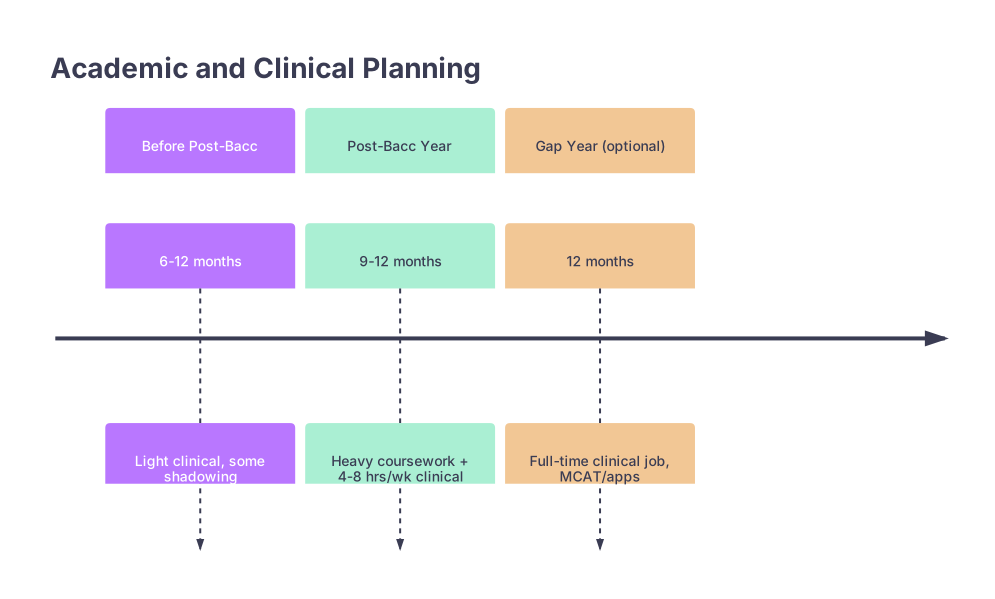
| Period | Event |
|---|---|
| Before Post-Bacc - 6-12 months | Light clinical, some shadowing |
| Post-Bacc Year - 9-12 months | Heavy coursework + 4-8 hrs/wk clinical |
| Gap Year (optional) - 12 months | Full-time clinical job, MCAT/apps |
Think sequence, not simultaneity. You do not get extra points for suffering through an insane schedule if the outputs (grades, MCAT, letters, hours) are mediocre.
Step 8: Common Bad Plans (And What To Do Instead)
I’ve watched students sabotage themselves with the same few patterns over and over.
Bad Plan #1:
“I’ll work 30 hours/week as a scribe, take 16 credits of heavy science, and self-study for the MCAT at night.”
Result: 3.2 post‑bacc term, burned out, average MCAT. Committee shrugs.
Better: Cut work to 8–12 hours/week, get A’s in that term, push MCAT to the summer or gap year.
Bad Plan #2:
“I bombed freshman year, but I want to show how committed I am to medicine, so I’ll stack 3 volunteer gigs plus a research lab on top of my post‑bacc.”
Result: Great stories, mediocre GPA. That transcript kills you before anyone hears the stories.
Better: Pick ONE solid clinical role + ONE non-clinical or research if you truly have bandwidth. Do them well, not widely.
Bad Plan #3:
“I’ll do no clinical in post‑bacc, just full-time classes, then promise schools I’ll get experience later.”
Result: You look like a pure academic who might hate real medicine once exposed to it. Risky bet for schools.
Better: 4–6 hours/week of something real (hospital volunteer, hospice, MA, etc.) while you crush classes. Then scale up clinical later.
Quick Decision Framework For You
Here’s your personal gut check. Answer these honestly:
Is your overall GPA or science GPA below ~3.4?
- If yes: academic repair is your primary mission. GPA first.
Do you already have at least 150–300 hours of decent clinical exposure across your life?
- If yes: you can afford to keep clinical modest during post‑bacc. Maintain or slightly build, but don’t chase hours.
- If no: you need to start now, even if small, and maintain continuity.
Are you consistently earning A/A- in current or recent science coursework with your current schedule?
- If no: you don’t increase clinical time. You fix the academic leak first.
- If yes: you can consider incremental increases in clinical involvement if you want more depth.
That’s the algorithm. Not complicated, but most people talk themselves into ignoring it.
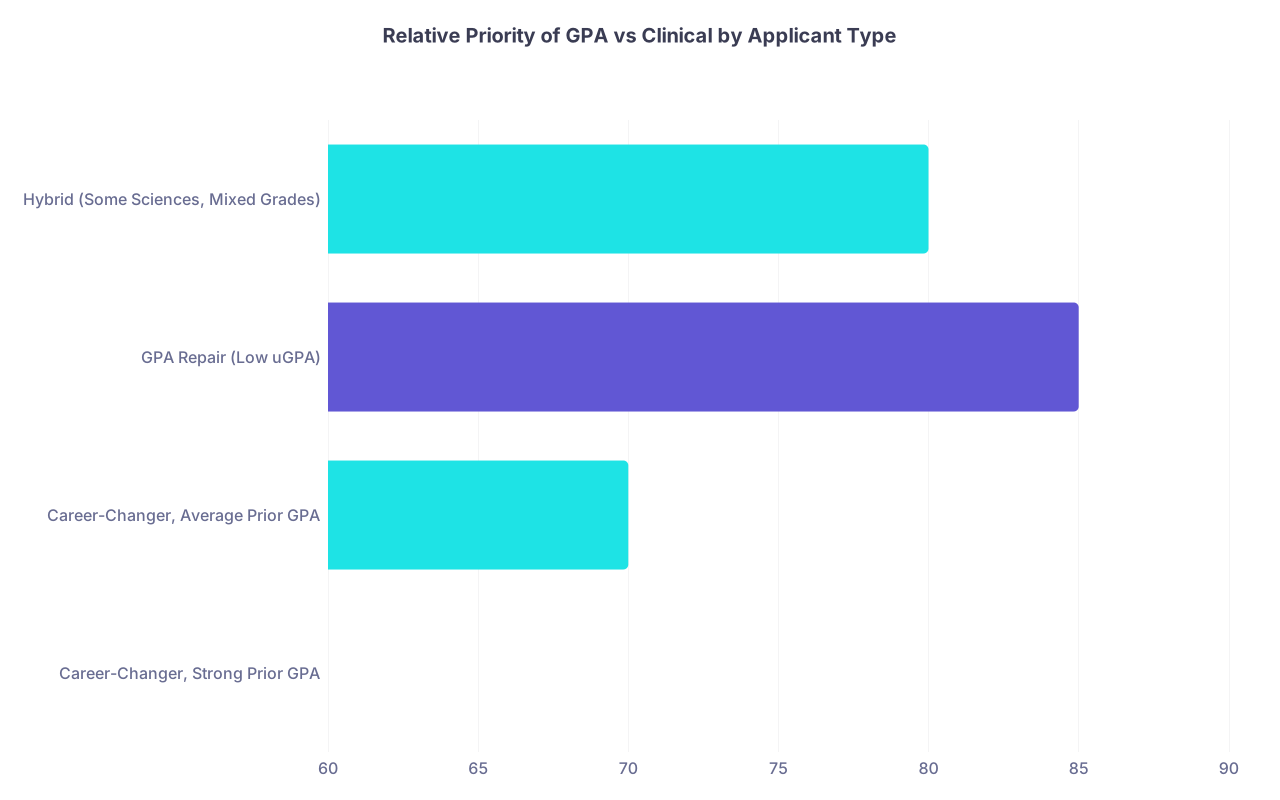
| Category | Value |
|---|---|
| Career-Changer, Strong Prior GPA | 60 |
| Career-Changer, Average Prior GPA | 70 |
| GPA Repair (Low uGPA) | 85 |
| Hybrid (Some Sciences, Mixed Grades) | 80 |
(Values represent suggested emphasis on GPA vs all other activities during post-bacc; higher = heavier GPA focus.)
Final Word: If You’re Going To Sacrifice Something, Don’t Let It Be GPA
Post‑bacc programs are expensive, draining, and high-stakes. Their primary currency is not “experience” — you can get clinical experience almost anywhere, at many stages of your life. The unique thing they offer is a fresh academic record.
So yes, most of the time, you should prioritize GPA during a post‑bacc year. Not to the exclusion of all clinical exposure. But you should design your life so that your grades reflect your best possible performance, while you maintain a steady, believable level of patient contact.
Two or three essentials to keep in your head:
- Use post‑bacc to prove academic mastery. That’s its main job.
- Maintain steady clinical exposure (4–8 hours/week) rather than chasing giant hour totals.
- Think in phases: grades now, volume clinical later if needed—don’t try to max everything at once and end up mediocre across the board.
FAQ (Exactly 7 Questions)
1. How many clinical hours do I need during my post‑bacc year?
You don’t need a magic number from that single year. If you can sustain 4–8 hours/week over 9–12 months, that’s typically 150–400 hours, which is more than enough from that period. Admissions will look at your total clinical history; combine post‑bacc with earlier or later experiences. Priority is consistency and depth, not raw hours.
2. Is it a red flag if my clinical experience is mostly from after my post‑bacc (gap year)?
No, not if you already had some exposure beforehand and can credibly explain your timeline. A very common pattern: light clinical during undergrad or early post‑bacc, heavy clinical during a gap year. What is a red flag is applying with almost no hands-on experience and only hypothetical future plans.
3. Can I work full-time clinically while doing a DIY post‑bacc part-time?
You can, but you have to be brutal about course load. If you’re working 30–40 hours/week as a scribe/MA and only taking 6–8 credits of science per term, you absolutely must crush those courses (A range). If grades dip, scale back work or reduce course load and extend your timeline. Do not accept mediocre grades just to keep full-time hours.
4. Do medical schools value scribing more than generic hospital volunteering?
Usually yes. Scribing and MA work tend to provide deeper clinical insight and closer physician interaction. But hospitals volunteering with real patient contact can also be strong. The hierarchy is less important than what you learned and how long you stuck with it. “I showed up weekly for a year and actually talked to patients” beats “I had a fancy title for one month.”
5. Should I delay the MCAT to protect my post‑bacc GPA?
Often yes. If trying to prep for the MCAT at the same time as heavy post‑bacc coursework threatens your grades, delay the MCAT. A strong MCAT on top of weak recent grades does not fix the underlying concern about readiness. A slightly later but stronger MCAT + clean post‑bacc record is a far better combination.
6. I already have a 3.7 cumulative GPA but little science; can I go heavier on clinical during post‑bacc?
You have more room, but not unlimited. Your new science GPA still matters a lot, because it’s the main signal of your ability with medical-school-like content. I’d still aim for A/A- in those sciences first, then use any remaining bandwidth to add clinical. You don’t need huge hours if you’re already academically strong—just enough to show maturity about the profession.
7. Will one B in a post‑bacc class ruin my “GPA-first” strategy if I’m also doing clinical work?
No. A single B won’t kill you. Patterns kill you. If the general trend is mostly A/A- across solid science coursework, one or two B’s are fine, especially in difficult classes. The problem is when “I’m working a lot clinically” turns into a transcript full of B’s in the very program that was supposed to redeem your academics. Use the B as a feedback signal: if it came from overload, adjust your clinical hours or course load for the next term.