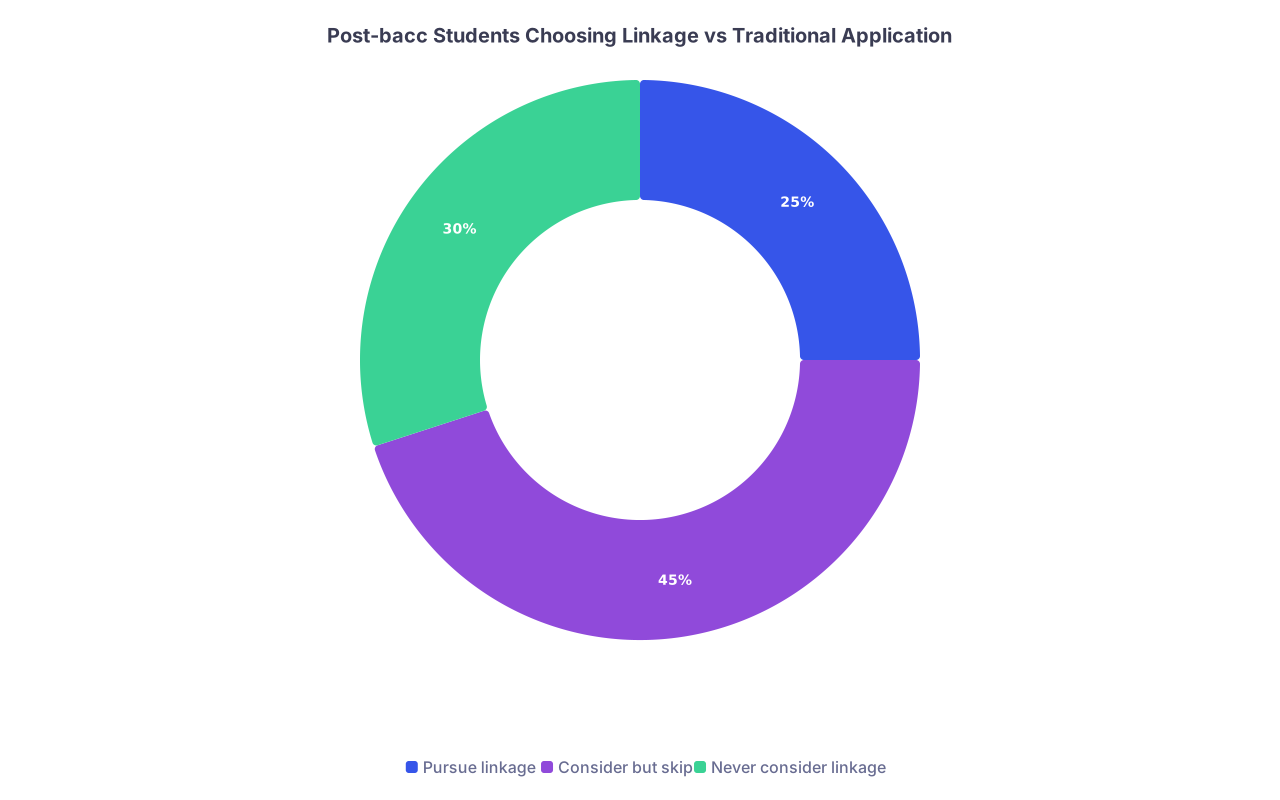
The blunt truth: A gap year after a post-bacc is not automatically necessary—but for a lot of applicants, it’s strategically smart. The mistake is treating it as all-or-nothing instead of a calculated decision.
You’re not asking, “Is a gap year good or bad?”
You’re asking, “With my specific stats, timeline, and finances, does a gap year help me or hurt me?”
Let’s answer that directly.
(See also: How Many Post-Bacc Credits Are Enough to Show Real Academic Change? for more details.)
The Core Question: Do You Need a Gap Year After Post-Bacc?
Here’s the answer in one line:
You do not need a gap year after a post-bacc if:
- Your post-bacc GPA is strong and complete by spring,
- Your MCAT is taken early with a solid score,
- Your letters, clinical, and non-clinical experiences are already in place,
- And you can submit your application early in the cycle.
You probably should take a gap year if:
- You’re still fixing an academic record (especially a low undergrad GPA),
- Your post-bacc grades aren’t fully available by June,
- Your MCAT isn’t done (or isn’t strong enough),
- Your clinical exposure or shadowing is weak,
- Or you’d be rushing everything just to apply “on time.”
Here’s the real litmus test I use when advising:
If you applied this cycle with your projected stats and experiences, would you be proud of that application—or just relieved to have “finally applied”?
If it’s the second one, you’re not ready. Gap year probably helps.
Understanding the Post-Bacc + Application Timeline
Most post-baccs run on this general timeline:
- Start: August/September
- End: May/June of year 1 (1-year programs) or year 2 (2-year programs)
- Med school applications (AMCAS/AACOMAS): Open in May/June
- Interview season: August–March
- Matriculation: Next July/August
This creates the classic fork:
Apply while still in post-bacc
Example: Start post-bacc Aug 2025 → Apply June 2026 → Matriculate 2027
(No “extra” gap year after the program.)Finish post-bacc, THEN apply
Example: Start post-bacc Aug 2025 → Finish May 2026 → Take gap year 2026–27 → Apply June 2027 → Matriculate 2028
The question is: Is path #1 even realistic for you?
Most students overestimate how much improvement a single semester of post-bacc grades can demonstrate by June of the application year. Medical schools don’t see future grades; they see what’s on the transcript at submission.
So if your turnaround story depends on:
- “I’ll do better next semester,” or
- “Once my last 12 credits post, my trend will look great,”
then you’re building your application on promises, not data. Committees are not impressed by hypothetical GPAs.
Concrete Reasons You Might NOT Need a Gap Year
Let me be clear: a gap year is not a status symbol. It’s a tool. You skip it when your foundation is already strong.
You probably don’t need a gap year if:
Academically, you’re already where you need to be
- Undergrad GPA is decent (e.g., ≥3.4–3.5 overall, higher science trend).
- Post-bacc is a polish, not an emergency repair.
- You’ll have at least 2 solid semesters of A/A- science work on the transcript by June.
- You don’t have a massive GPA hole (like 2.7–3.0) you’re trying to dig out of.
-
- You’ve already taken the MCAT with a score in your target range,
or - You’re taking it no later than March–April of the application year, with full prep time.
Taking the MCAT in June or July while trying to finish a post-bacc and build an application? That’s how people end up with a mediocre score and a wasted cycle.
- You’ve already taken the MCAT with a score in your target range,
Your experiences are already robust You already have:
- 100–200+ hours of clinical exposure (scribing, CNA, EMT, MA, hospital volunteering).
- Shadowing in at least 1–2 specialties.
- Some non-clinical service and at least one activity that shows initiative or leadership.
- People who know you well enough to write strong letters now.
You can apply early and well
- You’re ready to submit a polished primary application in early June.
- You can return secondaries within 1–2 weeks.
- You’re not financially or logistically constrained from applying strategically (not forced to apply to 10 schools when you probably need 25).
If this sounds like you, applying while you’re still in (or just finishing) your post-bacc is reasonable. A gap year might just delay you for no added benefit.
Strong Reasons to Seriously Consider a Gap Year After Post-Bacc
Now let’s flip it. Here are situations where I’ve seen a gap year clearly help applicants.
1. Your GPA Story Isn’t Finished Yet
Common scenario:
- Undergrad GPA: 2.9–3.2
- Post-bacc: You’ve done 1 semester, maybe 2
By June of the application year, admissions sees:
- So-so undergrad
- A modest number of post-bacc credits (maybe 12–20 credits of A’s)
That’s better than nothing. But it’s not a fully established trend. For significant GPA repair, I like seeing:
- 30–40+ post-bacc science credits of A/A- work
- Clear upward slope in both overall and science GPA
Without the full year of grades in hand, your “turnaround” is half-documented. You’re asking committees to trust that you’ll maintain that performance. They’ve seen enough students flame out to be skeptical.
In that case:
Finishing the full post-bacc, letting all grades post, and then applying the following year? That suddenly makes your academic story far more convincing.
2. You’re Rushing the MCAT
Common red flags:
- You’re planning to take the MCAT in May–June because “that’s when everyone does it.”
- You’re splitting focus between full-time post-bacc courses and MCAT prep.
- Practice scores are stuck below your target, but you “need” to test this year.
MCAT + heavy post-bacc coursework is where good GPAs go to die. And a mediocre MCAT on a repaired GPA is still a problem.
Gap year advantages here:
- Time for a dedicated 3–6 month MCAT study block.
- You can protect your post-bacc GPA from being dragged down by burnout.
- You apply with a real, finalized MCAT score—not a guess.
3. Your Activities are Thin or Superficial
Post-bacc students often have this profile:
- Strong recent academics.
- Decent but scattered clinical experiences from undergrad.
- Minimal recent shadowing.
- Non-clinical volunteering that basically stopped once school restarted.
Medical schools don’t just want to see that you can survive biochem. They want a coherent story: You understand the realities of medicine, you’ve served real people, and you’ve committed to something beyond just school.
Gap year= time to:
- Work in a clinical role (scribe, MA, EMT, patient care tech).
- Build sustained non-clinical service (tutoring, shelters, community orgs).
- Shadow regularly and update your understanding of modern practice.
If your “meaningful activities” section is mostly undergrad relics and a few scattered hours, a gap year can transform your app from “generic reapplicant in 2 years” to “solid, grounded candidate now.”
4. You’d Be Applying Weakly or Too Narrowly
I’ve seen this a lot:
- Limited budget → Apply to 8–10 schools that “feel right.”
- No time to research schools thoroughly.
- Personal statement and secondaries written in a hurry, without revision.
- No realistic school list strategy (e.g., only applying to brand-name schools with 3.4/509).
If your first application is rushed, under-researched, and underfunded, you’re accidentally auditioning for “reapplicant” status. That label follows you. Some schools absolutely look at that and expect clear, measurable improvement.
A gap year lets you:
- Save money to apply more broadly (20–30 schools, if needed).
- Craft a targeted school list (MD vs DO balance, mission fit, GPA/MCAT ranges).
- Actually refine your essays with feedback.
A Simple Decision Framework: Should You Take a Gap Year?
Use this as a reality check. Answer honestly.
Academic Readiness
- Is your overall GPA within or close to competitive ranges for your target schools?
- Do you have at least 30 credits of recent, high-level science with mostly A’s?
- Will those grades be on your official transcript by June?
If not, gap year is likely beneficial.
MCAT Readiness
- Do you have a real MCAT score at or near your target (not just a plan)?
- Were your last 3–4 full-length practice tests in that range?
- Can you study properly without tanking your post-bacc grades?
If no, don’t force a same-year application. Fix the MCAT first.
Experience and Story
- Do you have consistent, recent clinical work?
- Do you have genuine non-clinical service that isn’t just “checking a box”?
- Can you articulate why medicine in a way that doesn’t sound like a generic premed script?
If your answers feel flimsy, a gap year gives you material and maturity.
Life and Finances
- Can you afford one more year of living expenses without derailing your life?
- Could a year of work reduce your overall debt burden?
- Are you mentally burnt out or still energized enough to keep pushing?
If you’re cooked, forcing yourself into an immediate application and then med school is a recipe for misery.
If 2+ of these areas are weak → a gap year is not “falling behind.” It’s fixing the foundation.
What to Actually Do During a Gap Year After Post-Bacc
If you do take a gap year, it cannot be “vibes and Netflix.” Admissions will absolutely look at how you used that time.
High-yield gap year moves:
Work in a clinical role
Scribe, MA, EMT, hospital tech, hospice aide, etc. Shows commitment and builds stories for interviews.Strengthen non-clinical service
Long-term volunteering with underserved groups. Committees love sustained, real engagement.Crush the MCAT
Dedicated months, structured schedule, multiple practice exams, no panic-registering.Keep academics alive (if needed)
If your GPA is marginal, pick up a few additional upper-level sciences or continue a formal special master’s/post-bacc.Build maturity and narrative
Use this year to actually reflect. Journal after shifts. Notice what pulls you toward medicine and what worries you. That depth comes through in essays and interviews.

| Step | Description |
|---|---|
| Step 1 | Start Post-Bacc |
| Step 2 | Complete 1-2 Semesters |
| Step 3 | Apply During Post-Bacc |
| Step 4 | Finish Post-Bacc |
| Step 5 | Gap Year: Work, MCAT, Experiences |
| Step 6 | Apply Next Cycle |
| Step 7 | Interviews & Matriculation |
| Step 8 | Strong GPA, MCAT, Experiences? |
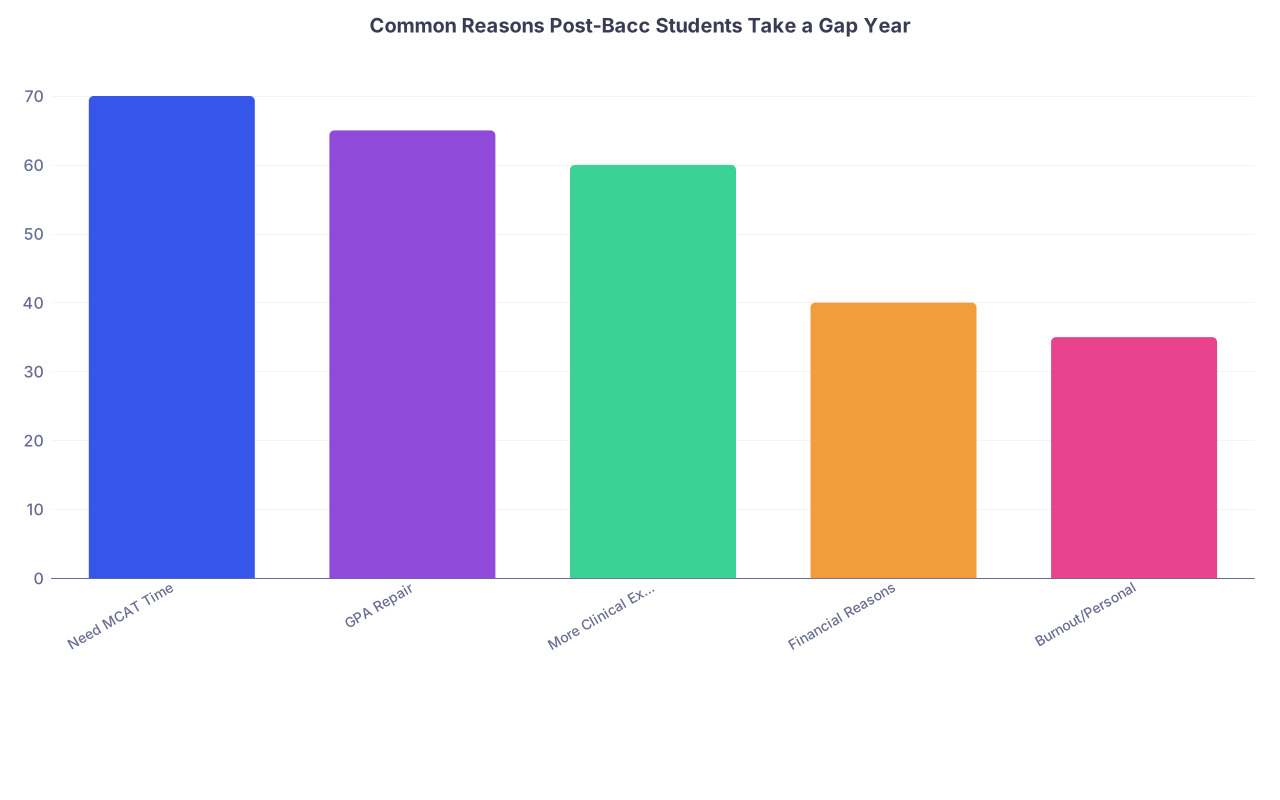
| Category | Value |
|---|---|
| Need MCAT Time | 70 |
| GPA Repair | 65 |
| More Clinical Experience | 60 |
| Financial Reasons | 40 |
| Burnout/Personal | 35 |

Common Myths About Gap Years After Post-Bacc
Let me kill a few bad ideas I hear constantly.
Myth 1: “If I take a gap year, schools will think I’m behind.”
Wrong. Most med students now have at least one gap year. Many have two or more. Schools care what you did, not whether you rushed.
Myth 2: “If I don’t apply this year, I’ll never apply.”
That’s not a reason to apply with a weak app. That’s a reason to address whatever fear or burnout you’re dodging. Wasting $2,000 on a doomed cycle does not build courage.
Myth 3: “Post-bacc students must apply immediately after finishing, or it looks bad.”
No. It looks bad if you drift aimlessly. A clear, intentional gap year—especially with clinical work—often makes you look more grounded, not less.
Myth 4: “I’ll fix my app after I see what feedback I get from schools.”
You don’t get feedback. You mostly get silence or rejections. Your “feedback” is: the cycle ended and you didn’t get in. Much better to submit a strong first application.

Bottom Line: Is a Gap Year After Post-Bacc Necessary?
No, it’s not inherently necessary. But here’s the practical rule:
- If your academics, MCAT, experiences, and story are already competitive, skip the gap year and apply.
- If any of those are significantly underdeveloped, a well-used gap year is not a delay—it’s a multiplier.
Don’t obsess over what your classmates are doing. They won’t be present when an adcom is reading your file at 10:45 p.m. in January. That committee will have one question:
“Does this application prove this person is ready for medical school?”
Your job is to decide whether applying right after your post-bacc lets you answer “yes” with evidence, not hope.
FAQ (Exactly 5 Questions)
1. If I finish my post-bacc in May, can I apply that June without a gap year?
Yes—if you already have your MCAT done, your earlier post-bacc grades posted, and a decent academic and clinical foundation. The spring grades may arrive after submission but will be updated later. If your whole “repair” depends on that final semester, it’s usually wiser to wait a cycle.
2. Will medical schools question why I took a gap year after a post-bacc?
They’ll question it if you did essentially nothing. If you worked clinically, strengthened your experiences, studied properly for the MCAT, or continued academic improvement, it’s easy to explain: “I used that year to deepen my clinical exposure and ensure I was fully prepared for the rigors of medical school.”
3. Should I work full-time or part-time during a gap year after post-bacc?
If money is tight, full-time clinical work is completely fine and often viewed positively. If your MCAT or experiences are still weak, you might do a mix: part-time work plus structured study and volunteering. The key is coherence—what you’re doing should clearly build your readiness for medicine.
4. Is it better to finish a DIY post-bacc or start a formal program, then take a gap year?
For most people, finishing what you started and showing a complete, strong academic track record matters more than hopping programs. A gap year is more about how you round out your MCAT and experiences than about stacking more degrees or certificates, unless your GPA is still below competitive ranges.
5. How many post-bacc credits should I have before I skip a gap year and apply?
As a rough guideline, 24–30+ credits of solid, upper-level science with mostly A’s gives admissions something real to work with. If you’re sitting at 12 credits and banking on future courses to “fix” your numbers, that’s a sign you’re probably applying too early and a gap year (with continued coursework if needed) would help.