The default premed advice about post-baccs is lazy and often wrong.
Too many people say, “If your GPA isn’t great, do a post-bacc.” That’s not a plan. That’s a slogan. You do not decide between a formal post-bacc and just taking more upper-level sciences until you’ve answered one brutal question:
What exactly do your numbers look like right now, and what do they need to look like to give you a realistic shot?
Let’s walk through this like I would with a student sitting in my office: transcript in hand, calculator out, and no sugarcoating.
(See also: How Many Post-Bacc Credits Are Enough to Show Real Academic Change? for more details.)
Step 1: Diagnose Your Situation (Not Your Feelings)
You don’t start with “I feel like my GPA is low.” You start with data.
Here’s what you need in front of you:
- Cumulative GPA (cGPA)
- Science GPA (sGPA – biology, chemistry, physics, math; some schools add more)
- Number of total credits
- MCAT score (or realistic target if you haven’t tested yet)
- Trend: what did your last 30–40 credits look like?
Most people fall into one of four buckets:
You’re fine.
- cGPA ≥ 3.6, sGPA ≥ 3.6, strong upward or stable trend
- You do not need a post-bacc. You probably don’t need extra upper-levels either, except for prep or interest.
You’re solid but need a bit more academic punch.
- cGPA 3.4–3.6, or sGPA a bit lower than your cGPA
- Here, targeted upper-level science courses or a light informal post-bacc can work.
You’re in the gray zone.
- cGPA 3.0–3.4 or sGPA < 3.2, especially with early poor grades
- You might need a more structured academic repair plan (mix of upper-levels, maybe a certificate or formal post-bacc).
You’re digging out of a real hole.
- cGPA below 3.0, or a long streak of poor science grades
- You likely need either:
- A serious, sustained informal post-bacc with strong performance
- Or a formal post-bacc / SMP (special master’s program) if you can execute at a very high level.
Most students asking this question are in buckets 2–4.
Step 2: Know What Each Option Actually Does
People use “post-bacc” to mean three different things. That’s part of why everyone’s confused.
Option A: Just More Upper-Level Science Courses (Informal)
You sign up at a local university or your alma mater as a non-degree or second-degree student and take upper-level sciences: things like physiology, biochemistry, genetics, microbiology, cell bio.
This is best when:
- You already have the basic prereqs done
- Your GPA isn’t terrible, but your science record is thin, mediocre, or old
- You need to prove recent, rigorous performance, not reinvent your entire academic record
What this does:
- Improves your BCPM trend (that’s what adcoms stare at on the AMCAS printout)
- Shows you can handle med-school-adjacent coursework
- Can bump your GPA meaningfully if you still don’t have a ton of total credits
What it does not do:
- Magically turn a 2.7 into a 3.6
- Provide built-in advising, committee letters, or a big name “program” on your app
- Guarantee linkage or interviews
If your GPA is around the low-to-mid 3s and your more recent coursework is already solid, this is often all you need.
Option B: Formal Undergraduate Post-Bacc Program
This is a defined program at a university labeled “post-baccalaureate premedical,” usually for one of two groups:
- Career changers (no prereqs yet)
- Academic enhancers (prereqs done, GPA not ideal)
Since you’re asking about “just” more upper-levels, I’m assuming you’re not purely a career changer.
What a formal post-bacc adds:
- Structure (cohort, preset course sequences)
- Advising and usually a committee or composite letter
- Sometimes linkages to med schools (conditional, not guaranteed)
- A brand name some adcoms recognize
What it costs:
- Real money. Often $20–40k+ total.
- Time inflexibility (set curriculum, set pace, commute, etc.)
Who actually benefits:
- Students with a shakier record (GPA in the 2.8–3.2 zone) who need a clean academic reboot with hand-holding, structure, and an obvious narrative: “I turned it around and here’s the proof.”
- Students who know they do better with external accountability rather than DIY planning.
Option C: Special Master’s Program (SMP) / Med-Linked Master’s
You asked about post-baccs vs upper-levels, but I’d be lying if I ignored this category because for some GPA profiles, this is the real decision point.
These are usually:
- 1–2 year master’s programs in physiology, medical sciences, etc.
- Often share classes with M1 students
- Explicitly marketed as “GPA repair” for borderline applicants
These are high-risk, high-reward. If you crush it (top 10–20% in a program next to med students), that’s a big signal. If you’re mediocre, you’ve just proved that med school–level work might be too much. Adcoms take that seriously.
Step 3: Match Your Numbers to the Right Intervention
Here’s the blunt version.
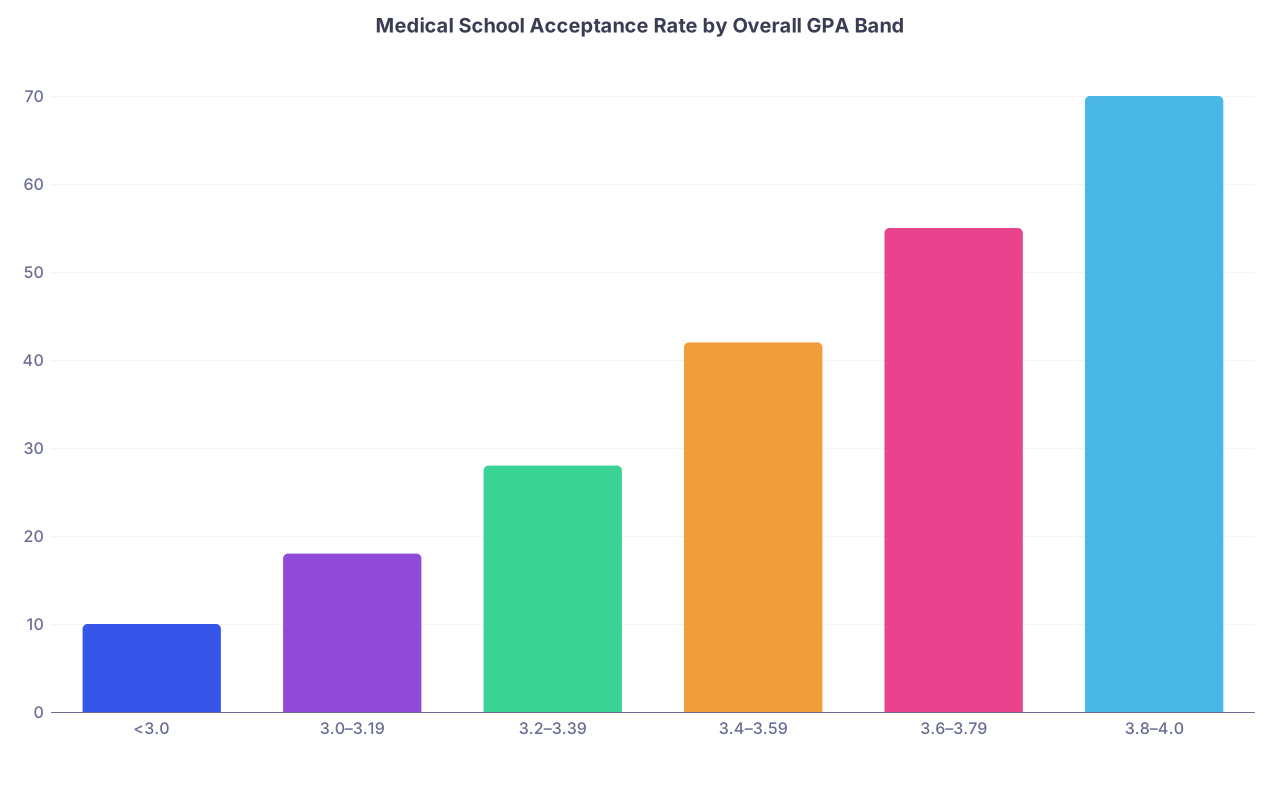
Interpretation:
- Lower GPA → you generally need more structured, heavier-duty repair.
- Higher GPA → you usually just need selected, strategic coursework.
Let’s break it down more practically.
If you’re at 3.6+ (cGPA and sGPA)
No, you do not need a post-bacc. You probably don’t even need extra upper-levels unless:
- Your prereqs are very old (5–7+ years)
- You want biochem or physiology to prep for med school + MCAT
This is not an “enhancer” GPA. It’s already competitive at many schools.
If you’re 3.4–3.6
You’re in striking distance for MD, strong for DO, assuming:
- Upward trend
- No catastrophic Fs in key sciences
- Reasonable MCAT
In this range:
- Take 2–6 upper-level sciences over 1–2 semesters and aim for A/A-
- Or do a light informal post-bacc year (10–20 credits) focused only on hard sciences
No need for a costly formal post-bacc unless you want the advising and committee letter badly and can afford it.
If you’re 3.2–3.4
This is the true decision zone.
Ask yourself:
- Are your recent grades (last 30–40 credits) already 3.7+?
- Is your sGPA roughly similar to your cGPA, not significantly worse?
- Do you have at least a year or more before applying?
If yes to those:
- A focused year of upper-level science (10–25 credits) with A-level work can be enough.
- Informal post-bacc is usually sufficient.
If no (your trend is flat or poor, or your sGPA is significantly lower):
- Strong case for a more structured academic-enhancer post-bacc or a heavier informal course load.
- You need to create a new section of your academic record that’s obviously stronger than the old one.
If you’re around 3.0–3.2
Now you’re in real “repair” territory for MD. DO is more forgiving, but you still need to prove you can excel in rigorous science.
Here’s what usually works better than just a couple of extra courses:
- Either:
- 1–2 years of sustained, high-performance (3.7+) upper-level sciences as an informal post-bacc (20–40+ credits)
- Or:
- A structured academic-enhancer post-bacc program where you load up on heavy sciences and show clear turnaround.
This is where a formal post-bacc actually earns its keep:
- It packages your reinvention story
- It puts you in a cohort with similar goals
- It often comes with targeted advising and letters
But it still only works if your grades are excellent. A 3.3 in a post-bacc on top of a 3.0 undergrad is not some magic ticket.
If you’re below 3.0
You are not choosing between “one extra upper-level course” and “a post-bacc.” You’re choosing between:
- Several semesters to years of sustained A-level work in sciences
- Possibly an SMP after you’ve already shown some upward trend at the undergraduate level
Med schools are not excited by someone who went from a 2.6 to a 2.9. They are interested in the student who had a rough start, then posted:
- 40–60 credits of 3.7–4.0 science in a clear, recent chunk
- Possibly topped with a strong SMP if MD is the goal
You can do that informally if you’re disciplined and cost-conscious. A formal post-bacc helps mainly with structure and signaling. It’s not mandatory—but you need a serious plan, not a couple of random classes.
Step 4: How To Decide – A Simple Flow
Here’s the decision logic I’ve used in advising sessions.

| Step | Description |
|---|---|
| Step 1 | Know cGPA & sGPA |
| Step 2 | No post-bacc needed |
| Step 3 | Targeted upper-level sciences |
| Step 4 | Informal post-bacc or small formal |
| Step 5 | Stronger academic-enhancer plan |
| Step 6 | Extensive repair: long informal or SMP after improvement |
| Step 7 | cGPA >= 3.6 & sGPA >= 3.6? |
| Step 8 | cGPA >= 3.4? |
| Step 9 | cGPA >= 3.2? |
| Step 10 | cGPA >= 3.0? |
Overlay this with:
- Trend (flat vs up)
- MCAT (or realistic target)
- How much time and money you actually have
Step 5: Non-Academic Factors That Break Ties
Sometimes your numbers could be handled either way. Then you let these decide:
Money
- Formal post-bacc: expensive, often no aid, sometimes full-time only
- Informal upper-levels: usually cheaper, can mix with working
Structure vs Flexibility
- If you know you do better with deadlines, advisors, and a cohort, a formal program helps.
- If you’re independent and can search for good professors/courses, informal can be ideal.
Need for a Committee Letter or Linkage
- If you have weak undergrad advising and no committee, a formal post-bacc that provides a strong composite letter can matter.
- Linkages can reduce your application cycle if you’re the kind of student who will be top of that cohort.
Life Commitments
- Working full-time, caregiving, or other responsibilities often pair better with an informal or part-time upper-level approach.
Step 6: How Much Upper-Level Work Is “Enough”?
If you decide you don’t need a full-blown post-bacc, the next question is: how many courses do I actually need?
Ballpark guidelines:
- Already 3.5ish GPA, need a bit more science:
- 8–12 credits (2–4 upper-level science classes) with A/A-
- Around 3.3, want to show clear “I’m ready now”:
- 12–20 credits over 2–3 semesters
- Around 3.0–3.2 aiming for MD consideration:
- 20–30+ credits of consistent high performance, ideally in tougher courses
Pattern matters more than sheer volume. A transcript with:
- Old 3.0 work, then
- 24 credits of 3.8 in upper-level biology/biochem
…tells a much better story than 60 credits of mixed B/B+ scattered everywhere.
Step 7: Common Mistakes That Waste Time and Money
I’ve watched people do all of these:
- Taking random easy A electives and calling it “academic enhancement”
- Doing an expensive formal post-bacc but still getting mostly Bs
- Taking graduate-level “fluff” that doesn’t align with med school rigor
- Spreading 12 credits over 4 years instead of showing 1–2 intense, recent semesters
- Ignoring MCAT until the end and then realizing their test score undercuts their shiny new GPA
If you’re going to invest time and tuition, the bar is simple:
Every course should either: (1) Repair your academic record, or (2) Directly help with MCAT/medical school prep.
If it doesn’t hit one of those, you probably do not need it.
FAQ (Exactly 5 Questions)
1. If I already graduated, should I do a second bachelor’s degree instead of a post-bacc?
Usually no. A full second degree is overkill and expensive. Med schools care about your overall trend and recent performance, not the label on the program. You can enroll as a non-degree or second-degree student, take only the science you need, and avoid the general education fluff. A second bachelor’s only makes sense if you have a compelling career reason outside medicine that requires that specific degree.
2. My GPA is 3.5 but my science GPA is 3.1. Do I need a post-bacc?
You need more solid science, not necessarily a formal post-bacc. In this case, 12–20 credits of upper-level biology/chemistry with all As can repair your science profile. Adcoms will see the split between cGPA and sGPA. Your job is to shrink that gap and show that when you’re doing science now, you can excel. A formal program is optional—prioritize courses in physiology, biochem, genetics, etc.
3. How do med schools view formal post-baccs versus informal coursework?
They care more about the grades and rigor than the packaging. A 3.9 in upper-level sciences taken informally at a reputable 4-year school looks excellent. A 3.3 in a fancy-name post-bacc does not. The advantages of formal programs are advising, committee letters, and sometimes linkage agreements, not automatic admissions preference. Use them if the structure will make you perform better, not because you think the name alone will carry you.
4. Should I fix my GPA first or take the MCAT first?
If your GPA is clearly below competitive ranges (say under 3.3 for MD), fix the GPA trend first. A stellar MCAT with a flat or weak academic record raises red flags: “Can this person handle a full, intense course load, not just a single test?” If you’re already in the mid-3s with a solid upward trend, you can prep MCAT in parallel with a lighter semester or right after finishing a strong academic year.
5. How recent do my “repair” grades need to be?
Closer is better. Med schools like to see that your strongest work is in the last 1–3 years before application. If your post-bacc or upper-level work is 6–7 years old, it has less punch. In that case, even if your overall GPA looks better, you may need a short, recent burst of strong science (1–2 semesters) to reassure them that your current abilities match your historical record.
Key points:
Most borderline applicants do not need an expensive formal post-bacc; they need a clear, recent block of A-level upper-level science. Match your plan to your actual numbers and trend, not your anxiety. And whatever path you choose, the only thing that really moves the needle is sustained, recent excellence in hard science courses.