The biggest mistake premeds make is picking a program type before they’re honest about their numbers.
You do not start with “post-bacc vs SMP vs master’s.” You start with: “What is actually broken in my application: GPA, MCAT, both, or neither?”
Once you’re clear on that, the choice becomes almost boringly obvious.
Let me walk you straight through it.
First: What Each Program Really Is (Not the Marketing Version)
You’ll see a lot of glossy language on program websites. Ignore it. Here’s the clean version.
Post-Bacc Programs
Undergraduate-level coursework after you’ve graduated.
Two main types:
Career-changer post-bacc
You have little/no science background. Goal: complete med school prerequisites (Gen Chem, Bio, Orgo, Physics, Biochem, etc.).GPA-repair/enhancer post-bacc
You already did the prereqs but your science or cumulative GPA is weak. Goal: prove you can now crush upper-division sciences and boost your numbers.
Key traits:
- Undergrad-level classes (200–400 level).
- Usually at a university with other undergrads.
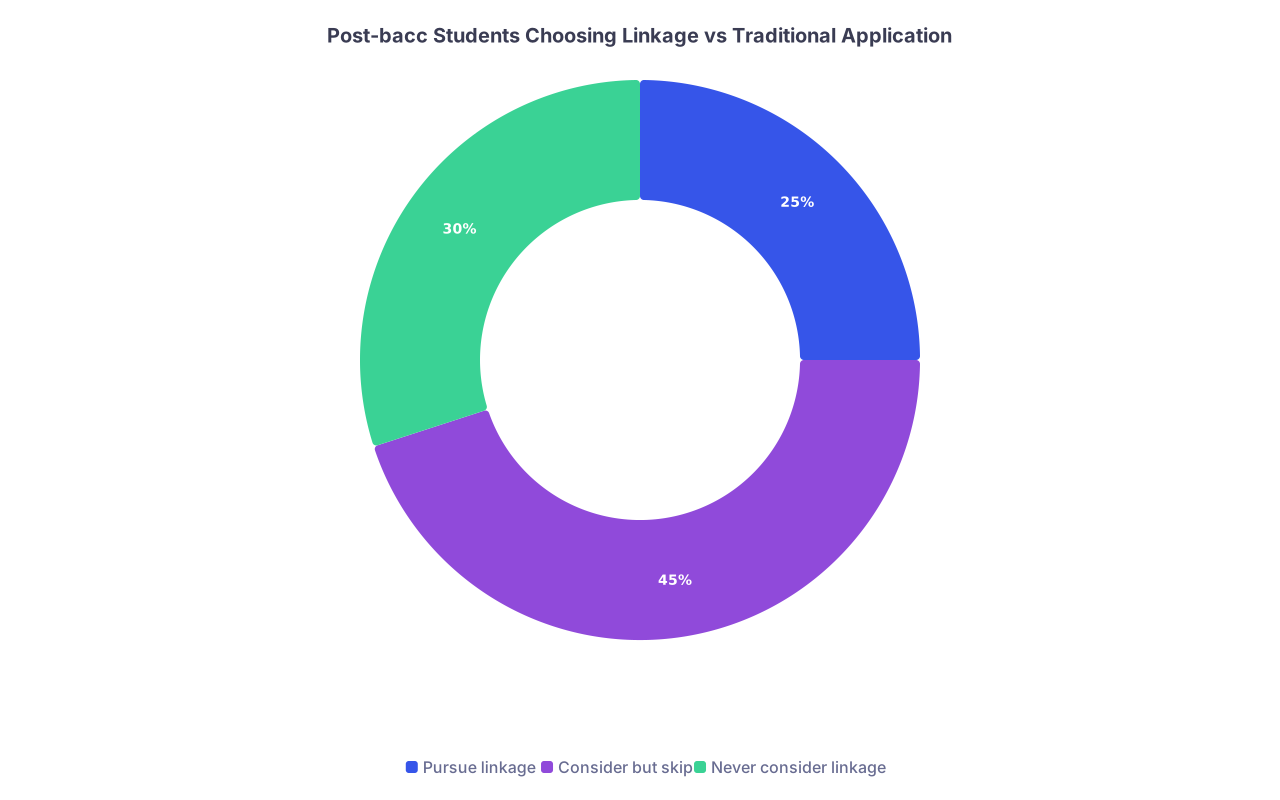
- Sometimes has a formal “linkage” to specific med schools.
- Best for: fixing undergrad GPA trends and/or finishing prereqs.
SMP (Special Master’s Program)
Graduate program built to mirror medical school science and often tied to a med school.
Common features:
- Take actual M1 classes with med students or very similar “med-style” classes.
- Graded on a med school curve.
- Often 1 year, sometimes 1.5–2.
- Frequently has linkage or guaranteed interview conditions if you hit certain benchmarks.
Key traits:
- High risk, high reward.
- A strong SMP performance can be a “GPA rehab plus academic readiness” stamp.
- A mediocre SMP performance can hurt you badly because adcoms know exactly how hard these are.
Best for: students whose undergrad GPA is already “stuck” and need to prove readiness at med-school rigor.
Generic Master’s (MS/MPH/MA, non-SMP)
Graduate program that is not specifically designed as a med school pipeline.
Examples:
- MS in Biology
- MS in Biomedical Sciences (non-affiliated SMP-style)
- MPH
- MHS in Epidemiology
- MPhysiology, Biotechnology, etc. without direct med-school linkage
Key traits:
- Some are rigorous and useful; some are soft and mostly expensive.
- Grad GPA is secondary to undergrad GPA in med school eyes.
- Helps more with narrative and skills than raw numbers, unless the coursework is heavy in upper-level hard sciences.
Best for:
- Adding research or public health experience.
- Strengthening overall profile when your GPA is borderline but not disaster-level.
- People actually interested in that field (not just credential-chasing).
Step 1: Diagnose Your Situation (Numbers First, Feelings Second)
Here’s the brutal truth: med schools care primarily about undergrad GPA and MCAT. Graduate work is supplemental.
Start by writing down four numbers:
- cGPA (overall undergrad)
- sGPA (BCPM – biology, chemistry, physics, math)
- Most recent 30–60 credit GPA
- Latest official MCAT (or practice average if you haven’t tested yet)
Now match yourself to a bucket.
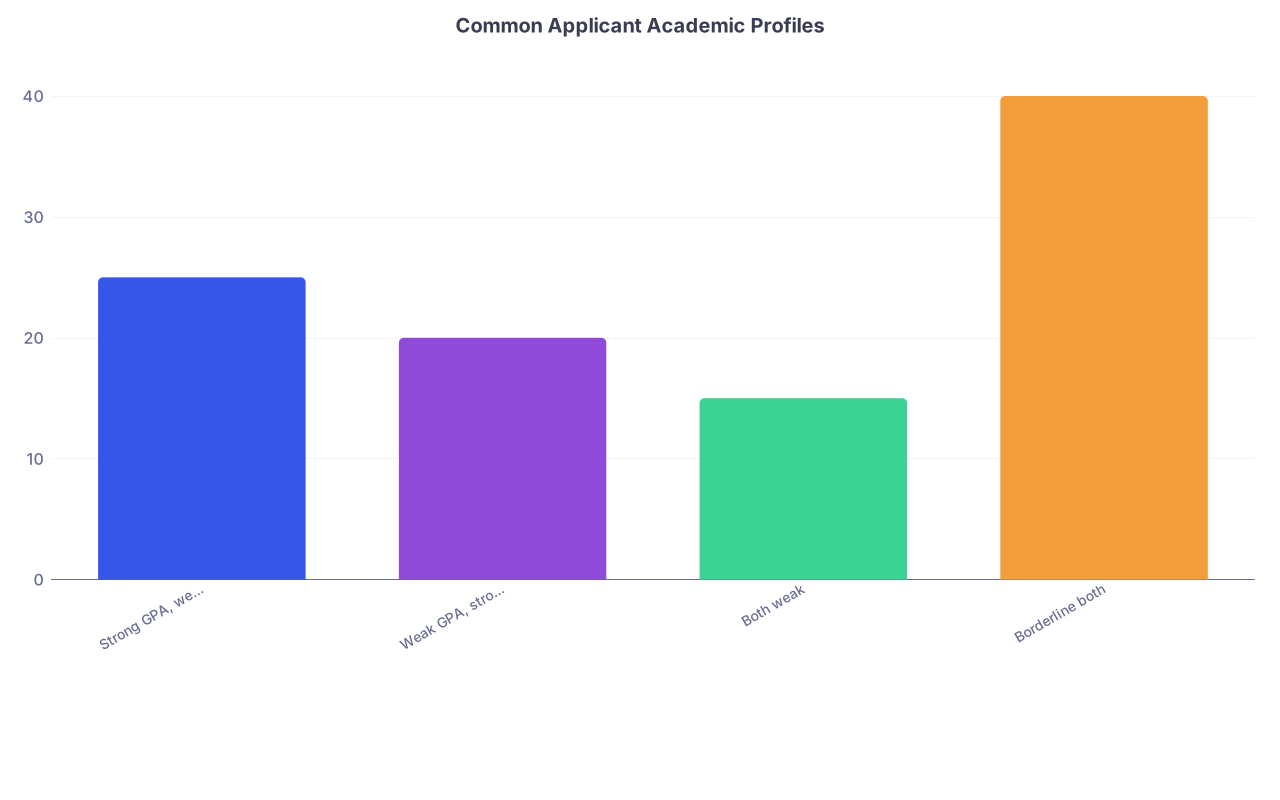
| Category | Value |
|---|---|
| Strong GPA, weak MCAT | 25 |
| Weak GPA, strong MCAT | 20 |
| Both weak | 15 |
| Borderline both | 40 |
These ranges are U.S. MD-focused; DO schools and Caribbean are different conversations.
- Competitive-ish GPA:
- ≥ 3.6 for MD
- ≥ 3.4–3.5 for DO
(See also: Is a Gap Year After Post-Bacc Necessary Before Applying to Med School? for more details.)
- Clearly low GPA:
- ≤ 3.3 for MD
- ≤ 3.2 for DO
Yes, there are exceptions. No, you’re probably not the exception.
Step 2: Match Scenario → Best Program Type
I’ll go through the most common scenarios and tell you what actually makes sense.
Scenario 1: GPA is fine, MCAT is weak
Example: cGPA 3.7, sGPA 3.6, MCAT 503.
You do not need a post-bacc or SMP.
Your issue is:
- Test prep strategy
- Content gaps
- Timing and discipline
Best move:
- Take a structured MCAT prep course or build a serious 3–4 month study plan.
- Maybe add 1–2 targeted upper-level classes if you’ve had a long science gap, but don’t pay for a full program “to prep for MCAT.” That’s an expensive excuse.
Program choice:
- None of the three. Fix MCAT directly.
Scenario 2: GPA is low, MCAT is strong
Example: cGPA 3.1, sGPA 3.0, MCAT 517.
This is the classic “smart but messy undergrad” applicant. Adcoms will think: “Clearly capable, but inconsistent or late bloomer. Show me sustained academic performance now.”
Now it depends on how low and why.
If your GPA is 3.0–3.3 (MD) or 2.9–3.2 (DO)
You want:
- A solid block of A-level science work to show a new trend.
- Enough credits that your cumulative GPA actually moves.
Post-bacc vs SMP?
- If your science foundation is shaky or ancient → GPA-enhancer post-bacc.
- If you already have a ton of credits and your GPA barely budges no matter what → SMP with strong linkage can be worth it.
Rule of thumb:
- If you can still raise your cGPA to ~3.3–3.4 with 30–40 credits of A/A- work → post-bacc first.
- If you have 140+ credits and your math says the cGPA will barely crawl from 3.05 to 3.12 → an SMP might be the more powerful signal.
If your GPA is < 3.0
Now you’ve got serious ground to cover.
- A generic master’s will not fix this. Adcoms will see 2.8 undergrad + 3.9 MPH and still worry.
- You need sustained A work in real sciences.
For most:
- Start with a post-bacc to rebuild fundamentals and demonstrate a new trend.
- Then, consider an SMP only if you crush the post-bacc (think ≥ 3.7–3.8 in 24–32 credits).
Jumping straight into an SMP with a 2.7 and weak foundation? I’ve seen that story. It ends with a 3.1 SMP GPA, big debt, and fewer options.
Scenario 3: Both GPA and MCAT are weak
Example: cGPA 3.1, sGPA 3.0, MCAT 500.
You need a coordinated academic rebuild. Not a random degree.
Sequence that works best:
Post-bacc or structured upper-level science work
- Goal: show 1–2 years of A-level performance and raise GPA closer to ~3.3+.
- While doing this, do not take the MCAT again until grades are trending up and your content base is solid.
MCAT retake with real prep
- Aim for ≥ 510 for MD re-entry, ≥ 505 for DO.
SMP only comes into play if:
- You’ve already done the post-bacc and crushed it.
- You’re targeting MD and still have a low overall cGPA that doesn’t reflect your recent performance.
A generic master’s here is almost always a mistake if the core sciences are still weak.
Scenario 4: You haven’t done the prereqs yet (career changer)
Example: You majored in English, took almost no science, and woke up at 25 deciding on medicine.
You do not need an SMP or a random MS first.
Best move:
- Formal or informal post-bacc focused on prereqs.
Gen Chem, Bio, Orgo, Physics, Biochem, maybe Stats/Psych/Soc.
Once you finish:
- Take the MCAT.
- If your GPA from the post-bacc + old degree is strong (≥ 3.5) and MCAT is solid → you apply.
- If your older GPA drags your cumulative down and your record is mixed, then consider additional upper-level work or a carefully chosen SMP.
Scenario 5: GPA is borderline, MCAT OK, and you want more than medicine long-term
Example: cGPA 3.4, sGPA 3.4, MCAT 510. You’re competitive for some DO and lower-tier MD but not a slam dunk, and you actually like the idea of public health or data science.
Here’s where a non-SMP master’s can make sense.
If:
- You choose a program with real academic rigor (epidemiology, biostats, strong biomedical sciences).
- You can realistically get a 3.7+.
- The skills and degree are useful to you even if med school never happens.
It will:
- Give you a narrative: “I built advanced skills in X and learned Y.”
- Show recent academic success beyond undergrad.
- Potentially open doors to research, policy, or industry work.
But do not lie to yourself: this is not a magic GPA eraser. It’s a polisher, not a repair tool.
How Each Option Impacts GPA and MCAT – Blunt Version
Impact on GPA
Post-bacc (undergrad-level)
- Directly affects undergrad GPA calculation.
- AMCAS and AACOMAS both factor post-bacc credits into new cumulative and science GPAs.
- Best leverage if you still have room mathematically for the cGPA to move.
SMP (graduate-level)
- Undergrad GPA stays the same.
- You now have “Undergrad: 2.9, Grad: 3.8 (very rigorous).”
- Schools view this as: “Can handle med school now?” Not “we’ll pretend the 2.9 never happened.”
Generic Master’s
- Same as SMP in terms of GPA calculation: separate graduate GPA.
- How much it helps depends heavily on the program’s rigor and relevance.
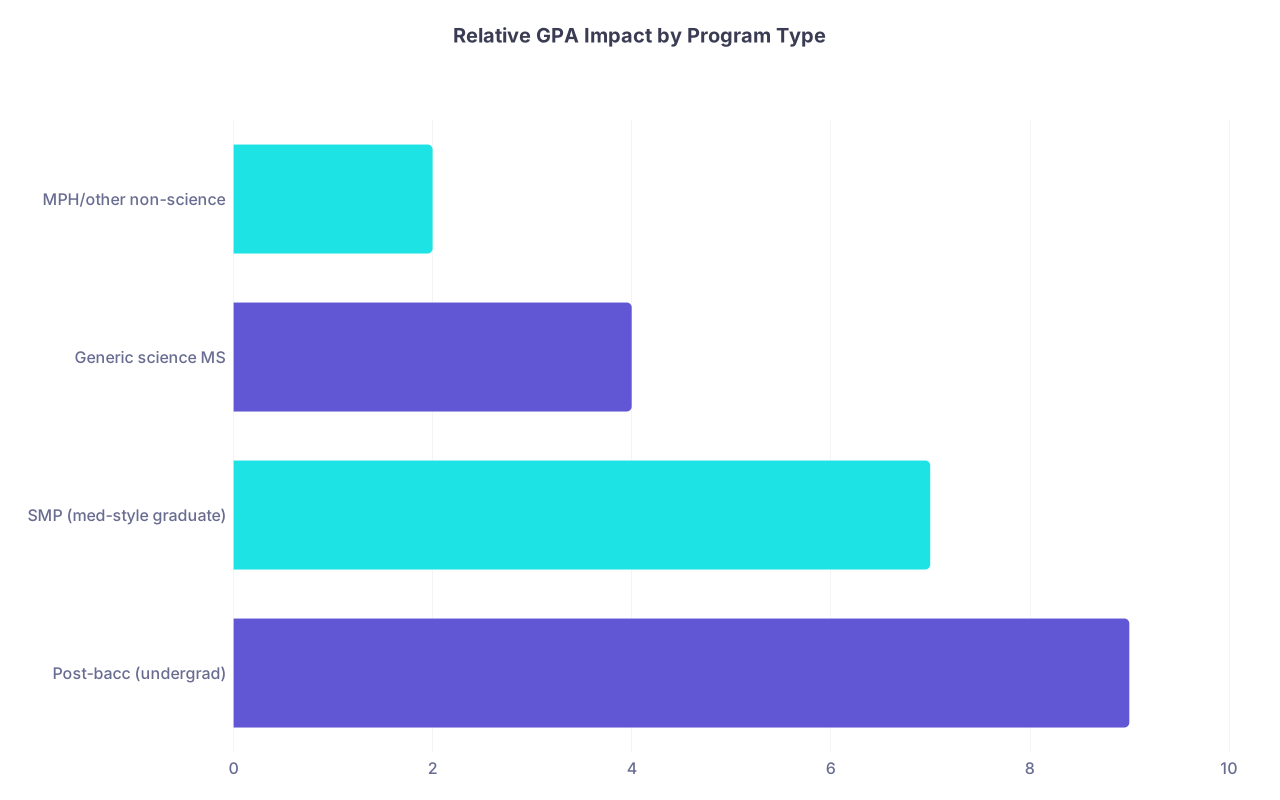
| Category | Value |
|---|---|
| Post-bacc (undergrad) | 9 |
| SMP (med-style graduate) | 7 |
| Generic science MS | 4 |
| MPH/other non-science | 2 |
(Scale 1–10: how strongly it can influence how adcoms interpret your academics, assuming you perform well.)
Impact on MCAT
Here’s where people get confused.
Post-bacc
- Indirect but real. You’re relearning all the core MCAT science with (hopefully) better habits.
- Great foundation if your issue was content/understanding.
SMP
- Can help indirectly with critical thinking and advanced bio/physio, but you’ll often be too busy and stressed to do focused MCAT prep concurrently.
- I don’t recommend doing an SMP primarily for MCAT performance.
Generic Master’s
- Usually minimal effect unless very heavy on relevant sciences. An MPH focused on health policy won’t fix your MCAT.
Bottom line: if MCAT is your main weak point, you fix it with MCAT prep, not a degree.
Cost, Risk, and When Not to Do Anything
Let me be clear: these programs are expensive and risky.
You should not do a post-bacc/SMP/master’s if:
- Your numbers already put you in range for the schools you’d realistically attend (for example, 3.7/515 and good experiences but no top-10 fantasies).
- You’re only doing it to “look more competitive” without a clear, measurable problem to solve.
- You’re chasing prestige (“I want a master’s before med school because it sounds impressive”). Adcoms do not care about credentials as much as you think.

| Step | Description |
|---|---|
| Step 1 | Check GPA & MCAT |
| Step 2 | Focus on MCAT only |
| Step 3 | Apply without new degree |
| Step 4 | Career-changer post-bacc |
| Step 5 | GPA-enhancer post-bacc |
| Step 6 | Consider targeted SMP after success in post-bacc |
| Step 7 | GPA below ~3.3? |
| Step 8 | MCAT below target? |
| Step 9 | Prereqs completed? |
| Step 10 | Many credits & GPA stuck? |
How to Choose Specific Programs (Once You Know the Type)
Once you pick the category (post-bacc vs SMP vs master’s), then you look at:
Linkages and outcomes
- Where do grads actually matriculate?
- Are there guaranteed interview or conditional acceptance agreements?
Coursework match
- Post-bacc: Are the classes you need available, at the right level, with space for non-majors or non-degree students?
- SMP: Are you taking real med-school-style courses, and how are they graded?
Advising and committee support
- Is there structured advising for med school applications?
- Letter support? Committee letters?
Cost and realistic ROI
- Will this realistically change your trajectory enough to justify debt?
- Are there cheaper DIY options (informal post-bacc at a state school) that accomplish the same academic goal?
Your current bandwidth
- If you barely held a 2.9 while working 30 hours a week, an SMP with no reduction in work hours is a setup for failure.
- Sometimes the right first move is stabilizing your life so you can actually perform.
FAQs (Exactly 7)
1. Will a master’s degree “erase” my low undergrad GPA for med school?
No. Undergrad GPA remains the primary academic metric. A strong, rigorous master’s (especially an SMP) can re-contextualize a low GPA and show you’re now capable of med-school level work, but it does not mathematically replace your undergrad record. Schools see both.
2. Is a DIY (informal) post-bacc as good as a formal program?
Often, yes. If you:
- Take legitimate upper-level science courses at an accredited 4-year school.
- Load enough credits (20–30+ hours) and earn mostly A’s.
- Build relationships for strong letters.
The lack of a “brand name” post-bacc matters less than your actual performance. Formal programs mainly add structure, advising, and sometimes linkages.
3. Should I do an SMP if my science foundation is weak?
Generally, no. SMPs assume you already mastered undergrad sciences and are ready for med-level pace. If you struggled in Orgo, Physiology, or Biochem the first time, it’s smarter to rebuild in a post-bacc first. Going straight into an SMP underprepared is how people end up with more mediocre grades and more debt.
4. How many credits do I need in a post-bacc to “fix” my GPA?
It depends on your current GPA and total credits. As a rough guide:
- If you have ~120 credits at 3.0, 30 credits of straight A’s raises you to around ~3.25.
- 45–60 credits of A-level work may pull you closer to the 3.3–3.4 range.
You don’t need to hit a magic number; you need a clear, sustained upward trend and a new story for your academic ability.
5. Does DO vs MD change whether I should do post-bacc vs SMP?
A bit. DO schools:
- Are generally more forgiving of lower GPAs if you show strong recent performance and a solid MCAT.
- Historically offered grade replacement (no longer on AACOMAS), but they still heavily value upward trends.
For many borderline DO applicants, a robust post-bacc plus solid MCAT is enough. SMPs are more often used by students trying to claw their way into MD territory after a rough undergrad start.
6. Can I do an SMP and MCAT prep at the same time?
You can, but I don’t recommend making that your main plan. SMPs are intense; you’re trying to prove you can survive M1-level work. Splitting focus usually means you perform “okay” in both instead of excellent in one. Most students are better off:
- Doing post-bacc → MCAT prep → then SMP (if still needed),
or - Doing SMP after a strong MCAT, focusing solely on grades.
7. If I can only afford one route, what’s usually the best value?
For most GPA-repair cases: a well-planned, lower-cost post-bacc at a state university is the best bang for your buck. It directly moves your undergrad GPA, strengthens your science foundation, and gives you a shot at a compelling upward trend. SMPs and formal master’s should be reserved for very specific scenarios where their added risk, cost, and rigor actually solve the remaining problem.
Open a blank page and write down your current cGPA, sGPA, last 30-credit GPA, and MCAT. Then, based on the scenarios above, circle one: “post-bacc,” “SMP,” “master’s,” or “no new program—MCAT/app readiness only.” If you can’t circle one confidently, your next step is not enrolling anywhere; it’s getting those numbers and scenarios clear.