It’s June. You’ve pulled up your unofficial transcript, and there it is in black and white: “Academic Probation – Spring 2023.” Maybe it’s just one semester. Maybe there are multiple terms of warning and probation. Either way, you’re staring at a GPA that doesn’t match the person you are now, and you’re trying to figure out how to convince medical schools of that.
You’re not asking, “Can I still get in?” You’re asking, “What do I need to do next so an admissions committee looks at my file and thinks, ‘This person figured it out’ instead of ‘This is a risk.’”
This is fixable. But it’s not fixable with vibes and a personal statement about “growth.” It’s fixable with specific, targeted academic and narrative work. Let’s walk through what that actually looks like.
Step 1: Own Exactly What Happened – With Data, Not Drama
Before choosing a post-bacc route, you need a brutally honest academic autopsy.
Pull your full transcript and look for:
- Pattern of grades before, during, and after probation
- Science GPA vs overall GPA
- Number of credit hours during your bad terms
- Any repeats/withdrawals/incompletes
Then answer these questions on paper:
Was your probation mostly:
- A single crash semester (illness, family crisis, mental health collapse)?
- A slow slide over multiple terms?
- A pattern related to specific course types (labs, heavy memorization, math-heavy)?
Did your performance recover afterward?
- Did you ever show a sustained stretch of A/A– work after the bad term(s)?
- Or did you just crawl from a 2.1 to a 3.0 and plateau?
How much “room” do you have before you apply?
- 1 year? 2–3 years? Already graduated and working?
If you can’t clearly describe your academic story in 3–4 sentences, you’re not ready to build a strategy. Adcoms want to see two things:
- What went wrong
- Evidence that the thing that went wrong has been fixed
You’ll eventually explain the story in your application, but your post-bacc plan has to provide the evidence.
Step 2: Figure Out Which Type of Post-Bacc Actually Fits Your Situation
Not all “post-bacc” paths are equal, and some are flat-out wrong for people with probation on the record.
Here’s the rough landscape:
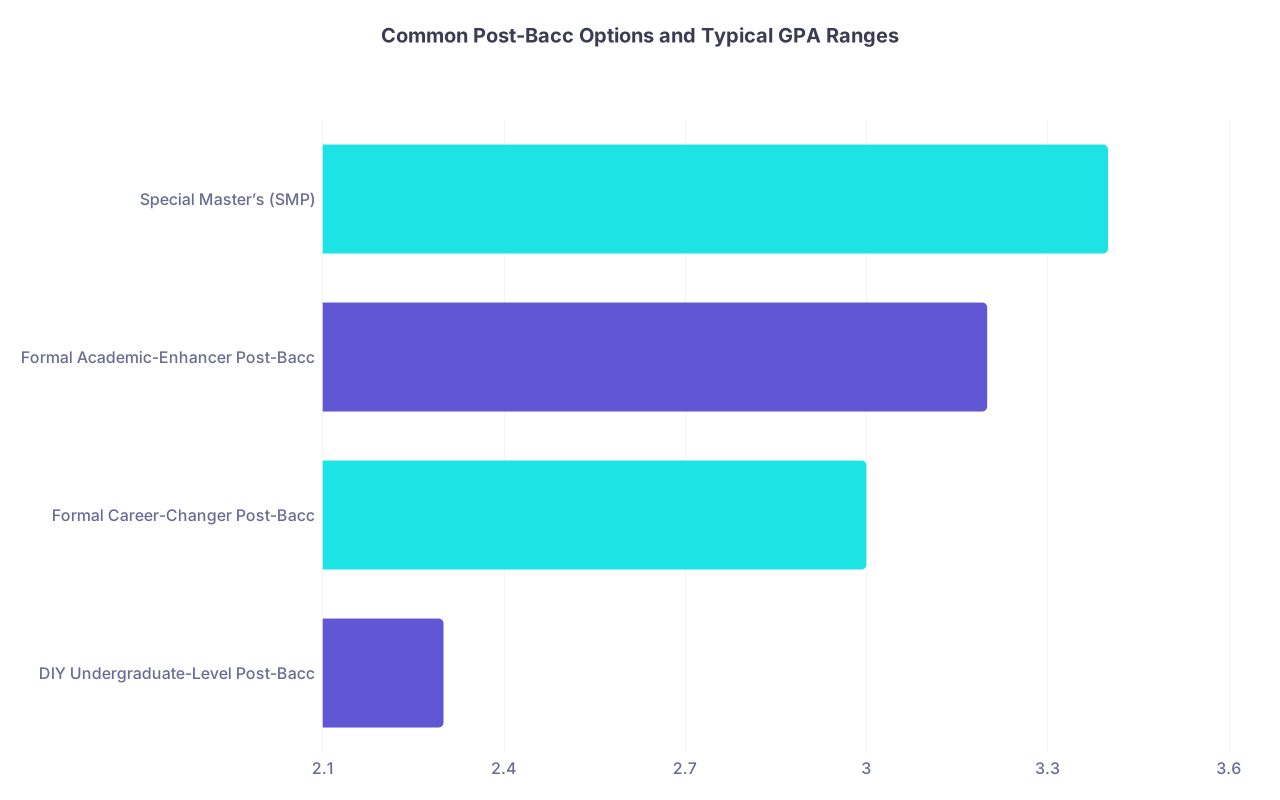
| Category | Value |
|---|---|
| DIY Undergraduate-Level Post-Bacc | 2.3 |
| Formal Career-Changer Post-Bacc | 3 |
| Formal Academic-Enhancer Post-Bacc | 3.2 |
| Special Master’s (SMP) | 3.4 |
These GPA values aren’t cutoffs; they’re the ballpark groups I’ve seen in these buckets.
1. DIY Undergraduate Post-Bacc (Most Common After Probation)
You enroll as a non-degree or second-degree student at a 4-year university and take upper-level undergraduate sciences. This is often the best fit if:
- Your GPA is < 3.0
- You have obvious gaps in core sciences (C/C– in orgo, physics, biochem, etc.)
- You’ve never had a long run of A-level work in hard science courses
Why this reassures adcoms:
- You’re showing competence in the same level of work that hurt you before.
- You control the timeline and course load to build a clean upward trend.
2. Formal Academic-Enhancer Post-Bacc
Fixed curriculum at a university (e.g., upper-division sciences), sometimes with linkages or advising. Good option if:
- Your GPA is ~3.0–3.3 with a bad patch that includes probation
- You already did the premed requirements but grades are weak or inconsistent
- You want structure and advising baked in
Admissions committees often recognize these programs by name. But they’ll still judge you by the grades and rigor, not just the brand.
3. Special Master’s Program (SMP)
Graduate-level, often at or affiliated with a med school, sometimes sharing courses with M1s. This is high-risk, high-reward.
Do not jump straight into an SMP if:
- You haven’t shown you can get mostly A’s in recent upper-level undergrad sciences
- You’re coming straight out of probation with no real bounce-back track record
An SMP with mediocre grades (B–/C+) can bury you. You want an SMP only if:
- Your recent undergrad post-bacc work is strong (3.6+ in 30–40 science credits)
- You need a “look, I can handle med school-level work” stamp because your undergrad GPA is chronically low (e.g., 2.7–3.0)
4. Second Bachelor’s Degree
Sometimes useful, but often unnecessary. It makes sense when:
- Your original degree has very little science
- Your institution won’t let you do non-degree coursework but will let you enroll in a second degree
Adcoms don’t care that you have two bachelor’s degrees. They care that during this second degree you took hard sciences at a high level and crushed them.
Step 3: Design a Transcript that Screams “This is a Different Student”
You’re not just “taking more classes.” You’re constructing a counter-argument to your probation.
Think like an adcom reading your AACOMAS/AMCAS GPA trend graph.
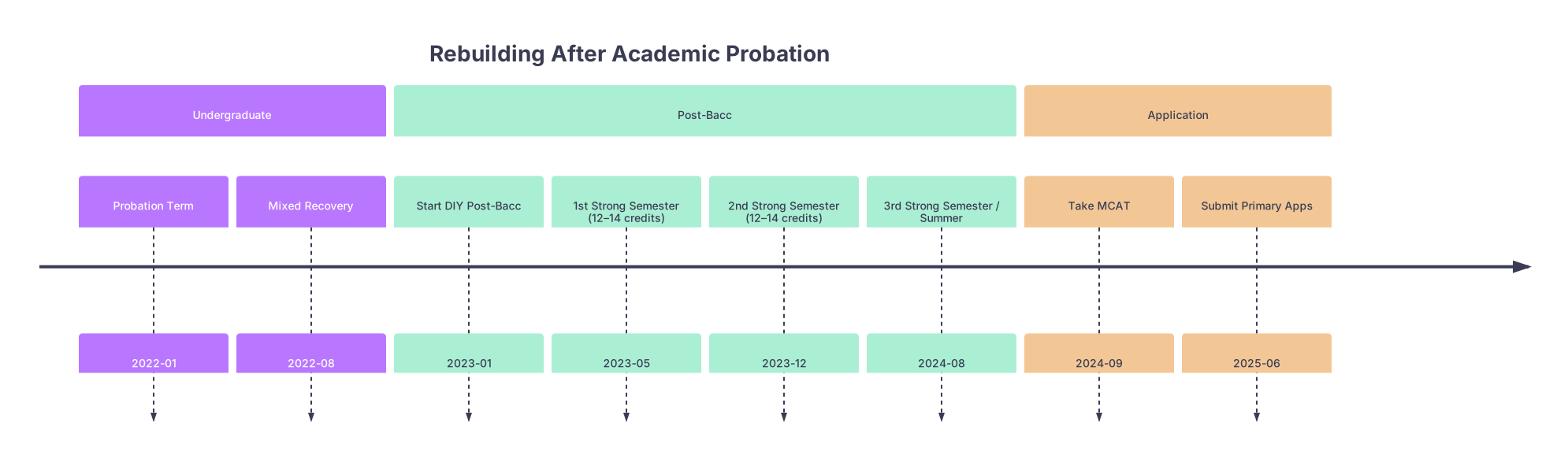
| Period | Event |
|---|---|
| Undergraduate - Probation Term | 2022-01 |
| Undergraduate - Mixed Recovery | 2022-08 |
| Post-Bacc - Start DIY Post-Bacc | 2023-01 |
| Post-Bacc - 1st Strong Semester (12–14 credits) | 2023-05 |
| Post-Bacc - 2nd Strong Semester (12–14 credits) | 2023-12 |
| Post-Bacc - 3rd Strong Semester / Summer | 2024-08 |
| Application - Take MCAT | 2024-09 |
| Application - Submit Primary Apps | 2025-06 |
That’s roughly the timeline I’d aim for if you’re serious about changing the narrative.
How Many Credits Do You Actually Need?
If you had academic probation and a low GPA, “I took one class and got an A” does not move the needle.
As a rough rule of thumb:
- Minimum: 24 new science credits at A/A– level (that’s 2 strong full-time semesters)
- More convincing: 30–40 credits with ≥3 consecutive strong terms
Can you get in with less? Occasionally. But if your starting point is a 2.6 GPA with probation, your margin for “occasionally” is gone. You need overwhelming evidence.
What Kind of Courses Should You Take?
You’re trying to answer: “Can this person handle a med school-like academic load in real sciences?” So:
Core / upper-level sciences that actually matter:
- Biochemistry
- Physiology
- Cell biology
- Genetics
- Microbiology
- Immunology
- Advanced anatomy
- Neuroscience
Avoid loading your post-bacc with:
- “Easy A” fluff (e.g., general fitness, intro-level non-science electives)
- A million random minors or certificates that dilute your transcript
You want an adcom to glance at your post-bacc terms and see: “Hard sciences. Full-ish loads. A’s.”
What Should the Course Load Look Like?
If you were on probation because of overloading and chaos, don’t try to “prove” yourself by taking 20 credits out of the gate. That’s how you blow up again.
Pattern I like:
- Semester 1: 9–12 credits of solid sciences while you rebuild your systems
- Semester 2: 12–14 credits with at least 3 legit sciences
- Semester 3 (optional but recommended if your GPA is really low): 12–14 more science-heavy credits
The trend matters. Adcoms like seeing you ramp up responsibly and sustain performance.
Step 4: Fix the Actual Problem That Led to Probation
This is where most people lie to themselves.
Probation is almost never just “I didn’t study enough.” There’s usually something structural:
- Untreated ADHD or depression
- Working 30–40 hours per week while taking 18 credits
- Chaotic living situation or family responsibilities
- Zero study strategy beyond rereading notes
You can’t reassure an adcom if the underlying problem still exists. Because deep down, you won’t reassure yourself.
So:
If it was mental health:
- Get evaluated. Actually follow through with treatment.
- Build documentation and a stable track record where your mental health is managed and your academics are strong.
If it was time/financial pressure:
- Do not repeat the same work–school imbalance.
- If you must work, aim for fewer credits and more semesters.
- Be prepared to explain this tradeoff in your application (adcoms understand working; they don’t accept “I wrecked my GPA again because I repeated my exact old mistake”).
If it was poor study habits:
- Fix your methods: spaced repetition, active recall, practice questions, weekly planning.
- Don’t just “study more hours.” Study differently and smarter.
I’ve seen applicants who fixed nothing, blasted into an SMP, got B–/C+ grades, and then tried to explain it away in their personal statement. That doesn’t work. The academic record is the loudest voice in your file.
Step 5: Build a Narrative that Matches Your Transcript
The post-bacc gives you data. You still have to tell the story.
An adcom reviewing your file will think in this order:
- What happened?
- How long did it last?
- What changed?
- How do I know that change is real and durable?
Your job is to make those answers easy to find and consistent everywhere: personal statement, disadvantaged/“other impact” sections, secondaries, and interviews.
How to Talk About Academic Probation Without Sounding Like a Train Wreck
Your explanation should be:
- Specific
- Honest
- Brief
- Matched to clear evidence of change
Bad version:
“I was immature and didn’t yet know how to balance my responsibilities. I’ve since grown and become more dedicated.”
Good version:
“During my sophomore spring, I was placed on academic probation after my GPA fell below the university minimum. I’d been working 35 hours a week while taking 18 credits, and I underestimated how much support I needed. After that semester, I reduced my work hours, met with academic support services, and over the next four terms I completed 36 credits of upper-level biology and chemistry with a 3.7 GPA. That period forced me to build better systems—and those same habits carried into my clinical work.”
See the difference? You don’t hide the problem; you make it the starting point of a clear, measurable turnaround.
Step 6: Use Your MCAT to Back Up Your Rebuild
If your GPA record is shaky, your MCAT becomes a referendum on your claim that you’re “different now.”
You want:
- A score at or above the median for your target schools, and
- Section balance that doesn’t scream “still weak in science”
If your undergraduate work includes probation and you score a 498, you’re asking adcoms to trust your words over two big red flags. They won’t.
Rough guidelines if you’re trying to reassure people:
- For MD: solid shot at many schools tends to start around 510+ with an upward science GPA trend
- For DO: more leeway, but I’d still aim for 503–505+ if your GPA is low and you have probation history
Do not rush the MCAT just to “stay on timeline.” Your new timeline is “whenever I’m strong enough that my app looks like a clear success story, not a hail Mary.”
Step 7: Choose Schools Strategically, Not Emotionally
You’re not applying as a blank slate. You’re applying as “student who was once on academic probation and then rebuilt.” That changes what makes sense school-wise.
Be realistic:
- Public in-state schools: often your best odds, particularly if they have a mission serving nontraditional or local students.
- DO schools: typically more forgiving of academic missteps if you show a strong upward trajectory and a solid MCAT.
- Some MD schools: especially those that emphasize mission fit, resilience, or nontraditional backgrounds, can be surprisingly open… if your recent record is stellar.
Read mission statements and class profiles. Look for language like:
- “Holistic review”
- “Nontraditional paths”
- “Second-chance opportunities”
Just don’t delude yourself that “holistic” means “we’ll ignore the transcript.”
Step 8: How Adcoms Actually Read a File Like Yours
Let me walk you through how your application might be viewed in a committee room.
They’ll pull up your GPA graph. First impressions:
Flat low line with a single horrible term (probation), then steady climb to strong recent terms?
→ “All right, what happened there… but looks like genuine recovery.”3 bad terms, 1 decent term, gap, spotty community college work, then 1 semester post-bacc with 2 A’s and a B?
→ “Not enough evidence. Risk.”
Then they’ll scan for:
- Total post-bacc science credits and GPA
- MCAT score relative to the rest of your app
- Letters: does anyone actually talk about your work ethic and turnaround?
- Your own explanation: do you dodge, blame, or own it?
They are not expecting perfection. They are expecting coherence. The more your story, your choices, and your data all point in the same direction—“this person fixed the root issue and has already been performing at a med-school-adjacent level for a while”—the safer you look.
Practical Example Scenarios
Let’s run two sample profiles so you can map yourself.
Scenario A: 2.5 GPA, Probation Sophomore Year, Mediocre Finish
- Undergrad cGPA: 2.5, sGPA: 2.3
- Academic probation: Spring of sophomore year, 1.8 term GPA
- Junior/senior years: mostly B/C, light loads, no clear upward trend
Plan that makes sense:
- 2–3 years of DIY post-bacc at a 4-year university
- Target 40–50 new science credits: biochem, cell bio, physio, genetics, micro
- Aim for ≥3.6+ post-bacc GPA
- Get MCAT after at least 3 strong semesters
- Likely target DO schools primarily, plus any MD where your state ties/mission fit are strong
What reassures adcoms here: a long runway of recent excellence and a great MCAT that proves the old you is gone.
Scenario B: 3.1 GPA, One Probation Term, Strong Recovery
- Undergrad cGPA: 3.1, sGPA: 3.0
- Academic probation: One term, sophomore fall, 1.9 that semester
- Last 4 undergrad terms: 3.6, 3.5, 3.7, 3.8 with higher-level sciences
Plan that makes sense:
- 1–2 semesters of targeted upper-level sciences (12–24 credits) as post-bacc to add more recency and depth
- Crush MCAT (aim ≥510)
- Apply MD + DO with explanation of that bad term matched to a clear multi-year upward trend
Here, the probation is a blip with strong counterevidence. Your job is to not sabotage yourself with rush jobs (MCAT too soon, weird SMP choice, or thin post-bacc work).
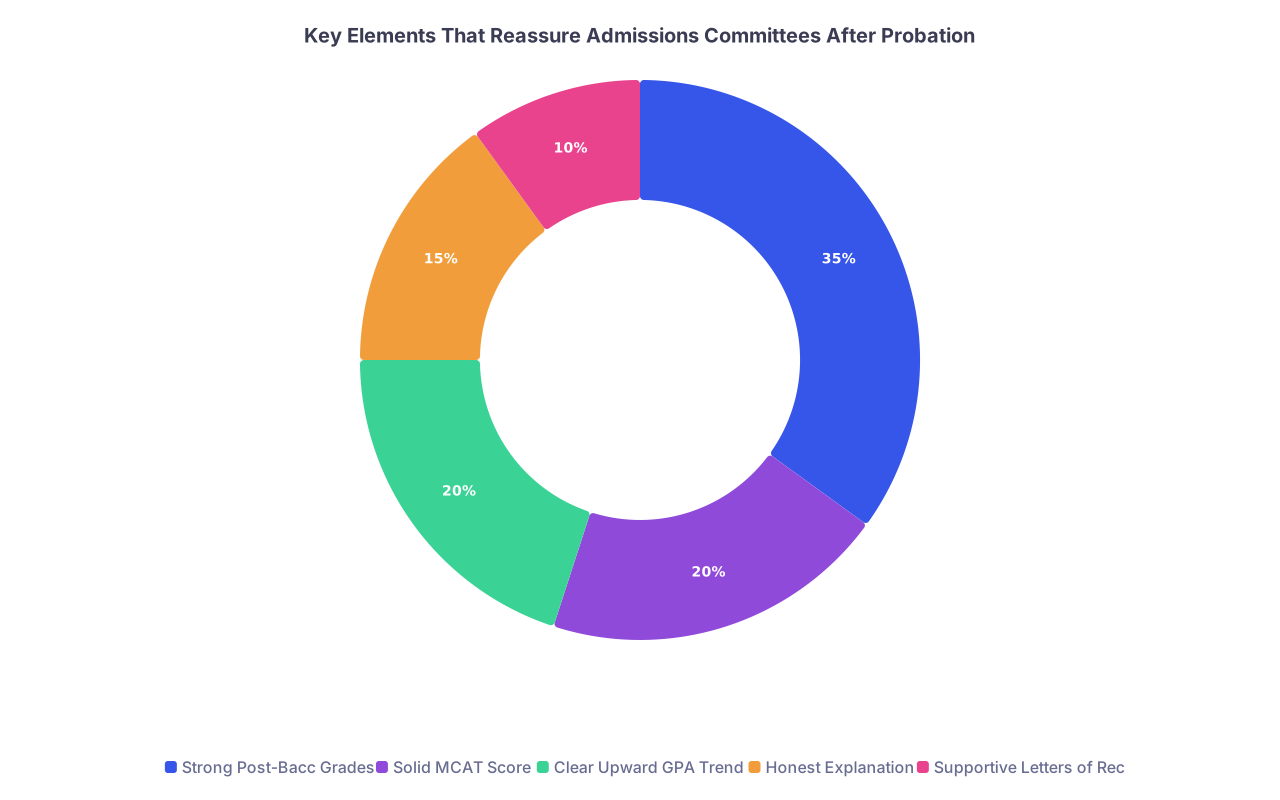
| Category | Value |
|---|---|
| Strong Post-Bacc Grades | 35 |
| Solid MCAT Score | 20 |
| Clear Upward GPA Trend | 20 |
| Honest Explanation | 15 |
| Supportive Letters of Rec | 10 |
FAQ (Exactly 5 Questions)
1. Do I have to disclose that I was on academic probation if it’s not on my current transcript?
If a primary or secondary application explicitly asks about academic probation, you must answer honestly, regardless of whether it still appears on the current transcript. Lying or omitting when asked directly is a fast route to rescinded offers if discovered later. If the application never asks, you’re not obligated to volunteer a label—but if the grades from that term clearly crater, you should still briefly explain what happened and how you changed.
2. Is community college OK for my post-bacc after probation?
It’s not ideal as your only evidence of improvement, especially if your original problem was performing poorly in a 4-year environment. Some CC coursework can be fine—particularly for cost reasons—but you should plan to show sustained, strong performance at a 4-year institution in upper-level sciences. That’s what reassures adcoms that you can handle med school rigor.
3. How long should I wait to apply after starting my post-bacc?
Usually, you want at least 2–3 strong semesters completed before your application is reviewed. That means: don’t apply the summer after your very first post-bacc term. A common pattern is 1.5–2 years of post-bacc work, MCAT after you have a solid base, and then apply. You’re not trying to be fast; you’re trying to be undeniable.
4. Can a strong MCAT “erase” my academic probation?
No. A great MCAT won’t erase anything, but it can balance the file. Think of it as independent confirmation that your current academic ability matches the story you’re telling about turning things around. With probation in your past, you want your MCAT to say, “Yes, this person can handle high-level science,” not “still questionable.”
5. How do I get strong letters of recommendation if I’ve been rebuilding after a rough undergrad?
Use your post-bacc time intentionally. Sit in the front, go to office hours, ask good questions, and let your professors see you as the serious, consistent version of yourself. After a semester or two of strong performance, ask for letters that specifically comment on your growth, work ethic, reliability, and readiness for rigorous study. A post-bacc professor saying, “This student is one of the strongest I’ve had in the last few years” carries more weight than an old undergrad letter that pretends the bad terms never happened.
Key points to walk away with:
- Academic probation is not a death sentence, but it is a demand for strong, sustained evidence that you’ve changed—most often through a well-planned post-bacc.
- Adcoms believe grades and trends more than they believe stories. Build 24–40+ credits of A-level science work and back it with a solid MCAT.
- Fix the root cause, not just the transcript. The goal isn’t to “sneak past” admissions; it’s to become the kind of student who survives and succeeds once you’re actually in medical school.