The biggest mistake students make when they’re torn between MD and DO is picking a post‑bacc that quietly closes doors before they even know which path they want.
If you’re hazy on MD vs DO right now, that’s normal. Choosing a post‑bacc that locks you into one lane? That’s how people end up redoing years of work or applying twice. I’ve watched it happen.
You do not need to know “MD or DO” yet. You do need to pick a post‑bacc structure that keeps both options alive as long as possible.
Let’s walk through exactly how to do that.
(See also: Reapplicant with Multiple Rejections: When a Post-Bacc Is the Right Reset for more details.)
Step 1: Be Brutally Honest About Where You’re Starting
Your MD vs DO flexibility starts with one thing: your academic profile.
Forget vibes, YouTube opinions, or what your cousin’s friend said about DO schools. You need three hard numbers:
- Cumulative undergrad GPA
- Science GPA (BCPM: biology, chemistry, physics, math)
- MCAT (actual or realistic practice range)
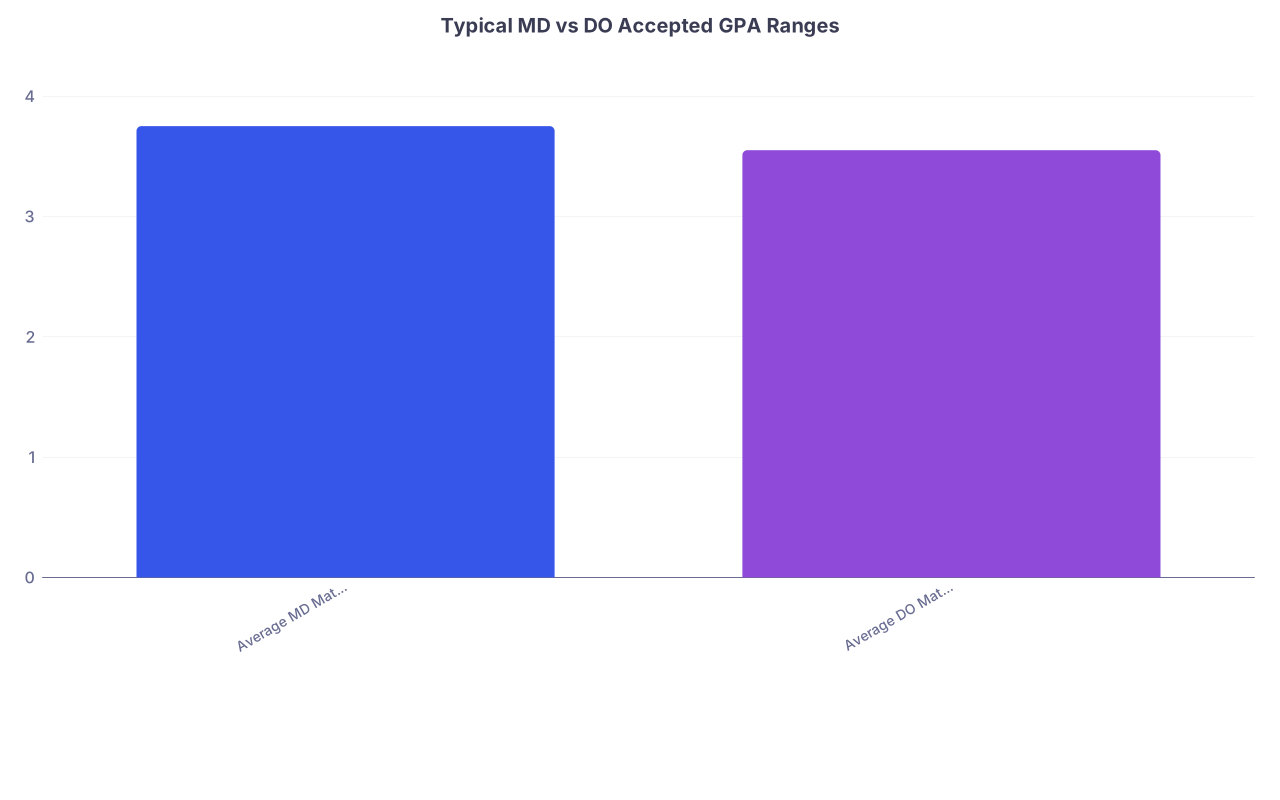
Here’s the rough reality of where MD vs DO competitiveness typically splits:
| Category | Value |
|---|---|
| Average MD Matriculant GPA | 3.75 |
| Average DO Matriculant GPA | 3.55 |
Not gospel. But close enough.
Now plug yourself in:
3.7+ GPA, no major red flags, and you’re just missing prereqs?
You’re in “MD and DO both very realistic” territory. You want to protect that.3.3–3.6 GPA, some shaky semesters, or inconsistent science grades?
You’re in “could be MD, likely DO, depends how you recover” territory. You need a smart repair.Below ~3.2 GPA, multiple bad semesters, or repeated core sciences?
You’re in “serious academic rehabilitation, DO more realistic in the near term, MD still possible but uphill” territory. You need a rebuild, not just a checklist.
Why this matters: different post‑bacc types help with different problems. And some count heavily for MD schools, while others barely move the needle.
If you’re unsure MD vs DO, you want to choose a path that:
- Counts for both sets of schools
- Fixes your real weakness (prereqs vs GPA vs MCAT timing)
- Gives you time to figure out your fit without sabotaging options
Step 2: Understand Post‑Bacc Types Through the MD/DO Lens
There are three main categories you’re choosing among.
1. Career-Changer (Prereq) Post‑Baccs
Who they’re for:
People with little to no science background. Philosophy major who took only “Physics of Music”? Business major with zero chemistry? That’s you.
Typical structure:
- 1–2 years of core sciences: Gen Chem, Bio, Physics, Org Chem, maybe Biochem
- Often cohort-based with advising and sometimes linkage agreements
- Grades go into post‑bacc GPA, but your undergrad GPA still exists
MD vs DO impact:
- Both MD and DO schools accept these
- MD schools will absolutely look at undergrad + post‑bacc together
- DO schools also see everything, but grade replacement is gone (old myth still floating around)
If you’re undecided MD vs DO, this is the most flexible format as long as:
- You take the exact same prereqs the MD kids take
- You don’t skip Physics or Biochem because “some DO schools don’t require it”
- You perform at a high level (3.7+ in this coursework ideally)
Red flag moves that quietly burn MD options:
- Doing a light, watered-down version of prereqs through online-only, unaccredited, or non-rigorous programs
- Skipping recommended MD-level courses like Biochem and upper-level Bio because “they’re not technically required”
2. Academic-Enhancer (GPA Repair) Post‑Baccs
Who they’re for:
You already did the prereqs. The problem is how you did them. C’s in Org Chem, a D+ in Physics, science GPA in the low 3s.
Structure:
- Upper-level undergrad sciences: Physiology, Microbiology, Immunology, Biochem, advanced Bio
- Sometimes repeats of older prereqs (depends on policy)
- You’re usually taking classes alongside undergrads
MD vs DO impact:
- MD schools: Will see this as evidence you’ve changed trajectory if you pull 3.7+ in tough sciences. You’re not erasing bad grades; you’re building a new trend.
- DO schools: Similar now that grade replacement is gone. They still like clear upward trends, and strong recent science can help a lot.
If you’re unsure MD vs DO, an enhancer post‑bacc is often your best bet if:
- Your undergrad GPA is weak but not catastrophic (think 2.8–3.3 range)
- You can realistically sustain a different level of performance now (fewer distractions, better habits, etc.)
- The program lets you load up on rigorous sciences from a real university, not fluff
Bad moves that narrow your options:
- Choosing a program where the classes are watered-down “for non-majors”
- Taking random easy A’s (Health 101, Nutrition for Non-Majors, etc.) instead of solid sciences
- Spreading courses too thin (1–2 classes a term) so your “trend” isn’t convincing
3. Special Master’s Programs (SMPs)
Who they’re for:
You already finished a degree and prerequisites. GPA is usually sub-3.3. You need something dramatic. You’re willing to risk a lot for a big move.
Structure:
- 1–2 years of graduate-level science, often with med-school-style courses
- Sometimes you literally sit in first-year med lectures (or parallel versions)
- Often linked to a specific med school or DO school
MD vs DO impact:
- MD schools: Can be very impressed if you crush an SMP tied to their med curriculum. But if you bomb it, it hurts badly.
- DO schools: Also take them seriously. Strong SMP performance can make you a very competitive DO applicant, sometimes more than MD.
If you’re undecided MD vs DO, SMPs are high risk, high reward:
- Pro: Strong performance (3.6+ in a legit SMP) can keep both MD and DO in play even with a rough undergrad record
- Con: Mediocre or poor performance can sink your MD hopes and even ding DO chances
This is not a casual decision. I’ve seen people with 2.7 undergrad GPAs go to structured SMPs, pull a 3.8, and land MD. I’ve also seen people land 3.1 in the SMP and spend years trying to patch things.
If you’re on the fence MD vs DO, and don’t have a compelling recent upward trend yet, I’d usually say: do a strong undergrad-level enhancer post‑bacc first, then consider SMP if you still need it.
Step 3: Filters That Keep Both Doors Open
Once you know your category (career-changer vs enhancer vs SMP), you need to filter programs with MD/DO flexibility in mind.
Here’s what actually matters:
A. Where are the classes taken?
Best case:
- At a 4-year college or university with a solid reputation
- Same courses (or nearly same) that traditional undergrads take
- Letter grades, not pass/fail
Why: both MD and DO schools respect rigorous, graded science taken in a real academic environment. Community college can be fine in context, but if you’re repairing a GPA or proving readiness, upper-level science at a 4-year school is safer.
Worst case for flexibility:
- A program that uses mostly pass/fail
- Courses that are clearly “pre-health lite” instead of real sciences
- Tons of online-only labs that some MD schools will frown on
If you must do community college (financial or geographic reality), you can still keep doors open by:
- Doing your best there (all As)
- Later taking a few upper-level sciences at a 4-year school or through a reputable extension program
- Knowing some MD schools will be cautious, but DO will generally be more flexible
B. What’s the advising attitude toward DO?
Spot the red flags early. Things I’ve literally heard from advisors that should make you cautious:
- “We don’t really work with DO schools.”
- “If you’re strong enough, you won’t need to apply DO.”
- “We focus on allopathic placement; osteopathic is more of a backup.”
That’s outdated and snobbish. And it usually means their relationships, linkages, and support are MD-centric only.
You want advisors who:
- Talk about both AMCAS (MD) and AACOMAS (DO) as standard routes
- Understand DO-specific nuances (COMLEX vs USMLE, letter expectations, mission fit)
- Don’t act like DO is a consolation prize
Why? Because when you hit application season and realize you should apply broadly to both MD and DO (and you probably should), you’ll want advice that isn’t accidentally sabotaging half your options.
C. MCAT Timing and Flexibility
You can’t choose MD vs DO intelligently until you see how you actually perform on the MCAT.
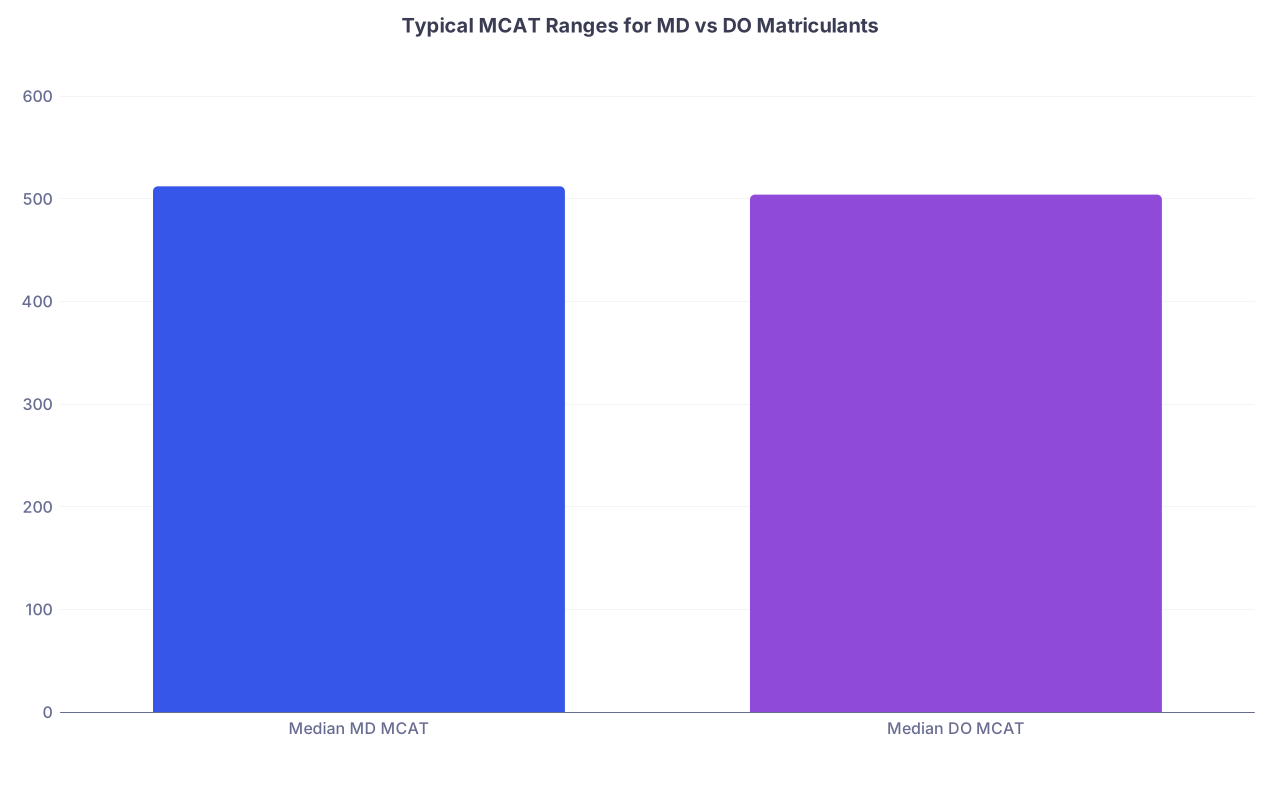
Here’s a rough (but real) picture:
| Category | Value |
|---|---|
| Median MD MCAT | 512 |
| Median DO MCAT | 504 |
Again, these are approximations, but they track.
Your post‑bacc should:
- Either build in MCAT prep after you’ve finished the key sciences
- Or at least not cram you into taking the MCAT at a terrible time (e.g., halfway through Org 2 and never took Biochem)
If you’re MD/DO unsure, you want the MCAT score to be part of the decision:
- 513+ with strong GPA trend: MD and DO both realistic; MD may be primary target
- 505–512 with solid upward trend: many MDs and most DOs in play
- Below ~503 with GPA issues: DO-heavy or DO-only may be the smarter immediate play, with possible MCAT retake
So choose a post‑bacc schedule where you can:
- Take a full MCAT practice test after key courses
- Delay your final “this is my real score” MCAT if you’re not ready
- Avoid being locked into an application year before you’ve stabilized grades and MCAT
Step 4: Specific Scenarios and What to Do
Let’s get concrete.
Scenario 1: 3.6 GPA, non-science major, no prereqs, no MCAT
You’re competitive if you don’t screw up the next 2 years.
What to do:
- Choose a career-changer post‑bacc at a reputable 4-year school (formal or well-structured DIY)
- Take full, rigorous sequences: Gen Chem, Bio, Physics, Org Chem, Biochem, maybe one or two advanced Bio courses
- Aim to match or beat your undergrad GPA in the sciences (3.7+)
- Plan to prep for the MCAT after Org Chem and Biochem
MD vs DO status: both wide open, you'll decide later based on MCAT and how much you like the allopathic vs osteopathic philosophies.
Scenario 2: 3.1 cumulative GPA, 2.9 science GPA, all prereqs done, one MCAT 500
You need evidence you’re not that same student.
What to do:
- Enroll in an academic-enhancer post‑bacc with 24–30 credits of upper-level sciences
- Load semesters with 3 hard sciences at a time and crush them (3.7+ target)
- Retake MCAT after you’ve proven you can handle heavy science loads
- Keep your eyes open to SMPs only if you show you can perform at that level
MD vs DO status: DO is very realistic if you show a strong upward trend and a 505+ MCAT. MD can remain in play for certain schools if your last 40–60 credits look like a different person.
Scenario 3: 2.6 GPA, rocky transcript, scattered withdrawals, no recent coursework
You’re not “out,” but this is not a quick repair.
What to do:
- Start with undergrad-level GPA repair, not straight into an SMP
- Take 30–40 credits of solid sciences over 1.5–2 years and aim for 3.7+
- If you prove you can do that, then consider an SMP if MD remains your top goal
- Meanwhile, build non-academic strengths (clinical, volunteering, letters) so you’re not only fixing numbers
MD vs DO status: DO is more within reach in the nearer term. MD might become realistic after a strong repair + possibly an SMP, but this is a multi-year plan.
Step 5: How to Evaluate Individual Programs for MD/DO Flexibility
Don’t just read the marketing brochure. Ask real questions.
Email or call the program and ask:
“Where did your last two cohorts actually matriculate? MD vs DO vs SMP vs other?”
- Look for a mix of MD and DO placements. If it’s 95% MD only, that can still be fine, but ask what support they give for DO.
“What percentage of your students end up applying to DO schools?”
- If they act weird about the question, that’s a sign.
“Do you have any linkages or strong relationships with DO schools?”
- Linkages to DO schools = great option flexibility.
“Are your sciences the same as the ones taken by your undergrads?”
- You want them to say yes, or very close.
“Do you advise on both AMCAS and AACOMAS?”
- If they hesitate, they probably don’t understand DO admissions deeply.
Also look at:
- Grade distribution: is grade inflation obvious, or is it reasonably rigorous? Both MD and DO adcoms can spot fluff.
- Class size: smallish cohort means more individualized advising and stronger letters.
- Letters: Will you get a committee letter? Will they support you equally for MD and DO?
Step 6: Keep Your Story Coherent While You Stay Flexible
You can’t present yourself as “I have no idea what I want, MD or DO, just let me in somewhere.” That’s not compelling.
You can, however, keep doors open while telling a clear story.
Here’s how:
Build a personal narrative around the kind of physician you want to be, not the letters.
Talk about primary care vs specialty interests, patient populations, values like continuity, hands-on care, holistic thinking. MD and DO both fit many of these.On MD secondaries:
Emphasize your interest in academic medicine (if true), research, or whatever aligns with that specific school. Don’t bash DO or imply MD is superior; just align your story.On DO secondaries:
Actually learn what osteopathic medicine is beyond “more holistic.” Shadow a DO, understand OMM’s role (and its limits), and be able to articulate why that approach resonates with you. Again, no bashing MD.
You’re not lying. You’re highlighting different angles of the same real person and values depending on where you’re talking.
Step 7: What To Avoid If You Want Maximum Flexibility
A quick hit list of moves that quietly kill optionality:
- Choosing a post‑bacc with weak science rigor and assuming any A is a good A
- Loading up on online labs from sketchy providers when you could do in-person
- Starting an SMP before you’ve shown you can handle 15+ credits of hard science with A-level performance
- Listening to anyone who tells you “DO is beneath you” or “MD is impossible for someone like you”
- Rushing into an application cycle with a half-baked GPA repair and wishful thinking MCAT plan
You can salvage a lot in this process. But unsalvaging a botched SMP or a long record of mediocre science grades is brutal.
Step 8: Make One Concrete Move This Week
You do not need to pick MD or DO today.
You do need to pick a direction for your post‑bacc that doesn’t quietly slam either door shut.
Here’s what you should do today:
Open a blank document and write three numbers at the top—cGPA, sGPA, (actual or target) MCAT. Underneath, write which bucket you’re in: career-changer, enhancer, or rebuild/SMP-track. Then list three actual programs (by name) that fit that bucket and look like they’d keep both MD and DO options open.
If you can’t name three, your next step is clear: start looking them up and emailing programs with the questions above until you can.