The worst decisions are the ones you drift into. You’re not going to drift into this one.
You’ve got a post-bacc acceptance in hand. You just got a job offer. And now your brain is running in circles: “If I defer, will schools think I’m not serious?” “If I don’t take this job, am I being financially reckless?” “What if I pick wrong and wreck my med school chances?”
(See also: Reapplicant with Multiple Rejections: When a Post-Bacc Is the Right Reset for insights on academic recovery.)
Let me cut through the noise. There is a right answer for you here, but it depends on three concrete things:
- Why you needed a post-bacc in the first place
- What this job actually is (not the fantasy version in your head)
- Your financial, academic, and timeline realities
We’re going to walk through this like a decision consult. No fluff. By the end, you should know exactly which way you’re leaning—and what to do next.
Step 1: Be Brutally Clear Why You Chose a Post-Bacc
Most people skip this and then wonder why they’re stuck. You can’t compare a job to “a post-bacc” in the abstract. You have to compare it to your specific academic problem and how the post-bacc is supposed to fix it.
You likely fall into one of these buckets:
- Low or mediocre GPA (especially science)
- Missing or outdated prereqs
- Career changer with no science background
- Already strong stats, but using a top formal post-bacc as a launchpad (linkage, brand name, etc.)
Let’s be concrete.
If any of these are true:
- cGPA < 3.3 or sGPA < 3.2
- Multiple C/C+ grades in core sciences
- Several withdrawals, repeats, or a bad semester/year
Then the primary job of the post-bacc is GPA and academic repair. That’s not optional. That’s not “nice to have.” MD and even DO schools will not magically ignore a weak academic record because you had a cool job.
If instead:
- You have a non-science degree with almost no prereqs done
- GPA is fine (3.5+) but you literally need the courses to even apply
Then the post-bacc is about eligibility and building an academic track record in the sciences from scratch.
If you’re in a structured, brand-name post-bacc (Goucher, Bryn Mawr, Scripps, Columbia, etc.), there’s another layer: linkage potential and reputation. Those programs are pipelines. Walking away from one is a bigger decision than walking away from a random DIY post-bacc at your local state school.
Write down, in one or two sentences:
- “I chose this post-bacc because ________ is holding me back from med school.”
If that blank is mainly “GPA” or “I literally need prereqs,” then that’s the standard you judge everything else against. A job does not magically fix GPA or missing coursework.
Step 2: Diagnose the Job Offer for What It Really Is
Not all jobs are created equal from a premed perspective. Stop calling it “a great opportunity” and name the thing.
Is it:
- A high-paying, non-clinical corporate role unrelated to medicine? (consulting, tech, finance, marketing)
- A clinical job that screams premed (scribe, ED tech, MA, CNA, EMT, research coordinator)?
- A generic job to pay the bills (retail, tutoring, admin, service industry)?
Here’s the harsh truth:
A glamorous non-medical job does almost nothing for your medical school application if your stats are weak or your prereqs are incomplete. It might be good for your life, your bank account, and your sanity. But it doesn’t replace academic repair.
A clinical or research job is helpful if:
- You already have solid GPA and prereqs
- Your weakness is experience, exposure, or a vague narrative
- You can still take classes (DIY post-bacc or upper-division sciences) alongside it if necessary
If you’re thinking, “But adcoms love unique backgrounds,” that’s only partly true. They like unique and academically safe applicants. They don’t trade a 2.9 GPA for “but this person did product management at a startup.”
So classify your job offer:
- Tier 1: High clinical relevance (scribe, MA, CNA, ED tech, EMS, clinical research with patient contact)
- Tier 2: Research-heavy but not necessarily clinical (bench research, data roles in healthcare systems)
- Tier 3: Good paycheck, low med relevance (corporate, tech, finance, etc.)
- Tier 4: Survival job (keeps you afloat, gives you flexibility for classes)
You’re not judging it as good/bad. You’re judging how much it actually strengthens your medical school application relative to what the post-bacc does.
Step 3: Map Out Your Actual Numbers and Timeline
Hand-wavy thinking is where bad decisions come from. You need hard data.
Answer these:
- Current GPA (cumulative and science)
- How many science credits you’ve completed
- Projected GPA bump from the post-bacc (be realistic: 30 credits at 3.9 doesn’t magically turn a 3.0 into a 3.7)
- When you really want to start med school (not fantasy; actual earliest and latest you’re okay with)
- Your debt, savings, and cost of the post-bacc vs. income from the job
Now combine that with this question:
If I skip or delay this post-bacc, will I mathematically meet the thresholds for the schools I want?
Not “in theory.”
Not “with a great MCAT.”
I mean: would your GPA be at or near 3.4–3.5+ with a clear upward trend and recent A-level science work? If the answer is no, the job is background noise. The post-bacc or something equivalent still has to happen.
Step 4: Decide Between Three Realistic Paths
Almost everyone in your situation has one of these three actual options hiding underneath the chaos:
- Do the post-bacc now, decline the job
- Take the job and fully replace the post-bacc with a different academic plan
- Try to defer or modify the post-bacc and take the job short-term
Let’s break them down.
Option 1: You Stick with the Post-Bacc and Decline the Job
This is usually the right call if:
- Your GPA is weak enough that you need a formal, structured academic fix
- Your post-bacc has strong advising, linkage, or a track record you can’t DIY
- The job is non-clinical or only loosely related to medicine
- You can financially survive the program (even if it’s tight and uncomfortable)
What you do next in this option:
- Email the job contact: “I’m honored by the offer but I’ve committed to a full-time academic program that I’m not able to delay.” Keep it short. You don’t need to overshare.
- Fully commit to crushing the post-bacc: no half-assing, no unnecessary side obligations. Your ROI only exists if you get A’s.
- Build clinical exposure within the post-bacc year via volunteering, part-time, or structured opportunities, not a full-time job.
This path looks “conservative” but, for a lot of premeds with shaky stats, it’s actually the most efficient way to reach a competitive application in the shortest time.
Option 2: You Take the Job and Replace, Not Cancel, Your Academic Plan
You do this if:
- Your GPA is borderline but not disastrous (say, 3.3–3.4ish, science close behind)
- The job is heavily clinical or research-based, or uniquely valuable for your story
- There’s a realistic way to shore up academics via DIY coursework or a future SMP/post-bacc without losing 3–4 years
- Financially, you need income for stability, debt, or family reasons
Key thing: you’re not just walking away from the post-bacc. You’re actively sketching out an alternate academic fix.
For example:
- Take the job as a full-time clinical research coordinator at a major academic hospital.
- Enroll in 1–2 upper-division science classes per semester at a local university or extension.
- Focus on straight A’s in those courses to build a recent upward trend and demonstrate rigor.
- Later, depending on how your numbers look, apply either directly or to a specialized master’s program (SMP) if your GPA still lags.
This path can work very well if your academic issues are moderate, not catastrophic. It’s terrible if your GPA is in the low 3.0s or below and you’re clinically empty. Then you’re trying to fix too many things at once with a very slow tool.
What you must not do here:
Take the job, do zero coursework for two years, and hope MCAT + vibes erase a weak GPA. They won’t.
Option 3: You Try to Defer or Tweak the Post-Bacc to Fit the Job
People forget this is often on the table.
Some post-baccs will let you:
- Defer your acceptance one cycle
- Start in the spring instead of fall
- Switch to part-time or evening coursework
Others won’t budge. That’s why you ask.
This option is strong if:
- The job is high-yield for your application (clinical, research, unique impact)
- The post-bacc is high quality, and you don’t want to lose your spot
- You can tolerate a small delay in your med school timeline
- You’re financially better off working 6–12 months before paying tuition
What to actually do:
Contact the post-bacc program director or coordinator. Do not send a vague email. Say something like:
- “I was recently offered a full-time clinical position at [Hospital/Clinic] in [Role], which is highly relevant to my long-term goal of becoming a physician. I’m very committed to your program. Would deferring my start by one year (or to spring term) be possible so I can gain this experience and then fully focus on my coursework?”
Ask explicitly about:
- Deferral policy
- Whether your acceptance is guaranteed if you defer
- Whether part-time or split-year options exist
Only after you know their flexibility do you accept or decline the job.
Students are often shocked by how reasonable some programs are when they see you’re taking a relevant clinical role and not just running off to backpack Europe.
Step 5: Red Flags That Mean “Don’t Take the Job (Yet)”
You shouldn’t take the job now if:
- Your GPA is below ~3.2 and this post-bacc is a structured, known-grade repair program
- You have almost no science background and this is a non-clinical job
- You’re drawn to the job mainly because you’re burned out and scared of more school
- You’re vaguely thinking, “I’ll do the job for a year and then decide,” with no concrete plan
Burnout is real. But punting academic repair into the undefined future rarely ends well. A year becomes two, then three, your prereqs get older, your motivation fades, and suddenly it’s “I always wanted to be a doctor but…”
If you know, at your core, that medicine is the path, then you have to honor the academic reality. Sometimes that means saying no to a shiny job offer.
Step 6: How to Frame This Choice Later to Med Schools
You’re also probably worried: “Will med schools think I’m not committed if I delay the post-bacc?” The answer depends on how coherent your eventual story is.
If you choose the post-bacc:
You later say, “I was offered a full-time position at X, but I chose to enroll in a rigorous post-baccalaureate program to strengthen my academic foundation and fully commit to my path toward medicine.” That reads as focused and serious.
If you choose the job and maintain an academic plan:
You say, “I deferred my post-bacc to work as a clinical research coordinator at X, where I gained hands-on experience with [patients/studies]. During this period, I also completed additional upper-division science coursework to strengthen my academic record.” That reads as strategic, not flaky.
If you choose the job and do no academic work for years:
That’s harder to spin. You end up in the “I took some time off, then realized medicine is my calling” cliché. It can still work, but you’ve made your own road steeper.
Step 7: Make the Call in 24–48 Hours with This Mini-Checklist
You don’t need three weeks of torture to decide. Sit down with this and force yourself to answer:
- Is my GPA/prereq situation bad enough that skipping this post-bacc leaves me uncompetitive? Yes/No
- Is this job directly helping my medical school profile (clinical/research) or mostly just paying well?
- Can I realistically do meaningful coursework while working this job? Concrete plan, not fantasy.
- Can I defer or modify the post-bacc instead of giving it up entirely? Have I actually asked?
- Which option moves me closer to submitting a credible med school app in the next 2–4 years, not just the next 2–4 months?
Once those are answered honestly, the “right” move is usually obvious. You’re just scared of the tradeoff. That’s normal. But you can’t dodge the tradeoff; you can only pretend you didn’t make one.

| Step | Description |
|---|---|
| Step 1 | Accepted to Post-bacc + Job Offer |
| Step 2 | Prioritize Post-bacc |
| Step 3 | Take Job + Defer/Modify Post-bacc |
| Step 4 | Take Job + Formal DIY/Alt Academic Plan |
| Step 5 | GPA & Prereqs Competitive Without Post-bacc? |
| Step 6 | Job High Clinical/Research Value? |
| Step 7 | Can Post-bacc be Deferred/Modified? |
| Step 8 | Can You Do Strong DIY Coursework While Working? |
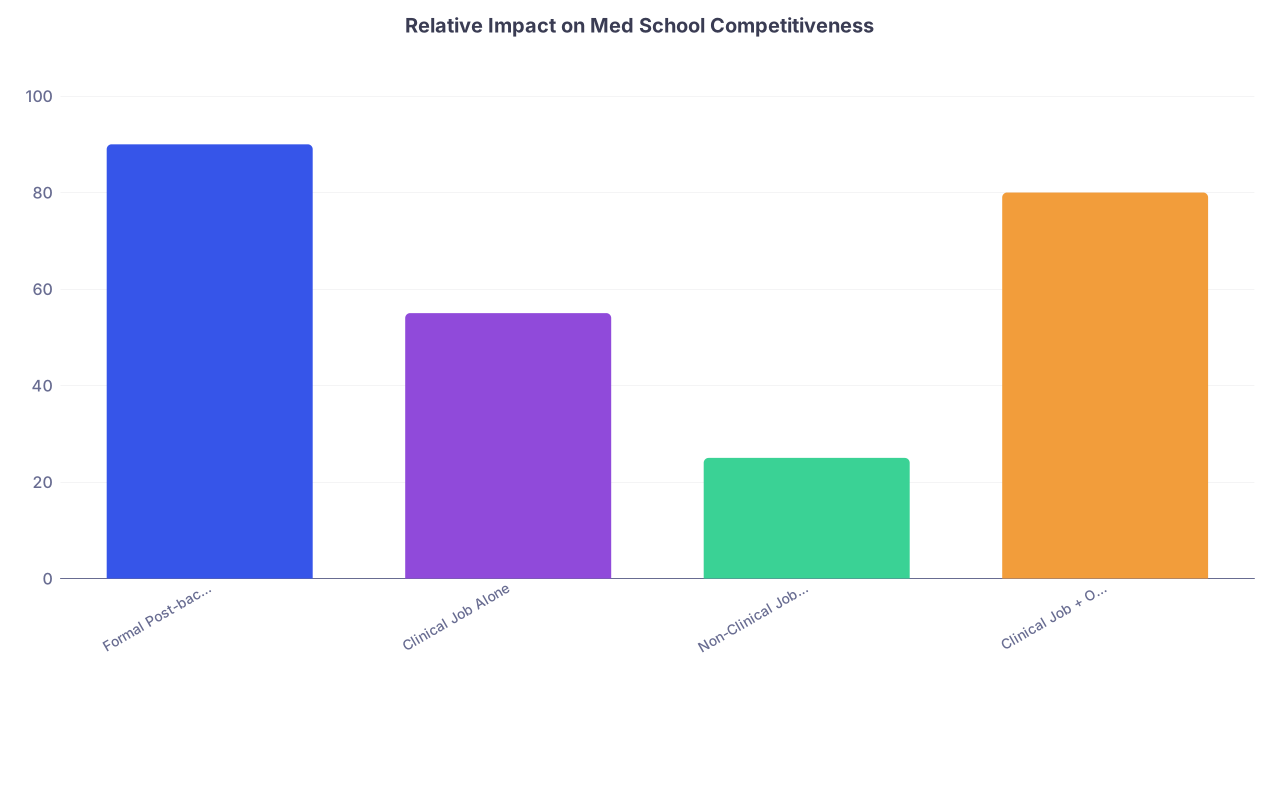
| Category | Value |
|---|---|
| Formal Post-bacc (GPA Repair) | 90 |
| Clinical Job Alone | 55 |
| Non-Clinical Job Alone | 25 |
| Clinical Job + Ongoing Science Coursework | 80 |

Quick Scenarios So You Can See Yourself
Sometimes examples make the decision obvious.
Scenario 1: GPA 3.05, science 2.9, accepted to a structured GPA-repair post-bacc; offered $70k remote tech job, non-clinical.
You go to the post-bacc. Period. The job makes you richer, not more admissible.
Scenario 2: GPA 3.45, science 3.4, prereqs mostly done, accepted to mid-tier post-bacc; offered full-time scribe job in a busy ED with a physician mentor who regularly writes strong LORs.
You seriously consider either deferring the post-bacc for one year or skipping it entirely and instead doing 2–3 upper-division sciences per semester while scribing.
Scenario 3: Career changer with English degree, zero science, accepted to a highly reputable career-changer post-bacc; offered a marketing job at a startup.
You go to the post-bacc. The job has nearly zero premed value.
Scenario 4: GPA 3.6, science 3.55, already have prereqs, accepted to brand-name post-bacc mostly for linkage; offered full-time clinical research coordinator job in your dream specialty at a top academic center.
You ask the post-bacc about deferral. If they say yes, you take the job for a year, build insane experience, then start the post-bacc. If they say no, you decide whether the linkage/network of the post-bacc beats the research/letters/network at the job. That’s a closer call.
FAQ (exactly 5 questions)
1. Will med schools think I’m less committed if I defer or decline a post-bacc for a job?
They’ll judge the pattern, not the single decision. If you defer once to take a clearly relevant clinical or research job and you keep building your academic record alongside it, that can look mature and strategic. If you bounce around aimlessly from job to job with no coursework for years, then suddenly “remember” medicine, that looks less committed. The key is that your actions form a coherent story: “I strengthened my academics and deepened my exposure to patient care,” not “I avoided making a decision for three years.”
2. What if the job is amazing money and I’m drowning in debt—doesn’t that matter too?
Of course it matters. You’re a human, not a robot. If you genuinely need the income to stabilize your life—pay off high-interest debt, support family, avoid eviction—that’s not selfish; it’s responsible. But if your GPA is weak, you still have to do the academic work eventually. So the question becomes: can you use that job period to also knock out key classes, or are you just delaying the inevitable? Make a financial plan with actual numbers and a parallel academic plan. If there’s no way to do both, you have to decide whether medicine is worth a longer, harder road.
3. Is a formal post-bacc always better than DIY classes while working?
No. For some applicants, DIY is smarter. If your GPA is already close to competitive and you just need more recent A-level science work, then upper-division courses at a solid local university while working a meaningful clinical job can absolutely do the trick. Formal post-baccs shine when you need major GPA repair, a structured environment, committee letters, or linkage opportunities. They’re not inherently superior; they’re tools. The right choice depends on how broken your academic record is and how much scaffolding you need to fix it.
4. If I take the job and my GPA isn’t terrible, can a strong MCAT compensate for skipping the post-bacc?
A strong MCAT can complement a borderline GPA, not erase a bad one. If you’re in the mid-3.3+ range with a clear upward trend and then drop a 515+ MCAT on top, you can often skip a formal post-bacc. But if you’re sitting at a 3.0–3.2 with spotty science performance, a great MCAT just says “smart but inconsistent.” Schools still worry about your ability to handle the volume and pace of med school. Recent A’s in tough science classes are the antidote to that concern. So if you take the job, you still need a plan for those A’s.
5. How late is “too late” to delay the post-bacc for a job?
There’s no magic age cutoff, but there is a pattern cutoff. One year? Fine. Two years with steady clinical/research work and ongoing coursework? Still fine, often even strong. Five years of unrelated work with no classes, no MCAT, and no clear trajectory? Now you’re climbing a steeper hill—skills get rusty, prereqs age out at some schools, and committees start wondering how serious you are. If you’re delaying more than 1–2 years, you should either be taking classes or doing something so compellingly relevant to medicine that it clearly advances your candidacy.
Bottom line:
You don’t compare “job vs post-bacc” in the abstract. You compare “this specific job” against “the exact academic hole I need to climb out of.”
If your GPA and prereqs are your main liability, the post-bacc—or a solid alternative academic plan—wins. If your academics are already acceptable and your experiences are thin, a well-chosen job can be the smarter move, especially with a deferral.
Make the decision with numbers, not fear. Then commit fully to the path you choose and make it obviously, undeniably premed-strong.