
It’s April. Again. Your email is a graveyard of “We regret to inform you.” The last waitlist just turned into a rejection. You’ve already been through one—or two—full cycles, spent thousands on primary and secondary applications, reworked your personal statement, maybe even retook the MCAT.
And you’re sitting there thinking: “Do I need a post-bacc? Or am I about to waste another year and another pile of money?”
This is where you are. Reapplicant. Multiple rejections. The usual “just tweak your application” nonsense clearly did not work. You don’t need pep talk. You need a reset plan, or a clear signal that a post-bacc is not the right move.
Let’s walk through this like a triage:
– Who actually needs a post-bacc reset
– Who absolutely doesn’t
– How to choose the right kind of post-bacc if you do
– And what your next 12–24 months should look like if you’re serious about turning “failed cycles” into “competitive reapplicant”
Step 1: Be Honest About Why You’re Getting Rejected
Before you even say the word “post-bacc,” you need a blunt diagnosis of why you struck out. A post-bacc is a tool, not a magic eraser.
Here’s the basic breakdown. Every failed application cycle usually comes down to one or more of these:
- Academic metrics problem
- MCAT problem
- Clinical/extracurricular/story problem
- Application strategy problem (school list, timing, letters, etc.)
- Combination of the above
If your instinct is “everything is kind of okay except maybe my GPA,” that’s not specific enough. You need numbers.
Do the cold audit
Grab a sheet and write:
- cGPA (overall)
- sGPA (BCPM: biology, chemistry, physics, math)
- Trend: early GPA vs last 60 credits
- MCAT score and section breakdown
- Clinical hours, shadowing hours, non-clinical service
- Research, leadership, unique experiences
Now compare your stats against real ranges, not Reddit fantasy.
For MD, typical realistic competitive ranges (not top 10 schools, just solid MD):
- cGPA: 3.6+
- sGPA: 3.5+
- MCAT: 510+
For DO:
- cGPA: 3.4+
- sGPA: 3.3+
- MCAT: 503–507 is workable; 508+ is better
Can people get in below these? Yes. But if you’re a reapplicant with multiple rejections, you don’t get to rely on outliers and luck anymore.
Here’s the rule I use with reapplicants:
- If cGPA < 3.3 or sGPA < 3.2 → you almost certainly need structured academic repair (post-bacc or SMP).
- If GPA is fine but MCAT < 505 (and you want MD/DO), the MCAT is a primary problem, not GPA.
- If GPA 3.5+ and MCAT 510+ and you still got zero interviews → your issue is not academic; a post-bacc is likely a waste.
You’re trying to figure out: Is my rejection academic, narrative, or strategic? Because a post-bacc only fixes one of those.
Step 2: When a Post-Bacc Actually Is the Right Reset
You should seriously consider a post-bacc in these situations:
1. You’ve got low GPA and no strong upward trend
Example: 3.1 cGPA, 3.0 sGPA, MCAT 508.
You improved a bit near the end of undergrad, but it’s not dramatic, and you applied anyway. You got crickets.
For you, a post-bacc is not optional. ADCOMs aren’t going to gamble on someone with a 3.0 science GPA without very fresh evidence that you can handle heavy science loads and excel.
What a post-bacc can do for you here:
- Show a strong 3.7–4.0 in 24–32 credits of upper-division sciences
- Create an “upward trend” narrative you can point to in secondaries and interviews
- Get you new, recent science letters from faculty who know you as a strong student
- Move your sGPA and BCPM trend from “risky” to “safe bet”
If your GPA is clearly below threshold, this is what a “reset” actually means: building a new academic track record.
2. Your academic record is chaotic or old
Example:
– You started college in 2012, did badly, dropped out, came back 5–6 years later.
– Or you changed majors three times and your transcript reads like a mess.
– Or your science courses are ancient (10+ years old).
Med schools care about recent evidence. A formal or structured DIY post-bacc that shows two solid years of As in science can completely reframe your file from “chaotic” to “mature applicant who figured it out.”
3. You have a career-change background
If you weren’t premed originally (engineer, business, teacher, etc.) and your undergrad is light on the core sciences, a career-changer post-bacc can be the right structured path.
This isn’t “repair” as much as “build from scratch,” but the logic is the same:
Programs give you:
- All core prereqs
- Often a committee letter
- Advising and linkage opportunities
You don’t need this if you already did all the prereqs and just performed average. But if you never built the science foundation at all, a career-changer program is a legitimate reset.
Step 3: When a Post-Bacc is the Wrong Move (And a Waste of Time)
There are situations where I’d almost always tell you: do not pour money into a post-bacc.
1. Your GPA and MCAT are already competitive
Example: 3.65 cGPA, 3.6 sGPA, MCAT 513. Zero interviews.
Your problem is not the numbers. It’s everything else.
Common culprits:
- Horrible school list (too top-heavy, ignored DO, no in-state focus)
- Weak personal statement or secondaries; generic, cliché, or vague story
- Very low or shallow clinical experience (under 100–150 hours, or checkbox-style)
- Almost no non-clinical service, especially with underserved populations
- Mediocre or unknown letter writers who barely know you
- Late application (submitting primaries in August, secondaries in October)
If that’s you, a post-bacc does nothing except delay the real fix.
You should be spending your next year on:
- Strong clinical job (scribe, MA, CNA, EMT, etc.)
- Consistent non-clinical service with real depth
- Rebuilding your personal statement and secondaries from scratch
- Getting better, more recent letters
- Correcting your school list
But adding more As on top of already good grades? That is rearranging deck chairs.
2. Your MCAT is the obvious weak link
Example: cGPA 3.6, sGPA 3.5, MCAT 498–503, two cycles, no interviews.
No post-bacc on this planet will make them ignore a 498. You need an MCAT overhaul, not a post-bacc.
Could a post-bacc help your study discipline? Maybe. But if money and time are finite, put them into a dedicated MCAT retake:
- 3–6 focused months, practice-test heavy
- Realistic scoring goal (505–510 for DO-focused; 508–512 for MD-focused)
If MCAT is under 500 and you are trying for MD/DO, schools will simply screen you out before even caring about your new post-bacc grades.
3. You’re treating a post-bacc like “something to do” while reapplying
If your logic is: “I don’t know what else to do, so I’ll do a post-bacc and reapply at the same time,” stop.
That kind of half-commitment usually leads to:
- Mediocre post-bacc grades because you’re juggling applications and classes
- No coherent narrative of change, because nothing has fundamentally changed yet
- Wasting one more cycle showing them the same application plus a few extra credits
If you commit to an academic reset, commit to it. Often that means: Don’t apply during the first post-bacc year. Build a real track record first, then apply with those completed grades in hand or at least mostly done.
Step 4: Choosing the Right Kind of Post-Bacc for a Reapplicant
You’ve done the audit, and you’re convinced: your biggest issue is academic. Your GPA is the anchor. Now what?
There are three main flavors:
- Career-changer post-bacc
- Academic enhancer post-bacc (formal)
- DIY post-bacc
- SMP (special master’s program) – separate beast but related
Let’s keep this practical.
Career-changer post-bacc
Who it’s for: people with limited or no science background. Not primarily reapplicants who already did all the prereqs.
If you already took gen chem, orgo, bio, physics, biochem etc., you don’t need a career-changer program. You need enhancement, not duplication.
Formal academic-enhancer post-bacc
Who it’s for:
- cGPA usually in the 2.8–3.4 range
- You’ve already completed the core prereqs
- You need sustained high performance in upper-level science
- You’d benefit from structure, advising, and possibly a committee letter
Upsides:
- Cohort, advising, sometimes direct linkage or conditional interviews
- Built-in narrative: “I entered X post-bacc program to address my academic weaknesses…”
Downsides:
- Expensive
- Some are predatory and don’t actually move your chances much
- Not all carry equal weight with med schools
If you go this route, look at:
- Matriculation data (real numbers, not brochure fluff)
- Linkage agreements (are they legit or “you get to apply earlier” nonsense?)
- Average GPA of accepted students they report
- Rigor of courses – you want real upper-level sciences, not fluff
DIY post-bacc (at a local university or state school)
For many reapplicants, this is the smart move.
Who it’s for:
- You’re disciplined enough to self-structure
- Money is a real concern
- You mostly need 24–32 credits of upper-division science As to prove yourself
- You don’t need formal linkage; you just need better stats and letters
The playbook:
- Enroll as non-degree or second-degree student
- Take 2–3 upper-division sciences per term (physiology, cell bio, immunology, genetics, micro, etc.)
- Aim for straight As. Not “good enough.” You’re trying to overwrite your history.
- Build relationships with 2–3 professors for future letters
For reapplicants with a shaky 3.1–3.3 GPA, a DIY post-bacc done well is often more than enough to get schools to take a second look.
SMP (Special Master’s Program)
Think of SMPs as “med school-lite” academic rehab. High risk, high reward.
Who it’s for:
- Your undergrad GPA is rough (often <3.2)
- You’ve already exhausted undergrad-level repair or need a dramatic, credible turnaround
- You’re prepared for serious financial and academic pressure
Strong SMPs put you in actual med school courses or parallel them closely. Doing well (top 20–25% of the class) can seriously move the needle.
But if you go into an SMP and get B-/C-level work? That’s usually game over for MD and often DO.
Do not touch an SMP unless:
- You’re confident you can handle intense, med-school-style coursework
- You’re ready financially
- You accept the stakes
Step 5: How to Use a Post-Bacc Year (or Two) So It Actually Counts
Say you commit. You’re doing a post-bacc. The goal is not just straight As. The goal is: coming out of this with a fundamentally different application.
Here’s what that looks like.
Academics
- Take 8–12 credits/term of real science. No fluff.
- Prioritize classes that med schools recognize as rigorous: physiology, biochem, neuroscience, immunology, genetics, micro, etc.
- Treat this like your full-time job. A single B might not kill you, but repeated Bs send the wrong message for “reset.”
Clinical and non-clinical work
Don’t disappear completely from clinical exposure. But also don’t overload.
Balance:
- 8–12 hours/week of clinical (scribe, MA, CNA, hospital volunteering with actual patient contact)
- 4–6 hours/week of consistent non-clinical service, ideally with an underserved group (shelter, food bank, tutoring, crisis line)
This gives you fresh, recent experiences to talk about in your reapplication, without tanking your grades.
MCAT timing
If your MCAT is still valid and decent (e.g., 508+ within 2–3 years), you can sometimes ride with it.
If it’s weak or expiring:
- Ideally, knock out the MCAT either before you start the post-bacc or during a lighter term (summer).
- Don’t try to do a heavy post-bacc load + MCAT + full reapplication at the same time unless you enjoy self-sabotage.
Step 6: When to Reapply After Starting a Post-Bacc
This is one of the most common screwups I see.
Everyone’s in a rush: “I’ll start a post-bacc in August, apply in June, and schools will just trust I’ll get all As.” That’s not how this plays out most of the time.
Here’s a smarter framework:
If your GPA isn’t that low (say 3.3–3.4) and you knock out one full year of A-level post-bacc work by next June, then applying that cycle can work. Schools will see the trend and enough graded credits.
If your GPA is in deep hole territory (sub-3.2), strongly consider doing two full years of repair before reapplying. Yes, that means waiting. The alternative is burning another cycle with half-baked improvement.
Ask yourself: When adcoms look at my transcript, will the post-bacc look like a rounding error, or like a clear inflection point?
If it’s the former, you’re reapplying too soon.
Step 7: Building the New Narrative as a Reapplicant
You aren’t just fixing numbers. You’re rewriting your story.
When you apply again after a post-bacc, your application needs to scream: “I understood exactly what was wrong. I fixed it. Here’s how.”
You should be able to say, clearly:
- “Previously, my science GPA and academic consistency were weak. That was the main barrier.”
- “I enrolled in X program / took Y courses to address this.”
- “In the past 12–24 months, I completed Z credits of upper-division coursework with a GPA of ___.”
- “Alongside that, I deepened my clinical experience by doing ___ and my service involvement in ___.”
Reapplicant essays and secondaries often ask what you changed. If your honest answer is “I took two extra classes and tweaked my essay,” that’s a problem.
A post-bacc done right gives you a powerful, concrete answer.
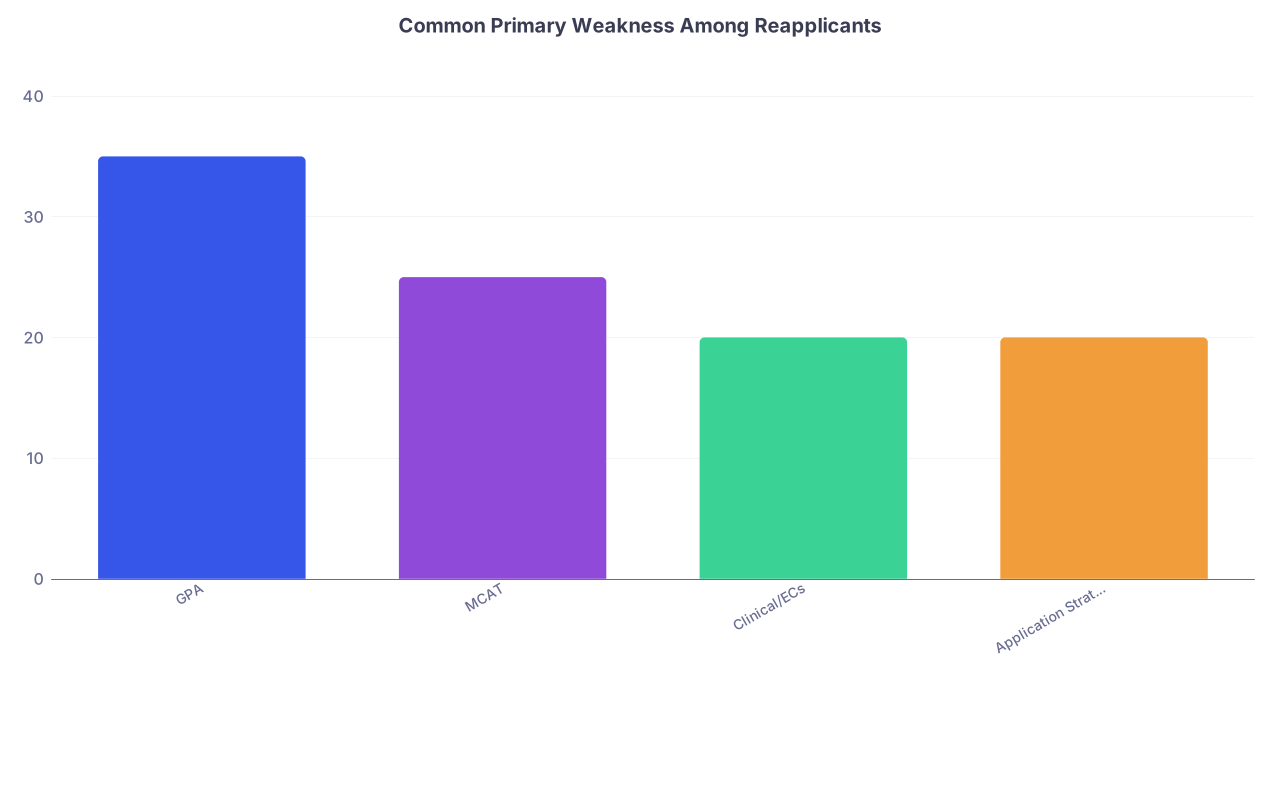
| Category | Value |
|---|---|
| GPA | 35 |
| MCAT | 25 |
| Clinical/ECs | 20 |
| Application Strategy | 20 |

| Step | Description |
|---|---|
| Step 1 | Multiple Rejections |
| Step 2 | Audit GPA/MCAT/Experiences |
| Step 3 | Consider Post-bacc or SMP |
| Step 4 | Focused MCAT Retake |
| Step 5 | Strengthen Experiences & Rewrite Application |
| Step 6 | 1-2 Years Academic Repair |
| Step 7 | Reapply With New Record |
| Step 8 | GPA & Trend Weak? |
| Step 9 | MCAT & ECs Weak? |

Concrete Scenarios: Where You Probably Are
Let me spell out a few profiles I’ve actually seen, and what I told them.
Scenario 1: The 3.1/508 MD-or-bust reapplicant
- Two cycles, mostly MD, a few DO
- cGPA 3.1, sGPA 3.0, MCAT 508
- Decent clinical and volunteering
Reality: MCAT is fine. GPA is not. Program directors see your file and worry you’ll crash in M1.
Advice:
– Stop applying for one cycle.
– Do 24–30 credits of upper-division sciences with 3.7–4.0.
– Strongly open up to DO schools, and some mission-fit MD schools that reward reinvention.
– Apply after they can see at least a full year of those new grades.
Scenario 2: The 3.6/499 multi-cycle applicant
- Three cycles already
- Decent GPA, MCAT 499 twice
- “Thinking of a post-bacc to show dedication”
Reality: Your GPA is giving them permission to take you. Your MCAT is forcing them to say no. A post-bacc doesn’t solve the screening gate.
Advice:
– Forget the post-bacc for now.
– Hire a reputable MCAT tutor or build a structured plan.
– Next MCAT needs to be 505+ just to re-enter DO conversations.
– Do not sit again until your practice tests are consistently at or above your target.
Scenario 3: The 3.4/511 poor strategy case
- One cycle, applied MD only
- 25 schools, almost all mid/high tier, no in-state or DO
- 1 interview, waitlisted, then rejected
- Strong clinical, good service, okay essays
Reality: You are closer than you think. You do not need a post-bacc. You need better targeting and slightly cleaner storytelling.
Advice:
– No post-bacc.
– Improve essays with someone who’s read med apps before.
– Apply earlier and smarter: state MD, a few lower/mid-tier MD, 8–12 DO.
– Shore up letters, maybe add a little more longitudinal service for depth.
Completely different interventions for three people all “thinking about a post-bacc.”

FAQs
1. How many post-bacc credits do I actually need to make a difference as a reapplicant?
For most reapplicants using a post-bacc as academic repair, 24–32 credits (roughly 2–3 semesters) of solid upper-division science with mostly As is enough to change the trajectory. If your GPA is severely low (sub-3.0), you may need closer to 40+ credits or to consider an SMP. The key is not some magic number; it’s whether your recent record clearly shows “this person now performs at a high level, consistently, in hard science courses.”
2. Should I apply to med school while I’m in my first year of post-bacc?
Usually no, especially if your academic issues are significant. If you reapply too early, schools only see a small slice of your new performance and still mostly judge you by your old GPA. The safer pattern is: complete at least one full year of strong post-bacc work, then apply in the following cycle so they see a meaningful block of new grades and a clear upward trend.
3. Will med schools “penalize” me for being a reapplicant even if I complete a strong post-bacc?
They don’t penalize you for the label “reapplicant.” They judge whether you’re the same applicant or a materially different one. If you come back with the same GPA, same MCAT, minimal new experiences, and slightly reworded essays, yes, your reapplicant status hurts you. If you return with a strong post-bacc record, a clearer narrative, stronger experiences, and evidence that you actually addressed weaknesses, being a reapplicant can even work in your favor by showing persistence and growth.
Key points:
- A post-bacc is the right reset only if your primary problem is GPA/academic record, especially with no strong upward trend.
- If MCAT, experiences, or strategy are the main issues, fix those directly; a post-bacc won’t rescue a fundamentally unchanged application.
- If you do commit to a post-bacc, go all-in: rigorous courses, high grades, balanced experiences, and don’t rush to reapply before that new record is real, not theoretical.