Working Full-Time with Family Duties: Adapting a Part-Time Post-Bacc Plan
It’s 9:47 p.m. Your kid’s lunch is finally packed, the dishwasher is humming, Slack has gone quiet after a brutal day of back-to-back meetings, and you’re staring at a general chemistry textbook you were supposed to read three chapters from… three days ago.
(See also: If You’re Changing Careers at 30+: Structuring a Post-Bacc That Fits Life for insights on adapting your post-bacc plan.)
You’re supposed to be following a “part-time” post-bacc plan you found online: 2 classes a term, study 3 hours every night, MCAT in 18 months. Whoever wrote it clearly did not have a toddler, an aging parent, and a boss who thinks “urgent” means “reply by 10 p.m.”
You’re not wondering if medicine is for you. You already know you want this. You’re wondering if it’s even realistic without blowing up your job, your relationship, or your sanity.
Here’s the blunt truth: you cannot just copy a standard part‑time post‑bacc schedule and “try harder.” You have to redesign the entire plan around three constraints:
- You work full‑time.
- You have real family duties that don’t care about your Orgo exam.
- Medical schools still expect solid grades, strong MCAT, and consistent progress.
So let’s build a version that actually fits your life, not the life of a 22‑year‑old with a meal plan and no dependents.
Step 1: Get brutally honest about your actual bandwidth
Before you pick course loads, you need numbers, not vibes.
You’re going to do a quick “bandwidth audit.” No journaling. No vision board. Just math.
Work:
How many real hours are you working weekly, including:- Commute (door to door, both ways)
- “Just checking email” time at night
- Regular overtime / crunch weeks
If you’re “40 hours on paper” but consistently at 50+, write down 50+. Do not lie to yourself here.
Family duties:
- Childcare: drop‑offs, pick‑ups, bedtime, weekends
- Elder care: appointments, meds, driving, check‑ins
- Household load: groceries, cooking, cleaning, bills, logistics
Translate this into a weekly average. If Wednesdays are insane but Mondays are light, average them. Overestimate a little. Life never under‑books itself.
Minimum sleep you must have to function:
- For most working adults with real responsibilities, 6 hours is the absolute rock‑bottom you can flirt with for short periods, not a long‑term plan.
- Be honest: if you’re a disaster on less than 7, work with that.
Now do this quick calculation:
160 (waking hours in a week if you sleep 8/night)
– work hours (real)
– commute
– family duties
– non‑negotiables (exercise, religious services, therapy, standing commitments)
What’s left? That’s your total academic bucket: classes + studying + MCAT + admin (applications, emails, etc.).
If your available time is:
- 20+ hours/week: you can do a true part‑time post‑bacc (usually 2 classes) if you’re disciplined.
- 12–20 hours/week: you’re in “slow but doable” territory (often 1 class/term, maybe 2 in summers).
- <12 hours/week: you’re in “micro‑progress” mode. You can still move forward, but very carefully.
Most full‑time workers with families land in the 12–18 hour range once they stop lying to themselves. That’s fine. You just don’t get to pretend you have 30.
Step 2: Pick the right post‑bacc structure for your life
Forget the label: “formal” vs “DIY,” “part‑time” vs “linkage.” Your first filter is not the program brochure. It’s: Can this structure coexist with my job and my family?
Model A: One science at a time (the tortoise plan)
Who this fits:
You have young kids, unpredictable work, or major caregiving duties. Or you know your GPA is fragile and you cannot afford B‑minus roulette.
What it looks like:
- Fall: Gen Chem I + lab (only class)
- Spring: Gen Chem II + lab
- Summer: Light elective (e.g., medical terminology, basic psych) or nothing
- Next Fall: Bio I
- Next Spring: Bio II
- Then Orgo, Physics, etc., over 3–4 years
Why this works:
You protect your GPA while learning how to study again. You can absorb emergencies (sick kid, crunch at work) without your whole house of cards collapsing.
Downside:
Longer timeline. You’re probably looking at 3–5 years to be MCAT‑ready. If that feels unbearable, remember: those years are passing anyway.
Model B: Two sciences cautiously (the “stretch but doable” plan)
Who this fits:
You have some flexibility at work (e.g., predictable hours, remote days, real PTO) and a partner or support system willing to absorb more household load temporarily.
What it looks like:
- Semester 1: Gen Chem I + Bio I (or Chem + Psych if you’re rusty)
- Semester 2: Gen Chem II + Bio II
- Summer: No class or 1 lighter class
- Semester 3: Orgo I + lab only (don’t layer heavy work project here)
- Semester 4: Orgo II + Physics I
- Semester 5: Physics II + Biochem
Then MCAT.
This can be done by working parents. I’ve seen it. But the people who survived it had:
- Hard boundaries at work (no constant overtime).
- A partner or family explicitly on‑board.
- Non‑negotiable sleep and some form of stress outlet.
If your job frequently explodes (“we might need you some weekends” actually means “we always need you weekends”), do not pick this path lightly.
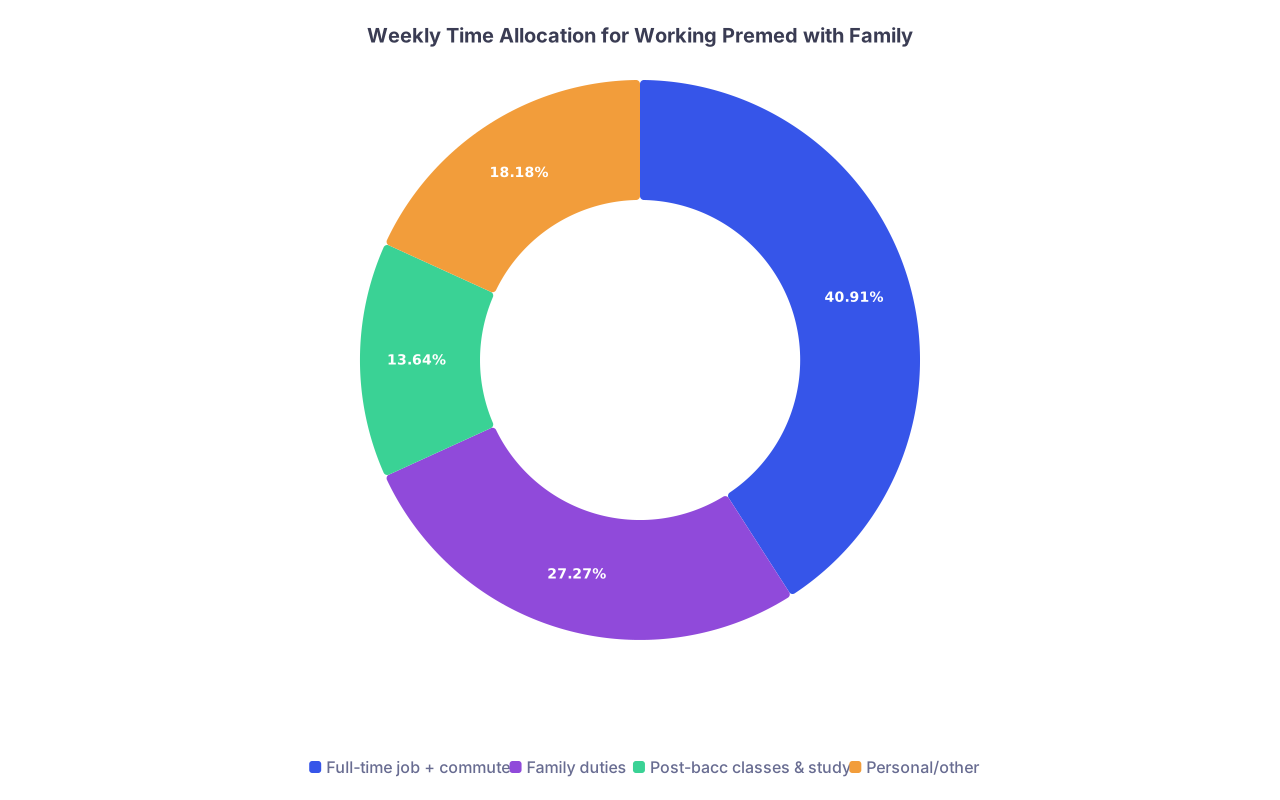
| Category | Value |
|---|---|
| Full-time job + commute | 45 |
| Family duties | 30 |
| Post-bacc classes & study | 15 |
| Personal/other | 20 |
Step 3: Align course timing with your actual life cycles
You can’t treat every term as equal. They aren’t.
Look at your year and mark:
- Peak chaos months at work (fiscal year end, product launches, audit season).
- Known family crunches (new baby coming, surgery for a parent, spouse in busy season).
- Stable periods (slow quarter, grandparents in town, more childcare coverage).
Then match classes to life:
Put the hardest courses in your most stable seasons.
- Orgo I should not coincide with “we’re implementing a new EMR” or “our startup’s Series B close.”
- If your spouse is an accountant, do not put Orgo or Physics during tax season.
Use summers strategically.
- Short, intense summer classes + full‑time job + family = dangerous.
- But: one well‑timed summer course (e.g., Psych/Soc, or a single lab) can speed things up without killing you.
Protect at least one “light” term per year.
- A term where you take a lighter class or no class and just shore up life.
- That might be when you build MCAT foundations slowly rather than add new coursework.
If your program doesn’t let you flex timing easily (fixed sequence, rigid schedules), that program might simply not be compatible with your life. Better to admit that early than fail two classes and dig a GPA grave.
Step 4: Redesign your weekly rhythm like a parent, not a college kid
The typical “premed study schedule” assumes you can just create 3–4 hour blocks every evening. You can’t. Someone always needs something.
So you stop chasing big blocks and stitch together reliable, repeatable chunks.
Here’s how working parents who actually pull this off usually structure it:
1. Anchor two or three “non‑negotiable” study sessions
You need 2–3 sessions per week that are sacred. Examples:
- Tuesday 6–9 a.m.: Spouse handles kids, you go to a coffee shop and do problem sets.
- Thursday 7–10 p.m.: After bedtime, headphones on, spouse agrees not to interrupt unless bleeding.
- Saturday 8–11 a.m.: You leave the house. Library, campus, whatever. No chores “real quick” first.
Those are your deep‑work windows. That’s where you tackle problem sets, dense readings, lab write‑ups.
You will not “find” these hours. You will buy them—by:
- Negotiating with your partner (and maybe giving them their own protected time too).
- Paying for a little extra childcare if possible.
- Saying no to some social stuff.
2. Exploit micro‑blocks
You’re not 19; your day is chopped up, but you can weaponize that.
- 20 minutes in the car at daycare pickup? Anki cards.
- Lunch at your desk? One passage, 5 questions, or 10 pages of reading.
- Standing in line? Quick concept review on your phone.
Micro‑blocks are terrible for learning brand‑new, complex content. They’re fantastic for:
- Reviewing flashcards.
- Re‑doing problems you missed.
- Drilling formulas, pathways, or vocab.
3. Pick the right class formats
Given your life, you want:
- In‑person labs (schools like to see you’ve done real labs).
- Lectures that are:
- Recorded, or
- At predictable times you can protect.
Evening or Saturday classes can be a lifesaver if childcare is stable. But don’t underestimate how brutal a 7–10 p.m. Orgo class is after an 8–5 shift and bedtime chaos. If you go this route, you must protect the day before and after (lighter at work, freezer meals ready, etc.).
Step 5: Protect your GPA, even if it slows you down
You do not have the luxury of “learning by failing.” If you tank Gen Chem or Orgo because you overloaded, that damage follows you.
Here’s the rule:
If you cannot consistently study at least 2 hours outside of class per credit hour per week for your science courses, you’re taking too many at once given your reality.
Example:
- 4‑credit Gen Chem with lab → 8–10 hours/week outside class.
- 4‑credit Orgo → 10–12 hours/week outside class.
You’re a working parent? Assume you’re on the high end of that range because you’ll have more interruptions and more evenings where your brain is fried.
If your bandwidth audit says you have 12–15 hours weekly, you cannot sustain 2 heavy sciences + lab and do well. I don’t care how motivated you are.
Create explicit “drop criteria” for yourself before the term starts:
- “If by week 3, I’m consistently behind and scoring <80% on quizzes, I will drop one class.”
- “If a family or work crisis hits that eats more than 10 extra hours/week, I will drop down to one course.”
Harsh truth: dropping a class early looks much better than finishing with a C‑ or D. Schools understand life happens. They’re less forgiving about academic patterns of overreach and poor judgment.
Step 6: Integrate MCAT prep into the long game, not as a last‑minute add‑on
With your constraints, the MCAT isn’t a sprint. It’s a slow burn layered onto your coursework.
Here’s what usually works best for full‑time workers with families:
Phase 1: Passive build (during prerequisites)
While you’re taking core sciences:
- Use Anki or a spaced repetition app for key concepts as you learn them.
- When you finish a course (e.g., Bio II), do a light pass through an MCAT review book section for that subject within 1–2 months. Not heavy studying. Just alignment.
If you can bank 2–3 hours/week on average for “MCAT alignment” during this phase, you’ll save yourself months later.
Phase 2: Focused prep (6–9 months, part‑time)
When your core prereqs are 80–90% done:
- Plan 6–9 months of gradual but consistent prep.
- Early months: 6–8 hours/week.
- Final 8–10 weeks: 10–15 hours/week if you can carve it out (this may mean taking fewer or no courses that term).
For many working parents, that means:
- One weeknight session (2–3 hours).
- One weekend block (3–4 hours).
- Daily 20–30 minute review.
Do not stack: full‑time job + two heavy sciences + full MCAT prep. That’s how you burn out, tank your score, and blow up your GPA at the same time.
Plan one “MCAT year” where your course load is intentionally lighter.
Step 7: Have the hard conversations early
You’re not doing this alone—even if it feels that way.
You need explicit agreements, not vague “I’ll support you.”
With your partner / family
You sit down and say:
- “Here’s the rough timeline: 3–4 years of coursework and MCAT prep.”
- “Here’s what I’ll need in specific terms: Tuesday nights out to study; you handling bedtime those nights; one weekend morning; possibly a sitter during exam weeks.”
- “Here’s what you get in return: my dedicated time on [other days], guaranteed date night every other week, and I’ll take lead on [specific responsibilities] when school is lighter.”
You negotiate. You don’t just apologize constantly for studying.
With your employer (when appropriate)
Not everyone can do this, but sometimes you can get:
- Slightly adjusted hours (7–3 instead of 9–5).
- A remote day each week to save commute time.
- Protected PTO around exam weeks.
You don’t need to say “I’m going to medical school and leaving you.” But you can say:
- “I’m taking evening science courses and might need to shift some flexibility into my afternoons during exam weeks. Here’s my plan for making sure my work doesn’t slip.”
If your job offers tuition benefits, even better. But don’t bank your whole plan on your employer being enlightened.
Step 8: Expect setbacks and build a recovery strategy now
Something will go sideways: kid hospitalized, layoffs at work, a parent’s health crisis, your own burnout. The question is not “if” but “when.”
So before that happens, write down:
Your non‑negotiables:
- “I will not consistently sacrifice sleep below X hours.”
- “I will not stay in a course if I’m below a B– by midterm without a clear recovery path.”
Your “slow mode”:
- What does it look like when you deliberately downshift? Maybe:
- No classes for one term, only light MCAT vocab review.
- Switch from 2 classes to 1 and accept a later MCAT.
- What does it look like when you deliberately downshift? Maybe:
Your check‑in points:
- At week 3 and week 7 of every term, you evaluate:
- Am I consistently behind?
- Are my scores where they need to be?
- How’s my sleep and mood?
- Is my family barely tolerating this or genuinely on board?
- At week 3 and week 7 of every term, you evaluate:
If you’re drowning by week 7, the answer is not “try harder.” It’s “change the plan.”
Sample realistic 2‑year slice for a full‑time worker with kids
Just to ground this:
Year 1
Fall:
- Gen Chem I + lab (1 class)
- Study: 8–10 hrs/week
- Learn how to be a student again. No MCAT prep yet.
Spring:
- Gen Chem II + lab (1 class)
- Study: 8–10 hrs/week
- Start light Anki for basic chem concepts.
Summer:
- No class, or Psych 101 online (lighter)
- Start 2 hrs/week of MCAT “alignment” with chem and psych.
Year 2
Fall:
- Bio I + lab
- 8–10 hrs/week
- Build Anki for bio concepts, maybe 1 MCAT passage per week.
Spring:
- Bio II + lab
- Keep MCAT review of finished subjects.
Summer:
- No heavy classes.
- Start structured MCAT prep: 6 hrs/week (2 evenings of 2 hours + 2 hours weekend).
At this point, you’ve done 4 heavy sciences in 2 years, kept your GPA strong, and started the MCAT slow burn. Is it flashy? No. Is it adult, sustainable, and compatible with not getting divorced or fired? Yes.
FAQ (exactly 5 questions)
1. Does working full-time and taking only one class at a time look “too slow” to medical schools?
No. What matters is your performance and your trajectory, not whether you look like a traditional college kid. If you’re working 40+ hours and carrying family responsibilities, adcoms understand a lighter academic load. What looks bad is mediocre grades in heavy loads you clearly couldn’t handle. A strong A/B record in one or two classes at a time, with a clear upward trend, plus good MCAT, tells a story of maturity and realism.
2. Should I quit my job to speed up my post-bacc if we can barely afford it?
If “barely afford it” means wiping out savings, losing health insurance, or putting your family in constant financial stress, I’d argue no. You’re signing up for over a decade of training. Starting that in a financial hole and with a resentful partner is a bad trade. A more reasonable compromise: look for less intense roles, part‑time options, or flexible/remote positions that pay enough but free some time. Stability is underrated in this process.
3. Is a formal post-bacc better than DIY for someone with full-time work and kids?
Not automatically. Formal programs can offer structure, advising, and sometimes linkages—but they also tend to assume you can attend daytime classes and take heavier loads. If the schedule doesn’t fit your life, it’s not “better” for you. Many nontrads do very well with a DIY approach at a local university or community college, picking evening/weekend sections. What matters: accredited institution, solid sciences with labs, and strong performance.
4. How many hours per week should I realistically plan for each science course while working full-time?
For a standard 3–4 credit science with lab, expect 8–12 hours per week outside of scheduled class and lab. Closer to 8 if you’re strong in the subject and have recent background; closer to 12 if you’re rusty or it’s Orgo/Physics. If you can’t consistently allocate that, you either take fewer courses, extend timelines, or accept a real risk to your GPA.
5. Will medical schools “penalize” me for taking longer (4–5 years) to finish prereqs because of work and family?
Length alone is not a problem. In fact, for nontraditional applicants, a longer trajectory that’s consistent and successful often looks very responsible. What admissions committees care about: Are you trending upward academically? Did you show you can handle upper‑level science once your feet were under you? Did you maintain steady progress rather than long gaps with no explanation? If your AMCAS personal statement and secondaries connect the dots—full-time work, family responsibilities, deliberate pacing—you’ll be fine.
Key takeaways:
- Build your post‑bacc around your actual time and energy, not fantasy bandwidth. Be ruthless in that audit.
- Protect your GPA and sanity by limiting course load, designing repeatable study blocks, and planning MCAT prep as a long, layered process—not an afterthought.
- Expect this to be slower than the standard script, and accept that. Stable progress that fits your real life beats an impressive plan that falls apart by midterms.