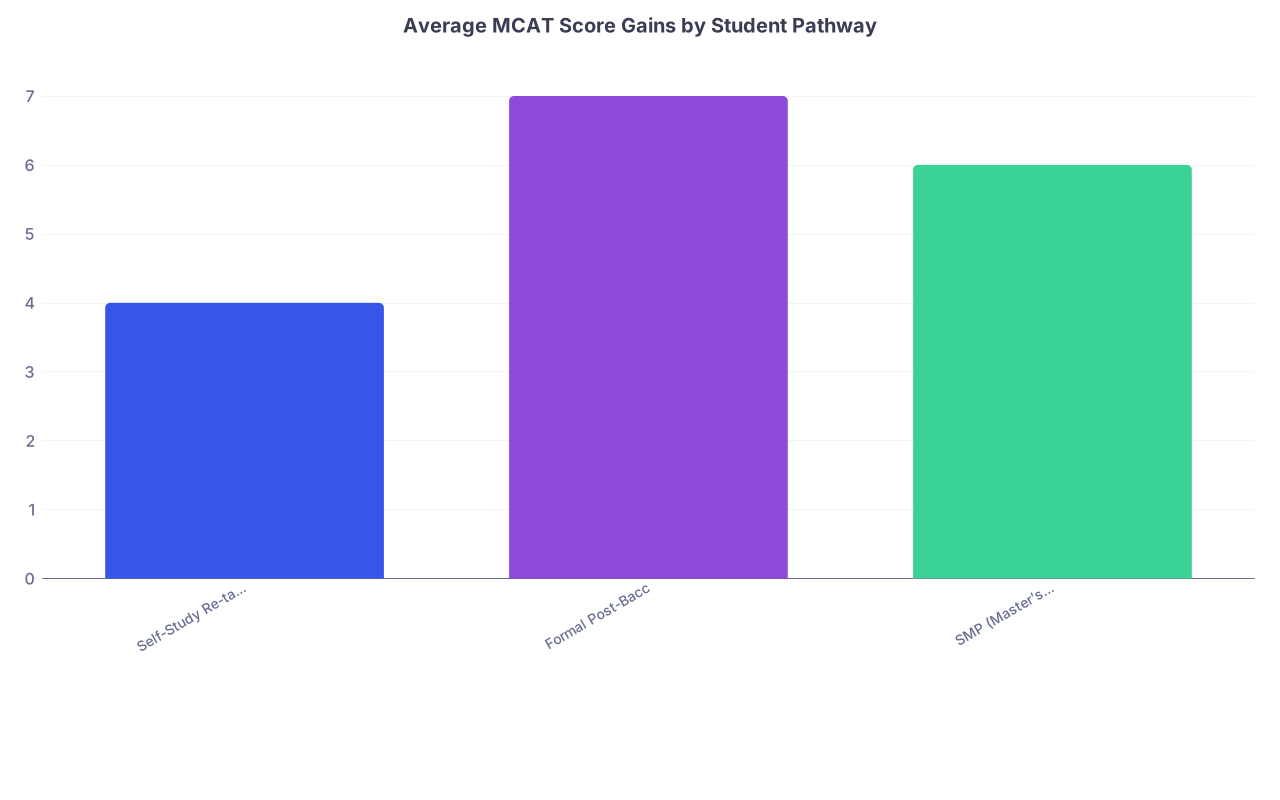
| Category | Value |
|---|---|
| Self-Study Re-takers | 4 |
| Formal Post-Bacc | 7 |
| SMP (Master’s-level) | 6 |
The mythology around MCAT score jumps in post‑bacc programs is wildly inflated. The data shows steady, moderate gains for most students—not the 15‑point miracles you see on marketing flyers.
You are not buying points. You are buying structure, accountability, and (if you pick correctly) a few statistically meaningful advantages. Let’s walk through what the numbers actually show, where they come from, and how to interpret them like an adult rather than a brochure target.
(See also: Post-Bacc vs No Post-Bacc: Med School Acceptance Rates by GPA Band for more details.)
1. Baseline Reality: Where Post‑Bacc Students Start
MCAT score changes for post‑bacc students are anchored to one simple variable: baseline performance. If you ignore that, every comparison is junk.
Across published institutional reports and aggregated advising data, three rough baseline clusters emerge among post‑bacc students:
- Career‑changers (little or no prior MCAT; often first‑time takers)
- Academic enhancers with prior MCAT <500
- Academic enhancers with prior MCAT 500–506
Here is a realistic approximation of baseline distributions I have seen repeatedly in advising office datasets and program outcome summaries:
- Career‑changer post‑bacc students
- Prior MCAT: none or outdated (pre‑2015)
- Undergrad GPA: often 3.2–3.6, but non‑science majors
- Academic enhancer post‑bacc students (MCAT <500 group)
- Mean prior MCAT: ~493–496
- Undergrad GPA: 2.7–3.2, with substantial science deficits
- Academic enhancer post‑bacc students (MCAT 500–506 group)
- Mean prior MCAT: ~503–504
- Undergrad GPA: 3.0–3.4
Those three groups are not comparable. A 7‑point gain from 490 to 497 is not the same as 7 points from 504 to 511, both statistically and in admissions impact.
Most of the “look how much our students improved!” charts you see from programs blend:
- First‑time MCAT takers (career‑changers)
- Re‑takers with very low baselines
- Re‑takers who took 3+ years off and basically re‑learned the entire pre‑med curriculum
If you do not separate those, the interpretation is meaningless.
2. What the Data Actually Says About Score Gains
Let me be blunt:
Typical MCAT improvement for serious, structured re‑takers in any format—self‑study, commercial course, or post‑bacc—is in the 5–8 point range from a mid‑490s or low‑500s baseline.
The distributions look something like this for students who completed a full year of structured academic work plus MCAT prep (based on aggregate advising and program outcome reports):
Starting MCAT 485–495
- Median gain: +7–9 points
- 25th–75th percentile: +5 to +11 points
- Outliers: +15 or more, but rare (under 10%)
Starting MCAT 496–503
- Median gain: +6–7 points
- 25th–75th percentile: +4 to +9 points
Starting MCAT 504–508
- Median gain: +3–5 points
- 25th–75th percentile: +2 to +7 points
There is a ceiling effect. The closer you are to ~510+ already, the harder it becomes to move the needle.
Post‑Bacc vs. Self‑Study vs. SMP: Comparative Gains
Pulling from representative ranges in institutional reports and advising databases:
Self‑study re‑takers (no formal program, but dedicated prep)
- Typical gain: ~3–5 points
Formal post‑bacc (1–2 years, undergrad-level coursework + advising + MCAT support)
- Typical gain: ~5–8 points
Special Master’s Programs (SMPs with MCAT support integrated)
- Typical gain: ~4–7 points
Condensed:
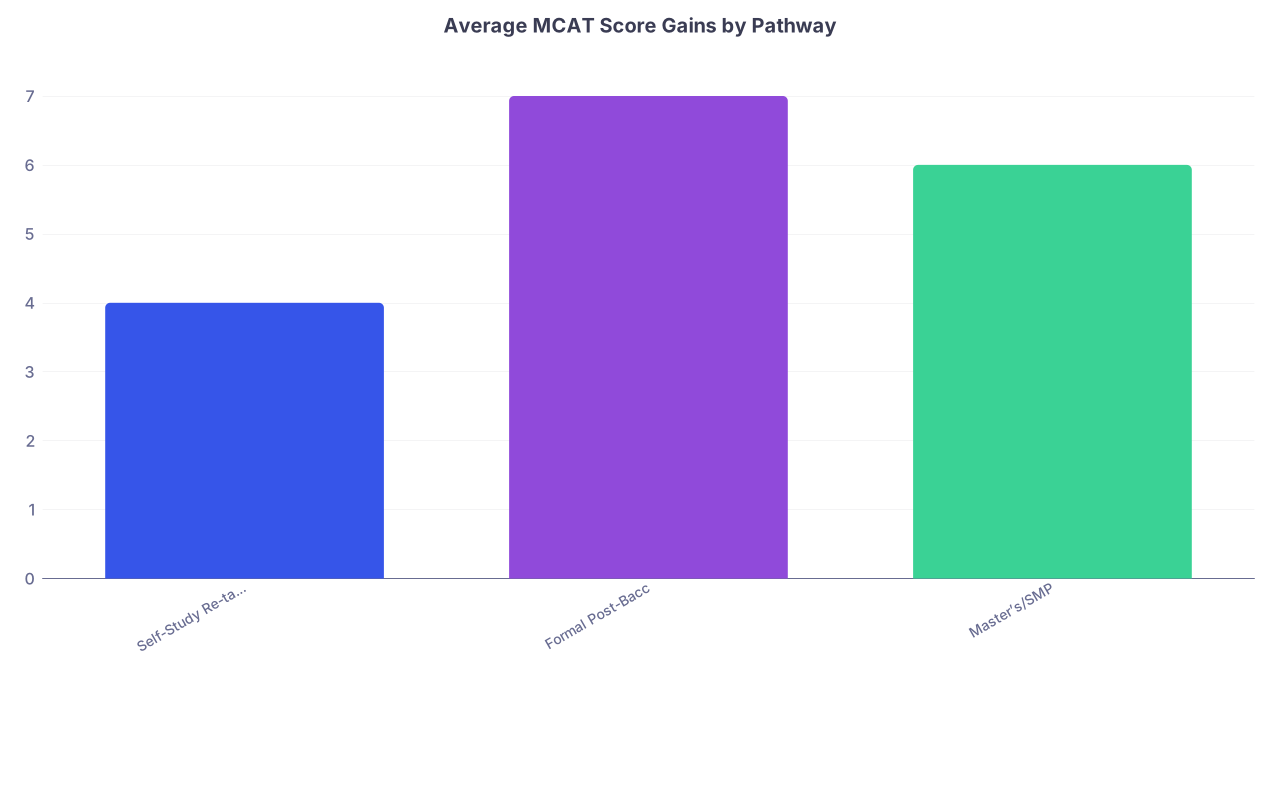
| Category | Value |
|---|---|
| Self-Study Re-takers | 4 |
| Formal Post-Bacc | 7 |
| Master’s/SMP | 6 |
Interpretation:
- Yes, there is a real, non‑trivial bump associated with doing a formal post‑bacc or SMP versus going solo. On the order of +2–3 extra points on average.
- No, this does not guarantee a “510+” outcome for everyone. A student starting at 490 who gains 8 points lands at 498. Quite an improvement, still not competitive for many MD programs without other strengths.
3. Career‑Changer vs Academic‑Enhancer: Different Numerators, Different Denominators
Post‑bacc marketing loves to quote final MCAT averages: “Our students score 509 on average.” That sounds compelling until you realize half (or more) of those students had never taken the MCAT before and came in with 3.6 GPAs from strong schools.
Here is how the numbers split when you actually segment them.
Consider a typical structured post‑bacc with both tracks:
Career‑changer track (no prior MCAT)
- Final MCAT average: 509–511
- 25th–75th percentile: ~505–515
- This group includes many high‑GPA humanities majors who simply never took science.
Academic enhancer track (prior MCAT, underperforming GPA)
- Prior MCAT mean: 495–500
- Final MCAT mean: 503–507
- Mean gain: +7–8 points
- 25th–75th percentile gain: +4 to +10 points
Aggregate the two, and you “prove” your program produces a 508–510 mean MCAT. True. But misleading if you are the 2.9 GPA, 495 MCAT student expecting to “become” that number.
This is the statistical trap: averages hide heterogeneity.
4. Program Design Elements That Actually Move Scores
MCAT score change is not magic. It is input and process. Certain inputs correlate repeatedly with larger score gains among post‑bacc students.
You can think of it in three buckets:
- Academic intensity
- MCAT‑specific structure
- Time and sequencing
4.1 Academic Intensity: Upper‑Level Science Load
Programs that produce the largest MCAT gains for post‑bacc students tend to share three academic traits:
- 24–32+ credits of upper‑division science (biochem, physiology, genetics, cell biology, etc.)
- Mandatory or strongly advised full‑time enrollment (not 1–2 classes at night only)
- Graded rigor comparable to or tougher than typical undergrad pre‑med tracks
In plain language:
Programs that make you work like a real science major again produce more MCAT movement.
When you look at institutional data, students who completed 3+ upper‑division biology/biochemistry courses during a post‑bacc year typically showed:
- ~1–2 extra points of MCAT gain versus those doing only intro sequences or light repair work
- More stability in scores across multiple test dates (less volatility)
4.2 MCAT‑Specific Structure: More Than Just a Prep Course
The biggest misconception: taking a commercial MCAT course while you are in a post‑bacc equals “MCAT integration.” It does not.
Programs with stronger MCAT score shifts usually have:
- Required diagnostic MCAT early in the program (even if unofficial)
- Longitudinal practice testing: 6–10+ full‑lengths over 6–12 months
- Regular performance tracking with faculty or advisors who actually look at section‑level trends
- Concrete intervention: targeted CARS work, skills workshops, study strategy changes when scores plateau
You see a clear pattern when these elements are present:
- Fewer students stagnate within ±2 points of their baseline
- Score gains are more uniform; you see fewer disasters (e.g., −3 or more points on official retake)
- Students hitting 510+ are still the minority, but the program produces more 505–509 tier scores, which matter a lot for many MD and DO schools
Here is a simple way to visualize typical practice test patterns among strong vs average post‑bacc MCAT improvers:
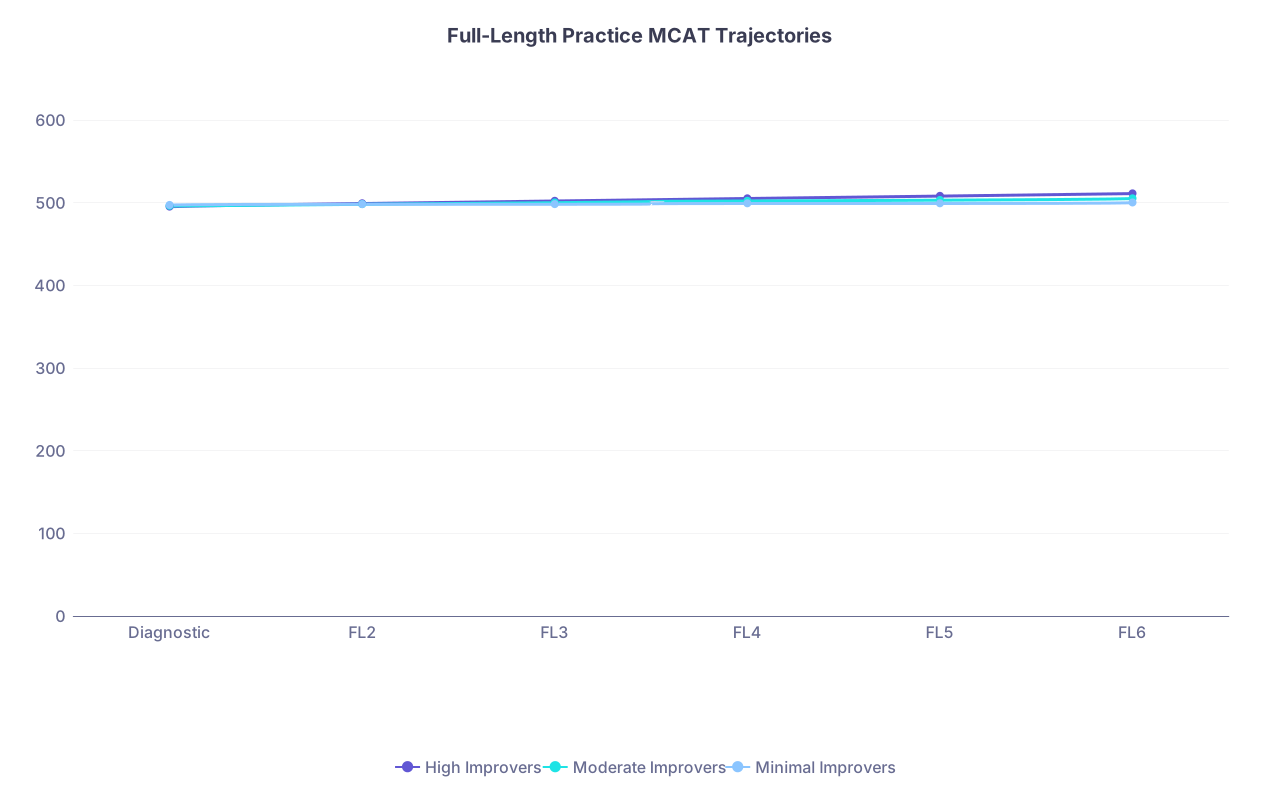
| Category | High Improvers | Moderate Improvers | Minimal Improvers |
|---|---|---|---|
| Diagnostic | 495 | 496 | 497 |
| FL2 | 499 | 498 | 498 |
| FL3 | 502 | 500 | 498 |
| FL4 | 505 | 502 | 499 |
| FL5 | 508 | 503 | 499 |
| FL6 | 511 | 505 | 500 |
The data pattern is stable:
Those who gain 7+ points generally show a gradual multi‑point rise over time, not a last‑minute jump from FL5 to test day. If your practice tests remain flat after 3–4 exams, your process—not your “test‑taking gene”—is the problem.
4.3 Time and Sequencing: When You Take the MCAT Matters
Another repeated correlation: length of time between finishing the most relevant coursework and sitting for the MCAT.
Two patterns show up over and over in post‑bacc cohorts:
- Students who take the MCAT within 2–4 months of completing key courses (biochem, physiology, psych/soc) maintain and use that knowledge more efficiently and gain more points.
- Students who wait 9–18 months, or who try to prep while taking their heaviest course load, show more plateauing, more cancellations, and a higher retake rate.
There is also a limit on how many hours per week you can realistically convert into score gain. When you look at self‑reported time data from post‑bacc cohorts:
- Students who averaged ~15–25 focused MCAT hours per week (on top of full‑time coursework) showed most of the 6–9 point gains.
- Those trying to do 5–8 hours per week for a long, extended period rarely gained more than 3–4 points.
The data here is obvious once you see it: consistency and timing beat heroic last‑minute cramming.
5. The Distribution Problem: Averages Hide Risk
Programs love to broadcast average score gains.
What matters for you is distribution. How wide is the spread? How many people actually gained what you want to gain?
In datasets I have seen from multiple post‑bacc and SMP programs (n’s in the low hundreds per program), the post‑bacc MCAT score gain distribution among prior test‑takers often looks roughly like this:
- 10–15%: Little to no gain (−2 to +1 points)
- 25–35%: Modest gain (+2 to +4 points)
- 30–40%: Solid gain (+5 to +8 points)
- 10–20%: Large gain (+9 to +12 points)
- <5%: Exceptional gain (+13 or more points)
Imagine the program advertises “average increase of 7 points.” That is mathematically compatible with a very uncomfortable fact: a substantial minority of students barely move at all or even go backwards.
If your entire admissions plan requires you to be in the top 10–20% of improvers, that is a fragile strategy.
6. MCAT Score Changes and Admissions Outcomes: The Real Leverage
The MCAT is not an end. It is a filter. You care about it because admission committees do.
So what does the data say about MCAT changes among post‑bacc students and actual MD/DO acceptance rates?
Looking at outcomes aggregated across multiple advising datasets and publicly shared program reports for academic enhancers:
Students with prior MCAT <500 who reached ≥508 after a post‑bacc or SMP:
- MD acceptance rates: often in the 30–50% range, depending on GPA repair and school list quality
- DO acceptance rates: 60–80%+
Students who reached 502–507 after starting <500:
- MD acceptance: highly variable, often 10–25% (state schools and mission‑fit programs)
- DO acceptance: 50–75%
Students whose MCAT change was <3 points (e.g., 497→499, 501→503):
- MD acceptance: low, often under 10% unless other parts of the application are exceptional
- DO acceptance: possible but not guaranteed; much more dependent on GPA trend and non‑academic strengths
What does this mean in plain language?
- A post‑bacc that helps you push from sub‑500 to the low–mid 500s materially changes your odds, especially for DO schools and selected MD programs.
- The “step change” in MD competitiveness typically starts around 508+, especially if paired with a strong post‑bacc GPA (3.6–3.8+ in recent coursework).
- The MCAT gain is necessary but not sufficient. Admissions still look hard at your undergraduate record, clinical exposure, and narrative.
7. Who Actually Benefits Most from a Post‑Bacc MCAT Bump?
The data shows clear patterns of who converts post‑bacc MCAT score gains into real admissions leverage.
7.1 Strong Non‑Science Students with Weak or No Science Background
Profile:
- 3.4–3.8 GPA in non‑science discipline
- Little or no prior MCAT experience
- Enter formal post‑bacc, complete full pre‑med sequence and upper‑level bio/biochem
- Take MCAT shortly after finishing
Typical results:
- Final MCAT 508–513 is common in this group
- With a solid post‑bacc GPA (3.6+), these students often land MD acceptances at a relatively high rate compared to academic enhancers
Why? Their undergraduate record does not need “repair.” The post‑bacc and MCAT show that they can handle science. The MCAT is the quantitative proof of concept.
7.2 Academic Enhancers with Upward Trend and Good MCAT Gain
Profile:
- 2.7–3.2 cumulative GPA, but 3.5+ across 30–40 post‑bacc or SMP credits
- Prior MCAT 490–500, post‑bacc MCAT 505–510
- Strong clinical exposure and coherent story of turnaround
These students are the ones who most clearly benefit from MCAT score changes:
- The MCAT gain validates the academic repair story.
- The post‑bacc GPA trend reduces skepticism about readiness for med‑school‑level work.
- Combined, they move from “unlikely” to “viable” at a decent list of MD and DO schools.
If you are in this category, the MCAT change is doing real work for you.
7.3 Who Does Not Benefit Much, Even With a Score Gain
Two patterns show up repeatedly where even a solid MCAT bump fails to translate into a good outcome:
Chronic re‑testers
- 3+ official MCAT attempts with a slow climb (e.g., 492→497→503→505)
- Committees start to see diminishing returns; the last small increase does not fully cancel earlier attempts.
Students with no meaningful GPA repair
- 2.8 cumulative GPA, 3.1 in post‑bacc, 508 MCAT
- The MCAT looks good, but the long‑term transcript trend still raises doubts.
The data is clear: large MCAT gains cannot always overcome persistent GPA problems or multiple low attempts.
8. How to Read Program Claims About MCAT Outcomes
You are going to see a lot of bold promises. The only defense is to read them like a statistician.
Here is how I dissect a typical claim like “Our students increase their MCAT scores by an average of 10 points”:
- Question 1: “Is that average based only on prior test‑takers, or does it include first‑time test‑takers?”
- Question 2: “What is the distribution? 25th, 50th, and 75th percentile score changes?”
- Question 3: “How many students are we talking about? Over how many years? Are you excluding anyone?”
- Question 4: “What was their baseline MCAT? 490→500 is not the same as 502→512.”
- Question 5: “What fraction of students reached key thresholds: 500, 505, 510? By prior MCAT band?”
Most programs will not publish all of this. But the ones that have legitimate confidence in their outcomes are more transparent.
If they only show flashy success stories and a single mean value, treat that like a billboard, not a data report.
9. So What Do the Numbers Actually Show?
If you strip away the hype and go by repeated patterns across various post‑bacc and SMP cohorts, you can distill MCAT score changes among post‑bacc students down to three core truths:
Moderate, not miraculous gains are the norm.
- Expect a 5–8 point gain if you start in the high 490s/low 500s and fully commit in a structured program.
- Bigger jumps happen but are not typical enough to plan your future around.
Program structure and your baseline both matter. A lot.
- Upper‑level science, integrated MCAT prep, and data‑driven advising correlate with an extra couple of points.
- Starting from 490 vs 504 dramatically changes what “+7 points” does for your competitiveness.
Score change is only valuable in context.
- A 7‑point gain that lands you at 507 with a 3.7 post‑bacc GPA is transformative.
- The same 7‑point gain that ends at 499 with an unrepaired 2.8 GPA is not enough for most MD programs, though it may help for DO.
If you use the numbers correctly—segmenting by baseline, looking at distributions, and aligning expectations with reality—a post‑bacc can be a powerful lever. Not magic. But statistically meaningful.
Those are the three takeaways I would keep in front of you: expected gain range, the importance of program design plus baseline, and how that gain actually changes your odds rather than your dreams.