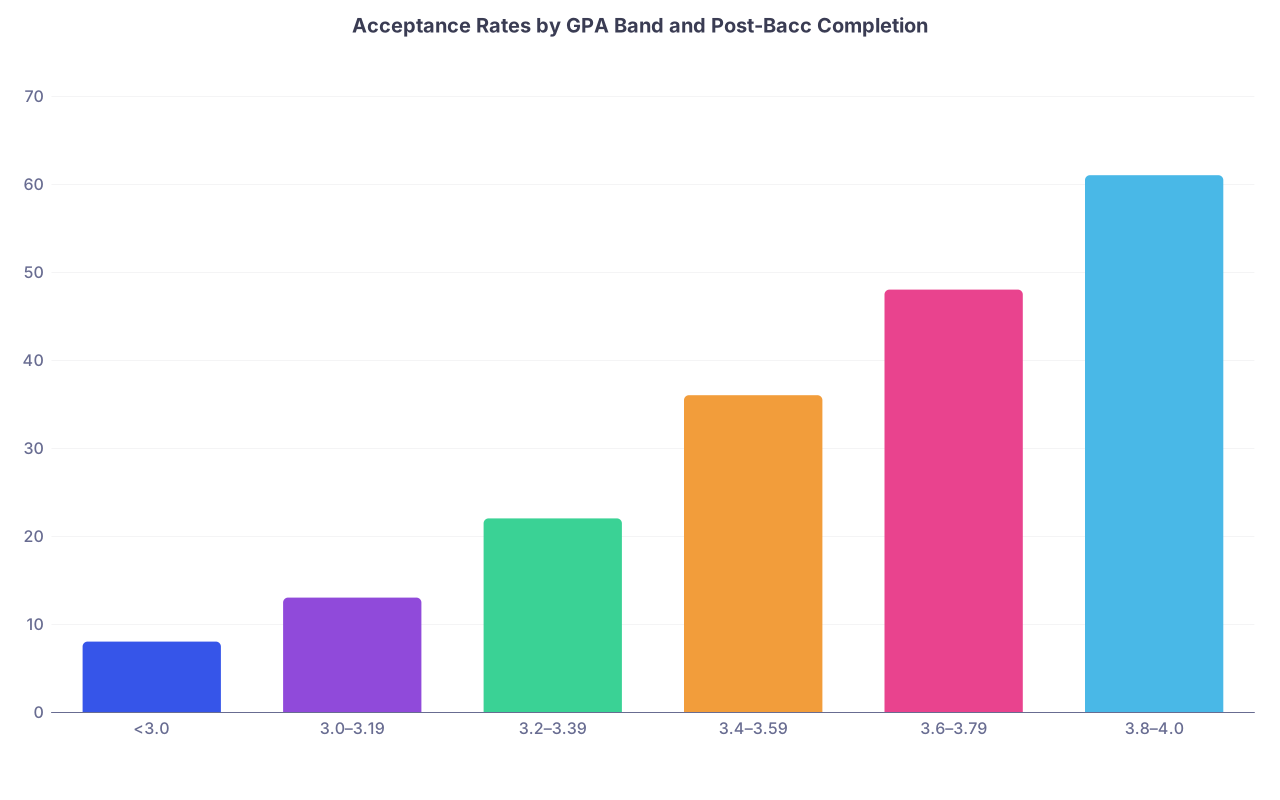
| Category | Value |
|---|---|
| <3.0 | 8 |
| 3.0–3.19 | 13 |
| 3.2–3.39 | 22 |
| 3.4–3.59 | 36 |
| 3.6–3.79 | 48 |
| 3.8–4.0 | 61 |
The usual advice about “fixing” a low GPA with a post‑bacc is dangerously oversimplified. The data show something harsher: a post‑bacc does not magically erase a weak academic record. It amplifies whatever trend you create. Up or down.
You are not deciding “Post‑Bacc vs No Post‑Bacc” in a vacuum. You are choosing between two different statistical trajectories for your application profile. So let us treat it that way.
(See also: Cost per Acceptance: Financial ROI of Major Post-Bacc Pathways for more details.)
1. The Baseline: What GPA Bands Actually Do To Your Odds
Start with the hard numbers. Ignore the marketing language from programs for a moment.
Using aggregated AAMC trends (U.S. MD) as a backbone and rounding for simplicity, the overall acceptance rates by cumulative undergraduate GPA band look roughly like this:
- 3.8–4.0: ~60–65%
- 3.6–3.79: ~45–50%
- 3.4–3.59: ~30–35%
- 3.2–3.39: ~20–25%
- 3.0–3.19: ~10–15%
- <3.0: often <10%
Layer MCAT on top of that and the stratification widens. A 3.2 with a 520 is not the same as a 3.2 with a 505. But GPA alone already shapes the hill you need to climb.
So where does post‑bacc come in? It does not replace this baseline. It modifies it. Think conditional probabilities.
Rough model:
- Let P(accept | GPA band) be your baseline probability.
- A strong post‑bacc adds a multiplicative factor to that probability (not a full reset).
- A mediocre or weak post‑bacc adds zero or even a negative multiplier.
This is where people get misled. They assume:
Low GPA + Post‑Bacc → “I am now in the ‘good GPA’ category.”
No. The data and admissions behavior do not support that. You become:
Low GPA + Evidence of Later High‑Level Performance.
That helps. Considerably. But it does not delete the first half of your transcript.
2. What the Data Actually Suggest About Post‑Bacc Impact
There is no single AAMC table that says “post‑bacc vs no post‑bacc acceptance rate by GPA band.” But you can combine:
- AAMC GPA–MCAT–acceptance tables
- Published outcomes from reputable post‑bacc programs
- Program placement percentages (who actually ends up in med school)
- Observed patterns from admissions deans and committee reports
When you triangulate all of that, a clear pattern shows up:
For applicants with a 3.6+ cumulative GPA, a generic post‑bacc offers relatively low marginal return unless:
- You need missing prerequisites,
- You are switching careers, or
- You are aiming at particularly competitive MD/PhD or top‑tier schools and your science coursework is thin.
For applicants in the 3.2–3.59 band, a strong, high‑GPA post‑bacc can shift your outcomes from “borderline” to “solidly in the game,” especially if:
- Your original science GPA is below your overall GPA,
- Your trend was flat or slightly downward,
- Your MCAT is at or above the national mean (~511–512+).
For applicants below 3.2, the post‑bacc effect is highly sensitive to performance:
- A 3.9+ in rigorous post‑bacc sciences for 30+ credits can rehabilitate you into a realistic MD/DO pool.
- Anything less than ~3.7 in the post‑bacc rarely changes the story as much as students hope.
Let me quantify this with a simplified, stylized model.
Assume two applicants in each GPA band: one with no post‑bacc, one with a strong post‑bacc (≥30 credits of upper‑division science at ≥3.7 GPA, with a decent MCAT, say 510–515).
We can model an “effective” acceptance probability like this:
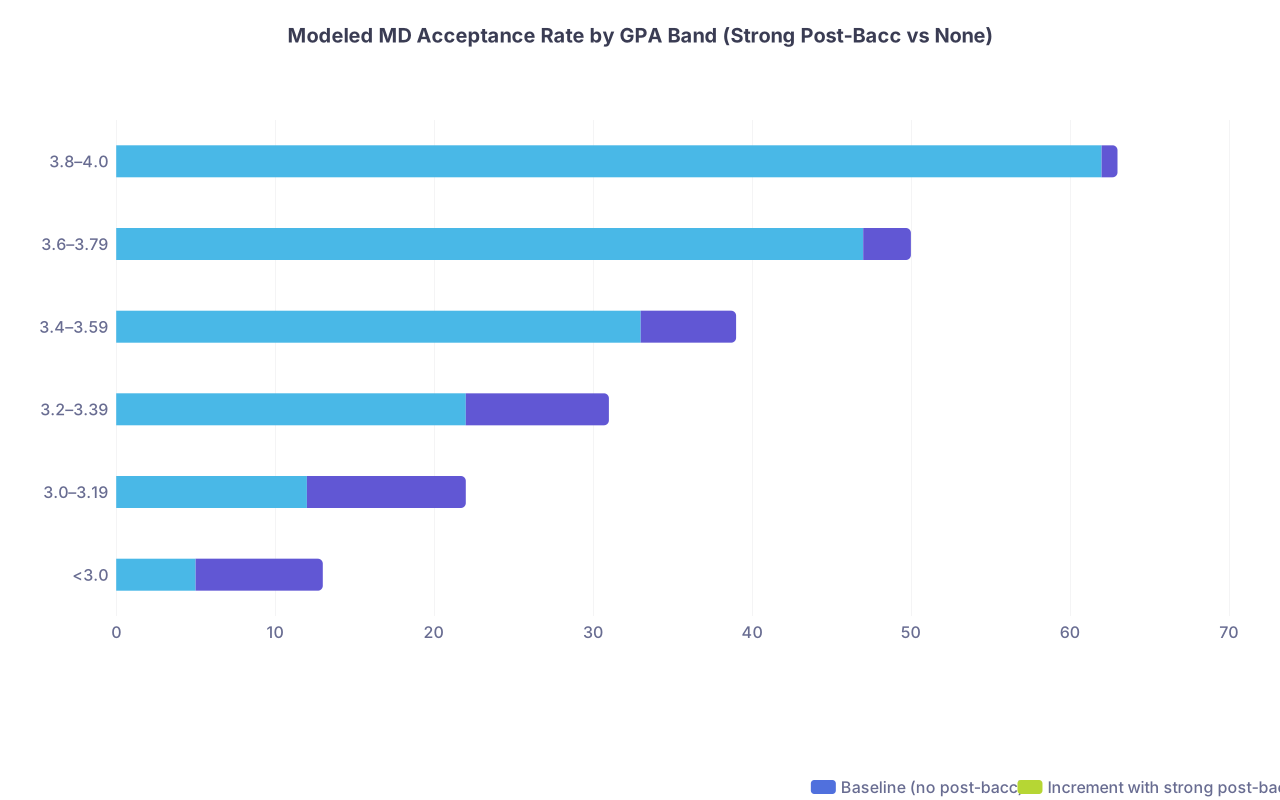
| Category | Baseline (no post-bacc) | Increment with strong post-bacc |
|---|---|---|
| <3.0 | 5 | 8 |
| 3.0–3.19 | 12 | 10 |
| 3.2–3.39 | 22 | 9 |
| 3.4–3.59 | 33 | 6 |
| 3.6–3.79 | 47 | 3 |
| 3.8–4.0 | 62 | 1 |
Interpreting that:
- A 2.8 GPA without post‑bacc might see ~5% MD acceptance odds. With a strong post‑bacc, you might push into the 13% range.
- A 3.1 might move from ~12% to ~22%.
- A 3.3 from ~22% to ~31%.
- A 3.5 from ~33% to ~39%.
- A 3.7 from ~47% to ~50%.
- A 3.9 from ~62% to ~63%.
These numbers are rough, but the pattern is not: the lower your original GPA, the more you must lean on a post‑bacc to create a new trajectory. And the gains are biggest in the low‑3s range. Above ~3.6, the incremental return from a post‑bacc for purely “GPA repair” is small.
3. GPA Band by GPA Band: Post‑Bacc vs No Post‑Bacc
Let me go through each major band with explicit scenarios.
3.8–4.0: The Overkill Zone
If you already sit in this band, your biggest enemies are paranoia and inefficiency.
Data reality:
- MD acceptance: ~60–65% overall, higher with MCAT ≥515.
- Your main risk factors: weak clinical exposure, no clear motivation, generic essays, bad interviews.
Effect of post‑bacc:
- No post‑bacc: You are already in the top academic decile.
- With post‑bacc: You spend 1–2 more years proving something already proven. The acceptance rate is not jumping from 60% to 90% because you took more A’s in undergrad biochem 2. You might move a few percentage points, at best.
Verdict: Post‑bacc purely for GPA reasons at this level is statistically wasteful. If you need missing prerequisites as a career changer, fine. Otherwise, your marginal gain in acceptance rate is minimal compared to simply applying strategically and building clinical + research depth.
3.6–3.79: Strong But Vulnerable
You are in decent territory. Not bulletproof.
Baseline:
- MD acceptance: ~45–50% overall.
- With MCAT ≥513–515, you may behave more like the 3.8+ group.
- Without a strong MCAT, you behave more like mid‑3s.
Effect of post‑bacc:
- Strong post‑bacc: Might move you from ~47% to ~50% or slightly higher in specific niches (e.g., more research‑heavy programs if your post‑bacc includes that).
- Mediocre post‑bacc (≤3.5): Can actually harm you by breaking your “upward” or “stable strong” trajectory.
You gain more acceptance probability from:
- MCAT improvement,
- Targeted application strategy (right school list),
- Real clinical engagement,
than from tacking on more 4.0 terms.
Verdict: A general post‑bacc does not meaningfully shift acceptance probability for most in this band. Do it only if you have a clear gap: missing prereqs, a weak science GPA compared to overall, or a late‑breaking interest in medicine with thin science exposure.
3.4–3.59: The Borderline MD Band
This is where the decision gets real.
Baseline:
- MD acceptance: ~30–35% overall, assuming MCAT around the mean.
- Many applicants here get screened harder at more competitive MD programs.
- DO prospects are much better.
With no post‑bacc:
- You rely heavily on MCAT (515+ helps a lot), trend (upward senior year), and narrative.
- A downward trend or poor science GPA can sink you.
With a strong post‑bacc:
- 30+ credits of A/A‑ in upper‑division sciences with a 3.7–3.9 GPA dramatically changes your “trajectory story.”
- Admissions committees see: “They figured things out late and sustained high‑level performance for ~2 years.”
Reasonable modeled outcomes:
- No post‑bacc, 3.5 GPA, MCAT 511: ~30–35% MD acceptance.
- With strong post‑bacc, same MCAT: ~35–40%, possibly higher depending on school list and non‑academic factors.
The increase is not magical. But it can move your odds from “coin‑flip” into “moderately favorable” if the rest of your application is coherent.
Verdict: In this band, post‑bacc starts to make statistical sense if (and only if) you are confident you can crush it. If you are going to float at 3.4–3.5 again, do not bother; you just demonstrate plateaued performance.
3.2–3.39: The Classic “Academic Rehab” Zone
This is where a well‑executed post‑bacc can flip the narrative.
Baseline:
- MD acceptance: roughly 20–25% depending on MCAT.
- Many committees will flag this as “high risk” unless something else compensates.
No post‑bacc:
- To hit >30% MD acceptance odds, you usually need a strong MCAT (≥515) plus a very compelling story and strong trend.
- Otherwise you trend toward lower acceptance rates vs the overall pool.
With a strong post‑bacc:
- If you put up a 3.8–4.0 in 30–40 credits of rigorous, upper‑level sciences and a 510–515+ MCAT, your effective odds can jump into the low‑30% range for MD, much higher when you include DO.
- You are no longer “3.2 GPA who might not handle the rigor.” You are “3.2 early, 3.9 in later, harder classes who probably figured it out.”
Modeled example:
- 3.3 cGPA, MCAT 512, no post‑bacc → ~22–25% MD acceptance.
- 3.3 cGPA, 35 post‑bacc credits at 3.85, MCAT 512 → ~30–33% MD acceptance (again, these are directional, not exact).
Verdict: If you are in this band and medicine is non‑negotiable, a strong post‑bacc is often your best statistical lever. But “strong” here means top‑tier performance. Not B+/A‑ sprinkled with Bs.
3.0–3.19: The High‑Risk Zone
This band is harsh. With no additional coursework:
- MD acceptance is often in the ~10–15% range, heavily dependent on an exceptional MCAT and other stand‑out features (URiM status, unique background, outstanding research, etc.).
- DO may still be in play with a strong MCAT, but many schools will be cautious.
No post‑bacc:
- You are essentially asking admissions committees to take a bet against your full academic record. Many will not.
With a strong post‑bacc:
- 30–40 credits of 3.8–4.0 level performance in rigorous science can shift you into the low‑20% MD acceptance region, and substantially higher when including DO.
- This roughly doubles your MD odds and more than doubles your overall MD/DO odds.
But there is a catch: if you do a post‑bacc here and earn anything short of a 3.7+, your implied risk profile barely changes. Another 3.1 term does not reassure anyone.
Verdict: In this band, “no post‑bacc” is statistically poor for MD aspirations, and marginal for DO. A high‑performance post‑bacc can move you from long‑shot to plausible. But the tolerance for anything less than excellence is small.
Below 3.0: The Red‑Flag Zone
Below a 3.0, MD acceptance is single‑digits on average.
No post‑bacc:
- You are essentially in the “extraordinary exception” category.
- Even with a very high MCAT, most MD schools will be skeptical.
- DO remains a possibility but not a guarantee.
With a strong post‑bacc:
- If you manage 40–50 credits of 3.8+ work, some MD programs and many DO programs will recalibrate.
- Are you suddenly a 40% MD candidate? No. But moving from ~5% to ~12–15% is already a large relative gain.
Real talk: I have seen 2.6–2.8 students do this successfully. But they treated their post‑bacc like a full reboot—no work, no distractions, obsessive discipline. They pulled a 3.9+ in hard sciences and often went on to SMPs or special master’s programs afterward.
Verdict: If you stay below 3.0 with no significant new academic story, MD is statistically close to zero. Post‑bacc is not optional; it is the only viable data‑driven path, and it must be excellent.
4. Risk: Post‑Bacc Is Not a Free Roll
Here is the part most people ignore: post‑baccs are high‑variance bets.
End of story: a post‑bacc that does not substantially outperform your undergrad will hurt you. It confirms the exact concern committees already had.
So the decision is not:
“Do a post‑bacc → better acceptance rate.”
The actual fork is:
- Do no post‑bacc → keep your current risk profile.
- Do post‑bacc and excel → improve your odds significantly (especially in low GPA bands).
- Do post‑bacc and perform average → waste time and money, sometimes worsening your odds.
To decide rationally, you need a process. Not vibes.

| Step | Description |
|---|---|
| Step 1 | Know your GPA band |
| Step 2 | Targeted post-bacc OK |
| Step 3 | Skip; focus on MCAT & experiences |
| Step 4 | Structured post-bacc likely worthwhile |
| Step 5 | Apply broadly, DO-heavy, reconsider MD expectations |
| Step 6 | Intensive post-bacc or SMP; delay apps |
| Step 7 | Odds for MD low; consider DO, other careers |
| Step 8 | >= 3.6? |
| Step 9 | Missing prereqs or career change? |
| Step 10 | 3.2–3.59? |
| Step 11 | Can you realistically get 3.7+ in 30+ sci credits? |
| Step 12 | < 3.2 |
| Step 13 | Willing to fully commit and aim 3.8+? |
The uncomfortable step in that diagram is G and K. “Can you realistically get 3.7–3.8+?” If history, life circumstances, or your own habits say no, the data do not support doubling down on coursework.
5. Integrated View: Post‑Bacc vs No Post‑Bacc by GPA Band
Let me summarize the comparative effect cleanly.
Assume:
- Reasonable MCAT (around 510–512).
- Adequate clinical exposure and activities.
- No glaring professionalism issues.
Modeled MD acceptance probabilities (directional, not exact):
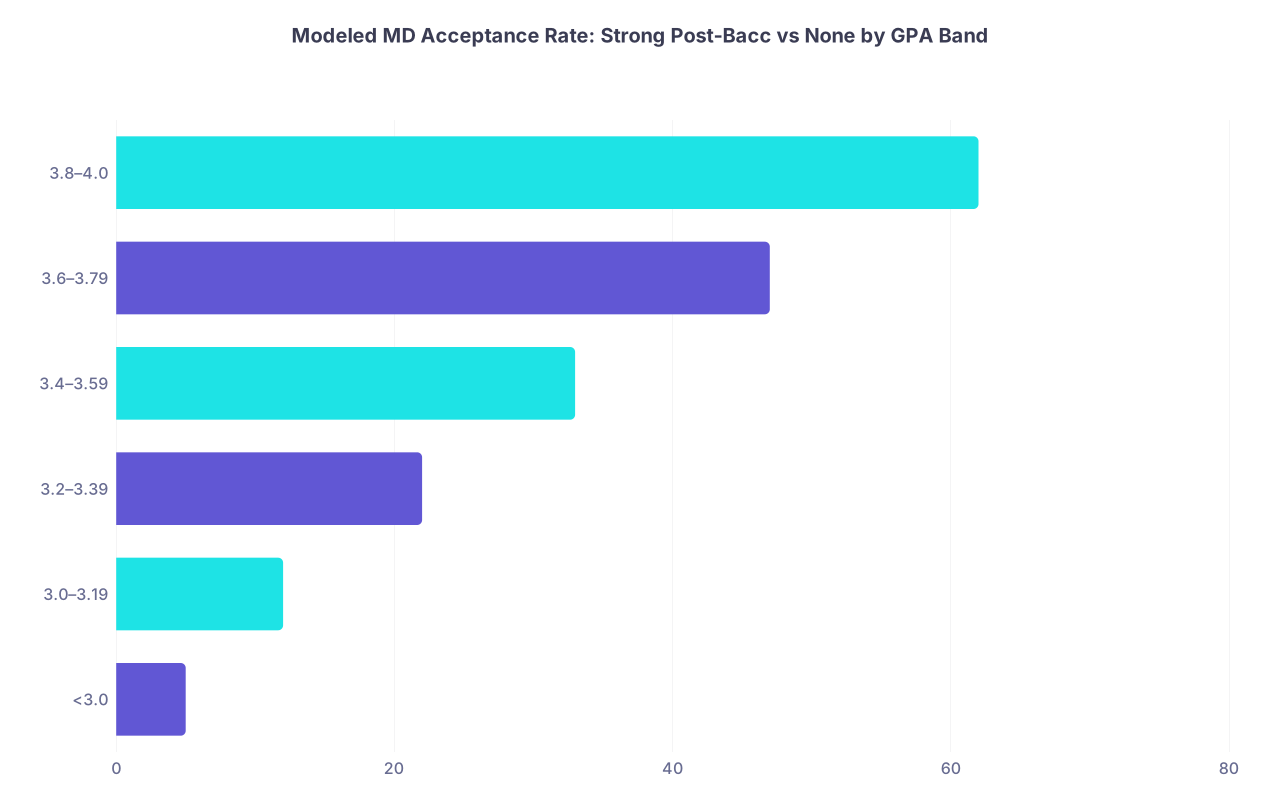
| Category | Value |
|---|---|
| <3.0 | 5 |
| 3.0–3.19 | 12 |
| 3.2–3.39 | 22 |
| 3.4–3.59 | 33 |
| 3.6–3.79 | 47 |
| 3.8–4.0 | 62 |
Now mentally overlay this:
- Add ~+7–10 percentage points in the <3.2 bands if you complete a strong 30–40 credit post‑bacc.
- Add ~+5–7 points in the 3.2–3.59 band.
- Add ~+0–3 points above 3.6.
You see the pattern:
- Below 3.2: post‑bacc (done well) can double or more than double your MD odds.
- 3.2–3.59: post‑bacc can shift you from long‑shot/coin‑flip to credible candidate.
- Above 3.6: post‑bacc is marginal for GPA alone; your acceptance rate is driven more by MCAT and experiences.
So “Post‑Bacc vs No Post‑Bacc” is not one question. It is at least six questions, one per GPA band.
6. How To Decide for Yourself, Without Self‑Deception
I will be blunt: most bad post‑bacc decisions are driven by emotion, not data. Panic about GPA. Desire to “do something.” Fear of applying “too early.” The result is a lot of extra transcripts and not much additional acceptance.
Here is a more analytic way to frame it.
Identify your true GPA profile
- Cumulative GPA
- Science GPA (BCPM)
- Last 60 credit GPA
If your last 60 credits are already ≥3.7 and science is strong, a post‑bacc is rarely necessary for GPA alone.
Estimate your baseline odds
- Locate your AAMC GPA‑MCAT cell.
- Look at the acceptance rate.
- Adjust ±5–10 points based on URiM status, state school preference, and experiences.
Define your target band
- Are you trying to move from 10–15% to 25–30%?
- From 25–30% to 35–40%?
Ask whether a post‑bacc can realistically produce that delta
- If you are already at 50%+ projected odds, sinking 1–2 extra years for a 2–3 point gain makes little sense.
- If you are at 10–15% and can push to 25–30% with strong new grades, that is compelling.
Stress test your plan
- Assume you hit only a 3.5 in your post‑bacc. Would you still be glad you did it?
- If not, your margin for error is too small, and you may be overestimating your ability to change your study habits.
The bottom line: post‑baccs are powerful but blunt instruments. The data show clear benefit for applicants in the 3.0–3.5 range who can demonstrably outperform their past selves. For everyone else, the value is limited, and sometimes negative.
Your next step is not to enroll somewhere. It is to build a spreadsheet: your exact GPAs, potential course loads, and realistic grade expectations, then map those against acceptance probabilities. Once you see it in numbers, not feelings, the right path is usually obvious.
With that groundwork laid, the next analytical move is looking at specific program types—informal post‑baccs, structured certificates, SMPs—and modeling how each one would change your risk profile. That is where the real optimization begins.