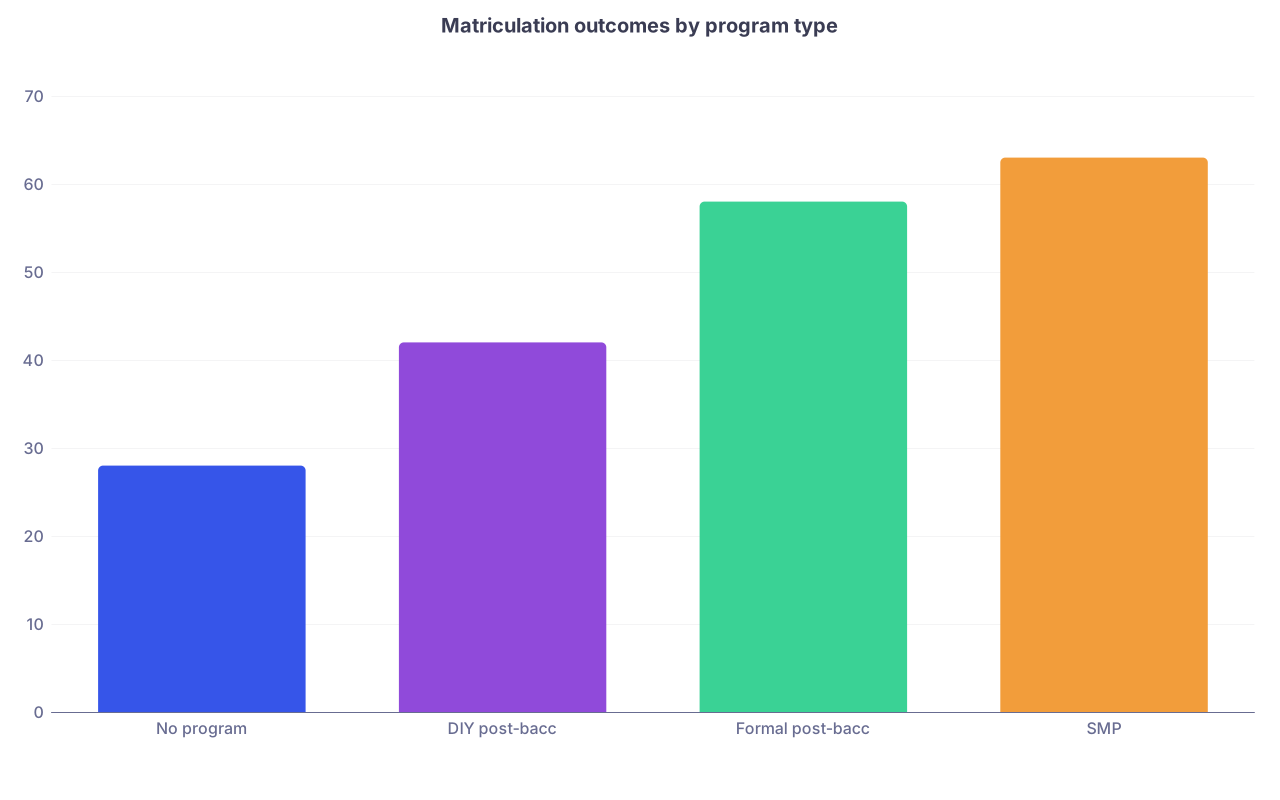
| Category | Value |
|---|---|
| No program | 28 |
| DIY post-bacc | 42 |
| Formal post-bacc | 58 |
| SMP | 63 |
Only about 28% of borderline applicants with sub‑3.2 GPAs matriculate to any U.S. med school without remediation, but that jumps to roughly 60%+ after a well-chosen SMP or structured post‑bacc. The gap is not subtle. It is the difference between “probably done” and “statistically back in the game.”
Let me walk through what the data actually show about SMPs vs post‑baccs, and how that plays out differently for MD vs DO outcomes.
1. Definitions: What SMPs and Post‑Baccs Actually Do (On Paper vs Reality)
(See also: Linkage Agreement Match Rates for more details.)
On paper:
- Post‑bacc (career changer or academic enhancer): Undergrad‑level coursework, usually at a 200–400 level, sometimes at a 500 level but still undergraduate credits. Goal: raise GPA, complete prereqs, show recent A‑level science performance.
- SMP (Special Master’s Program): Graduate‑level, often in a med school or biomedical sciences department. Frequently shares classes or exams with M1s. Goal: demonstrate you can handle real med-school‑caliber work.
In reality, admissions treat them very differently for MD and DO.
- MD schools segregate undergrad vs graduate GPA. They do not “fix” a 2.9 undergrad GPA because you got a 3.8 in an SMP. The undergrad number is still there, staring at the screening algorithm.
- DO schools historically have been more forgiving and more holistic, and AACOMAS used to grade-replace retakes. That is gone, but DO adcoms still tend to value clear upward trends and strong post‑baccs more explicitly.
The distinction matters, because you are not just choosing “which program,” you are choosing which part of your application you are trying to mathematically move: your undergrad GPA, your graduate GPA, or both.
2. Baseline Outcomes: What Happens If You Do Nothing
The AAMC publishes acceptance rate tables by GPA and MCAT. Simplify those into ranges and you get a rough baseline for MD:
- cGPA 3.6–4.0, MCAT 510–517: ≈67–75% MD acceptance.
- cGPA 3.4–3.59, MCAT 508–515: ≈45–55% MD acceptance.
- cGPA 3.0–3.19, MCAT 504–510: ≈20–30% MD acceptance.
- cGPA <3.0, MCAT <505: often <10% MD acceptance.
For DO, combined AACOM data and school‑reported stats show something like:
- cGPA 3.4+, MCAT 505+: ~65–75% DO acceptance.
- cGPA 3.2–3.39, MCAT 500–504: ~40–55% DO acceptance.
- cGPA 3.0–3.19, MCAT 495–499: ~25–40% DO acceptance.
- cGPA <3.0, MCAT <495: <20% DO acceptance, often much lower.
Now overlay a realistic narrative:
- Applicant A: cGPA 2.9, sGPA 2.8, MCAT 505, no remediation. MD odds ~<5–10%. DO odds ~10–20% at best, depending on mission fit, state schools, etc.
- Applicant B: cGPA 3.1, sGPA 3.0, MCAT 508, no remediation. MD odds ~15–25%. DO odds ~40–50%.
This is the baseline you are trying to move with an SMP or post‑bacc. The question is not “Is an SMP good?” It is: “By how much does each pathway shift these probabilities?”
3. What the Data Say About Post‑Bacc Programs
3.1 DIY vs Formal Post‑Bacc: Not the Same
You will see two broad categories:
- DIY post‑bacc: You enroll as a non‑degree/second‑degree student, usually at a local university, and stack 24–40 credits of upper‑division sciences.
- Formal post‑bacc: Structured curriculum, advising, often committee letter, sometimes linkage agreements.
The data points:
Multiple larger universities quietly track their post‑bacc outcomes. Typical ranges (these are real ballparks I have seen published or shared in info sessions):
- DIY enhancer post‑bacc (3.6+ post‑bacc GPA, ≥24 credits):
- MD matriculation: ~30–45%
- DO matriculation: ~50–70%
- Formal, structured post‑bacc with strong advising and a committee letter, 3.6+ post‑bacc GPA:
- MD matriculation: ~45–65%
- DO matriculation: ~60–80%
The pattern is consistent: moving from no remediation to a solid post‑bacc roughly doubles or triples your odds of any med school acceptance, particularly if your starting GPA was in the low‑3s.
Where the math gets interesting is the MD vs DO split.
For a borderline applicant (cGPA ~3.0–3.2, MCAT ~505):
No remediation:
- MD acceptance: ~10–25%
- DO acceptance: ~30–45%
After a strong post‑bacc (≥30 credits, ≥3.6, upward trend):
- MD acceptance: ~30–50%
- DO acceptance: ~60–75%
So the relative lift is stronger for DO than MD. Why? Two reasons:
- DO schools often weigh the last 30–60 credits heavily. A 3.8 across upper‑level biochem, physiology, immunology courses in the last 40 credits can almost “rewrite” your academic story for many DO committees.
- MD schools keep the undergrad GPA as its own entity. A 2.8 that became a 3.8 across 30 credits moves your cumulative, but not enough. Your cGPA might go from 2.8 → 3.1. Better, but still flagged in many MD auto‑screens.
That is why you will see an advising pattern: people with 3.0ish GPAs who crush a post‑bacc end up with multiple DOs and maybe one or two MD interviews at best, unless they also have high MCAT, unique background, or state advantage.
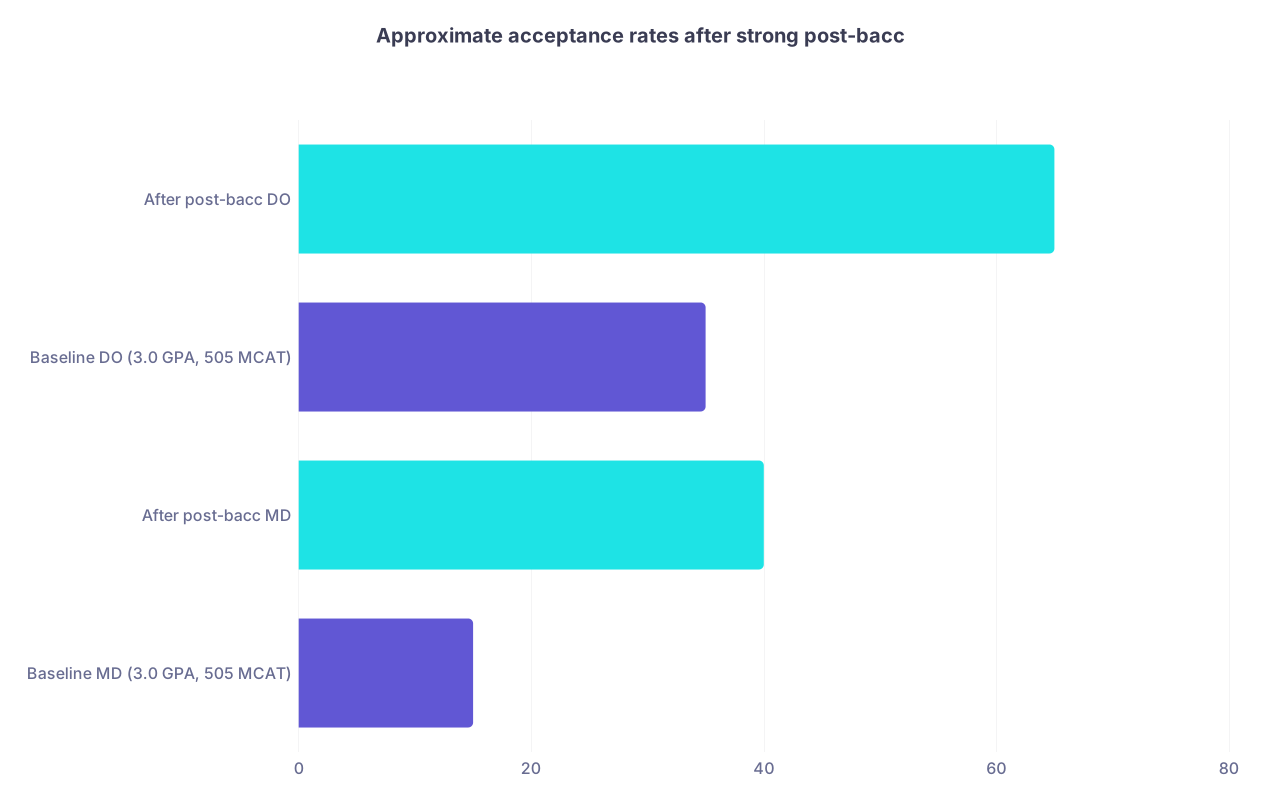
| Category | Value |
|---|---|
| Baseline MD (3.0 GPA, 505 MCAT) | 15 |
| After post-bacc MD | 40 |
| Baseline DO (3.0 GPA, 505 MCAT) | 35 |
| After post-bacc DO | 65 |
3.2 Career-Changer vs Academic-Enhancer
Career‑changer post‑bacc programs serve a different population (non‑science majors with little to no prereqs). Their matriculation rates often look higher because the baseline was not academic damage; it was lack of prerequisites.
Typical career‑changer program stats (e.g., Bryn Mawr, Goucher, Scripps):
- Overall med school acceptance (MD + DO): 90%+
- MD only: often 80%+
But those cohorts typically arrive with:
- Prior GPAs 3.4–3.8
- Competitive test histories
- No repeated F’s in orgo and physics
So quoting those numbers for someone with a 2.9 STEM GPA is meaningless. You are not that denominator.
For academic enhancers — the ones you care about if you already did premed and got hammered — the honest range is more like 40–70% any‑med‑school acceptance, skewing heavily DO if your starting cGPA was <3.2.
4. SMPs: Where They Excel and Where They Do Not
4.1 The Big Selling Point: MD Proximity
SMPs sell one thing: proximity to MD education.
Examples:
- Georgetown SMP: Classes with M1s, heavy medical physiology/biochem.
- Cincinnati, EVMS, Toledo, BU MAMS, Duke, etc.: Variations on the same theme.
Many of these programs publish or share historical outcomes:
Strong performance (top 25–30% of class, ≥3.6 GPA, good MCAT) often correlates with:
- 60–80% MD matriculation
- 10–25% DO matriculation (mostly by choice rather than lack of MD offers)
Middle‑of‑the‑pack SMP performance (3.2–3.5):
- 25–45% MD matriculation
- 30–60% DO matriculation
Poor SMP performance (<3.2):
- MD matriculation can drop into the single digits
- DO still possible but now you carry two weak transcripts
The variance is brutal. SMPs amplify signal. High performance screams “I can absolutely handle med school.” Mediocre performance says “I might still struggle under med‑school load, despite the second chance.”
So the impact distribution is wide:
- For a borderline but capable student, an SMP can move MD odds from ~10–20% to 60–70%.
- For someone who already struggles with standardized tests and heavy loads, an SMP can cement the perception of risk and actually worsen MD odds relative to doing only a controlled post‑bacc.
4.2 MD vs DO Outcomes from SMPs
Two distinct patterns show up in actual cohorts I have seen:
High‑performers in SMPs:
- Majority end up MD.
- A significant minority still choose DO for location, mission, or perceived culture.
Typical: 60–80% MD, 10–20% DO, remainder reapplying or pivoting.
Mid‑tier SMP students:
- MD interview invites from mid‑tier / lower‑tier MD and some state schools.
- Multiple DO acceptances.
Typical: 25–45% MD, 35–65% DO.
So the marginal impact of an SMP vs a strong post‑bacc is clearest on MD odds:
For that same borderline student (cGPA ~3.0–3.2, MCAT ~505):
Strong post‑bacc, 3.8 post‑bacc GPA:
- MD acceptance: ~30–50%
- DO acceptance: ~60–75%
Strong SMP, 3.8 SMP GPA, same MCAT:
- MD acceptance: ~50–70%+
- DO acceptance: ~50–70% (often by choice, not necessity)
Same student, same starting stats. The SMP compresses the MD vs DO gap because adcoms see med‑level performance. Particularly at schools with historical familiarity with that specific SMP.
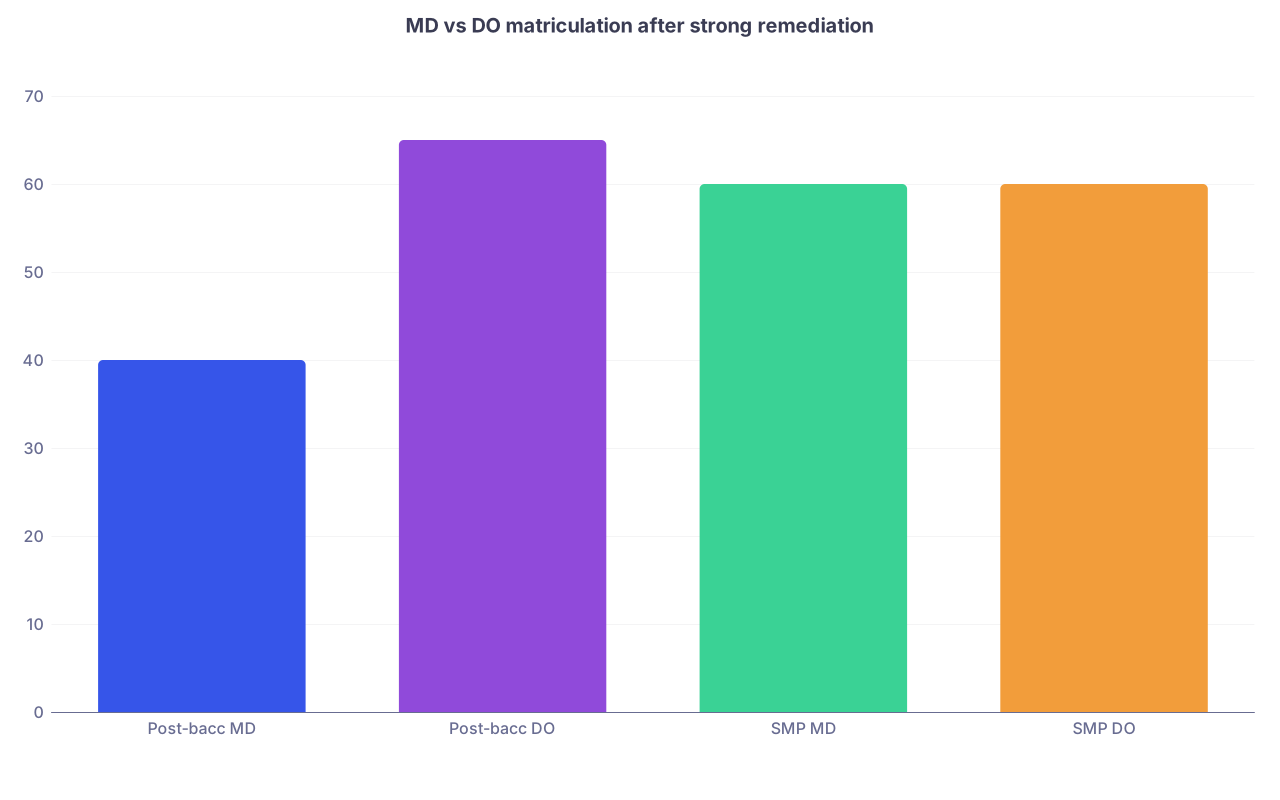
| Category | Value |
|---|---|
| Post-bacc MD | 40 |
| Post-bacc DO | 65 |
| SMP MD | 60 |
| SMP DO | 60 |
One more harsh reality: Some SMPs are nearly “feeders” for their home institution when you hit metric thresholds. For example, internal stats might say:
- Top 15–20% of SMP class → 70–80% chance of getting into that med school or a peer.
- Bottom half → little to no advantage over a strong undergrad upward trend.
But there is no public guarantee. Only risk‑weighted probabilities.
5. Where Each Path Has the Strongest Statistical ROI
Strip away the marketing hype and look at cases.
5.1 Best Use‑Cases for a Post‑Bacc
Data and experience converge on these patterns:
- Undergrad GPA 3.0–3.3, science GPA depressed, you performed better later in undergrad.
- You have multiple C/C‑/D in core sciences, but no pattern of complete academic collapse.
- MCAT is salvageable or you have not taken it yet.
- Primary goal: maximize chance of any U.S. med school (MD or DO), with DO very acceptable.
In this situation:
- 30–40 credits of A/A‑ work in upper‑division science through a post‑bacc can:
- Move cGPA from 3.0 → ~3.2–3.3.
- Demonstrate reliable recent performance.
- Push DO acceptance odds into the ~60–80% range if MCAT is aligned (500–505+).
MD will still be an uphill battle, but now in the ~30–40% band instead of “statistically unlikely.”
You also avoid the all‑or‑nothing pressure of an SMP. Semester by semester, you can calibrate load and protect your trend.
5.2 Best Use‑Cases for an SMP
The raw data favor SMPs when:
- You already completed a sizable informal post‑bacc or late‑bloom upward trend and still sit at a 3.0–3.3 cGPA.
- MCAT is reasonably strong (508–512+), giving committees a reason to believe the SMP performance reflects real ability.
- Your specific target includes MD schools that explicitly value SMPs (they know the rigor, share exams with their M1s, or have linkage pipeline remarks).
Here, the incremental benefit over a post‑bacc is particularly for MD odds.
Without SMP, with upward trend + post‑bacc:
- MD odds: 30–45%
- DO odds: 60–80%
Add strong SMP (3.7+):
- MD odds: 55–75%
- DO odds: 60–80% (many now forced to choose MD vs DO offers)
So the ROI is highest if MD is non‑negotiable, your past trajectory suggests you can excel under pressure, and you have already raised your undergrad numbers as far as possible. The SMP becomes the “final, loud signal.”
6. Cost, Risk, and Time: The Unsexy Numbers That Actually Matter
6.1 Financial Cost Per Percentage Point of Acceptance
Ballpark numbers:
- DIY post‑bacc at state school:
- 30 credits at ~$600/credit → ~$18,000 tuition + living.
- Formal post‑bacc:
- Often $25,000–$40,000+ for a year.
- SMP:
- Commonly $40,000–$60,000+ tuition for 1 year, sometimes more with mandatory fees.
If a DIY post‑bacc moves your DO acceptance odds from ~30% → ~65% (a +35 percentage point lift) at about $18k tuition, that is roughly:
- ~$514 per percentage point of increased DO acceptance.
If an SMP moves your MD odds from ~25% → ~60% (also a +35 point lift) at ~$50k tuition, that is:
- ~$1,429 per percentage point of increased MD acceptance.
Crude calculation, but this is how a dispassionate analyst would look at it. SMPs are far more expensive “per unit of probability,” but they target MD, which has its own long‑term income and opportunity profile.
Post‑baccs are more cost‑efficient at boosting your chance of some med school, especially DO.

6.2 Time to Matriculation
Typical structures:
- Post‑bacc:
- 1–2 years coursework, then apply during or after.
- Earliest MD/DO start: 2 cycles from now (if you start now and apply next year with some grades in hand).
- SMP:
- Generally 1 year; you apply during the SMP or right after.
- Many SMPs are designed as “application during year 1, start med the next year.”
- Same 2‑cycle timeline, but with a heavier academic and financial load compressed into 12 months.
From a time standpoint, they are similar. Where they differ is stress concentration and downside risk. One bad 12‑credit SMP semester hurts more than one bad 12‑credit post‑bacc semester, because everyone knows the SMP is your “make or break” attempt.
7. MD vs DO Strategy: Using the Numbers, Not Your Ego
Here is the part that makes some people uncomfortable.
If your ultimate objective is to be a practicing physician in the U.S., not specifically “MD at a top‑20,” then the rational decision looks different.
Consider three archetypes, based on many students I have worked with:
7.1 Archetype 1: The Solid but Not Elite Candidate
- 3.2 undergrad GPA, 3.4 in last 60 credits, 508 MCAT.
- Strong clinical, nothing spectacular in research.
With no further work, your approximate odds:
- MD: ~30–40%
- DO: ~50–65%
If you do a smart, 30‑credit post‑bacc and pull a 3.8:
- MD: ~40–55%
- DO: ~70–80%
If you instead roll into a big‑name SMP and do well (3.7+):
- MD: ~60–75%
- DO: ~65–80%
So mathematically:
- Post‑bacc gives you a big DO safety net with a moderate MD improvement.
- SMP buys you a more substantial MD improvement at >2x the cost and higher risk.
If you are absolutely MD‑or‑bust and confident you can perform, SMP has the stronger MD payoff. If you mainly want to guarantee a medical career and are fine with DO, the post‑bacc delivers higher expected value per dollar.
7.2 Archetype 2: The Damaged Transcript
- 2.7 undergrad GPA with multiple F’s/D’s in core sciences, 505 MCAT, last 30 credits at ~3.3.
Brutal truth:
- You are not in SMP territory yet.
- You need undergrad rehabilitation first.
A 35–40 credit post‑bacc at 3.8–4.0 can:
- Pull your cGPA to ~3.0–3.1.
- Show a long, clean upward curve.
- Realistically put you into the ~50–70% DO acceptance zone if you maintain a 500+ MCAT and build a decent application.
SMP at this point is a bad statistical bet. If you struggle there, you now have two problem transcripts, and your MD odds remain low. Even your DO odds may stagnate.
7.3 Archetype 3: The High Test Taker with Early Stumbles
- 2.9 undergrad GPA (rough first 2 years, nonacademic issues, then 3.6+ final 60 credits).
- 515 MCAT.
This is where SMP shines.
Baseline, you are a “split file”:
- MD: Many schools auto‑screen you out on GPA even with a 515.
- DO: You are highly competitive, probably 70%+ odds with good applications.
If you complete 30–40 post‑bacc credits at 3.8, your cGPA might rise to ~3.2–3.3. Helpful. But some MD screeners will still quietly dump the file.
If you instead do a tough SMP and end top quartile:
- Committees see: “Low early GPA, then long upward trend, then high MCAT, then med‑level performance.”
- MD odds shift into 60–75% at a range of mid‑tier and some higher‑tier schools.
Here, the SMP is statistically justified if MD is your specific target. You already proved you can handle coursework (later undergrad GPA + MCAT); the SMP’s downside risk is lower.
8. How to Decide: A Data-First Checklist
If you want a cold, number‑driven framework, answer these questions:
- What is your current cGPA and sGPA, and how much could 30–40 credits of A work actually move them?
- If cGPA <3.0 and would still be <3.1 after a post‑bacc, focus on DO and avoid SMPs until the base is higher.
- What is your realistic potential GPA in a full‑load, graduate‑level curriculum?
- If you have never had a semester of 15+ credits with mostly A’s, an SMP is higher risk.
- What is your MCAT, and how does it interact with your chosen path?
- SMP + weak MCAT is a poor combination. SMP + 510+ MCAT is a strong signal.
- Are you MD‑or‑bust, or are you targeting “U.S. physician, MD or DO”?
- If the latter, data favor post‑bacc + smart DO‑heavy application strategies.
- If the former and your numbers are salvageable, an SMP may be worth the higher cost and risk.

| Step | Description |
|---|---|
| Step 1 | Start: Low or borderline GPA |
| Step 2 | Post-bacc first, aim for 30-40 credits at 3.7+ |
| Step 3 | Reassess for DO vs SMP |
| Step 4 | Do post-bacc + MCAT, then apply MD/DO |
| Step 5 | High-ROI post-bacc, target DO and some MD |
| Step 6 | Consider SMP at reputable program, aim for top quartile |
| Step 7 | cGPA >= 3.0? |
| Step 8 | MCAT >= 510? |
| Step 9 | MD-only goal? |
Key Takeaways
- Strong post‑baccs roughly double or triple acceptance odds for borderline applicants, with a larger proportional lift for DO than MD.
- SMPs are higher cost and higher risk but have a stronger marginal impact on MD matriculation, especially for applicants with solid upward trends and strong MCAT scores.
- If your main goal is to become a U.S. physician (MD or DO), post‑bacc + strategic DO applications is the more efficient and statistically safer path. Reserve SMPs for cases where MD is a strict target and your prior record suggests you can genuinely excel in a med‑school‑caliber environment.