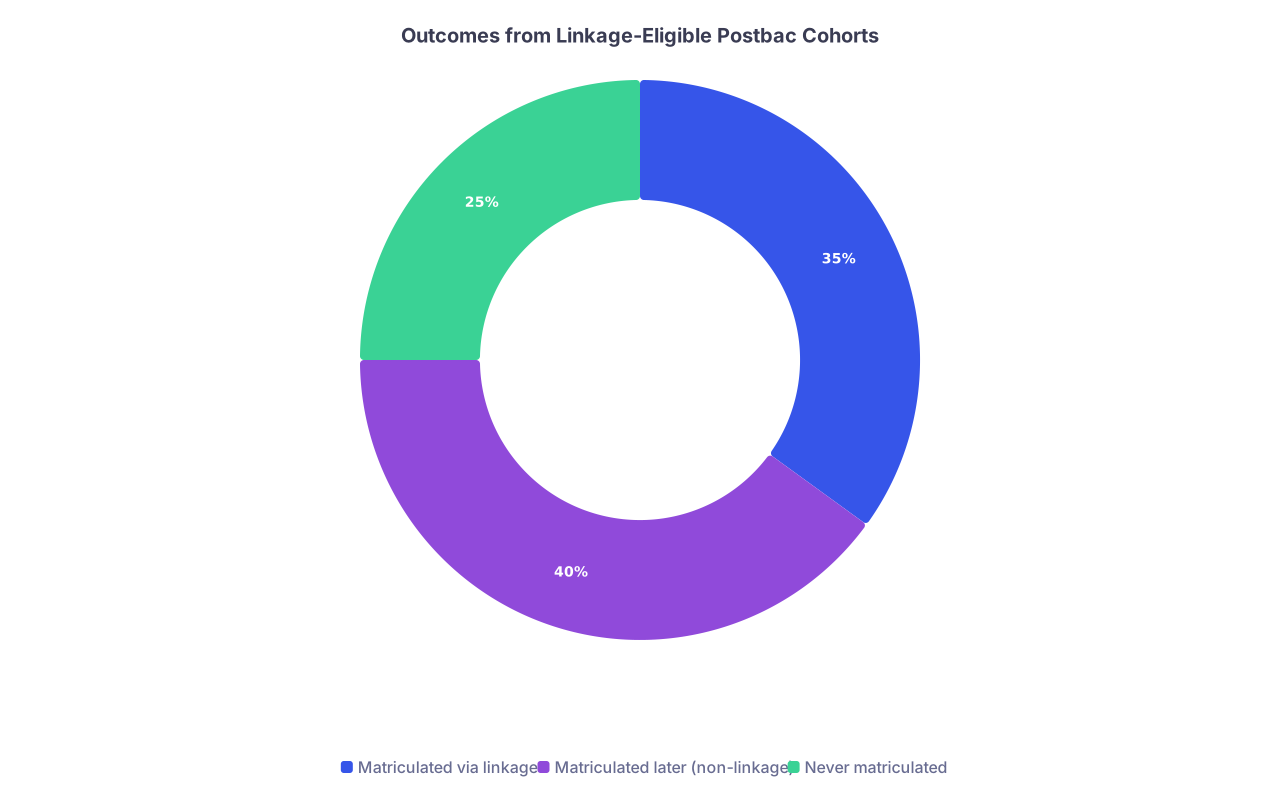
| Category | Value |
|---|---|
| Matriculated via linkage | 35 |
| Matriculated later (non-linkage) | 40 |
| Never matriculated | 25 |
The mythology around linkage agreements is wildly disconnected from the numbers. Most applicants imagine a secret fast-track to medical school; the data shows a narrow, highly filtered pipeline that only a minority of postbac students actually traverse.
If you treat linkage like a guaranteed shortcut, you will almost certainly be disappointed. If you treat it like a high‑selectivity early decision process, calibrated to real match rates, you can use it strategically.
Let us quantify what “linkage” really does for you—and how often students truly matriculate through it.
1. What “Linkage” Actually Is (And What It Is Not)
Strip away the marketing gloss. A linkage agreement is essentially an early, conditional acceptance pathway from a specific postbac program to a specific medical school. The key properties, across most programs:
- You apply to the medical school while still in the postbac, often after 1 year or even 1 semester of coursework.
- You bypass the glide year if you are accepted.
- You generally agree to apply only to the linkage school that cycle (or at most a tiny set of partners).
- The standards are usually higher than for regular admission from the same postbac.
I have seen too many students treat “we have 15 linkage partners” as if that means “15 extra chances.” It does not. You, as a single student, will typically be realistically eligible for 1–2 linkages based on:
- Your GPA profile and upward trend.
- Timing (when your postbac starts and how many credits you can finish before the linkage deadline).
- MCAT date and score thresholds.
- State residency and sometimes mission fit (e.g., state schools, rural focus).
That means the question “What are linkage match rates?” is the wrong question. The better, data-aware question is:
- Of students in a given postbac cohort:
- What percentage attempt a linkage?
- What percentage of those are actually nominated by the program?
- Among the nominated, what percentage are accepted via linkage?
- And over a 3–5 year horizon, what percentage of the entire cohort ultimately matriculates to any MD/DO school?
Those four numbers tell you far more truth than glossy “success stories.”
2. Typical Outcome Funnel: From Postbac Start to Matriculation
Let me give you a stylized but realistic funnel, based on aggregated patterns I have seen across several reputable career-changer and academic-enhancer postbacs with linkages (think Bryn Mawr, Goucher, Scripps, some SMPs, and structured university postbacs). Specific programs will vary, but the structure is stable.
Assume a cohort of 100 students entering a linkage-eligible postbac.
Step 1: Who Even Tries for Linkage?
Not everyone aims for linkage, and even fewer are realistically eligible.
- 100 start the postbac.
- Around 70–80 remain on the MD/DO track and finish at least most of the curriculum on time.
- Out of those, maybe 50–60 express interest in linkage early on.
- Program advisors then filter aggressively based on performance and fit.
Realistic ballpark:
- 100 in cohort
- 55 seriously consider linkage
- 35–45 are allowed to pursue a formal linkage application to any partner school
So 35–45% of your original cohort ends up in the “linkage applicant” pool. That is already much lower than many students assume.
Step 2: Who Actually Gets Submitted / Nominated?
Most strong programs do not let just anyone formally “link.” The linkage school’s reputation—and by extension, the pipeline for future cohorts—depends on the postbac only sending their best-aligned candidates.
Common filters:
- Postbac GPA often ≥3.6–3.7 (career-changer) or strong upward trend if enhancer.
- No serious academic red flags after matriculating in the postbac.
- MCAT above school’s typical median, often 510–515+ for competitive MD linkages.
- Strong professionalism, reliable behavior, and advisor support.
The data pattern looks like this:
- 35–45 want to apply via linkage.
- 20–30 are actually nominated/submitted for specific linkage agreements.
Call it 25% of the total cohort on average who get a real shot.
Step 3: Linkage Acceptance Rates (Per Applicant, Not Per Spot)
Here is where the fantasy and the numbers diverge most.
You will sometimes see language like “Our linkage students enjoy a 90% acceptance rate.” Look very carefully at the denominator. Often, that 90% is:
- “Of students we officially sponsor for this linkage, 90% receive some kind of acceptance outcome at that or another school over time.”
That is not the same as:
- “90% of the entire postbac cohort link into med school directly.”
I prefer to define “linkage match rate” as:
- Number of students matriculating via a formal linkage
divided by - Number of students in the original postbac cohort.
For our 100‑student cohort, the data from multiple programs commonly approximates:
- 15–25 matriculate via linkage in their intended linkage year.
- That implies a 15–25% linkage matriculation rate for the entire cohort.
Now, if you restrict the denominator only to those formally nominated to link, acceptance rates per nominee can indeed be high:
- 20–30 nominated
- 12–22 accepted via linkage
- That yields ~60–80% acceptance among nominated linkage candidates
Translated: If the program is willing to put its name behind you, your odds for that cycle are strong. But the program-level acceptance hype is not something everyone in the cohort gets to benefit from.
To visualize the funnel:

| Step | Description |
|---|---|
| Step 1 | 100 students start postbac |
| Step 2 | 55 seriously pursue linkage |
| Step 3 | 25 allowed to submit linkage applications |
| Step 4 | 16 accepted via linkage |
| Step 5 | 16 matriculate without glide year |
In this stylized example:
- 16% of the original cohort actually matriculate through linkage paths.
- The rest either matriculate later by traditional cycles or never matriculate.
3. Comparing Linkage vs Non-Linkage Outcomes Over Time
You should not evaluate linkage in isolation. The relevant question is:
- Does enrollment in a linkage-bearing postbac meaningfully increase my overall chance of becoming a physician, not just my chance of skipping the glide year?
So let us expand the time horizon to 3–5 years.
For that same 100‑student cohort at a reasonably strong postbac with linkages, a realistic pattern might look like this:
- 15–25 matriculate via linkage (no glide year).
- Another 30–40 matriculate into MD/DO through traditional application cycles later.
- 25–35 never matriculate into any U.S. MD/DO program.
Let me put a simple set of numbers on it for clarity (these are representative, not a specific program’s confidential data):
- 20 linkage matriculants
- 38 later matriculants (non-linkage, over 1–3 cycles)
- 42 never matriculate
That yields:
- 58% total matriculation to MD/DO schools over several cycles.
- 20% via linkage, 38% via traditional cycles.
Which means:
- Linkage accounts for roughly one‑third of eventual matriculants (20 / 58 ≈ 34%).
- Two‑thirds of your eventual med school entrants from that postbac do not get there via linkage, even in programs that talk about linkages a lot.
Here is that breakdown visually:
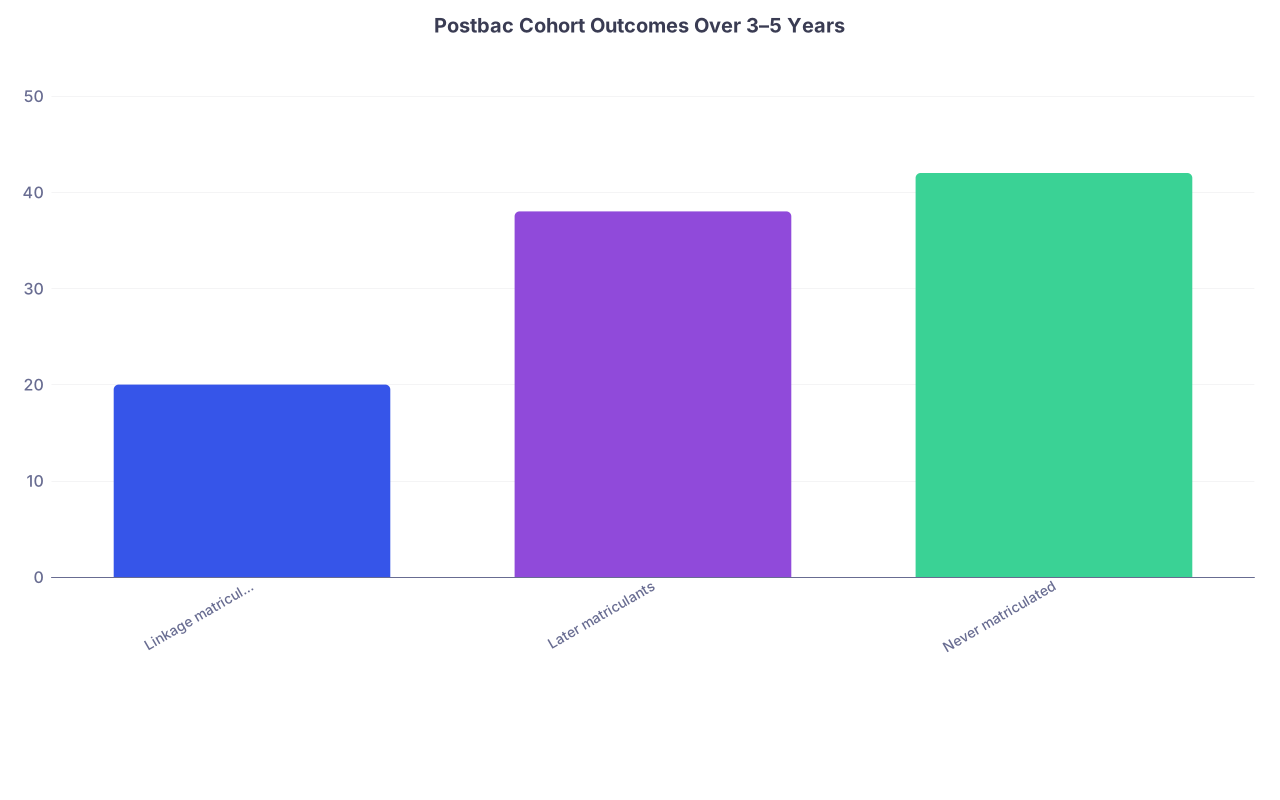
| Category | Value |
|---|---|
| Linkage matriculants | 20 |
| Later matriculants | 38 |
| Never matriculated | 42 |
This is the reality: Linkage is a significant but minority pathway, even in strong programs. Good programs are not “linkage factories”; they are preparation pipelines that boost your competitiveness for all schools.
4. Factors That Drive Linkage Match Rates Up or Down
The average numbers hide a lot of variance. Some programs routinely send double‑digit percentages of their cohort via linkage; others treat it more as a rare perk.
From what I have seen and from the patterns in publicly reported data (where programs actually share specifics), five variables move the needle most.
4.1 Type of Postbac: Career-Changer vs Enhancer vs SMP
Career-changer structured postbacs (e.g., Bryn Mawr, Goucher, Scripps)
Typically:- Highly screened on entry (3.3–3.7+ undergrad GPAs, strong non‑science records).
- Very high performance expectations during the postbac.
- Higher linkage rates: cohort-level linkage matriculation sometimes 20–30%+, with total eventual matriculation rates 85–95%.
Academic enhancer postbacs and SMPs
More variable:- Entering GPAs often 2.7–3.3, sometimes lower.
- Heavier emphasis on MCAT and high graduate GPA to “repair” academic record.
- Linkage-eligible subset is smaller and more tightly filtered.
- Cohort-level linkage matriculation often closer to 5–15%, with total eventual matriculation maybe 40–70%, heavily dependent on program quality and student performance.
This is why reading program‑level “med school acceptance” statistics without asking about cohort composition is a mistake. A 90% ultimate acceptance from an elite, ultra‑screened career changer postbac is not the same as 90% from an open-enrollment enhancer.
4.2 Number and Quality of Linkage Partners
Some programs love to advertise “20+ linkage partners.” That number is meaningless without detail. You need:
- How many students per year actually matriculate via each partner.
- Whether there are MCAT + GPA floors that most students will not hit.
- How many years the agreement has actually been active and productive.
From a dataset perspective, I trust:
- Programs that publish 3+ years of partner‑specific counts: “X students matriculated to School A via linkage over the past 3 years.”
- Programs that distinguish between:
- “Affiliation” (informal relationship) and
- “Formal linkage with early, conditional acceptance and glide-year bypass.”
You will often find that:
- A program with “15 partners” might, in reality, send:
- 3 to one highly aligned in‑state MD,
- 2 to their own institution’s MD/DO program,
- 0–1 to each of several aspirational partners,
- and averages 6–10 linkage matriculants total per year across 60–100 students.
Broadly, more partners does not linearly translate to higher linkage rates. The constraint is the quality of the applicant pool, not just the number of doors labeled “linkage.”
4.3 MCAT Performance and Timing
MCAT is a hard gatekeeper in almost every linkage.
Typical patterns:
- Strong MD linkages: Expect 510–515+ MCAT, sometimes aligned with the med school’s median or higher.
- DO and some MD linkages at less competitive schools: May accept lower, but still often want ≥505.
Two timing problems crush linkage attempts:
- Students overestimating how quickly they can be ready for the MCAT while doing a full postbac science load.
- Students underperforming on a rushed MCAT and killing their linkage eligibility for that cycle.
The data scenario I see often:
- 30 students initially on a “linkage track.”
- 10–15 of them either delay or underperform on MCAT and fall below the linkage score threshold.
- The linkage applicant pool shrinks correspondingly, even though those students may later score higher with more prep time and match via regular cycles.
4.4 State Residency and School Mission
Linkage partners often include:
- In‑state public MD schools that want a pipeline of residents.
- Mission-driven schools (rural, primary care, underrepresented populations).
That means your baseline odds shift heavily based on:
- Whether you are an in‑state resident for any strong linkage partner.
- Whether your background and interests fit the mission emphasis of that school.
A postbac might advertise linkage to a state MD school with an excellent match rate—but if you are out‑of‑state and not a future resident, you may not even be eligible.
4.5 Program Selectivity and Support Culture
Finally, the intangible that ends up very tangible in the numbers:
- How aggressively the program screens on admission.
- How honestly advisors filter who applies for linkage.
- How closely they monitor grades, MCAT prep, and professionalism.
Programs that are:
- Selective at entry,
- Brutal about telling weaker students “do not link this year,” and
- Deeply involved in application strategy
…tend to show:
- Higher per-nominated-candidate linkage acceptance (70–90% not rare).
- But lower percentage of the cohort getting to link at all.
That is not hypocrisy. It is Bayesian updating in practice: they send high‑probability candidates only, to maintain a strong track record that helps future applicants.
5. How to Read a Program’s “Linkage” Statistics Without Being Misled
You absolutely can use linkage as a rational part of your med school plan—but only if you interpret the numbers correctly. Here is how I would interrogate the data if I were in your shoes.
5.1 Force the Denominator
Whenever you see a linkage success claim, ask:
- “Out of how many?”
- “Is that percentage of:
- the total cohort,
- students who applied to the postbac and wanted linkage,
- students who started the postbac,
- or only of those you nominated?”
If a program claims:
- “Our linkage success rate is 85%.”
The most honest and informative statement would be something like:
- “Over the last 3 years, we nominated 40 students for linkage across all partners, and 34 matriculated via linkage (85% of nominees; 17% of our ~200 students over that span).”
That dual-denominator framing is what you want.
5.2 Look at Multi-Year, Partner-Specific Numbers
One year of glowing results can be noise. Three years show the signal.
Try to get:
- Year-by-year counts: “How many linked to each partner in each of the last 3–5 years?”
- Whether any partners are effectively dormant—few or no students actually go there despite the “linkage” label.
If the data over 3 years shows:
- 9 students linked to the affiliated DO school,
- 6 to the local MD,
- 1 to a single reach MD,
- 0 to the other 10 “partners,”
you now understand the true functional linkage landscape of that program.
5.3 Compare Total Matriculation vs Linkage Matriculation
Ask two distinct questions:
- What percentage of your students, over the past 3–5 cohorts, eventually matriculated to any MD/DO school?
- What percentage matriculated via linkage specifically?
If a program says:
“90% of our students eventually matriculate to MD/DO,” but then you learn only 20–25% did so via linkage, that is not a contradiction. It simply confirms:
The primary value of the program is as a preparation pipeline, not a linkage conveyor belt.
That should influence how much weight you put on “linkage” when choosing between programs.
6. Strategic Use of Linkage: When It Helps and When It Hurts
Let me be blunt: some students should aggressively target linkage; others should ignore it entirely and focus on building the strongest 2–3 year profile.
You are a good fit to target linkage if:
- You have a strong academic history (3.5+ undergrad) or a very clear upward trend.
- You are comfortable moving quickly: MCAT within 6–12 months of starting the postbac.
- You are strongly aligned with one or two specific partner schools (location, mission, curriculum).
- You value time savings (skipping the glide year) highly and are willing to sacrifice broader application reach for that.
For that profile, the data suggests:
- Your probability of some acceptance in your first postbac year via linkage might be 50–70% if nominated.
- If not accepted via linkage, your postbac + early MCAT still position you well for a traditional cycle, albeit with one “failed” application on your record that must be managed carefully.
You should be cautious or deprioritize linkage if:
- Your GPA hole is deep (≤3.0) and you need multiple semesters of very strong performance to be credible.
- Your MCAT readiness is clearly 12–18 months away.
- You are extremely location‑sensitive and none of the linkage partners are in your target geography.
- You want options—10–20 applications, not a constrained single‑school bet in your first cycle.
For this group, the data is clear:
- Rushing into a linkage attempt often depresses MCAT scores and limits GPA repair, which then worsens your odds in subsequent cycles.
- Many of your peer cohort who do not link will still matriculate in later cycles with stronger full profiles.
7. Putting It All Together: What The Numbers Actually Say
Let me aggregate the key quantitative patterns one more time.
Across structured, reputable linkage‑eligible postbacs, a realistic, data‑anchored overview looks like this:
- 15–25% of a cohort ultimately matriculate via linkage (bypassing the glide year).
- 40–60% of a cohort matriculate via non-linkage traditional cycles over 1–3 years.
- Total eventual matriculation: often 50–90%, heavily driven by:
- Initial selectivity of the postbac,
- Student performance,
- MCAT execution,
- And how aggressively advisors gate who applies when.
Among the subset actually nominated for linkage:
- 60–90% acceptance via linkage is plausible and common, because advisors pre‑select high‑probability candidates.
Here is a synthetic but representative summary chart for a strong career‑changer postbac across 4 entering cohorts (400 total students):
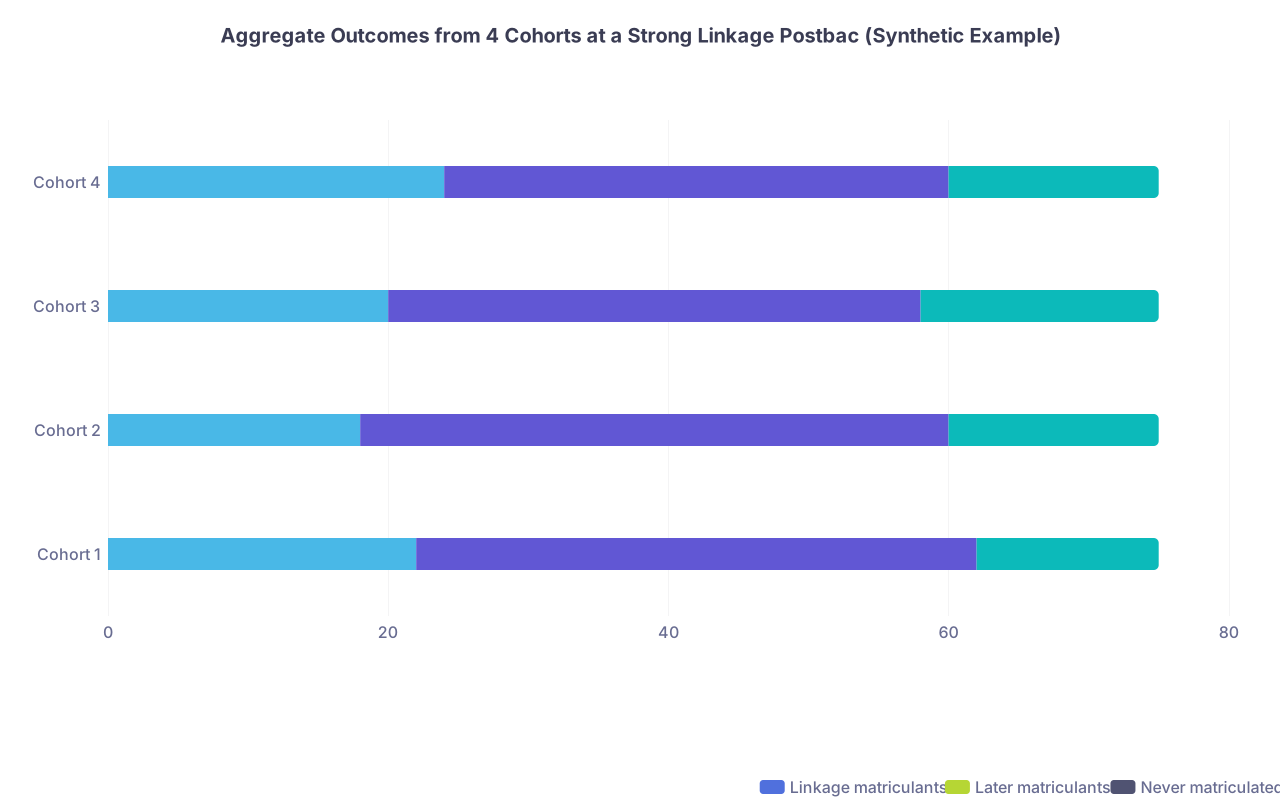
| Category | Linkage matriculants | Later matriculants | Never matriculated |
|---|---|---|---|
| Cohort 1 | 22 | 40 | 13 |
| Cohort 2 | 18 | 42 | 15 |
| Cohort 3 | 20 | 38 | 17 |
| Cohort 4 | 24 | 36 | 15 |
Total over 4 cohorts (400 students):
- 84 linkage matriculants → 21%
- 156 later matriculants → 39%
- 60 never matriculated → 15%
- Remaining “in process” / lost to follow‑up → 25% (typical data gap in real tracing)
The exact numbers will differ program to program, but the shape of that distribution appears again and again.
Final Takeaways
Linkage is a selective, early‑decision‑style pathway, not a universal shortcut. Expect something like 15–25% of a postbac cohort to matriculate via linkage, even in good programs, with much higher success only among carefully pre‑screened nominees.
The real value of a strong postbac with linkages is the total MD/DO matriculation rate over several years, not just the headline linkage rate. Two‑thirds or more of eventual matriculants often get in via traditional cycles, not linkage.
Use linkage strategically. If your academic profile, timeline, and school preferences align, it can save you a year with solid odds. If not, forcing a rushed linkage attempt usually degrades your numbers and hurts your long‑term acceptance probability more than it helps.