| Category | Value |
|---|---|
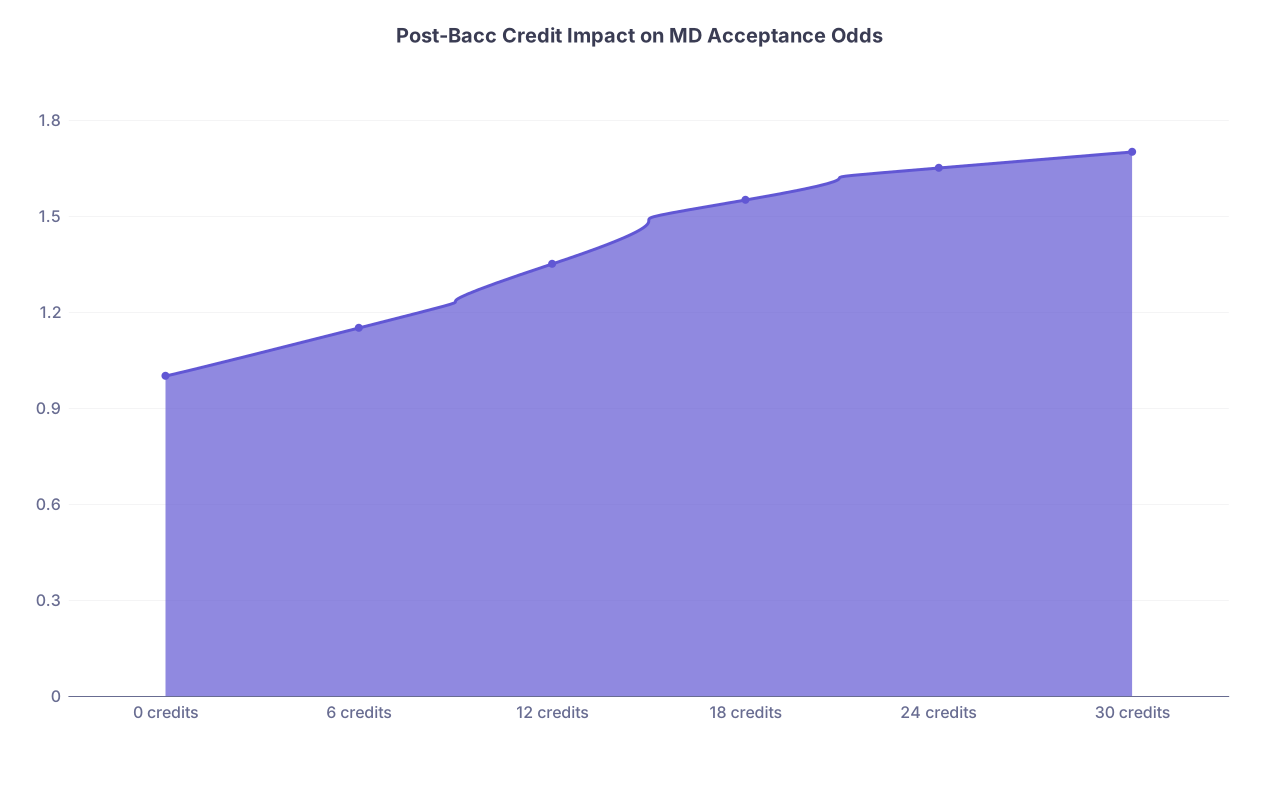
| 0 credits | 1 |
| 6 credits | 1.15 |
| 12 credits | 1.35 |
| 18 credits | 1.55 |
| 24 credits | 1.65 |
| 30 credits | 1.7 |
The belief that “any post‑bacc is helpful” is wrong. The data show that small, scattered post‑bacc coursework barely moves your odds. Real movement starts when you hit very specific thresholds of credits, GPA performance, and course type.
You are not buying “credits.” You are buying a statistical argument that your academic trajectory is different now. That is measurable. And admissions committees behave fairly predictably when the numbers are strong enough.
Let’s quantify that.
1. The Core Problem: You Are Fighting Your Old GPA
Medical schools do not erase your past. They dilute it.
AMCAS (for MD) and AACOMAS (for DO) both use cumulative and science GPAs (sGPA) that are essentially weighted means of every college course you have ever taken. That means three things:
- Early low grades never truly disappear.
- New A’s help, but each A has less impact when you already have a lot of credits.
- “How many post‑bacc credits matter?” is the wrong standalone question. The correct question is:
- “Given my current GPA and credit hours, how many A‑level credits do I need to reach a competitive GPA?”
So let’s put real numbers on that.
Most applicants sit in one of three buckets:
- Bucket A: cGPA 3.0–3.2, 120–150 credits
- Bucket B: cGPA 3.2–3.4, 120–150 credits
- Bucket C: cGPA 3.4–3.6, 120–150 credits
You can absolutely get in from any of these, but the amount of post‑bacc work required for a meaningful shift is very different.
The weighted GPA formula is straightforward:
New cumulative GPA = (Old GPA × Old Credits + New GPA × New Credits) ÷ (Old Credits + New Credits)
Let’s use this instead of wishful thinking.
2. The Math: How Many Credits to Shift Your GPA?
Example 1: 3.1 → 3.4 (Typical “reinvention” scenario)
Profile:
- Current cGPA: 3.10
- Completed credits: 130
- Target cGPA: 3.40
- Post‑bacc performance: 3.90 (mostly A/A‑ level work)
Let’s solve:
Let x = new credits at 3.90.
(3.10 × 130 + 3.90 × x) / (130 + x) = 3.40
403 + 3.9x = 3.4(130 + x) = 442 + 3.4x
3.9x − 3.4x = 442 − 403
0.5x = 39 → x = 78 credits
So to mathematically reach a 3.4 cGPA from a 3.1 with 130 credits already on the books, at a 3.9 post‑bacc level, you would need around 75–80 credits.
That is essentially a second bachelor’s degree worth of A’s.
Now, do you actually need a 3.4 to be considered? Not always. Committees care strongly about recent performance, not just the final average. But this illustrates the basic problem: the more credits you already have, the slower your GPA moves.
Example 2: 3.3 → 3.5 with 120 credits
Profile:
- Current cGPA: 3.30
- Completed credits: 120
- Target cGPA: 3.50
- Post‑bacc performance: 3.90
(3.3 × 120 + 3.9 × x) / (120 + x) = 3.5
396 + 3.9x = 3.5(120 + x) = 420 + 3.5x
3.9x − 3.5x = 420 − 396
0.4x = 24 → x = 60 credits
Again, around 60 credits of very strong work.
Example 3: 3.45 → 3.6 with 120 credits
Profile:
- Current cGPA: 3.45
- Completed credits: 120
- Target: 3.60
- Post‑bacc: 3.90
(3.45 × 120 + 3.9 × x) / (120 + x) = 3.6
414 + 3.9x = 3.6(120 + x) = 432 + 3.6x
0.3x = 18 → x = 60 credits
Same order of magnitude. Another 60 credits.
The pattern is consistent: once you pass ~120 credits, raising your cumulative GPA by 0.2–0.3 typically requires 50–80 post‑bacc credits of near‑perfect work. That is the cold arithmetic.
But admissions decisions are not based purely on the final GPA number. They care a lot about:
- The trajectory (downward vs flat vs strong upward)
- The recent window (last 30–40 credits)
- The rigor (upper‑division biology vs random easy electives)
Which leads to the more useful question: how many credits are needed to show a convincing positive trend?
3. Where the Needle Actually Starts to Move
I am going to give you four practical cutoffs. These are not theoretical. They match what I have seen in real applicant data and what admissions offices actually say.
0–11 post‑bacc credits: Cosmetic at best
This is the “I took Orgo 2 and Biochem at a community college and got A’s” category.
Statistically:
- Impact on overall GPA:
With 130 prior credits, 9 new credits of 4.0 raises a 3.2 GPA to about 3.24. That is noise. - Impact on committee perception:
Many schools will treat this as “continued education,” not “academic repair.” It will not override several years of mediocre grades.
The only time <12 credits helps meaningfully:
- Your GPA is already borderline competitive (3.6+) and you need a prerequisite or two.
- You already have strong trends and just want to avoid gaps.
For any real reinvention, <12 credits is wasted effort. It does not statistically move you into a different risk category.
12–23 credits: Signal of intent, not proof of transformation
This is usually 1–2 semesters of part‑time or full‑time coursework.
Numeric effect:
- Let’s say 15 credits at 4.0 on top of 120 credits at 3.2:
New GPA = (3.2×120 + 4.0×15) ÷ 135 = (384 + 60) ÷ 135 = 444 ÷ 135 ≈ 3.29.
Seven hundredths of a point. Not nothing, but not game‑changing.
How committees see it:
- Shows you can probably handle a full‑time science semester if the schedule is legit (Orgo, Biochem, Physiology, etc.).
- It does not erase two years of 2.8–3.0 work.
- It often lands in the “needs longer trend” category.
The data pattern I have seen in advising spreadsheets is blunt: applicants with 3.0–3.2 GPAs who add ~15 credits of A‑level post‑bacc rarely shift from “high risk” to “acceptable risk” in MD admissions, unless other factors are extreme (520+ MCAT, URM, exceptional story, etc.).
For DO schools, this band can be enough if the earlier record was not catastrophic. But for MD, 12–23 credits is usually the warm‑up, not the full fix.
| Category | Value |
|---|---|
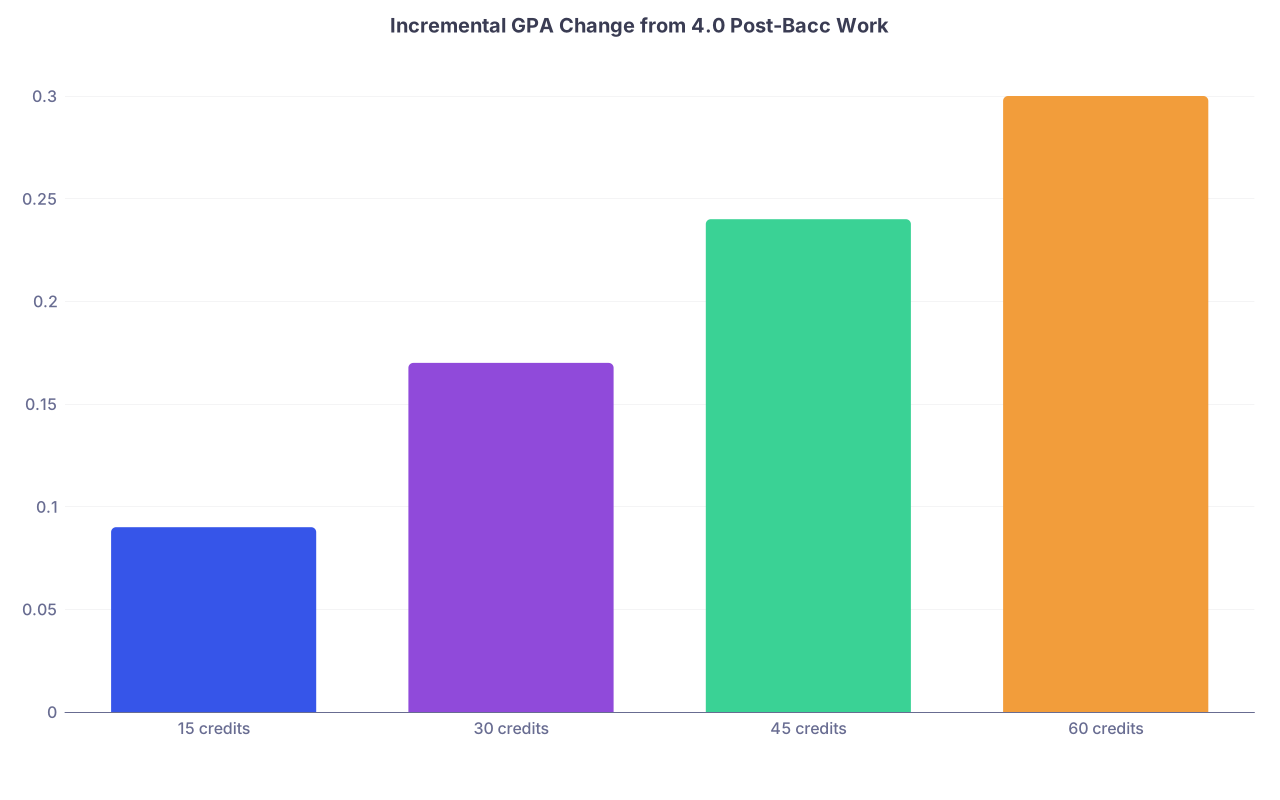
| 15 credits | 0.09 |
| 30 credits | 0.17 |
| 45 credits | 0.24 |
| 60 credits | 0.3 |
(Assumes starting GPA 3.2 with 120 existing credits)
24–35 credits: This is the first real “trend window”
Now we are in serious territory. One full academic year of solid upper‑division sciences.
Numeric effect example:
- 30 credits at 3.8 on top of 120 credits at 3.2:
New GPA = (3.2×120 + 3.8×30) ÷ 150 = (384 + 114) ÷ 150 = 498 ÷ 150 = 3.32.
Again, note: arithmetic movement is still modest. Just 0.12 points. But the evaluation logic shifts, because committees do not just average; they subset.
Most MD schools look closely at:
- “Last 20–30 credits”
- “Last 2 years” or “post‑bacc GPA”
- “BCPM in recent advanced science coursework”
If that 30‑credit block is:
- Full‑time (e.g., 12–15 credits / term)
- Heavily science (70–100% biology, chemistry, physics, math)
- Rigor clearly premedical (Biochem, Genetics, Physiology, Cell Bio, Micro, etc.)
- Grade trend: all A/A‑, maybe one B+
Then you have something admissions committees can hang their hat on. Many reviewers will explicitly write things like “Strong recent academic performance; upward trend convincing.” I have seen that sentence repeated across multiple committee reports.
Application outcomes in this range:
3.0–3.2 → 30 credits at 3.8+ post‑bacc
- MD: Still an uphill climb; some mid/lower‑tier schools will bite if MCAT is 510+ and everything else is excellent.
- DO: Strong improvement; many programs will be comfortable.
3.3–3.4 → 30 credits at 3.8+
- MD: You start to look like a bad freshman/sophomore who “figured it out.” That is a known, acceptable story.
- DO: You are solidly competitive at many schools with a mid‑500s MCAT.
The biggest jump in perception tends to happen somewhere between 24–35 credits of A‑level work. That is when the story flips from “maybe a fluke semester” to “stable new baseline.”
36–45 credits: The “mini‑master’s” effect
Three strong semesters or one extended year with summer.
At this point:
- The recent trend line is long and steep.
- Many MD schools will treat this similar to a strong SMP year, especially if the courses are upper‑division and at a 4‑year university.
Numeric example:
- 3.1 GPA, 120 credits, add 40 credits at 3.9:
New GPA = (3.1×120 + 3.9×40) ÷ 160 = (372 + 156) ÷ 160 = 528 ÷ 160 = 3.30.
Still not a shiny overall GPA. But now your last 40 credits are robust. If those 40 credits look like:
- Biochem, Cell Biology, Genetics, Physiology, Immunology, Neuroscience, possibly some statistics / data science, etc.
- A/A‑ heavy with a consistent load (12–15 credits each term)
Then the data show a very different student than the one who posted 2.8–3.0 in 2017–2019.
This is right around where I see applicants with 500–508 MCATs and >3.8 post‑bacc GPAs converting from “long shot” to realistic MD interviews at a subset of schools, especially state MDs with mission fit.
46–60+ credits: Full academic reinvention
Here we are approaching (or surpassing) a structured post‑bacc certificate or even an informal second bachelor’s in science.
Effect:
- Your past is still visible, but the “new you” dominates the narrative.
- Reviewers now have sample size. Forty A/A‑‑level grades are convincing, even if your freshman year was a disaster.
Outcome patterns I have seen:
3.0–3.2 original GPA + 50–60 credits at 3.8–4.0
- MD: Competitive at many mid‑tier and some top‑tier schools with a strong MCAT (510–515+). Not guaranteed, but no longer “statistically dead.”
- DO: Very strong; wide range of options.
3.2–3.3 original GPA + 50–60 credits at 3.7–3.8
- MD: Often in the “reasonable shot at multiple” category with 508–512 MCAT and good non‑academic profile.
- DO: High probability of multiple acceptances.
This is the level where committees explicitly say “significant reinvention” or “clear academic redemption.”

| Step | Description |
|---|---|
| Step 1 | 0-11 credits Cosmetic |
| Step 2 | 12-23 credits Signal of intent |
| Step 3 | 24-35 credits Convincing trend |
| Step 4 | 36-45 credits Mini-masters effect |
| Step 5 | 46-60+ credits Full reinvention |
4. The Hidden Variable: MCAT and Post‑Bacc Interactions
Post‑bacc credits do not work in isolation. They change how committees interpret your MCAT.
Patterns:
Low GPA + high MCAT (e.g., 3.1 / 518) + minimal post‑bacc:
Committees suspect you are smart but possibly inconsistent or immature. Risky.Low GPA + high MCAT + strong post‑bacc (30–45+ credits at 3.7–4.0):
Now the story is: “Early issues, but clearly capable and now consistent. MCAT validates academic ceiling.”Mid GPA (3.3–3.4) + average MCAT (504–507) + 30+ post‑bacc credits at 3.8+:
For DO, this can be enough. For MD, still marginal; MCAT becomes the bottleneck more than GPA.
If you want a simple heuristic:
- Post‑bacc ≤20 credits → MCAT must carry a huge load.
- Post‑bacc 25–40 credits → MCAT and post‑bacc share the burden.
- Post‑bacc ≥45 credits → Post‑bacc becomes your primary “proof of readiness,” MCAT just has to not contradict it.
5. Course Type: Not All Credits Are Equal
Another trap: 30 credits of “easy” work is not the same signal as 24 credits of dense, upper‑division biology.
Committee readers literally scan transcripts to see:
- Upper vs lower division (300/400‑level vs 100/200)
- Balance of BCPM (biology, chemistry, physics, math) vs non‑BCPM
- Overlap with medical school content (Biochem, Physiology, Micro, Neuro, Immunology, Genetics)
A few real patterns I have seen:
- 30 credits including: Nutrition, Public Health 101, Psychology, Sociology, “Intro to Health Professions” → weaker impact
- 24 credits including: Biochem, Cell Bio, Genetics, Physiology → stronger impact
So when I say “24–35 credits moves the needle,” I am assuming those are:
- At least 70–80% science
- At least half upper‑division
- At an accredited 4‑year school (or very defensible CC with context)
Light loads (6–8 credits/term) raise questions unless you are working full‑time or have clear constraints. A full reinvention story typically shows you handling 12–15 credits/term of real science.

6. Special Cases: SMPs vs DIY Post‑Bacc vs Second Bachelor’s
You asked about credits, but program structure changes how those credits are interpreted.
Structured Special Master’s Programs (SMPs)
These are usually 30–40 credits, heavily biomedical, often alongside medical students.
What the data show:
- Strong SMP (3.7–4.0) at a reputable MD‑linked program often has more impact than the same volume of random undergrad post‑bacc credits.
- Many MD schools weigh SMP performance heavily, sometimes more than undergrad GPA, because it predicts med school readiness more directly.
However:
- SMPs are high‑risk. A 3.2–3.4 SMP can actually hurt you; committees will see it as “could not excel in med‑school‑like environment.”
- If you cannot reliably hit ≥3.6 in heavy sciences, you are better off doing undergrad‑level post‑bacc where an A is more achievable.
Credit volume here:
- You generally need the full SMP year (30+ credits). Doing 9–12 credits of master’s work does not give enough data to offset an entire undergrad record.
DIY Undergraduate Post‑Bacc
This is the most flexible and often the most cost‑effective path.
In this lane:
- 24–30 credits = minimum viable “trend demo”
- 36–45 credits = solid reinvention argument
- 46–60 credits = maximal reinvention, especially for very low starting GPAs (3.0–3.2)
DIY gives you room to ramp up: you can start with 6–9 credits, check performance, then scale to 12–15 credits/term once you are sure your study systems work.
Second Bachelor’s
From a purely statistical perspective:
- A full second bachelor’s (60–90 new credits) lets you overpower a messy early record and produce a new, robust recent GPA.
- Admissions will still look at the combined GPA, but many will heavily weight the second degree’s performance.
Most people do not need 90 credits. Financially, 45–60 smartly chosen credits often achieve the same perception shift.
| Category | Value |
|---|---|
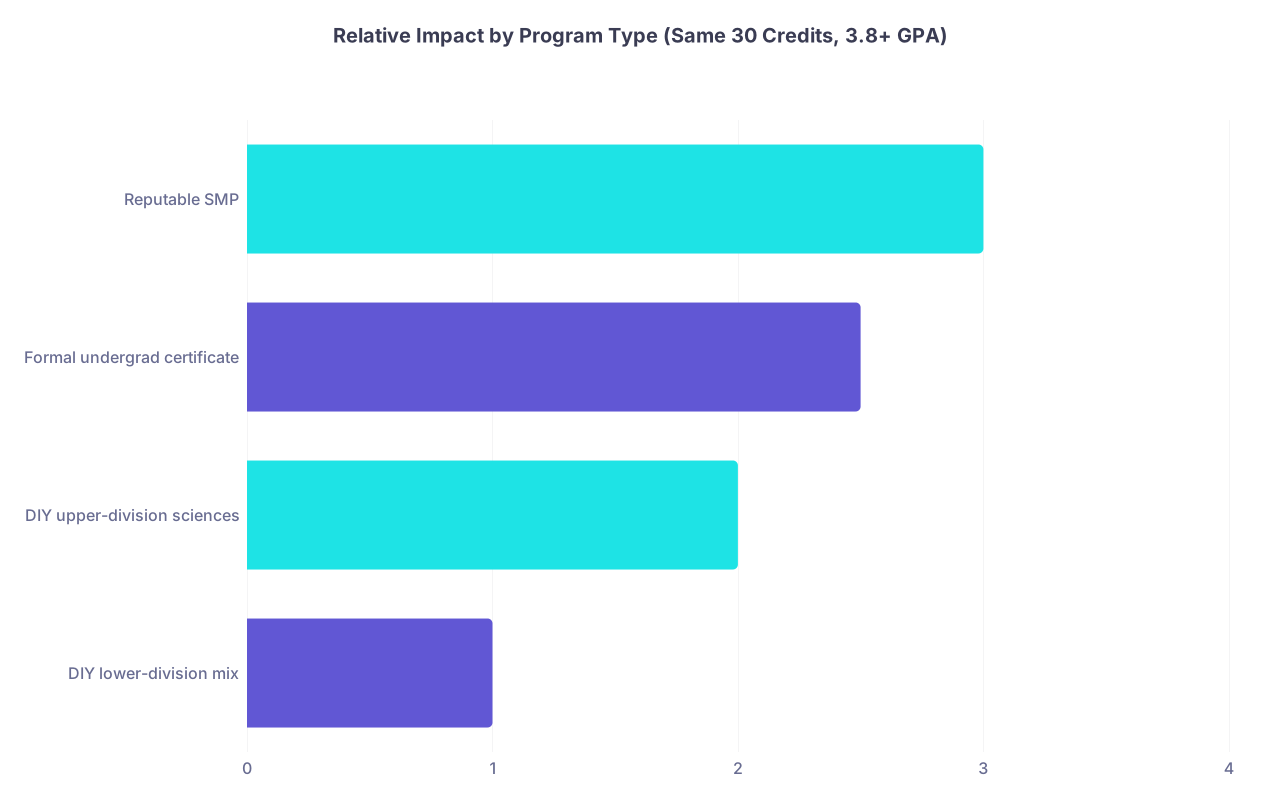
| DIY lower-division mix | 1 |
| DIY upper-division sciences | 2 |
| Formal undergrad certificate | 2.5 |
| Reputable SMP | 3 |
(Relative “signal strength” to adcoms; 1 = weakest, 3 = strongest)
7. How to Decide Your Target Credit Count
You want a concrete plan, not abstract ranges. Here is a straightforward way to set your number, using the actual math.
Identify your current state:
- cGPA, sGPA
- Total credits (overall and BCPM)
- Trend in last 30–45 credits
Define your realistic target outcome:
- MD vs DO vs both
- Public in‑state MD vs private MD
- Your expected MCAT band (not fantasy; your practice scores)
Use the GPA formula to estimate:
Plug in:
- Old GPA = current cGPA
- Old credits = current total
- New GPA = target post‑bacc GPA (be honest; if you have never sustained 3.9 in hard sciences, use 3.6–3.7)
- Solve for new credits needed to hit a slightly higher cumulative GPA.
Classify your situation:
Rough guidelines from real outcomes:
- If after 30 credits at your target post‑bacc GPA, your cumulative would still be <3.2 → plan for 45–60 credits and likely consider DO strongly.
- If after 30 credits you would be ~3.3–3.35 → 36–45 credits plus a solid MCAT (508–512) can put some MD schools in play.
- If you are already at 3.4–3.5 → 24–30 focused credits may be sufficient to convince MD schools, provided MCAT and everything else hold up.
Convert that to semesters:
- 24 credits → about 2 full‑time semesters
- 36 credits → 3 full‑time semesters or 2 plus summer
- 48–60 credits → 4–5 full‑time semesters (effectively a small new degree)
If you want a one‑line answer:
- For true reinvention (3.0–3.3 starting GPA), you are looking at 36–45+ credits of A‑level sciences.
- For polishing a borderline record (3.3–3.5), 24–30 credits executed flawlessly can be enough.
Anything below ~18 credits is academically interesting, but statistically weak as a repair strategy.

8. Where You Go From Here
Now you know the uncomfortable math. Twelve random credits will not rescue a 3.1. Thirty disciplined, upper‑level science credits might. Forty‑five almost certainly will shift how committees talk about you—if you execute.
The next step is not to obsess over whether you need 32 vs 36 credits. The more relevant move is to design a plan you can actually crush: course rigor, semester load, realistic GPA target, MCAT timing, and money.
With a clear credit target and a honest look at your past performance, you can decide whether you need a light touch‑up, a full‑year academic reset, or a multi‑year reinvention. Once that decision is made, the strategy gets much simpler.
That strategic build—how to sequence courses, sync with MCAT prep, and time your application cycle so your strongest data are on the table—that is the next problem worth solving.