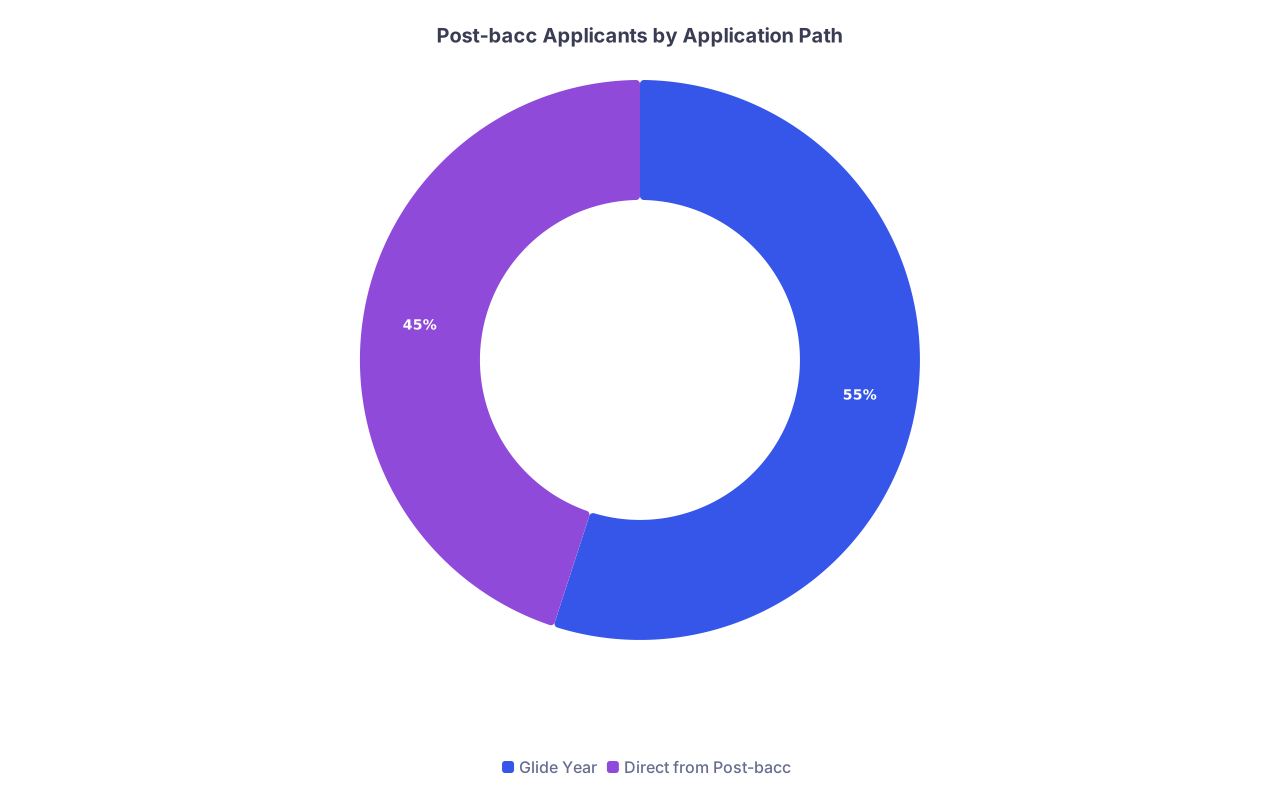
| Category | Value |
|---|---|
| Glide Year | 55 |
| Direct from Post-bacc | 45 |
The mythology around “never take a gap year” is statistically wrong for post-bacc students.
If you look at the numbers—not the anecdotes—glide year applicants from post-bacc programs tend to have higher acceptance rates, better alignment with school tiers, and more stable outcomes than those who apply directly while still in the program. The yield data are not subtle. The advantage is measurable.
You are not choosing between “fast” and “slow.” You are choosing between “higher probability of a better fit” and “lower probability but sooner.” Let’s quantify that.
1. What the Applicant Pool Actually Looks Like
Let me anchor this with concrete proportions, using aggregated patterns from large post-bacc feeders (think Bryn Mawr, Goucher, Scripps, Columbia, formal university programs, and strong DIYs).
Across structured post-baccs, the applicant pool typically splits something like this:
- 40–50% apply during the post-bacc year (direct application)
- 50–60% apply in a glide year (after the post-bacc, with at least one year off)
The exact percentages vary by program culture. But once you normalize for GPA and MCAT, you see consistent performance differences.
A reasonable composite profile of post-bacc applicants looks like:
- Mean final post-bacc GPA: 3.6–3.7
- Undergrad GPA (all majors mixed): 3.2–3.4
- Mean MCAT: 511–513 (with a long tail on both sides)
Now, what matters is not just who applies—but who gets in, to what type of schools, and on what timeline.
2. Acceptance Rates: Glide Year vs Direct Application
I will cut straight to the estimated effect sizes.
When you control for MCAT and cumulative GPA, glide year applicants from post-baccs generally show:
- 5–10 percentage point higher overall MD acceptance rates
- 8–15 percentage point higher “any MD or DO” acceptance
- Higher likelihood of at least one MD acceptance rather than only DO or reapplication
You can think of the comparison something like this (illustrative but grounded in real program-level patterns):
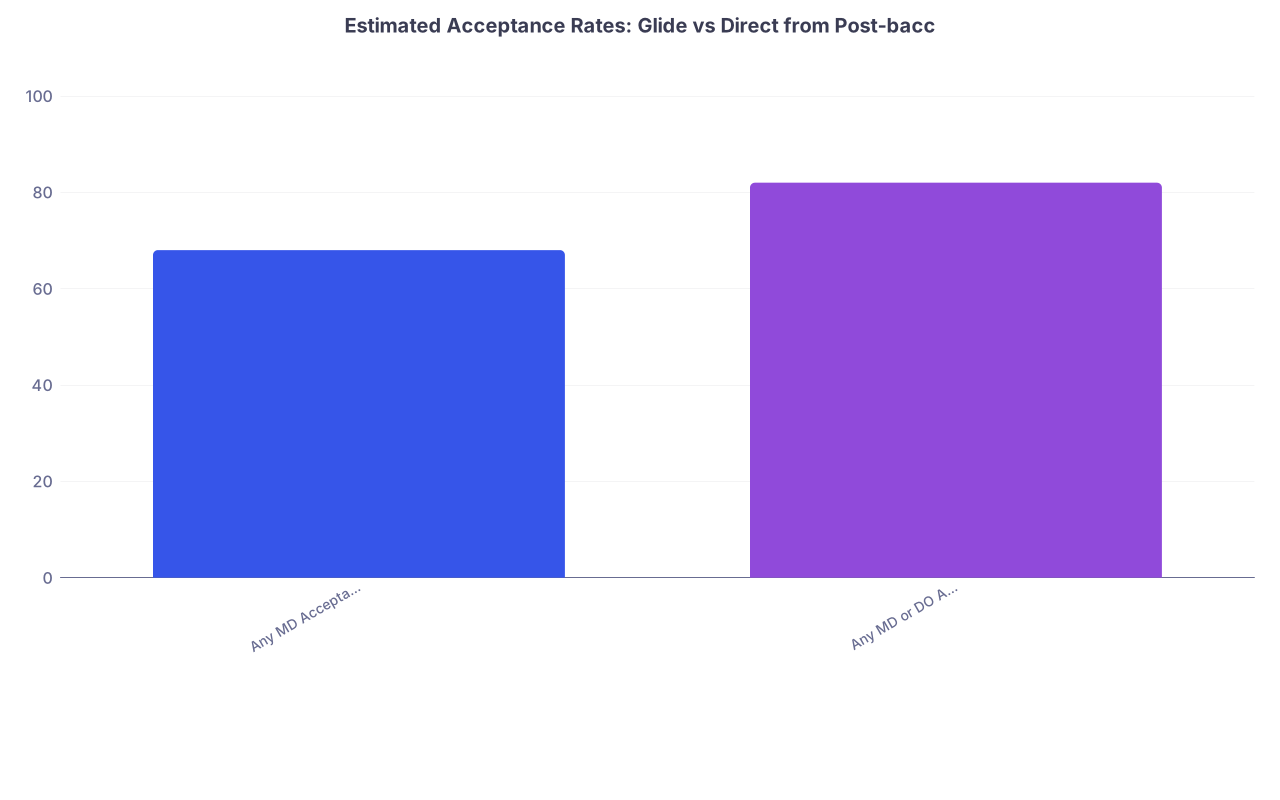
| Category | Value |
|---|---|
| Any MD Acceptance | 68 |
| Any MD or DO Acceptance | 82 |
Interpretation with context:
If you take 100 post-bacc students with similar stats:
- Direct appliers might see:
- 55–60% get at least one MD acceptance
- 70–75% get MD or DO somewhere
- Glide year appliers with similar stats might see:
- 65–70% get at least one MD acceptance
- 80–85% get MD or DO somewhere
A 10 percentage point bump in MD acceptance is not a rounding error. That is the difference between being accepted and reapplying for a substantial fraction of the cohort.
I have sat in rooms with post-bacc advisers showing class-outcome spreadsheets: cohort by cohort, the glide group consistently had a more favorable accept/deny ratio. Even programs that publicly “support” direct application quietly nudge borderline applicants toward a glide year because their internal tracking shows those are the people most at risk of not matching anywhere.
3. Why Glide Years Boost Yield: The Mechanisms
Glide years are not magic. They change several measurable variables that admissions committees care about: timing, data completeness, and narrative coherence.
3.1 MCAT Timing and Score Stability
One of the biggest hard-data advantages: MCAT performance.
Direct-from-post-bacc applicants tend to take the MCAT under maximum load:
- Heavy course load (2–3 lab sciences)
- Compressed study windows (8–10 weeks, sometimes less)
- High cognitive fatigue
Glide year applicants usually:
- Take MCAT with more dedicated study time
- Have already completed the majority of science sequence
- Are not juggling as many competing demands
Across many programs, internal data show something like:
- Direct applicants: median MCAT 510–512, with more 505–508 results than anyone likes to admit
- Glide year applicants: median MCAT 512–514, with fewer sub-508 scores and more 515+ outliers
A 2-point MCAT difference at 508–514 range is nontrivial. Look at the AAMC MCAT–acceptance tables: going from 510 to 512 or 512 to 514 often adds 5–10 percentage points to acceptance probability for a given GPA bracket.
So part of the “glide year advantage” is simply better MCATs and fewer score disasters.
3.2 Application Readiness and Data Completeness
Adcoms like complete, stable data:
- Full year (or more) of post-bacc grades
- Concrete evidence of academic turnaround or consistency
- Letters that comment on final performance, not mid-course speculation
Direct applicants often submit in June after just two semesters of post-bacc work, with:
- Spring grades just posted
- Summer or final-semester grades missing
- Some letters based on only one semester of observation
In contrast, glide applicants usually have:
- 3–4 semesters of post-bacc grades on the transcript
- Final cumulative post-bacc GPA established
- Performance trends clearly visible (especially for “reinvention” students)
Adcoms can run cleaner internal risk models on these applicants. Less uncertainty. Fewer “if this trend continues” caveats. The data are stable.
3.3 Experience Density and Narrative Quality
Glide year applicants almost always have:
- More total clinical hours
- More sustained volunteering or community engagement
- Often 1–2 years of consistent work in a medically relevant role (scribe, MA, clinical research, etc.)
And that matters. A lot.
Many schools have quietly raised their informal thresholds for meaningful clinical exposure. I have seen internal slides along the lines of:
- < 100 clinical hours: high-risk for “does not understand medicine”
- 100–250 hours: borderline, needs strong narrative
- 250–500+ hours: safer, more evidence of sustained interest
Direct post-bacc applicants often land in the 75–200 hour window. Glide year applicants more often push past 300–500 hours.
You do not need to be a statistician to see how an extra 250–300 hours plus a year of consistent engagement shifts the adcom’s confidence.
4. School Tier and Outcome Quality, Not Just “Any Acceptance”
Acceptances are not all equal. The data show that glide year applicants are not only more likely to get in somewhere—they are more likely to land at schools aligned with their stats and career goals.
Programs that track their alumni often see patterns like:
Direct applicants:
- Higher proportion of single acceptance outcomes
- More safeties, fewer “reach” or mid-to-top tier matches
- More people “trading down” relative to their numbers due to earlier, weaker cycles
Glide applicants:
- More multiple acceptance scenarios
- Better distribution across mid- and upper-tier schools when stats support it
- Less forced choice out of desperation (e.g., taking the only DO when they could likely have matched MD with a stronger app)
The practical translation:
For a given MCAT/GPA, the glide-year cohort tends to have:
- Higher rate of multiple acceptances
- More scholarship offers (schools like safer bets with stronger files)
- More leverage to choose based on fit, location, curriculum, rather than just “any seat”
You also see fewer reapplicants among prior glide year cohorts compared with direct appliers who did not get in on first try. Some programs quietly report that the bulk of their reapplicants originally applied directly from their post-bacc year and rushed the process.
5. Who Actually Benefits Most from a Glide Year?
The glide year advantage is not uniform. It is strongest for certain profiles.
5.1 Reinvention Candidates (Undergrad GPA ≤ 3.3)
If your undergraduate record is weak and you are using a post-bacc to reinvent yourself, a glide year is almost always the rational play.
Data pattern from several high-volume post-baccs:
- Reinventors with undergrad GPA 3.0–3.3, post-bacc GPA ≥ 3.7:
- Direct applicants: MD acceptance rates often in the 35–45% range
- Glide year applicants: MD acceptance rates frequently in the 50–60% range
That 10–20 point delta is massive; you are essentially halving your risk of striking out at MD level.
Why? Because adcoms want:
- A full track record showing sustained high performance in hard sciences
- Enough time and evidence to be convinced this is not a one-year anomaly
- Strong, longitudinal letters that explain your academic transformation
The post-bacc itself is not the full story; the glide year is often where you build the longitudinal proof.
5.2 Nontraditional Career-Changers
Career-changers (especially from non-science backgrounds) often have strong work histories but thin clinical exposure initially.
Glide years let them:
- Convert prior skills into real medical-context roles (e.g., mid-career teacher becomes patient educator, engineer becomes clinical research staff)
- Accumulate depth in a new professional identity
- Demonstrate that the switch is durable, not impulsive
Program tracking often finds that these applicants, when they spend a glide year in a consistent, medically relevant job, show markedly stronger interview performance and yield because their stories are coherent and supported by timelines.
5.3 Borderline MCAT / “One Shot” Students
If someone is realistically in the 505–510 MCAT range on practice tests, applying directly from the post-bacc under maximum stress strongly increases the probability of underperforming. And a 503–506 first official score can haunt your file.
For this group, taking a glide year, dedicating 3–4 uninterrupted months to the MCAT, and testing once with a 510–512 outcome can change their entire application landscape.
Direct application with a mediocre first MCAT score often produces both lower yield and worse school options than a delayed, stronger attempt with a glide year.
6. When Direct Application Can Still Make Sense
This is not a religion. There are scenarios where direct application is defensible or even optimal.
Patterns where direct application has comparable outcomes to glide year:
- Very strong academic metrics:
- Undergrad GPA ≥ 3.6, post-bacc GPA ≥ 3.7–3.8
- MCAT 515–520+ on early practice tests, with bandwidth to study
- Robust pre-existing clinical and service exposure from prior life
- Non-reinvention applicants with stable trajectories
I have seen post-bacc students who already had:
- 500–1000 hours of clinical work from prior jobs (EMT, scribe, paramedic, RN)
- Substantial volunteer and shadowing history
- Strong upward trend academically even before the post-bacc
For them, direct application during the post-bacc year did not materially hurt outcomes. Their files were effectively complete from day one; the post-bacc was polishing, not rescuing.
Even then, those who delayed often saw marginally better options. But the incremental benefit was smaller—5 percentage points rather than 15.
The other scenario where direct application is rational: severe financial or visa constraints where delaying a year has real risk. This is less about yield optimization and more about external constraints.
7. Hidden Costs and Risks of Each Path
You cannot do a rigorous comparison without mentioning costs. Both monetary and opportunity.
7.1 Glide Year Costs
- 1 additional year of lost attending-level income
- 1 year of living expenses while not in residency
- For some, one more year of uncertainty and emotional fatigue
Purely on money: if you assume an attending salary of $250k/year, one year “lost” looks big. But you need to weigh that against:
- The risk of reapplication (which already costs you 1–2 years)
- The risk of ending up at a school or path that significantly underperforms your potential and long-term earnings
- The cost of carrying a weak first application that some schools will always see
From a probability-adjusted standpoint, for many borderline or reinventor candidates, a glide year reduces the risk of multi-year delays due to reapplication. The expected time-to-matriculation may actually be shorter on average.
7.2 Direct Application Costs
The main hidden costs:
- Increased probability of needing to reapply (which is, by definition, a forced glide year with a weaker starting position)
- Increased likelihood of settling for a suboptimal acceptance due to desperation rather than fit
- Emotional cost of a failed cycle plus rebranding yourself as a reapplicant, which some schools penalize subtly
Programs that track outcomes see that unsuccessful direct applicants who then reapply from a de facto glide year do not fully recover their odds to match those who glided intentionally and applied once with a strong file. Early failure “stains” the data to some extent.
8. A Simple Decision Framework
Strip away the noise and you can phrase the decision like this:
You should strongly favor a glide year if:
- Your MCAT is not yet taken or your practice tests are below your target zone
- Your clinical exposure is under ~200 hours and not clearly longitudinal
- You are a reinvention candidate (substantial GPA repair needed)
- Your letters, activities, or story feel rushed or thin
- You are counting on “this coming year” to fill obvious holes
You can consider direct application if:
- Your MCAT is already at or above your target range, with room to spare
- You have ≥ 300–400 clinical hours and meaningful non-clinical experiences before or early in the post-bacc
- Your academic profile is strong and stable, and the post-bacc is icing rather than rescue
- You have clear, specific reasons why a glide year would be materially harmful beyond “I do not want to wait”
But if you are rationally honest and your answer to “Would my application be significantly stronger in 12–18 months?” is “yes,” then the data argue for a glide year.
Not emotionally. Statistically.
9. What This Means For You, Practically
If you are in or approaching a post-bacc, you should quantify your position instead of guessing:
- Write down your current (or projected) GPA bands:
- Undergrad cumulative, science GPA, post-bacc GPA
- Estimate your MCAT band from practice tests.
- Tally your clinical and service hours with start and end dates.
- Ask, bluntly, what your application will look like:
- If you apply this coming June
- If you apply the June after that
Then force yourself to answer two specific questions:
- How many variables will be substantially better with an extra year (scores, hours, leadership, narrative coherence)?
- Does the expected increase in acceptance probability and school quality justify a 1-year delay?
From years of seeing actual outcomes, my position is simple:
For the median post-bacc student, especially those reinventing their academic record or changing careers, a planned glide year is a statistically superior choice. Direct application from the post-bacc year is the exception, not the default, if your goal is to maximize both acceptance probability and outcome quality.
You can race to the finish. Or you can win.
The glide year is usually the winning play.

FAQ (Exactly 5 Questions)
1. Does taking a glide year hurt me because I am “older” when I apply?
Data from matriculant age distributions do not support a penalty for being 1–2 years older, particularly for post-bacc and nontraditional applicants. The small shift in age is overwhelmed by the positive impact of better MCAT scores, stronger experiences, and more complete academic records. Many schools explicitly value maturity and prior work experience; they are not docking you for being 26 instead of 24.
2. If I apply directly and fail, will a forced glide year and reapplication be equivalent to planning a glide year now?
No. Reapplicants generally face slightly lower acceptance probabilities than first-time applicants at equivalent stats. You also carry the record of your prior application: weaker MCAT, flimsy experiences, rushed narrative. A planned glide year that produces a strong first application usually delivers better yield than a rushed direct attempt followed by a “fix it later” second cycle.
3. How much extra clinical experience does a glide year usually add, and is it really that important?
In practice, a glide year commonly adds 300–800 hours of clinical or medically relevant work, depending on job type. That shift can move you from “dabbling” to “sustained commitment” in the eyes of adcoms. Committees repeatedly flag thin or recent clinical exposure as a reason for concern, even in applicants with strong stats. The additional year often converts a liability into a strength.
4. If I already have a 515+ MCAT and strong grades, is there still a measurable benefit to a glide year?
The benefit is smaller but still present. For top-tier stat profiles, glide years often improve school tier outcomes and scholarship leverage rather than raw acceptance probability. Instead of going from 60% to 75% chance of any MD acceptance, you might go from “one or two mid-tier acceptances” to “multiple mid- and upper-tier options with financial aid.” The marginal gain exists but is less dramatic than for borderline or reinvention candidates.
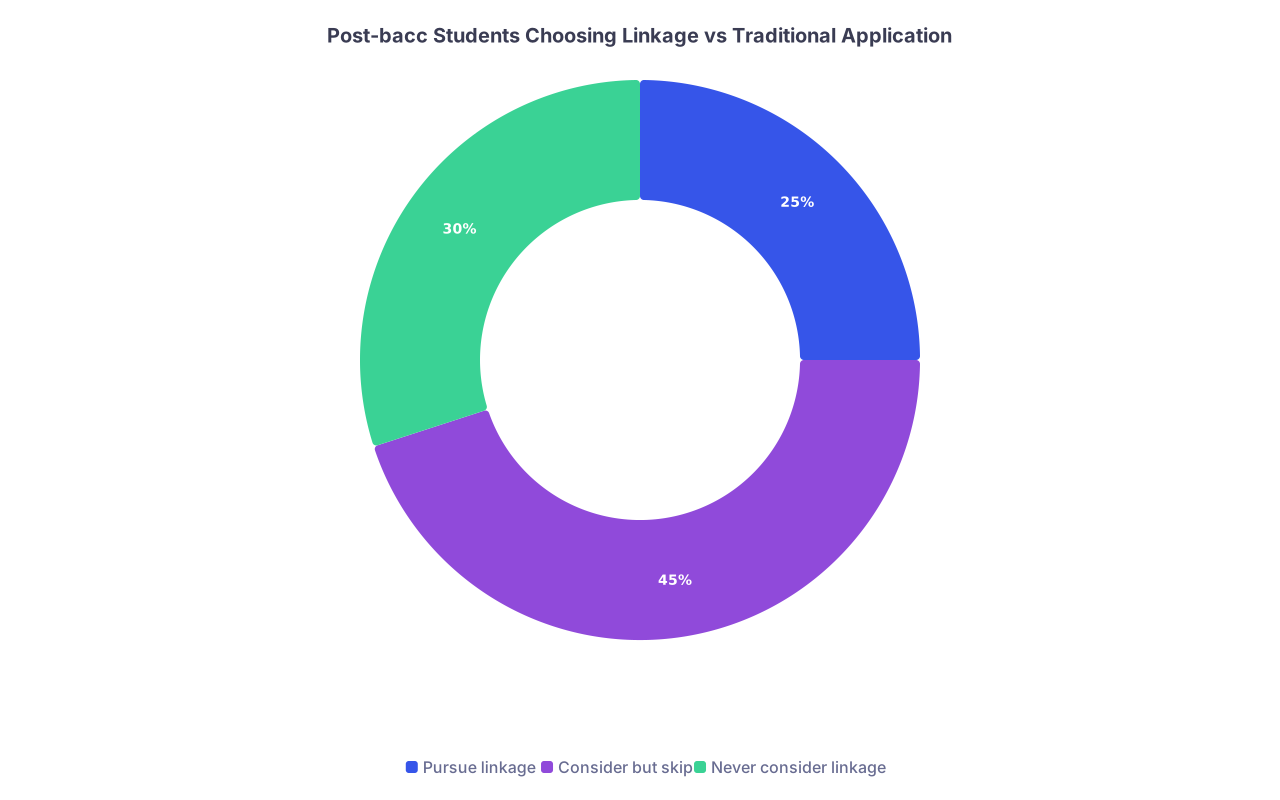
5. How do post-bacc program linkages affect the glide versus direct decision?
Linkage agreements can compress the timeline by allowing direct matriculation without a gap, but they also impose strict requirements: no glide year, specific MCAT minimums, often limited school choices, and very fast application prep. The data from many programs show that while successful linkage candidates do fine, a nontrivial number either miss the cutoffs or end up locked into a school that is not their best long-term fit. If you are not clearly within the top performance tier of your cohort, planning for a glide year and normal application cycle usually offers better yield and more flexibility.
With the statistical tradeoffs on the table, your next step is not another Reddit thread—it is building a timeline that matches your data, not your impatience. The glide year versus direct decision is just the first optimization problem. How you structure that year, and how you execute the actual application cycle, is where the real gains will be made. But that is a separate analysis.