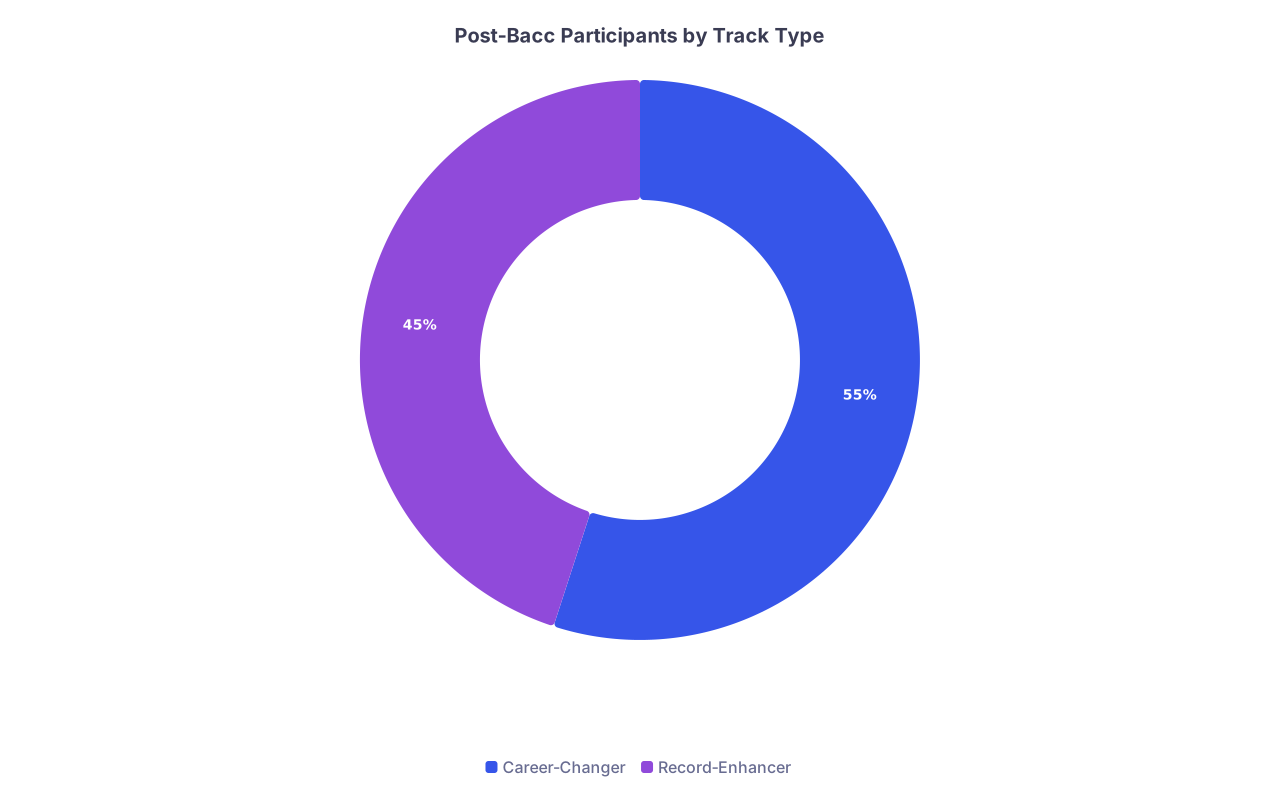
| Category | Value |
|---|---|
| Career‑Changer | 55 |
| Record‑Enhancer | 45 |
The biggest myth in post‑bacc advising is that career‑changer and record‑enhancer tracks “end up about the same.” The data says otherwise. The inputs are different, the risk profiles are different, and the outcomes diverge in very predictable ways.
You asked specifically about outcomes. So I am going to treat this like what it is: a stratified comparison of two distinct populations, not vague “paths.”
(See also: MCAT Score Changes Among Post-Bacc Students for more details.)
Defining the Two Cohorts (And Their Baseline Numbers)
Let us be precise about who we are talking about.
Career‑changer post‑bacc participants typically have:
- Minimal or no hard science coursework
- Often a prior non‑science major (business, humanities, social science, engineering without pre‑med prereqs)
- GPAs often in the 3.3–3.8 range, but with no demonstrated science record
- Zero or very limited clinical and shadowing experience
- Goal: build a first academic record in the sciences + MCAT + experiences
Record‑enhancer post‑bacc participants typically have:
- Completed pre‑med prerequisites already
- An existing science GPA that is weak relative to med school norms
- Often cumulative GPAs in the 2.7–3.3 range, science GPAs sometimes lower
- Some shadowing/clinical exposure already, but often thin or unfocused
- Goal: repair or significantly upgrade an existing academic record
These are not just different starting lines; they are different distributions.
Across a mix of formal and informal programs I have seen:
- Career‑changer cohorts: median undergrad GPA often around 3.4–3.6
- Record‑enhancer cohorts: median undergrad GPA often around 3.0–3.2, with long tails down below 2.8
So when someone asks, “Who does better after a post‑bacc?” the honest answer is: the group that started with the stronger overall academic profile, which is disproportionately the career‑changers.
Big‑Picture Outcomes: Acceptance Rates and Where People Land
Let’s put rough numbers on this, based on patterns from large structured programs, AAMC trend data, and what I have seen across applicant pools.
For well‑run, selective career‑changer post‑baccs (e.g., Goucher, Bryn Mawr, Scripps, Columbia, similar structured programs):
- Overall MD/DO acceptance within 1–2 cycles:
- 80–95% range for the top linkage‑heavy programs
- 65–80% for less selective or non‑linkage career‑changer programs
- Predominantly MD outcomes:
- Often 70–90% of matriculants landing in MD
- 10–30% in DO or other health professions (PA, NP, etc.)
For record‑enhancer post‑baccs and special master’s programs (SMP‑adjacent):
- Overall MD/DO acceptance within 1–3 cycles:
- 55–75% for highly structured, selective academic enhancers / SMPs
- 30–55% for less selective undergrad‑level record‑enhancer post‑baccs
- Mix of MD/DO:
- MD matrics might be 30–60% of acceptances, depending on how low the starting stats were
- DO makes up a much larger fraction compared with career‑changer cohorts
This is not because admissions committees “like” career‑changers more. It is because career‑changers usually present:
- Stronger non‑science undergraduate performance.
- Cleaner narratives without years of poor science grades.
- Shorter time horizon from start of science coursework to application, so less academic noise.
Record‑enhancers, by definition, are trying to pull a distribution upward against prior data that is already in the file. Committees see the full time‑series.
Academic Outcomes: GPA and MCAT Shifts
The cleanest way to compare outcomes is to look at delta—how much change you see in numbers before vs after the program.
GPA Movement
Career‑changer programs are building a fresh science record. Record‑enhancers are trying to override a bad one.
Typical patterns:
Career‑changer:
- Undergrad cumulative GPA: 3.3–3.6 median
- Post‑bacc science GPA: 3.6–3.9 in strong performers; programs often report >80% of students above 3.5
- Effect on overall cumulative GPA: modest uplift (e.g., from 3.4 to 3.55) because you add ~30–40 credits of mostly A/A– level work
Record‑enhancer:
- Undergrad cumulative GPA: often 2.7–3.2 starting
- Post‑bacc / SMP GPA: wide dispersion
- Top quartile may hit 3.7–4.0
- Middle often in the 3.3–3.6 range
- Bottom quartile can still be <3.2, which is catastrophic in this context
- Effect on overall cumulative GPA:
- Example: a 2.9 GPA after 120 credits, then 30 post‑bacc credits at 3.7 brings you to roughly 3.12. Better, yes. But you are still quantitatively below the median for MD matriculants.
This is the fundamental asymmetry: career‑changers build a high‑signal, clean science record; record‑enhancers are doing damage control on a denominator that is already large.
MCAT Outcomes
The MCAT is where the differences get obvious.
Career‑changer cohorts, especially in structured programs, often produce median MCATs in the 512–516 range, with upper‑tier programs publicly reporting medians around 514–517.
Record‑enhancer groups, even strong ones, usually report medians more in the 508–512 range. Within that:
- Students who truly “turn the corner” academically can absolutely hit 512+.
- But there is a heavier tail of 500–507 scores, especially when baseline study skills and test‑taking issues were part of why the original GPA was low.
So the joint distribution looks roughly like this (approximate, but representative):
Career‑changer:
- 75th percentile MCAT: 515–518
- Median: 512–515
- 25th percentile: ~509–511
Record‑enhancer:
- 75th percentile: 512–514
- Median: 508–511
- 25th percentile: ~504–507
Since MD admissions behave like a step function around certain combined GPA/MCAT thresholds, those small shifts in distribution have huge downstream effects.
Time to Matriculation and Application Cycles
Career‑changer and record‑enhancer paths also differ in how long it actually takes to get to “white coat.”
Career‑changer timeline
Common pattern for a structured 1‑year program with linkage options:
- Year 0: Finish old career / job, apply to post‑bacc.
- Year 1: Complete career‑changer post‑bacc (two or three semesters).
- Year 1 summer / early Year 2: Single application cycle, especially if using linkage.
- Matriculation: Often 2–3 years from starting the post‑bacc to M1.
And in many of the classic career‑changer programs, 60–80% of students use linkage or early assurance pathways, avoiding the “glide” year entirely.
Record‑enhancer timeline
More variable, more cycles:
- Year 0: Finish undergrad with weak record; realize stats are non‑competitive.
- Year 1–2: Do 1–2 years of academic enhancement post‑bacc or SMP.
- Year 2: Apply; many need one re‑application cycle if the first cycle is premature or weak.
- Matriculation: Often 3–5 years from first post‑bacc course to M1 for those who succeed.
I have seen plenty of record‑enhancers need two full application cycles to land at a school that makes sense for them, especially if the first attempt did not fully reflect their improved trajectory.
In other words: for career‑changers, the post‑bacc is usually the start of the med school path. For record‑enhancers, it is often a mid‑course correction after an already expensive and time‑consuming undergrad path.
Risk Profiles: Who Washes Out and Why
If you look only at students who eventually apply, you miss a big part of the story. The attrition within post‑baccs differs significantly between the two groups.
Career‑changer attrition
The main reasons I see career‑changer students not ultimately applying to med school:
- They discover that they dislike the day‑to‑day of clinical work once they start shadowing.
- They realize they prefer adjacent fields (PA, NP, PT, public health, data science).
- Less commonly, they cannot sustain A‑level work in the sciences.
Quantitatively, in strong career‑changer programs, 70–90% of matriculants complete the program and go on to apply to med school or another health profession. Of those who apply to MD/DO, most are eventually admitted somewhere.
So the main attrition is due to preference change, not academic failure.
Record‑enhancer attrition
Very different pattern.
Non‑completion or non‑application in record‑enhancer tracks is more often driven by:
- Continued mediocre performance (e.g., post‑bacc GPA <3.3 or, worse, new C’s/D’s in upper‑level science).
- Inability to move MCAT above a threshold (e.g., stuck in 498–504 territory after multiple attempts).
- Burnout from years of academic struggle with minimal visible payoff.
In many generic undergraduate‑level record‑enhancer programs, it is not unusual that only 40–60% of participants ultimately assemble a competitive application packet. The successful subset is highly self‑selected: they both improved their performance and strategically applied to schools aligned with their profile (often DO‑heavy lists, state schools, newer MD programs).
The blunt truth: if you come in with a science GPA under 3.0 and you cannot maintain near‑4.0 work in the enhancement program, your admissions probability remains low, no matter how badly you want it.
Type of Medical School Outcomes: MD vs DO vs Other Paths
The split between MD, DO, and “other” health careers is one of the clearest difference points.
Career‑changer outcomes
Rough, but realistic pattern across strong programs:
- 70–85%: End up in MD programs (often a mix of mid‑tier and some highly ranked schools).
- 10–20%: End up in DO programs.
- 5–15%: Pivot to other health careers (PA, dentistry, nursing, etc.) or non‑clinical tracks.
Why such a high MD fraction? Because the typical career‑changer:
- Starts with a 3.4–3.6 GPA.
- Earns a 3.7–3.9 post‑bacc science GPA.
- Scores 510–517 on the MCAT.
- Has a coherent narrative of a prior successful career plus clinical confirmation.
That is a strong MD applicant on paper and in practice.
Record‑enhancer outcomes
For solid record‑enhancer/SMP cohorts that do well:
- 30–60%: Matriculate into MD programs.
- 30–50%: Matriculate into DO programs.
- 10–30%: Do not matriculate into any med school but may pursue PA, nursing, MPH, or leave clinical paths altogether.
If the entering GPA is particularly low (say <3.0) and MCAT scores do not reach at least the low 500s, the DO fraction grows and the MD fraction shrinks.
Here is the key quantitative constraint: MD matriculants nationally have median cumulative GPAs around 3.8 and medians MCATs around 511–512. If your pre‑post‑bacc combined numbers land you at, say, 3.2 and 508, you are fighting the distribution. That combination might still work at some DO schools, especially with a strong SMP and upward trend, but you are not in the statistical sweet spot for most MD programs.
Linkages and Structured Pathways: Where They Help and Who Benefits
Linkage programs are heavily skewed toward the career‑changer side.
Career‑changer linkages
Look at the classic programs: they advertise linkage agreements to a specific set of MD schools. The conditions typically include:
- Minimum post‑bacc GPA (often ≥3.6–3.7).
- Minimum MCAT threshold (often 510–515 depending on school).
- No grades below B in any post‑bacc science.
- Very limited or no gap year between post‑bacc and matriculation.
For students who hit those marks, linkage admits can be in the 40–70% range at the specific partner schools. That is a huge structural advantage because it compresses the amount of uncertainty and removes at least one application cycle.
Record‑enhancer structured pathways
On the record‑enhancer side, SMPs and strong academic enhancers sometimes have “conditional acceptance” or interview guarantees. But the bar is usually higher:
- Top 10–20% of SMP class performance.
- MCAT thresholds often >510 for MD‑linked SMPs; lower thresholds may feed DO schools.
- No new weak grades during the program.
The result: far fewer guaranteed or near‑guaranteed outcomes. And the selection effect is harsher. You might enter a program because you struggled academically; then you are asked to outperform the majority of a group that also wants redemption.
From a numbers standpoint, if you are the kind of student who can finish in the top 10–20% of a rigorous SMP with a 515 MCAT, you probably could have succeeded in a demanding career‑changer curriculum too. The difference is that your baseline undergrad record forced you into the more risk‑loaded path.
Cost, ROI, and Psychological Load
Everyone focuses on acceptance rates. Almost nobody runs a real ROI analysis. Let us fix that.
Financial cost
Typical rough costs (tuition + basic living, not loans interest):
- Career‑changer post‑bacc:
- 1–2 years, often $40–$80k total.
- Then straight into med school if linkage works.
- Record‑enhancer:
- Undergrad already done (with weaker outcomes).
- 1–2 years of post‑bacc or 1–2 year SMP: another $40–$80k+.
- Often one extra “stutter step” year if first application fails, adding more opportunity cost.
If both paths eventually lead to MD, the career‑changer often reaches M1 2–3 years earlier and with less sunk cost trying to repair damage.
Psychological cost
This is harder to quantify, but the pattern is obvious if you listen to people:
- Career‑changer students talk about “imposter syndrome” in science, but not usually about being haunted by old grades.
- Record‑enhancer students talk about “digging out of a hole,” “needing to prove I’m not my 2.7,” and “I can’t afford one more B–.”
That psychological framing matters because admissions committees can read it between the lines. Career‑changer stories tend to be framed as expansion (“I built a new skill set”). Record‑enhancer stories are often framed as redemption (“Ignore who I used to be”). The former is easier to sell when your numbers support it.
Strategic Implications: Which Track Actually Fits Which Applicant
So what do you do with all this data if you are trying to decide or interpret outcomes? A few hard lines.
You are essentially a career‑changer if:
- You have little to no science background.
- Your cumulative GPA is ≥3.3 with no obvious academic red flags.
- Your weaknesses are lack of prerequisites, lack of clinical exposure, lack of MCAT prep.
You should not voluntarily throw yourself into the “record‑enhancer” bucket. You will just be importing risk you do not need.
You are a true record‑enhancer candidate if:
- You already completed the core pre‑meds.
- Your science GPA is <3.3, or your cumulative GPA is <3.0–3.2.
- You have C’s, D’s, or withdrawals sprinkled across key courses.
For you, the data shows:
- The ceiling is still high. Plenty of people successfully re‑engineer their profile.
- But the variance is large. Outcomes spread from “no admits” to “MD at a solid school” depending on how aggressively you perform in the enhancer and how realistic you are with school lists.
If your current GPA is in the 2.5–2.9 zone, you need to be mathematically honest: even with a 4.0 in 30–40 credits, your cumulative GPA will likely land in the low 3’s. At that point, DO becomes statistically much more probable than MD. That is not failure; it is just probability.

| Step | Description |
|---|---|
| Step 1 | Start: Considering Medicine |
| Step 2 | Career‑Changer Track |
| Step 3 | Record‑Enhancer Track |
| Step 4 | 1–2 Years Science Post‑Bacc |
| Step 5 | High MD Acceptance, Shorter Timeline |
| Step 6 | Standard MD/DO Application, Strong Odds |
| Step 7 | 1–2 Years GPA Enhancement / SMP |
| Step 8 | MD/DO Acceptance, Often Mixed |
| Step 9 | Lower Acceptance, Pivot to DO/Other Fields |
| Step 10 | Existing Science Record? |
| Step 11 | Meets Linkage Criteria? |
| Step 12 | Strong New GPA & MCAT? |
A Few Concrete, Data‑Driven Takeaways
Strip away the anecdotes and marketing copy, and the pattern is not subtle:
- Career‑changer post‑baccs have higher MD acceptance rates, shorter time‑to‑matriculation, and more frequent linkage benefits because their entrants start with stronger baselines and cleaner transcripts.
- Record‑enhancer programs are higher variance: they offer powerful redemption for the top performers but carry a real risk of “spending two more years and five figures to move from non‑competitive to barely competitive.”
- The single most predictive factor of your outcome is not which program logo you pick. It is whether you can sustain near‑A‑level work in rigorous science while hitting at or above the median MCAT for your target schools.
If you want to use a post‑bacc intelligently, you have to stop thinking in labels and start thinking like this: Given my baseline GPA, credit hours, and likely performance, what final GPA and MCAT are actually reachable—and how do people with those numbers fare in the real applicant pool?
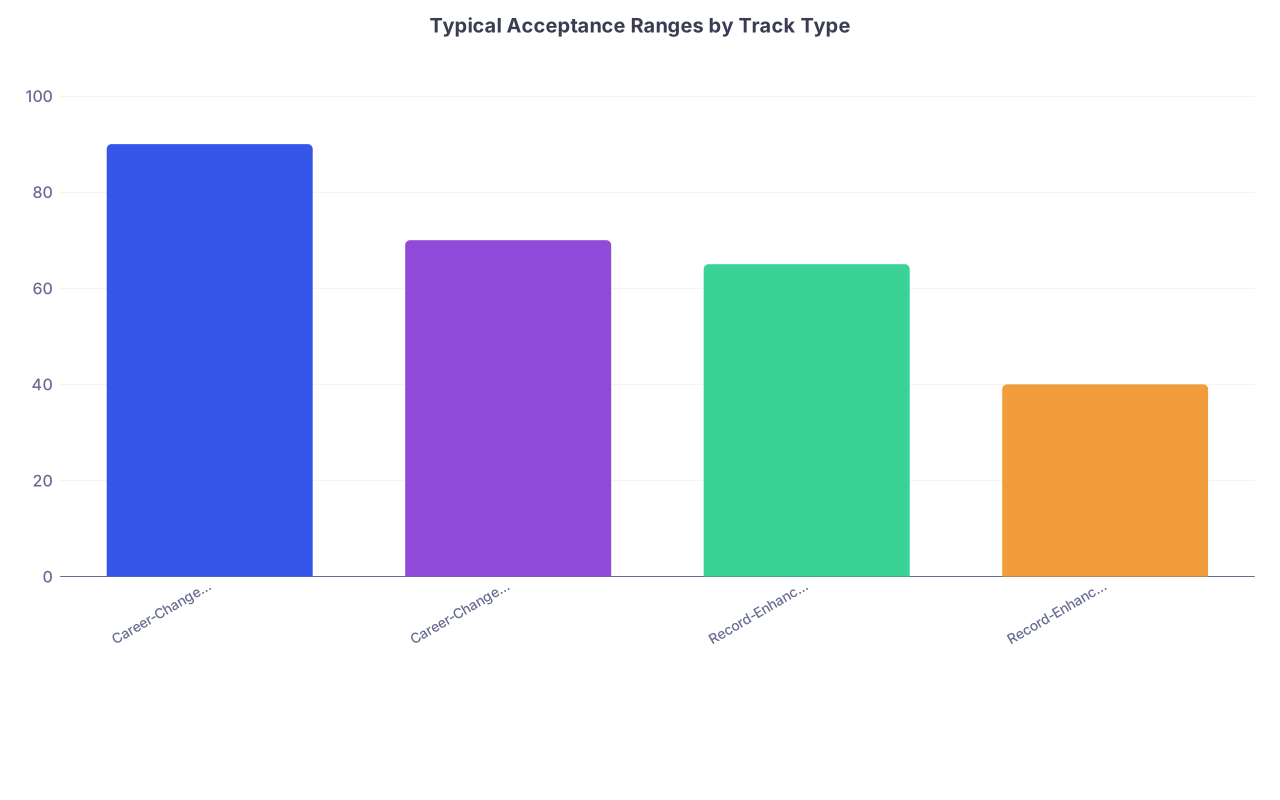
| Category | Value |
|---|---|
| Career‑Changer (Selective) | 90 |
| Career‑Changer (Generic) | 70 |
| Record‑Enhancer (SMP/Strong) | 65 |
| Record‑Enhancer (Generic) | 40 |