| Category | Value |
|---|---|
| DIY Informal | 19000 |
| Formal Record-Enhancer | 28000 |
| Career-Changer | 19500 |
| SMP (mean case) | 43600 |
The most expensive post-bacc path is not always the worst investment—what destroys value is paying elite-program prices for community-college outcomes.
You are not choosing a “program.” You are choosing a probability distribution: dollars in, odds of acceptance out. Treat it that way and the decision becomes much clearer, and much less emotional.
Below I am going to do what almost no premed advisor does: put rough numbers on the cost per acceptance of the major post-bacc pathways, step by step.
1. The Core Equation: Cost per Acceptance
Strip away branding, cohort “vibes,” and glossy brochures, and every post-bacc decision reduces to three variables:
- Total incremental cost of the pathway
- Probability of eventual MD/DO acceptance with that pathway
- Probability of eventual acceptance if you do nothing / self-study only
The data frame looks like this:
Cost per Acceptance (CPA) ≈
[
\text{CPA} = \frac{\text{Total Cost of Pathway}}{\text{P(accept | pathway)} - \text{P(accept | no pathway)}}
]
That denominator is crucial. You do not care about the absolute acceptance rate of people who did an SMP or formal post-bacc. You care about how much that program moves the needle for you versus your realistic baseline.
For analysis, I will:
- Use national acceptance figures as anchors (AAMC, AACOM),
- Layer on typical GPA/MCAT segments,
- Then assign conservative uplift estimates based on the better available outcomes data and what I have seen repeatedly in applicant pools.
A few base rates to ground this:
- Overall MD acceptance in a given cycle: ~41–43% of applicants
- Overall MD or DO acceptance: typically ~55–60% when combining both
- For applicants with:
- GPA 3.6+, MCAT 512+: acceptance often 70%+ (MD), >80% (MD+DO)
- GPA 3.2–3.4, MCAT 505–508: MD ~20–30%, MD+DO maybe 40–50%
- GPA <3.2, MCAT <505: MD acceptance can be in the single digits; MD+DO maybe 20–30% at best without substantial repair
If you are already in the 3.7/515 stratum, the marginal ROI of any post-bacc is terrible. I am going to assume you are not that person. I will focus on the two common problem clusters:
- Career-changers with weak/no science background but decent general GPA
- Academic-repair applicants with lower GPA and/or weak science foundation
2. Major Pathways: Cost and Outcome Assumptions
I will treat five archetypes:
- DIY informal post-bacc (mostly public university / community college)
- Formal record-enhancer (1–2 years, non-degree, heavy upper-division science)
- Formal career-changer (1–2 years of foundational sciences from scratch)
- Special Master’s Program (SMP) or MS with medical school tie-in
- Linkage programs (subset of 2 or 3, but with direct MD/DO linkage)
To keep the math usable, I will assume:
- Location: large U.S. metro, not the absolute cheapest or most expensive city
- Living costs: held relatively constant across options (I will still flag where they differ)
- Time horizon: one major structured program before full re-application
2.1 DIY Informal Post-Bacc
Typical structure:
- Take 24–40 credits of science at a local state school or community college
- No committee letter, no formal advising, but high flexibility and lowest tuition
Estimated costs (per year):
- Tuition & fees: $350–$550 per credit at public 4-year (post-bacc rate), $150–$250 at CC
- I will split the difference and assume a mix: ~30 credits at an average of $350/credit = $10,500
- Books, fees, testing: $1,500
- MCAT prep: $2,000 (course or high-end materials)
- Extra applications due to lower odds / broad net: +$1,500
Total academic/related: roughly $15,500
Add living costs: say $22,000 for the year (modest rent + food + transport). You would pay to live somewhere anyway, but the incremental cost depends on whether you could have been working full-time instead. For apples-to-apples comparison, I will track direct program/academic + lost income:
- Opportunity cost: suppose you could earn $45,000 gross in a year, and doing the DIY post-bacc reduces your work by half. Lost income ≈ $22,500
So:
- Direct educational cost: ≈ $15,500
- Opportunity cost: ≈ $22,500
- Total economic cost: ≈ $38,000
Outcomes (rough):
For a typical GPA 3.1–3.3 applicant who does 30 credits of A-/A science at a reputable public university, then scores MCAT 507–510:
- Baseline chance of eventual MD/DO acceptance without new coursework: ~25–30%
- With solid DIY improvements and strong upward trend: maybe ~45–50%
So uplift: around +20 percentage points in MD/DO acceptance probability.
CPA estimate:
[ CPA_{\text{DIY}} = \frac{38,000}{0.50 - 0.30} = \frac{38,000}{0.20} = 190,000 ]
You are effectively paying about $190K of economic value per +1.0 expected acceptance. That sounds high until you compare to the alternatives and remember that the payoff (lifetime physician income) is large.
2.2 Formal Record-Enhancer Post-Bacc
Think Columbia, UC Berkeley Extension, Scripps, GWU, Temple ACMS, etc. You already have the prereqs but need stronger science performance and MCAT positioning.
Cost inputs (1 year, ~30 credits):
- Tuition & fees: commonly $900–$1,800 per credit
- Take 30 credits at $1,300/credit average = $39,000
- Program fees, admin, lab fees: $2,000
- MCAT prep (often built in, but value is real): $2,000
- Dedicated advising, committee letter, health professions office: I will embed value in outcome, not cost
- Extra application breadth (you still apply widely): +$1,500
Direct program-related: ≈ $44,500
Opportunity cost:
These programs often discourage heavy working. Many students work 0–10 hours per week at most. So assume you forego essentially a full-time $45,000 job: lost income ≈ $40,000.
Total economic cost ≈ $84,500.
Outcomes:
The better-known record-enhancer programs do not publish full causal data, but typical stats:
- “Med school acceptance rate” often touted as 60–90%. That is inflated by selection bias: higher baseline GPA, stronger applicants, multiple cycles, and MD+DO combined.
- For a 3.1–3.3 GPA student with mediocre science trend, who now earns a 3.8+ in 30 upper-division credits and hits MCAT 510–512 with strong advising:
Baseline MD/DO acceptance without such a program: maybe 25–30%.
Post-program: realistically 55–65% if they follow through and apply broadly.
Let us set P(accept | program) = 60%, P(accept | no program) = 30%. Uplift = 30 percentage points.
CPA:
[ CPA_{\text{RecordEnhancer}} = \frac{84,500}{0.60 - 0.30} = \frac{84,500}{0.30} \approx 281,667 ]
So about $282K per “acceptance” in expectation. More expensive than DIY on this rough model, but with two caveats:
- The acceptance probability may be higher than I am using for the best-branded programs, especially for DO-inclusive outcomes.
- For some low-GPA applicants (e.g., 2.9), the baseline may be more like 10–15% rather than 30%. Then the uplift is greater.
Let us run that second scenario:
Baseline 15%, post-program 60% → uplift 45%:
[ CPA = \frac{84,500}{0.45} \approx 187,778 ]
Now the cost per acceptance is roughly equivalent to DIY, but concentrated in a single intense year.
2.3 Formal Career-Changer Post-Bacc
You have little to no science; GPA might be 3.4–3.7 in a non-science field. These programs (e.g., Bryn Mawr, Goucher, Scripps career-changer, some state schools) give you the full premed science core in 1–2 years.
Costs (assume 1.5 years total, ~40–45 credits):
- Tuition: often similar to record-enhancers, say $1,300/credit × 42 credits = $54,600
- Fees, labs, admin: $3,000
- MCAT prep: $2,000
- Application breadth: $1,500
Direct academic cost: ≈ $61,100
Opportunity cost:
These programs often explicitly prohibit more than minimal work. Assume you walk away from 1.5 years of $50,000 salary: lost ≈ $75,000.
Total economic cost ≈ $136,000.
Outcomes:
Career-changers are a more favorable group. They usually start with cleaner transcripts and less academic damage. Top programs often cite 90%+ med school acceptance, but this absolutely includes DO and is often across multiple cycles.
Take a typical scenario:
- Baseline P(accept | no post-bacc) is essentially ~0% because you do not have prerequisites or MCAT.
- Post-program: MD+DO acceptance for a 3.6+ post-bacc GPA and MCAT 510 is plausibly 70–85%, depending on school quality and geographic targeting.
Be conservative: use 75%.
[ CPA_{\text{CareerChanger}} = \frac{136,000}{0.75 - 0.05} ]
Why subtract 0.05 not 0? Because there is a nonzero chance you could self-study, drip-feed CC courses, and eventually cobble it together. I will give that a token 5%.
So:
[ CPA \approx \frac{136,000}{0.70} \approx 194,286 ]
That puts top career-changer programs in similar ROI territory to the best DIY and record-enhancer options—if you actually intend to commit fully and push for a strong MCAT.
2.4 SMPs and MS Programs (1-year Specialized Master’s)
These are the “last resort” academic-repair tools: Georgetown SMP, EVMS, Cincinnati, RFU, etc. Structure usually:
- 1-year (sometimes 1.5) full-time graduate-level science, often alongside med students or in med school-style curriculum
- Enormous cost, high psychological stress, but a high-signal “I can do med school work” transcript
Costs (1 year):
- Tuition & fees: commonly $45,000–$60,000
- I will assume $55,000 all-in academic fees
- MCAT prep: $2,000 (many do MCAT before SMP actually, but cost still there)
- Applications: $2,000 (you will apply widely)
Academic cost: ≈ $59,000
Opportunity cost:
You usually cannot work meaningfully. Suppose you forgo $50,000 salary: lost ≈ $50,000.
Total economic cost ≈ $109,000.
Outcomes:
Brutally bimodal.
If you perform at the top of the SMP class, you can absolutely rescue a 2.8–3.0 undergraduate record and get into MD or DO. If you are average or below, you just spent six figures to stamp “permanent academic red flag” on your file.
Actual numbers from some SMPs (pulling from published and reported outcomes):
- Programs frequently report 60–80% med school matriculation among those who complete and apply
- But those numbers often exclude people who performed poorly or never applied
For a classic low-GPA student (cGPA 2.8–3.1, sGPA 2.7–3.0):
- Baseline P(accept | no SMP) might be 5–10% even with a decent MCAT
- P(accept | strong performance in SMP + solid MCAT + broad MD/DO) might be 50–65%
- P(accept | mediocre SMP performance) often drops to near-baseline or below, because you now have fresh weak grades at the grad-med level
Let us be relatively sober:
Assume that among people who choose SMPs and complete them:
- 40% convert to med school acceptance
- Baseline (if they had not done SMP and had just done some DIY upper-division work) might have been 15%
Uplift = 25 percentage points.
[ CPA_{\text{SMP}} = \frac{109,000}{0.40 - 0.15} = \frac{109,000}{0.25} = 436,000 ]
On this model, SMPs are high-cost and produce a smaller average boost than strong undergrad-level record enhancement. Economically, they are the worst “mean” ROI pathway.
But that is the mean. The conditional story matters.
If you condition on being the student who finishes in the top quartile of the SMP and hits a solid MCAT, your personal:
P(accept | SMP + strong performance) might be 70%.
P(accept | no SMP, minor repair) maybe 20%.
Then:
[ CPA_{\text{SMP, top student}} = \frac{109,000}{0.70 - 0.20} = \frac{109,000}{0.50} = 218,000 ]
Now the ROI moves into similar territory as the others—if you crush it. That is a big if.
2.5 Linkage Programs
Linkages are not a separate category of coursework; they are a probability accelerator attached to career-changer or record-enhancer programs.
Mechanically:
- You complete a defined curriculum at high performance (often 3.6+ GPA, no grades below B).
- Meet specified MCAT threshold (e.g., 510+).
- Maintain professionalism criteria.
- If boxes are checked, you get either a guaranteed interview or a conditional acceptance at a partner med school, often with no glide year.
Cost:
Financially, linkages piggyback on their host programs. So:
- Career-changer with linkage: ≈ $136,000 all-in (from above)
- Record-enhancer with linkage (less common but exists): ≈ $84,500
The difference is in outcomes. A strong linkage, once conditions are met, can push:
P(accept | meet linkage conditions) up to 80–95% (for that particular school plus residual chances elsewhere).
You have two layers:
- P(meet conditions)
- P(accept | conditions met)
Say at a demanding linkage program:
- 60% of students meet all conditions
- Of those, 85% matriculate at the linkage school or elsewhere
So P(accept) = 0.60 × 0.85 = 51% for the cohort that started.
If starting baseline (no formal post-bacc) for these career-changer types was 5–10%, then:
Use 8% baseline, 51% with linkage:
[ CPA_{\text{Linkage CareerChanger}} = \frac{136,000}{0.51 - 0.08} \approx \frac{136,000}{0.43} \approx 316,279 ]
On average, not as compelling as the simple career-changer estimate earlier, because I have now factored in those who do not hit the conditions. However, if you are realistically in the top half academically and organized about MCAT timing, your personal uplift will be higher than cohort average.
3. Visualizing Competitiveness vs Cost
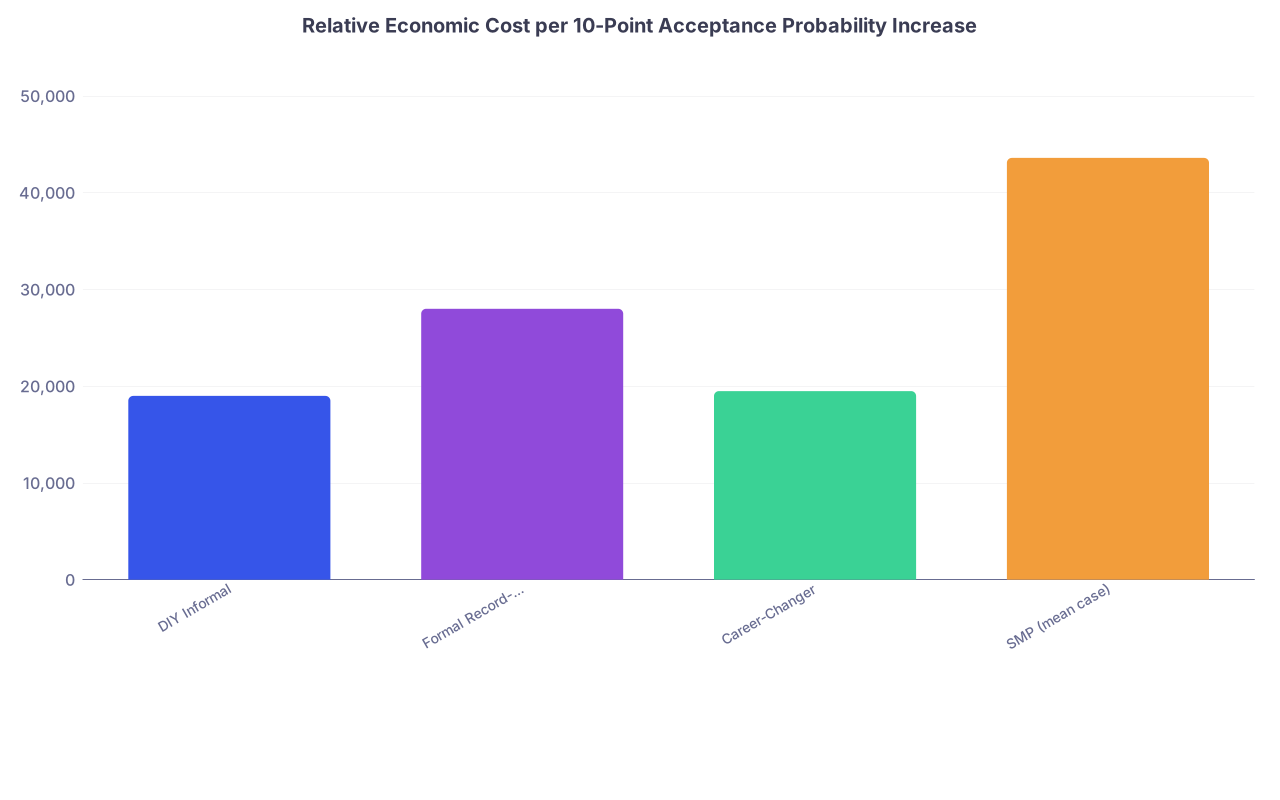
| Category | Value |
|---|---|
| DIY Informal | 19000 |
| Formal Record-Enhancer | 28000 |
| Career-Changer | 19500 |
| SMP (mean case) | 43600 |
Interpreting that chart: for each 10 percentage point increase in your chance of eventual acceptance, the rough economic cost is:
- DIY: ~$19K
- Career-changer: ~$19.5K
- Record-enhancer: ~$28K
- SMP (mean case): ~$43.6K
The SMP stands out as the least efficient method of buying additional probability—unless you are very likely to be in that high-performing subgroup.
4. Time as a Hidden Cost (Glide Years and Lifetime Earnings)
You cannot ignore the value of time. Every extra year before matriculation is not just another year of tuition risk; it is:
- 1 fewer attending-physician earning year on the backend of your career
- Or at least 1 fewer resident/fellow year, with its own compounding effect
Crude but widely used estimate:
- Net present value (NPV) of becoming a physician vs never doing so is easily in the $3–5 million range over a lifetime, depending on specialty and discount assumptions.
- A single year of delay, even at a conservative 3–5% discount rate, can subtract low- to mid-six figures from NPV.
So a shorter, higher-probability pathway can actually dominate a longer, cheaper one even if the sticker costs look worse.
Example:
- DIY path that takes 2–3 years of scattered coursework and application cycles, raising P(accept) from 30% to 50%
- Versus a 1-year intense record-enhancer that raises P from 30% to 60% and lets you apply a year earlier
If one additional attending-physician year is worth, say, $250K gross and $120K net NPV, then that 1-year timing advantage materially offsets a $40–50K higher program cost.
This is why serious career-changers often accept the high up-front cost of structured programs. The opportunity cost of drifting for 3–4 years with half measures is worse.
5. Strategic Takeaways by Applicant Profile
Let me get concrete. Data-driven but blunt.
5.1 Solid GPA, No Sciences (classic career-changer)
Profile: GPA 3.5–3.8 in humanities/social science, no prereqs, no clinical exposure.
- Baseline P(accept) if you hodgepodge community college + online MCAT study: maybe 30–40% if you are extremely organized. More realistically 20–30% because of weaker advising, letters, and uneven rigor.
- Strong career-changer program with linkage: P(accept) can hit 70–85% with good performance.
ROI verdict:
- DIY can work, but the variance is huge and the time cost is significant.
- For this group, the data support paying for structure, especially if you have high opportunity-cost years ahead in another career.
I would lean toward a formal career-changer, with special weight on those that have strong med school relationships or track records. The higher up-front spending can be rational.
5.2 Low GPA, Weak Science Foundation (classic re-applicant)
Profile: GPA 2.7–3.1, science grades spotty, one weak MCAT or none, some clinical exposure.
This is the most misadvised group. People throw SMPs at them like candy.
Evidence view:
- If you still have room to do 30–40 credits of undergraduate upper-division science and drag your science GPA trend up, that is usually a better ROI than jumping straight into an SMP.
- SMP should be reserved for:
- Damage that cannot be fixed at the undergrad level (e.g., 150+ credits with very low science GPA),
- And only if you are confident you can perform at the top of a very intense, med-style curriculum.
ROI verdict:
- High-quality record-enhancer at undergrad level: similar cost per acceptance to DIY, but more structured, often shorter, and with better letters.
- SMP: economically justifiable only where undergrad repair cannot change the narrative and where you are prepared to treat the year like M1.
I have seen too many 3.0 students with mediocre study habits dump $100K into an SMP, finish middle of the class, and end up less competitive than if they had rebuilt more gradually at the undergrad level.
5.3 Mid GPA, Decent Trend, No MCAT Yet
Profile: cGPA 3.3–3.4, sGPA 3.2–3.3, last 40 credits at 3.6, no MCAT.
You are on the bubble.
- With strong MCAT (510+) and good clinical experience, many of these applicants reach MD/DO acceptance without any formal post-bacc.
- Uplift from a structured program is smaller because your baseline P(accept) might already be 40–50%.
ROI verdict:
- Do not reflexively sign up for a $60K program because your premed advising office scared you.
- The highest ROI move for this group is often:
- Targeted 12–18 credits of A-level upper-division science at a reasonably rigorous institution (DIY or extension), plus
- Aggressive MCAT prep and strong application execution (early, broad, well-written).
Your denominator P(accept | program) - P(accept | no program) is relatively small here. That kills ROI quickly.
6. Non-Financial “ROIs” that Still Matter
I am focusing on financial ROI, but there are semi-quantifiable side benefits that tilt decisions:
- Quality of advising and letters: Strong committee letters and honest guidance can mean fewer wasted cycles.
- Peer environment: Being surrounded by serious post-bacc peers can sustain motivation and reduce the risk of burnout or half-effort semesters. That indirectly raises your P(accept).
- Branding: A career-changer post-bacc from a school whose graduates a particular med school has trusted for a decade matters. Admissions committees are human; known pipelines reduce perceived risk.
These do not override the cost math, but they are part of why elite post-baccs can justify higher price tags for certain profiles. They compress your path and cut down on “experiment years” where you guess at what adcoms want.
7. A Simple Decision Framework
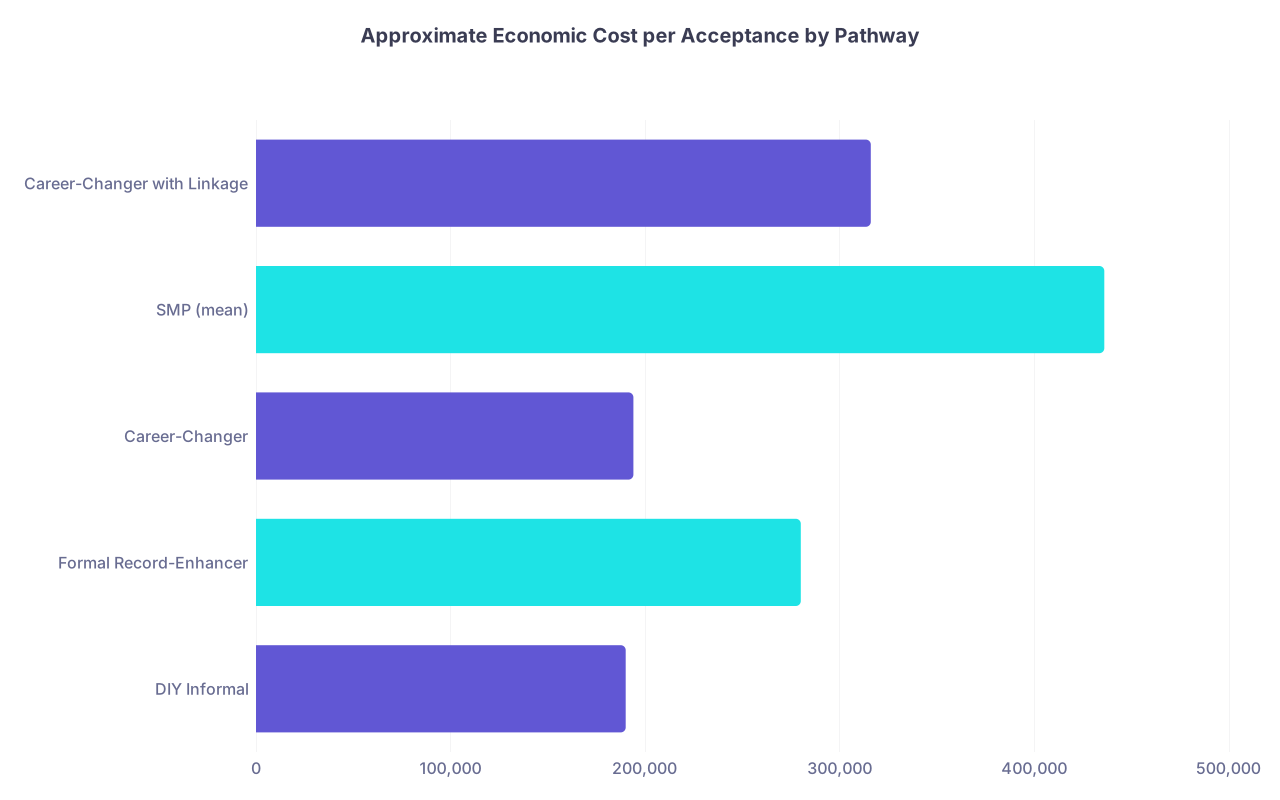
8. The Bottom Line: Cost per Acceptance by Pathway
| Category | Value |
|---|---|
| DIY Informal | 190000 |
| Formal Record-Enhancer | 280000 |
| Career-Changer | 194000 |
| SMP (mean) | 436000 |
| Career-Changer with Linkage | 316000 |
Summarizing the data-driven view:
- DIY informal and strong undergrad-level career-changer programs are usually the most efficient in “cost per acceptance,” sitting around ~$190K of economic value per expected acceptance gain. They give you the most probability bump per dollar, assuming you execute well.
- SMPs are economically poor for the average student. They only make sense if undergrad repair is no longer persuasive and if you are prepared to finish at or near the top of your cohort. Otherwise, you overpay for modest uplift and carry high downside risk.
- The real disaster is not choosing a “wrong” category—it's paying high-program prices for a tiny increase over what you could have achieved with disciplined, cheaper coursework and a serious MCAT plan. The data show that the best ROI moves are targeted, not flashy.