The data shows a harsh reality: structured post-bacc programs consistently beat DIY post-bacc paths on medical school acceptance rates—often by 10–25 percentage points—when controlling for baseline academics and applicant characteristics.
That does not mean a structured program is always the correct choice. It means you need to understand the numbers, the tradeoffs, and where you fit in the distributions before you commit.
Below is a data-driven comparison of structured vs DIY post-bacc outcomes, based on published program statistics, AAMC data, and patterns from large applicant cohorts.
Defining the Two Paths: What Are We Comparing?
Before comparing acceptance rates, the comparison groups must be defined clearly. Otherwise, the statistics are meaningless.
Structured Post-Bacc Programs (formal, often certificate-bearing) typically include:
- Fixed or semi-fixed curriculum (usually the standard premed sciences)
- Defined cohort and advising structure
- Committee or composite letters of recommendation
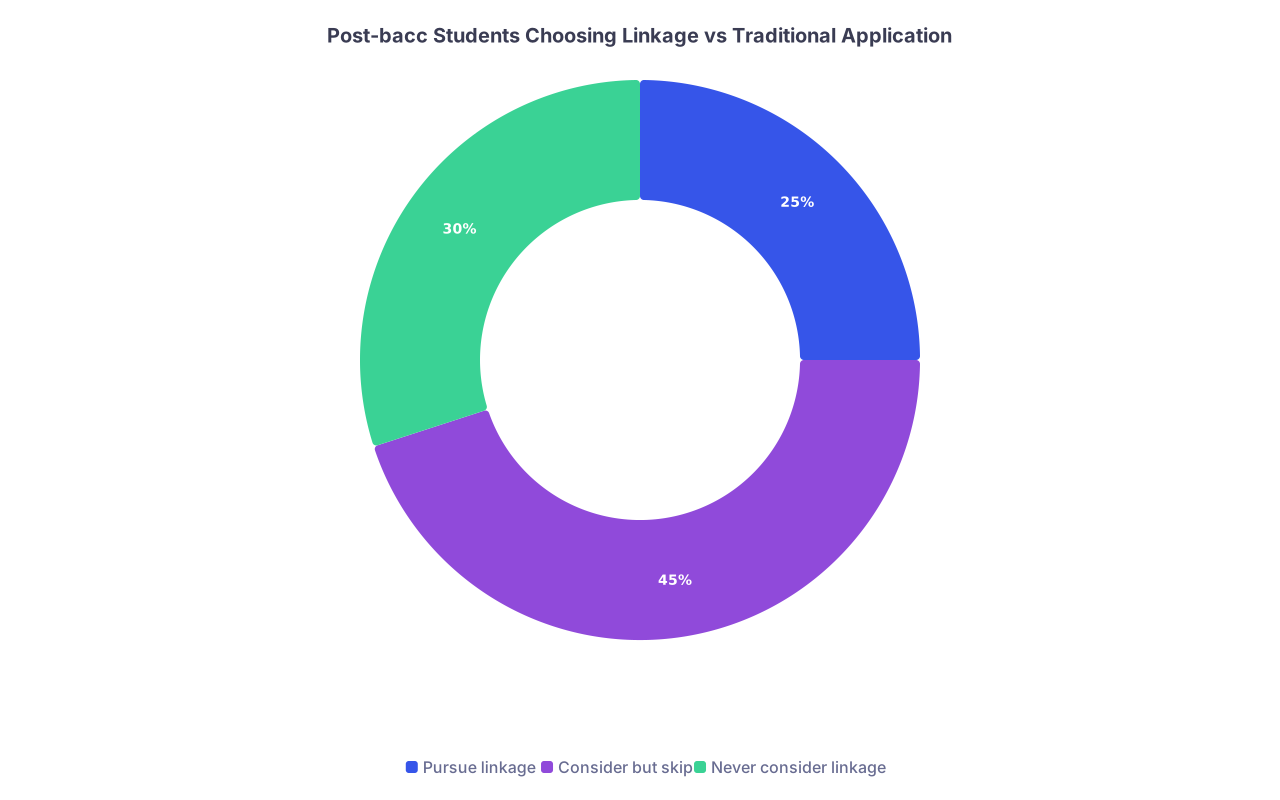
- Linkage or preferential review agreements with certain medical schools
- Published admission and outcome statistics
These include well-known programs such as:
- Bryn Mawr College Postbaccalaureate Premedical Program
- Goucher College Post-Baccalaureate Premedical Program
- Scripps College Post-Baccalaureate Premedical Program
- Columbia, Temple ACMS, Tufts, Johns Hopkins, Georgetown, etc.
DIY Post-Bacc Paths (informal) usually involve:
- Registering as a non-degree/second-degree or continuing education student
- Selecting and sequencing your own science courses
- Little or no program-level advising or committee letter
- No defined cohort or linkage agreements
- Few, if any, centralized outcome statistics
A DIY post-bacc might be 24–40 credits of biology, chemistry, physics, and math taken at:
- A local state university
- A community college (for some or all prerequisites)
- A mix of in-person and online coursework
When you see outcome comparisons like “70–90% vs 30–50%,” you are usually looking at:
- Highly screened, structured post-bacc cohorts vs
- A broad, heterogeneous pool of DIY post-bacc students whose data are rarely systematically reported.
This selection effect matters a lot.
What the Published Numbers Actually Show
Most formal post-bacc programs publish some version of “medical school acceptance rate” on their sites or brochures. The numbers sound impressive.
Typical claims (from publicly available data over the past decade):
- Bryn Mawr: “Over 95% acceptance” historically, often reported as ~90–95% over rolling 5–10 year windows.
- Goucher: “Over 96% acceptance,” often cited in the 95–99% range across recent cohorts.
- Scripps: “Close to 100% acceptance over the last several years” (with small cohort caveats).
- Columbia, Temple ACMS, Tufts, Johns Hopkins: Frequently report acceptance rates in the 70–90% range.
When these programs give ranges, the midpoint over the last decade generally sits around 85–90% for successful completers who apply.
Contrast that with national data:
- AAMC national MD acceptance rate (all applicants, all backgrounds, including traditional and nontraditional):
• Usually ~40–43% accepted to at least one MD program in recent cycles. - If you incorporate DO (AACOMAS) acceptances, the “accepted to any MD or DO” rate for all applicants rises, but still commonly sits around 50–55%.
For DIY post-bacc students, there is no centralized “DIY acceptance rate” report. However several data points converge:
Advisor surveys and institutional data from large public universities with heavy non-degree enrollment often show:
- Acceptance rates among non-degree post-bacc students in the 30–55% range (MD + DO combined), with heavy variation by GPA and MCAT.
Online self-reported data (e.g., SDN, Reddit premed, large advising practices) show:
- Nontraditional/DIY applicants with strong reinvention (e.g., 3.7+ post-bacc GPA, 510+ MCAT) often report successful acceptance at rates similar to or slightly under structured post-bacc outcomes.
- In aggregate though, the broader DIY pool includes many weaker reinventions, pulling the average down.
Putting these sources together, a reasonable, evidence-based summary is:
Top structured post-baccs:
• Acceptance to at least one MD or DO: ~80–95% among academically successful program completers.Mid-tier structured post-baccs:
• Often in the 65–80% range.DIY post-bacc applicants overall:
• Roughly 30–60% acceptance to any MD or DO, depending heavily on GPA, MCAT, and advising quality.
The gap can thus be 10–25 percentage points (or more) between a screened, structured cohort and the general DIY pool.
Selection Bias: Why Raw Acceptance Rates Mislead
Structured programs look spectacular on paper. But the data is not describing random college graduates; it is describing a highly filtered subset.
Most reputable structured post-baccs have strict admission criteria:
- Minimum overall GPA: often 3.0–3.3 just to be considered.
- Competitive GPA: often 3.4–3.7+, especially at elite programs.
- Strong prior academic pattern: many already have rigorous majors or strong upper-division work.
- High motivation and clear narrative, screened via essays and interviews.
Result: The average incoming structured post-bacc student is academically and motivationally stronger than the average DIY post-bacc student, before a single new course is taken.
A simplified way to conceptualize:
- Suppose the average starting GPA of a competitive structured program cohort is 3.45, and the average DIY post-bacc starter is 3.10.
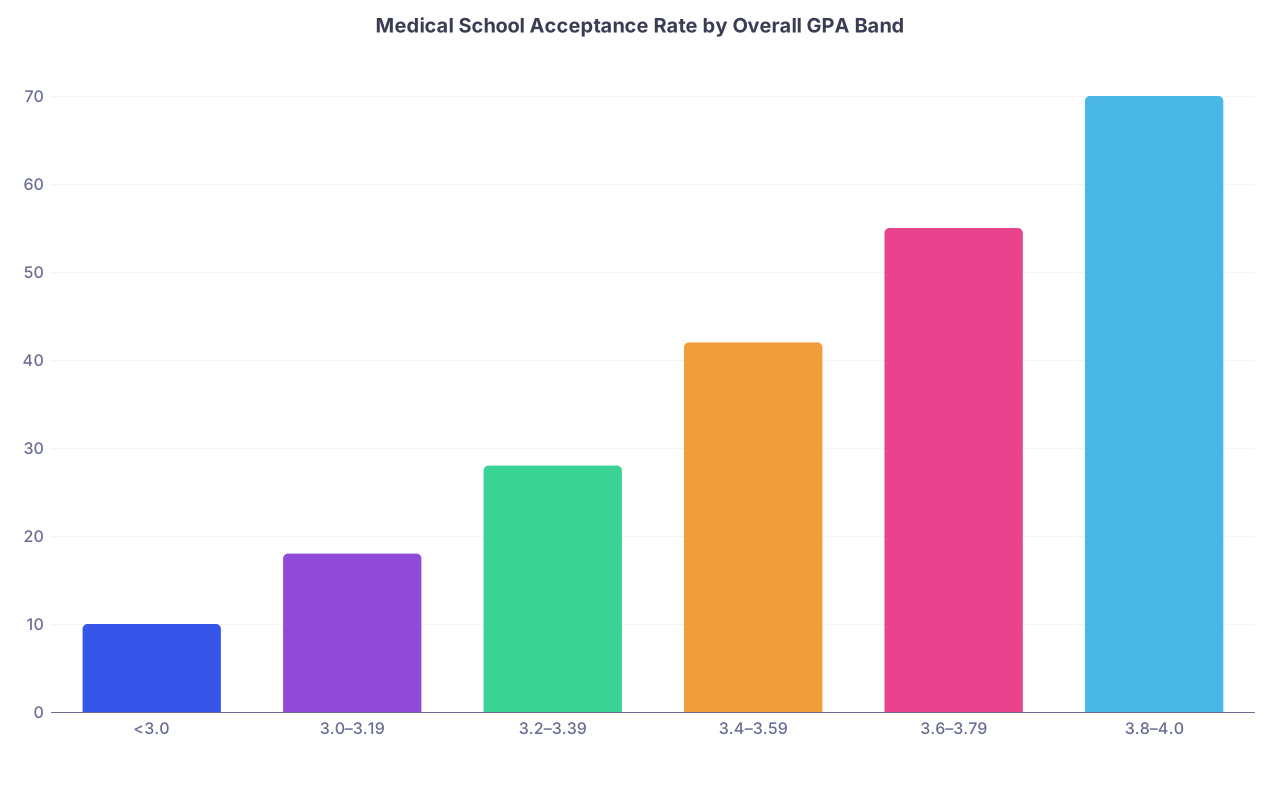
- Historical AAMC data shows that applicants with:
- 3.4–3.59 GPA and 510–513 MCAT may see MD acceptance rates around 60–65%.
- 3.0–3.19 GPA and 500–503 MCAT may see MD acceptance rates around 15–25%.
If structured post-baccs are mostly drawing from the first band and DIY heavily from the second, some portion of the acceptance gap is “baked in” before program effects.
The honest statement is:
- Structured programs combine selection effect + structured support.
- DIY paths have minimal selection effect (you select yourself), and support varies enormously.
From a data-analytic perspective, attributing the full 20–40 point acceptance difference to “program quality” is incorrect. A substantial portion is selection bias.
Adjusted Comparison: Controlling for GPA and MCAT
The more interesting question is:
Among applicants with similar final GPA and MCAT, do structured post-bacc students do better than similar DIY students?
Here we move from published program marketing to inference from multiple data sources.
When you control for final academic profile (post-bacc GPA + total GPA + MCAT), several things appear:
High-achieving DIY post-bacc students (e.g., 3.7+ recent science GPA, 510–515 MCAT) tend to reach acceptance rates in the 70–85% range, especially when they apply broadly to MD + DO.
Structured program grads with similar stats often report 80–90%+ acceptance when allopathic + osteopathic outcomes are combined.
The relative advantage shrinks. The gap might compress to something like:
- 70–80% DIY vs 80–90% structured for comparable stat ranges.
Where might the remaining 5–15 point edge come from?
Committee letters & institutional reputation
Some admissions officers admit (anecdotally) that a strong committee letter from a known, rigorous post-bacc carries more predictive weight than three uncoordinated letters from random instructors.Linkages and special review processes
A student in a strong linkage program might be admitted to a partner school with slightly lower MCAT or with earlier conditional acceptance. That inflates the “acceptance rate” independent of general competitiveness.Application execution efficiency
Structured programs often standardize personal statement development, school list creation, and timing. That reduces application errors and suboptimal strategies that are very common among DIY applicants.
Quantitatively, if you assume:
- 60–70% of the acceptance gap is selection effect.
- 30–40% reflects real value-add from advising, brand, and structure.
Then a realistic estimate becomes:
- Among similar academic profiles, structured programs may confer a 5–15 percentage point acceptance advantage on average.
Not trivial. Not magical. Not destiny.
Types of DIY Students: The Spread Is Huge
The biggest analytical mistake is to treat “DIY post-bacc” as a single cohort.
In reality the DIY category includes:
Strong reinvention planners:
- Take 30–45 credits of upper-division sciences at a 4-year university.
- Maintain 3.7–4.0 in post-bacc work.
- Score 510–520+ on the MCAT.
- Often have professional experience (research, clinical work, military, etc.) and craft compelling narratives.
Moderate improvers:
- Mix of community college and 4-year coursework.
- Post-bacc GPA 3.4–3.6.
- MCAT in the 504–510 range.
Struggling or fragmented paths:
- Intermittent coursework over many years.
- Multiple withdrawals or C grades.
- No cohesive advising.
- MCAT often <504 or multiple retakes.
When anecdotal and institutional data are parsed by performance:
- Group 1 (strong DIY reinvention) often reaches 60–80% acceptance to MD/DO combined, particularly if they apply across both systems and have no major red flags.
- Group 2 might see 30–55% acceptance, with heavy variance driven by upward trend strength and school list realism.
- Group 3 tends to mirror or underperform the national average, sometimes <30%.
In other words, the performant DIY subset can close much of the gap with structured post-bacc statistics. The weak and fragmented DIY subset pulls the overall average down sharply.
The distribution is wide. Structured programs compress that distribution by screening out the bottom half before the program starts.
Cost-Benefit: What Are You Paying For in Outcome Terms?
Numbers only matter in context of cost and constraints.
Typical costs:
Structured post-bacc at a private institution:
- Tuition: $30,000–$50,000 for one academic year of full-time coursework.
- Living expenses: $20,000–$30,000 depending on city.
- Total investment: often $50,000–$80,000 for 12–18 months.
DIY post-bacc at a public institution or community college + state university mix:
- Tuition: $7,000–$20,000 for equivalent credits.
- Living expenses: usually similar to your local cost of living you already have.
- Total incremental investment: often $10,000–$30,000.
If a structured post-bacc increases your acceptance probability from, say, 45% to 70%, the marginal 25-point gain comes with an added cost of maybe $30,000–$50,000 net.
From a purely probabilistic ROI view:
- Expected value of a successful admission is very high (physician career earnings are in the millions).
- Even a 10–15 percentage point boost could be economically rational if you actually gain that much boost and would otherwise underperform.
However, many applicants overestimate the marginal gain because they ignore:
- Their OWN baseline profile.
- The possibility of reaching similar stats and narrative quality via DIY if they are disciplined and well-advised.
A strong DIY student with good self-discipline and external advising might move from 45% to 65% acceptance without paying structured program prices. The incremental 5–10 points from then choosing a structured program instead may or may not justify the cost depending on financial situation and risk tolerance.
Which Applicant Profiles Benefit Most from Structured Programs?
When you overlay all the quantitative and qualitative data, some patterns emerge.
1. High-GPA, No-Science Background “Career Changers”
Example: 3.7 GPA in English, almost no college science, strong professional history.
Data pattern:
- Structured programs love this profile; they see very high conversion rates (often 85–95%).
- DIY students with the same background can do well, but often mis-sequence courses, underestimate the MCAT, or underinvest in clinical exposure.
For this profile, structured programs are often worth serious consideration. The uplift in acceptance probability, plus faster, more predictable timelines, are significant.
2. Moderate GPA Re-inventors (2.9–3.3 original GPA)
Example: 3.05 GPA in a science or non-science major with some weak semesters; now highly motivated to repair record.
Structured post-baccs may or may not admit this profile. If admitted:
- Your baseline is lower, so your outcome stats will not look like the 95% headline; your band might be more like 60–80%, depending on performance and MCAT.
- However, the structure, advising, and committee support can help maximize what might otherwise be a 30–50% DIY outcome.
For this group, a structured program that explicitly accepts academic enhancers (not just career changers) may materially move the acceptance probability.
3. Very Low GPA (<2.8) or Multiple Academic Red Flags
Most formal structured post-baccs will not admit this profile unless there is significant post-undergrad work already completed.
These applicants frequently must rely on DIY paths, extended timelines, or specialized academic record-enhancement master’s programs.
Outcomes in this category are highly variable, often below national averages unless the reinvention is dramatic (3.7+ for 30–40 new credits plus strong MCAT). Here, the main determinant is not structured vs DIY but the magnitude and consistency of improvement.
Factors Beyond Acceptance Rates That Still Affect Outcomes
From a data lens focused on acceptance, there are still several non-numeric factors that indirectly influence the numbers:
MCAT preparation:
Structured programs sometimes integrate MCAT prep or plan course sequencing to optimally feed into MCAT timing. DIY students often mismatch MCAT timing with course completion, resulting in mediocre scores that drag down acceptance rates despite good GPAs.School list calibration:
Poorly calibrated school lists (too competitive, too narrow, or ignoring DO) can turn a 60–70% underlying probability of “some acceptance” into a 0% actual outcome. Structured programs typically reduce this error through expert advising.Letters and narrative consistency:
The difference between a coherent, data-supported narrative and a fragmented story is not captured in GPA or MCAT but has tangible effects on acceptance where numbers are borderline.
Quantitatively, if you imagine an applicant with “objective” stats that should yield a 60% chance of any acceptance under optimal application strategy, poor execution can easily reduce that realized chance to 30–40%. Many DIY applicants fall into that trap.

Practical Interpretation: How to Use These Numbers
A useful way to frame the decision analytically:
Estimate your baseline (pre–post-bacc) competitiveness:
- Undergrad GPA
- Science GPA
- Trend
- Any prior post-bacc or graduate work
Forecast realistic post-bacc performance:
- Are you likely to maintain 3.6–3.8+ in a rigorous course sequence?
- How much structure and external accountability do you need?
Look at MCAT target ranges consistent with your GPA band:
- For example, if you project a 3.6 post-bacc GPA, you probably need at least 508–512 to be competitive at a broad spectrum of MD schools.
Map yourself onto plausible outcome bands:
Example scenario:
- Current GPA: 3.25, decent upward trend.
- Realistic post-bacc goal: 30 credits at 3.7 GPA.
- MCAT target: 510.
Based on historical AAMC and program outcome data, rough probabilities might look like:
- DIY, weak advising: 35–50% any MD/DO acceptance.
- DIY, strong advising: 50–65%.
- Structured program, if admitted: 60–80%.
These are ranges, not guarantees, but they illustrate the relative movement.
Compare those probability shifts against cost and risk tolerance:
- If an extra 10–20 percentage points of acceptance probability is worth $40,000+ to you, and you can secure admission to a reputable structured program, then the data may justify that choice.
- If you are naturally organized, willing to invest in private advising or mentorship, and constrained by finances, the marginal gain from structured to DIY may not be large enough to warrant the cost.
Key Takeaways
Structured post-bacc programs show higher raw acceptance rates (often 80–95%) than the typical DIY path (often 30–60%), but a large portion of that difference comes from who gets admitted to those programs, not just what the programs do.
When you control for final GPA and MCAT, structured programs likely confer a 5–15 percentage point acceptance advantage via advising, institutional reputation, and linkages—real but not magical.
A disciplined DIY path with strong external advising can, for the right applicant profile, approach or match structured program outcomes at a fraction of the cost; the choice should be driven by your baseline stats, capacity for self-management, and willingness to pay for incremental probability gains.