The Night Before Orientation: A Scenario
2:00 AM. The syllabus is glowing on your laptop screen, and you've been staring at the same paragraph about the first biochem module for twenty minutes. You closed the tab. Opened it again. Closed it. Your chest is tight. There's a cold, creeping dread that started somewhere around your sternum and is now sitting in your throat like a stone.
And then the thought lands, fully formed, devastatingly certain:
They must have admitted me by mistake.
You didn't debate it. You didn't question it. You just knew it. Someone on the admissions committee clicked the wrong button. Or they confused your file with someone else's. Or they took a chance they shouldn't have taken, and you're the ticking time bomb about to be discovered.
If you're already worrying about your first semester, see struggling in your first post-bacc semester.
Your heart is racing now. Not metaphorically. Actually pounding. You can feel it in your ears. You pull up LinkedIn. You scroll through your future classmates' profiles. One of them did research at a lab you've actually heard of. Another already has a master's in physiology. Someone posted about scribing in an ER for two years. You close the tab and open Reddit instead, searching "post-bacc imposter syndrome" at 2:14 AM with shaking fingers.
I need you to hear this clearly: nearly every post-bacc student has sat in this exact chair.
For warning signs about your program, see post-bacc red flags.
The 40-year-old career-changer who left a stable accounting job. The 24-year-old who bombed orgo the first time and is praying for GPA redemption. The biology major who somehow still feels behind. The one who got a 508 on the MCAT and thinks everyone else broke 515. This moment, the wide-eyed, 2 AM, doomscrolling, "I am the mistake" moment, is practically a rite of passage. It is not unique to you. It is not evidence that you don't belong. It is information. Useful information, actually, because it tells you something about how your brain responds to high-stakes transitions. It does not tell you anything about your future as a physician.
The feeling is not your identity. It's just a feeling. And it will pass.

What Is Imposter Syndrome, and Why Post-Bacc Programs Trigger It
Imposter syndrome, at its core, is the persistent inability to internalize your own accomplishments despite external evidence of your competence. You attribute your successes to luck, timing, or administrative error, and you live in constant fear of being "found out" as a fraud. It was first described by psychologists Pauline Clance and Suzanne Imes in 1978, and it has been wrecking the sleep of high-achievers ever since.
But let me be blunt about something: not all self-doubt is imposter syndrome, and not all imposter syndrome is harmless. Genuine academic warning signs exist. If you are failing multiple exams and ignoring offers of tutoring, that's not imposter syndrome, that's a performance gap that needs intervention. Imposter syndrome is specifically the disconnect between your actual performance and your internal story about that performance. You can have a 3.8 GPA in your post-bacc and still feel like a fraud. That's the disorder. If you have a 2.1 and feel like you don't belong, that's not imposter syndrome, that's accurate self-assessment, and you need academic support, not a pep talk.
Post-bacc programs are uniquely fertile ground for imposter syndrome. Here's why.
Career-changers walk into classrooms where half the students are straight out of undergrad and think, I've been out of school for eight years. I don't even remember how to study. GPA-redemption students sit next to classmates who never got a C in their lives and think, They're starting from a 3.7 baseline. I'm clawing my way up from a 2.9. Older students see the 22-year-olds and imagine silent judgment. Younger students see the career-changers and assume they have some adult superpower they lack.
And underneath all of it is the money. Post-bacc programs are expensive. Many students are financing them with loans or savings that took years to accumulate. Every quiz, every exam, every lecture feels weighted with the terrifying thought: If I mess this up, I'm not just failing a class, I'm proving that I wasted thousands of dollars on a fantasy.
Then there's what I call post-bacc perfectionism. It's the belief that anything less than an A+ is evidence you don't deserve to be a doctor. An A- becomes a warning shot. A B+ feels like a verdict. You convince yourself that medical school admissions committees are sitting in a room somewhere, squinting at your transcript, waiting for one blemish so they can stamp "DENIED" in red ink.
This is nonsense. I'm not being gentle here because gentleness sometimes lets the lie hide. Admissions committees know post-bacc students are building or rebuilding. They want an upward trajectory. They want resilience. They do not want a perfect, unblemished robot who has never struggled, because that person doesn't exist, and if they did, they'd make a terrible physician. Medicine is messy. Your transcript can be messy too.
If you're also wondering how your program choice factors into your confidence, see how to avoid choosing prestige over fit.

Your Brain Is Lying to You: Cognitive Distortions Keeping You Stuck
Here's the uncomfortable truth: your brain is not a neutral reporter. It's a storyteller with a strong bias toward threat detection. When you're in a high-stakes environment like a post-bacc, that bias goes into overdrive, and you start believing narratives that have no basis in reality.
Let's name the most common distortions.
Catastrophizing. You bomb one quiz on enzyme kinetics, and within thirty seconds your brain has written the complete screenplay of your failure. This quiz was worth 5% of my grade. If I get a B in this class, my science GPA won't budge. If my science GPA doesn't budge, I won't get into med school. I'll be 35 and broke and my parents will be right. This is not reasoning. This is emotional chain-reaction, and it moves so fast you don't even notice the leaps. One quiz is one quiz. It predicts nothing about your MCAT, your application cycle, or your worth as a human being.
For more on how to frame your post-bacc experience later, check out how to explain your post-bacc in secondaries.
Mind-reading. You assume, with absolute certainty, that your professor thinks you're the weakest student in the class. You assume your study group tolerates you but secretly wishes you'd drop out. You assume the quiet classmate in the back row is judging your transcript. You have zero evidence for any of this, but it feels true because your anxiety dresses up imagination as intuition. Spoiler: your classmates are too busy worrying about their own performance to spend mental energy judging yours. And if a professor actually thinks poorly of you, that's a single data point, not a universal indictment.
The imposter cycle. This one is mechanical. It runs on a loop, and once you see it, you can't unsee it.
The trigger fires, maybe it's a tough biochem problem set, or you see someone answer a question in lecture that you didn't understand. Immediately, the thought appears: I don't belong here. That thought generates anxiety. Your response to the anxiety is either to overwork (studying twelve hours for a five-point quiz) or to freeze (staring at your notes without absorbing anything). The outcome is either exhaustion that tanks your next performance or a grade that's fine but not spectacular. And then your brain takes that outcome and says, See? I told you. You're a fraud. And the cycle starts again.
The point of intervention is step two: the thought. You can't control the trigger, but you can notice the thought and label it. Ah. There's the "I don't belong" story again. Interesting. My brain is doing the thing. That tiny pause, that moment of meta-awareness, is where the cycle starts to break.
Rebuild Your Evidence File, and Write the Reflection That Carries You Forward
Okay. You've named the distortions. You've seen the cycle. Now what? Because understanding imposter syndrome intellectually doesn't make it disappear. You need concrete, repeatable practices that build an alternative narrative, one grounded in evidence, not fear.
Start an evidence log.
This is not a journal about your feelings. It's a log of facts. Get a notebook or a digital document, and every single day, record at least one piece of objective evidence that you are doing this work and doing it competently. Passed the weekly quiz? Write it down. Explained a concept to a study partner who was confused? Write it down. Got a piece of positive feedback from a professor on a lab report? Write it down. Answered a question correctly in lecture? Write. It. Down.
The entries don't need to be profound. "October 3: scored 88% on cell bio quiz. Professor wrote 'good analysis' on my short answer." That's it. On the days when your brain is screaming fraud, you open the log and read it. You don't argue with the feeling. You just present the evidence and let it sit there. Feelings are loud, but facts are stubborn.
Build a support scaffold.
Isolation is fuel for imposter syndrome. When you're alone with your thoughts at midnight, the fraud narrative has no competition. You need other voices in the room.
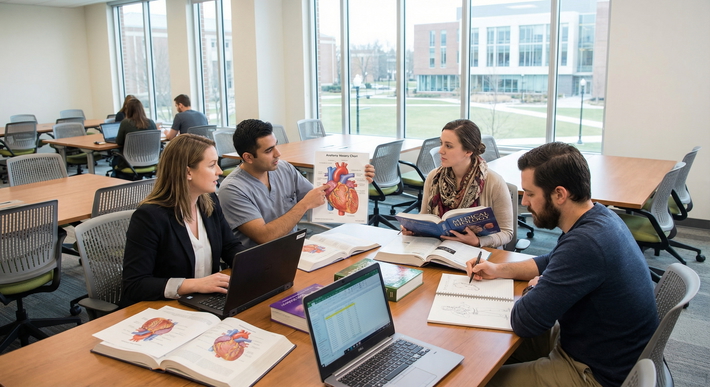
- Study group. Find two or three people you can be honest with. Not the people who posture and perform confidence. Find the ones who will say, "I have no idea what the Krebs cycle is and I've read the chapter three times." Be that person for them. You'll find out very quickly that you're not the only one struggling.
- Mentor. Ideally someone a year or two ahead of you, a former post-bacc student now in medical school. They remember exactly how this feels, and they can tell you what they wish they'd known.
- Academic advisor. Meet with them regularly, not just when you're in crisis. Let them know your goals and your fears. They've seen hundreds of students walk this path. They know the difference between a real red flag and normal imposter distress.
Reframe mistakes as data.
You're going to get something wrong. Maybe a quiz, maybe a lab practical, maybe a whole exam. When it happens, your brain will want to spiral into what-ifs. What if this is the beginning of the end? What if I can't recover? What if I'm just not smart enough?
Stop. A mistake is not a prophecy. It's a piece of data. You missed five questions on renal physiology. Okay. Which questions? What specific concepts didn't you understand? What specific study strategy didn't work this time? Choose one corrective action. Just one. "I will re-watch the lecture on countercurrent multiplication and do ten practice problems." Now you have a plan. A plan is the opposite of a spiral.
Write a letter to your future self.
Do this tonight, not next week, not when you "feel better." Sit down and write a letter addressed to the version of you who will, inevitably, doubt themselves again. Remind them of what's true.
You will doubt again. You'll sit in this chair with the same cold dread and the same thought loop. And you will move through it again, because you have before. Remember the evidence log. Remember the people who believed in you. Remember that you were admitted to this program because someone saw your file and said yes, not by accident, not by oversight, but because you earned it. Keep showing up. That's the whole job.
Seal it. Put it somewhere you can find it.
Permission to be a beginner.
Here's the thing nobody tells you clearly enough: you are allowed to be new at this. You are allowed to not know things. Medicine is a lifelong learning curve, and you are standing at the very beginning of it. You will learn biochem, and then you'll forget half of it, and then you'll re-learn it in medical school, and then you'll forget again, and then an attending will grill you on it during rounds and you'll look it up on your phone in the hallway. That's the job. The goal is not mastery on day one. The goal is persistence.

Key Takeaways
- Imposter syndrome is a stress response, not a biographical fact about you. Your brain is trying to protect you from failure by predicting it. That's a survival mechanism, not a truth-teller.
- Action beats analysis. Evidence logs, peer check-ins, and office hours break the cycle more effectively than ruminating alone ever will.
- Your worst-case "what ifs" are mental previews, not predictions. Don't let a screenplay your anxiety wrote at 2 AM determine what you do at 9 AM.
- You were admitted for a reason. Each post-bacc day you complete, each quiz, each lecture, each honest conversation, is another brick in your evidence wall. Lay them one at a time.