The biggest lie you’ve absorbed about premeds is that everyone knew in high school and followed a perfect four-year plan. They didn’t—and you definitely don’t have to.
You’re deciding late. Maybe junior year. Maybe after graduation. That doesn’t kill your chances; it just changes your timeline. At this point you don’t need motivation posters. You need a month‑by‑month, semester‑by‑semester plan from “Uh, I think I want med school” to starting a post‑bacc that actually sets you up to be competitive.
That’s what this is.
(See also: Month-by-Month Timeline: From Post-Bacc Enrollment to AMCAS Submission for detailed guidance.)
Big Picture: Your Multi‑Year Timeline
Let me zoom out first, then we’ll go step by step.
Most “late-decider” premeds land in one of three situations:
- Junior year realization – still enrolled, 3–4 semesters left
- Senior year realization – graduating in a few months
- Already graduated – working or drifting, now serious about medicine
The common path from all three:
- Year 0–1: Decision → Explore → Confirm commitment → Plan
- Year 1–2: Post‑bacc (formal or DIY) → Finish prereqs → Take MCAT
- Year 2–3: Apply to med school → Glide year (work, research, continue volunteering)
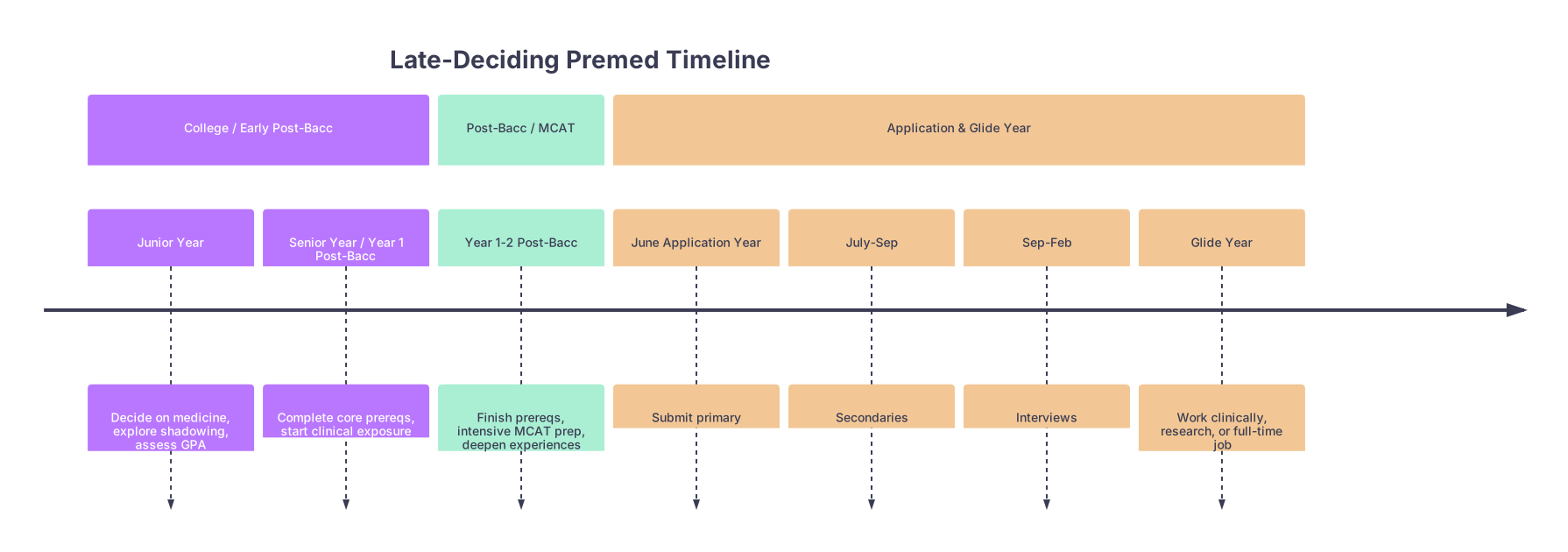
Here’s a rough application-year structure:
| Period | Event |
|---|---|
| College / Early Post-Bacc - Junior Year | Decide on medicine, explore shadowing, assess GPA |
| College / Early Post-Bacc - Senior Year / Year 1 Post-Bacc | Complete core prereqs, start clinical exposure |
| Post-Bacc / MCAT - Year 1-2 Post-Bacc | Finish prereqs, intensive MCAT prep, deepen experiences |
| Application & Glide Year - June Application Year | Submit primary |
| Application & Glide Year - July-Sep | Secondaries |
| Application & Glide Year - Sep-Feb | Interviews |
| Application & Glide Year - Glide Year | Work clinically, research, or full-time job |
Now let’s walk it chronologically, starting with junior year and ending with you starting a post‑bacc.
Junior Year: Realization, Recon, and Rescue Work
Junior Fall (or the semester you first decide)
At this point you should stop guessing and start gathering data.
1. Clarify your academic starting point
This week:
- Pull an unofficial transcript.
- Make a quick spreadsheet with:
- Every science course (bio, chem, physics, math, stats)
- Grades
- Credit hours
Then:
- Calculate:
- Cumulative GPA
- BCPM/sci GPA (Biology, Chemistry, Physics, Math)
- Flag:
- Repeated courses
- Withdrawals
- Any patterns (one bad semester vs chronic issues)
This shows you if you’re a good fit for:
- Undergrad record repair (still time to raise GPA as a junior)
- Post‑bacc for reinvention (if GPA is already significantly dented, think <3.3)
- Or SMP (special master’s) later (if you’re in big hole territory)
2. Get a quick read on your prereq gaps
Most med schools expect at least:
- 2 semesters of general chemistry + lab
- 2 semesters of organic chemistry + lab (or orgo + biochem, depending)
- 2 semesters of biology + lab
- 2 semesters of physics + lab
- 1 semester of biochemistry
- 1 semester of statistics
- 1–2 semesters of English / writing
At this point you should:
- Mark what’s done, in progress, and missing
- Note if your school offers post‑bacc‑friendly enrollment (non‑degree, 5th year, etc.)
3. Reality‑check your interest in medicine (fast, not perfect)
Within the next 4–6 weeks, aim for:
1–2 half-days of shadowing
- Easiest: ask your own PCP or campus health center
- Or cold‑email: “I’m a junior at [school] exploring medicine and wondered if I could observe you for a half day to better understand your work.”
1 consistent clinical exposure option identified for future:
- Hospital volunteer
- Medical scribe
- Hospice volunteer
- Free clinic volunteer
You don’t need 200 hours this semester. You need the first 10–20 hours to confirm you’re not chasing a fantasy.
4. Talk to real humans who know this terrain
By the end of the semester:
- Meet with:
- A premed advisor (yes, even if they’re bad; get the baseline info)
- 1–2 upperclass premeds or recent grads
- If possible, a current med student or resident (alumni, family, local hospital)
Ask:
- “If you were in my shoes as a junior starting late, what would you do in the next 6 months?”
- “How did your GPA, MCAT, and timeline look?”
- “Do you know anyone who did a formal post‑bacc?”
Take notes. Patterns in their answers matter.
Junior Spring: Decide Your Route and Start Positioning
By now you should have:
- GPA and science GPA roughly known
- A sense of whether medicine is real for you
- A rough list of missing prereqs
At this point you should design your next 2–3 academic years on paper.
1. Map two paths: “Stay at undergrad” vs “Post‑bacc later”
Scenario A – Still time to take many prereqs at your college:
- Plan out:
- Remaining semesters
- Which science classes you can realistically add
- Where you can fix GPA (take rigorous but manageable upper‑level sciences)
Scenario B – You’re too close to graduation / path too messy:
- Accept that:
- You’ll use a formal or DIY post‑bacc to clean things up later
- Junior and senior year will be about foundation and stability, not perfection
2. Junior Spring checklist
During this semester you should:
- Continue or start clinical exposure (even 3–4 hrs/week)
- Add one non‑science activity you actually like (music, sports, tutoring) so you’re not a robotic CV
- Identify 2–3 professors who could become future letter writers:
- Go to office hours
- Participate in class like you actually care
- Do not disappear after the midterm
Summer After Junior Year: The “Test Drive” Phase
This summer is where late-deciding premeds either confirm medicine or quietly let it go. Both outcomes are valid. But you should know by the end.
Your goals:
- Real clinical exposure
- Initial shadowing
- Early thoughts on post‑bacc vs staying path
Clinical/Shadowing Targets
By end of August, you should aim for something like:
- 50–80 hours clinical exposure (volunteering, scribe, MA, EMT, hospice)
- 20–40 hours shadowing across at least 2 specialties if possible
Not perfect numbers, but enough so you’ve seen real patient care.
Academic planning for senior year
By August you should:
- Have your senior year schedule drafted
- Decide:
- Are you front‑loading remaining sciences senior fall?
- Are there any “GPA-protection” decisions you need to make? (e.g., not taking 3 lab sciences + thesis at once)
You’re not racing other people’s timelines. You’re building a clean, upward trending record that post‑bacc programs and med schools can believe in.
Senior Year: Committing to the Post‑Bacc Path
If you realized late junior year, senior year is your transition year. If you realized in senior year, this same timeline still works—you’re just starting it a bit later.
Senior Fall: Lock In the Decision and Start Post‑Bacc Research
At this point you should stop thinking “premed major” and start thinking “post‑bacc candidate.”
1. Academics this semester
Your goals:
- Maintain or improve GPA
- Avoid transcript landmines (C– in orgo, withdrawals left and right)
- Build at least one strong academic relationship for a future LOR
You should:
Take:
- Any remaining foundational sciences your advisor recommends completing now
- Courses that show rigor + success (upper‑level bio, physiology, etc.), but not at the cost of tanking grades
Start compiling:
- Updated activity list (research, volunteering, leadership)
- A running document of meaningful experiences (will feed your future personal statement)
2. Start actively researching post‑bacc models
There are 3 main buckets:
- Career-changer formal post‑baccs
- For students with few/no science courses
- Examples: Bryn Mawr, Goucher, Scripps, Columbia
- Academic enhancer formal post‑baccs
- For students who took sciences but need GPA repair
- Examples: Temple ACMS, UC Davis post‑bacc, various state-school programs
- DIY post‑bacc at local university / extension
- You string together the courses; no linkage, less structure, more flexibility
By the end of the semester you should have:
- A shortlist of 5–10 programs with:
- Type (career changer vs enhancer)
- Required GPA/MCAT (if any)
- Linkage options
- Location, cost, length
Senior Spring: Applications and Exit Strategy
This is when a lot of people panic and try to cram MCAT + post‑bacc applications + senior thesis. Don’t.
At this point your main focus should be:
- Graduate cleanly
- Apply intelligently to post‑baccs
- Keep clinical exposure alive, even if minimal
1. Post‑bacc applications (Jan–May)
You should be:
Writing a personal statement that clearly explains:
- Why medicine
- Why now (late decision)
- How you’ve tested the decision (shadowing, clinical work)
- Why you need a post‑bacc (prereq completion vs GPA repair)
Requesting letters of recommendation:
- 2 science or relevant academic letters
- 1 character/professional (PI, supervisor, etc.) if requested
Applying on rolling timelines:
- Many formal post‑baccs fill early; you want to be in the first wave, not last.
2. Decide on your “gap year” vs immediate post‑bacc start
Most people fall into one of these:
- Graduate in May → Start post‑bacc that summer/fall
- Graduate in May → Work 1–2 years → Start DIY or formal post‑bacc later
By April/May you should know:
- Rough start date for your post‑bacc
- Location and cost, at least in ballpark
If You’ve Already Graduated: Year 0 After College
Let’s say you figured this out after graduation. You’re not behind. Your timeline just starts differently.
Months 0–3 Post‑Graduation: Assessment and Exposure
At this point you should treat this like a structured reset, not a random flail.
Month 0–1: Hard Assessment
You should:
- Pull transcript
- Calculate cumulative and science GPA
- List all science and math courses
- Mark prereqs completed vs missing
Then decide which bucket you’re in:
- Career changer – little/no science, decent GPA → career‑changer post‑bacc.
- GPA fixer – significant science with weak performance → academic enhancer post‑bacc / SMP later.
- Hybrid – some science, mixed grades → likely DIY or enhancer-type.
Month 1–3: Start proving you’re serious
You should:
Get clinical exposure:
- Scribe
- MA (if you can get quick training)
- CNA/EMT (slower to train but great long-term)
Arrange shadowing:
- Aim for at least 3–5 different days by the end of Month 3
Start post‑bacc research just like the senior-year folks:
- Build a spreadsheet of programs, requirements, and timelines
Year 1 of Post‑Bacc: The Academic Rebuild
Once you’re in a post‑bacc (formal or DIY), your life becomes structured. It has to.
This year has one central commandment: You do not screw up your second chance.
| Category | Value |
|---|---|
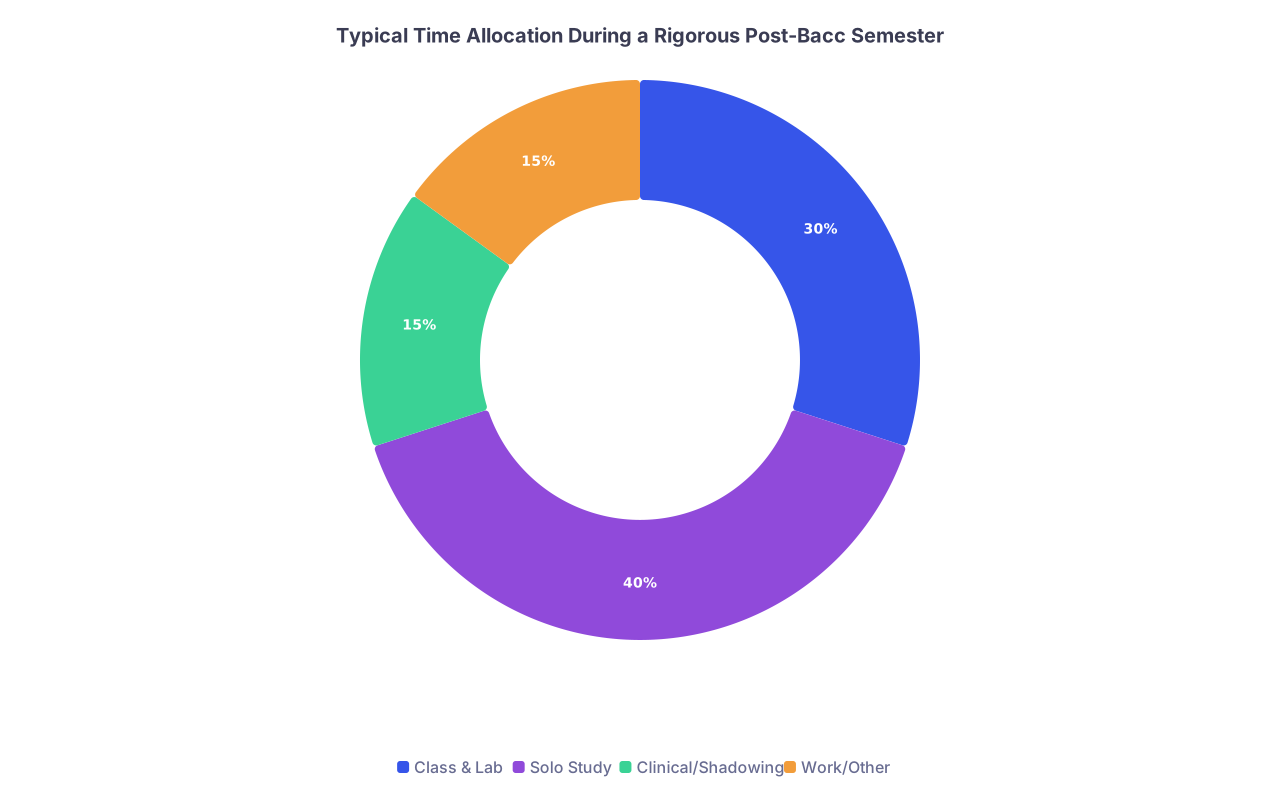
| Class & Lab | 30 |
| Solo Study | 40 |
| Clinical/Shadowing | 15 |
| Work/Other | 15 |
Pre‑Start (1–2 months before classes)
At this point you should:
Lock in housing, finances, and basic logistics
If DIY: finalize your course sequence for at least 2 semesters:
- Don’t overload first term. You’re proving you can get A’s.
- E.g., Term 1: Gen Chem I + Bio I + 1 non‑lab
- Term 2: Gen Chem II + Bio II + Physics I
Decide your work plan:
- If GPA is fragile, cap paid work to ≤10–15 hrs/week if possible
- Clinical roles > random retail; but academics still win
Post‑Bacc Year 1, Semester 1
Your job now is simple: A’s and consistency.
You should:
- Treat this semester like a MCAT prep foundation:
- Learn concepts well enough now that future MCAT studying is review, not discovery
- Build relationships:
- Attend office hours
- Be the student who asks thoughtful questions and follows through
- Keep light clinical exposure going:
- 3–5 hours/week is enough
- More is fine if (and only if) grades don’t slip
At the end of this semester you want:
- A clean A/A– transcript in your sciences
- 1–2 professors already in mind for future letters
Post‑Bacc Year 1, Semester 2
At this point you should start mapping your MCAT + application timeline.
You should:
Continue the A‑streak in slightly higher load or harder courses
Decide on your MCAT window, usually:
- After completing:
- Gen Chem I–II
- Org I (and often Org II or Biochem)
- Physics I–II
- Bio I–II
- Many post‑bacc students test:
- Summer after post‑bacc year 1, or
- Late summer/early fall of year 2
- After completing:
Clarify your application year:
- If you start post‑bacc in Fall 2025:
- MCAT: Summer 2026
- Apply: June 2027
- Matriculate: Fall 2028
- Glide year: 2027–2028
- If you start post‑bacc in Fall 2025:
Yep, that’s normal. Late‑deciders almost always have a glide year. It’s not a problem. It’s often an advantage.
Year 2 of Post‑Bacc (or Beyond): MCAT and Application Prep
By now, you should have:
- Strong recent science performance
- A coherent clinical story (not perfect, but real)
- At least 2–3 potential letter writers
MCAT Prep Phase (4–6 months)
At this point you should:
Pick a realistic test date based on:
- Course completion
- Life obligations
- Application year
Study timeline (rough example):
- Months 1–2: Content review + light practice
- Months 3–4: Heavy practice questions (UWorld, AAMC materials)
- Final 4–6 weeks: Full-length exams and corrections
Do not try to “squeeze” MCAT between 18 credits and 30 hours of work. I’ve watched that go badly more times than I can count.
Application Build (6–9 months before submission)
You should be:
Logging experiences with bullets and reflection:
- What you did
- What you learned
- A concrete moment/story
Planning your:
- Personal statement (1st draft 3–4 months before submission)
- Activity descriptions (start 2–3 months before)
- School list based on:
- GPA bands
- MCAT median ranges
- In-state vs out-of-state friendliness
FAQ (Exactly 2 Questions)
1. Should I do a formal post‑bacc or just take classes on my own (DIY)?
If your GPA is reasonably solid (say ≥3.4) and you mainly lack prereqs, a career‑changer formal program can be a fantastic accelerator—built‑in advising, cohort support, and sometimes linkage. If your GPA is weaker and you need serious repair, many formal “enhancer” programs exist, but DIY can also work if you’re disciplined, choose a reputable four‑year institution or strong extension, and rack up 30+ credits of A‑level science work. The non‑negotiable: whichever route you pick, you must show sustained academic excellence, not just “I took orgo at a community college and passed.”
2. Am I too old or too late if I decide on medicine in my mid‑20s or later?
No. The cycle gets longer—the realistic timeline from decision to med school may be 3–5 years—but mid‑20s, even early 30s, is very routine in post‑bacc programs. Adcoms care far more about whether your record, experiences, and story line up than whether you followed a traditional straight‑through path. If you handle each stage of this timeline deliberately—academic rebuild, authentic clinical exposure, thoughtful MCAT and application—you’ll look like a mature, intentional applicant, not a late, confused one. That’s the goal.