The biggest mistake reapplicants make is drifting into a post‑bacc without a ruthless, one‑year plan.
If you are using a post-bacc to rebuild your application, you do not have time to wander. You have exactly one application cycle to prove you’re not the same applicant you were last year. So we’re going to walk this month-by-month, then tighten it to week-by-week when things get busy.
This roadmap assumes:
- You were already rejected or waitlisted without acceptance.
- You’re starting (or about to start) a formal or DIY post-bacc.
- You want to use ONE application cycle to turn things around, not drag this out for three years.
(See also: Month-by-Month Timeline: From Post-Bacc Enrollment to AMCAS Submission for a detailed timeline.)
I’ll lay this out as if:
- Your post-bacc starts in August
- You apply in June the following year
If your dates shift, slide the timeline forward or backward—keep the sequence.
Big-Picture Year: What Has To Happen When
Before we dive into details, you need the skeleton of the year.
At this point, your year needs three parallel tracks:
Academic Repair (Post‑Bacc)
- 24–32 credits of hard science
- 3.7+ GPA this year (frankly, aim for 3.8–4.0)
- Strong upward trend visible before schools review your file
Score + Strategy
- MCAT retake if needed (yes, even if that hurts to hear)
- Fixing your school list and narrative
- Rewriting your personal statement and activities like a different person wrote them
Evidence of Growth
- New clinical exposure or continuity in existing roles
- Fresh letters of recommendation that speak to your “comeback”
- Specific reflection on what went wrong last time and what changed
Here’s your year as a timeline:
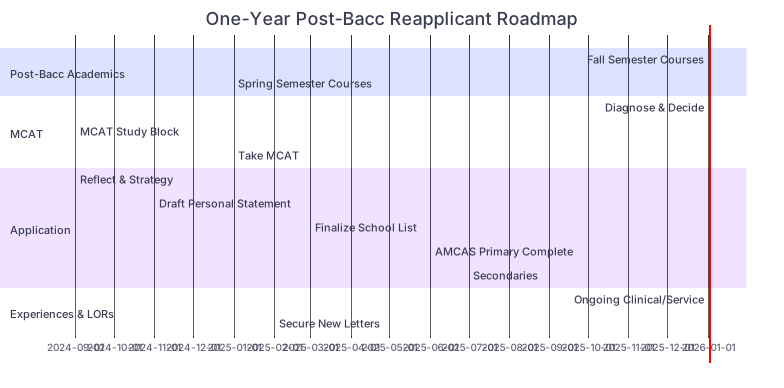
| Task | Details |
|---|---|
| Post-Bacc Academics: Fall Semester Courses | a1, 2024-08, 4m |
| Post-Bacc Academics: Spring Semester Courses | a2, 2025-01, 4m |
| MCAT: Diagnose & Decide | b1, 2024-08, 1m |
| MCAT: MCAT Study Block | b2, 2024-09, 5m |
| MCAT: Take MCAT | b3, 2025-01, 1m |
| Application: Reflect & Strategy | c1, 2024-09, 2m |
| Application: Draft Personal Statement | c2, 2024-11, 2m |
| Application: Finalize School List | c3, 2025-03, 1m |
| Application: AMCAS Primary Complete | c4, 2025-06, 1m |
| Application: Secondaries | c5, 2025-07, 2m |
| Experiences & LORs: Ongoing Clinical/Service | d1, 2024-08, 10m |
| Experiences & LORs: Secure New Letters | d2, 2025-02, 3m |
Step 1: Immediate Triage (Months 0–1, Right Now)
At this point, before you throw yourself into new classes, you need a post-mortem on your last application. No denial is allowed here.
Week 1–2: Brutal Debrief
Pull out your old application. Sit with it, not your feelings about it.
You’re answering three questions:
Stats problem?
- cGPA < 3.4, sGPA < 3.3 → yes, major problem.
- MCAT < 508 for MD or < 503 for DO → yes, probably problem.
- Massive grade trends (great last two years vs. early disaster) → needs explanation.
Strategy problem?
- Applied to <15 schools? Overly top-heavy list? Ignored DO entirely? That’s strategy failure, not fate.
- Late application (primary after August, secondaries into October)? You handicapped yourself.
Story & execution problem?
- Weak personal statement (“I’ve always wanted to help people”) = generic.
- Activities were job descriptions, not reflections.
- Letters from people who barely knew you.
Write your answers in one place. I’ve seen smart students skip this and then repeat the exact same errors. Admissions committees notice.
Week 3–4: Decide Your Post-Bacc Goals
Now that you know what went wrong:
If GPA is the main issue:
- Formal post‑bacc or DIY with upper-level science:
- Biochemistry, physiology, microbiology, cell biology, genetics, anatomy, etc.
- Your target: 3.7+ for at least 30 new credits.
- Formal post‑bacc or DIY with upper-level science:
If MCAT is the main issue:
- Block off a 4–5 month intense prep window.
- Do not take a full 20-credit semester plus MCAT if you historically struggle. That’s how people earn a second bad score.
If both GPA and MCAT are issues:
- This is a rebuild year, not a dabble year.
- Slightly lighter course load (12–14 credits) plus serious MCAT prep.
This is where you decide: will you actually do what’s necessary, or are you just “trying again” and hoping? The post-bacc isn’t magic. Your execution is.
Step 2: Fall Semester – Prove You’re Different (Months 1–4)
By the time fall grades post, adcoms should see the start of your comeback. That means your fall semester is not “let’s see how it goes.” It’s “I cannot afford a B in orgo again.”
Month 1 (August): Set the Academic Foundation
At this point, you’re starting classes.
Non-negotiables for the first two weeks:
- Build a weekly schedule:
- Every class meeting
- 2–3 hours of solo study per lecture per week
- MCAT slots (if studying now)
- Clinical/work hours
- Identify high-yield resources for each class:
- Recommended texts, Anki decks, office hours schedule
- Meet every professor once in office hours:
- Introduce yourself
- Mention you’re a reapplicant doing a post-bacc
- Ask what distinguishes A vs. B performance in their class
You’re not there to vent about last cycle. You’re there to signal: “I’m serious, and I will be one of your best students.”
Month 2 (September): Lock in Systems, Start MCAT Decision
At this point, the novelty has worn off. This is where people slip.
Your focus:
- Study process:
- Pre-read before lecture
- Active note-taking
- Same-day review
- Weekly cumulative review (Sunday, 2–3 hours)
- Assess your MCAT situation:
- Take one baseline full-length if your last MCAT is >1 year old or if content is rusty.
- If your previous real score was:
- ≤505 → you’re retaking, period.
- 506–509 → you probably should retake unless you’re heavy DO or have major hooks.
- 510+ with weak GPA → MCAT may be fine; focus on GPA and narrative.
If retaking, decide MCAT month now (likely January–March for this timeline).
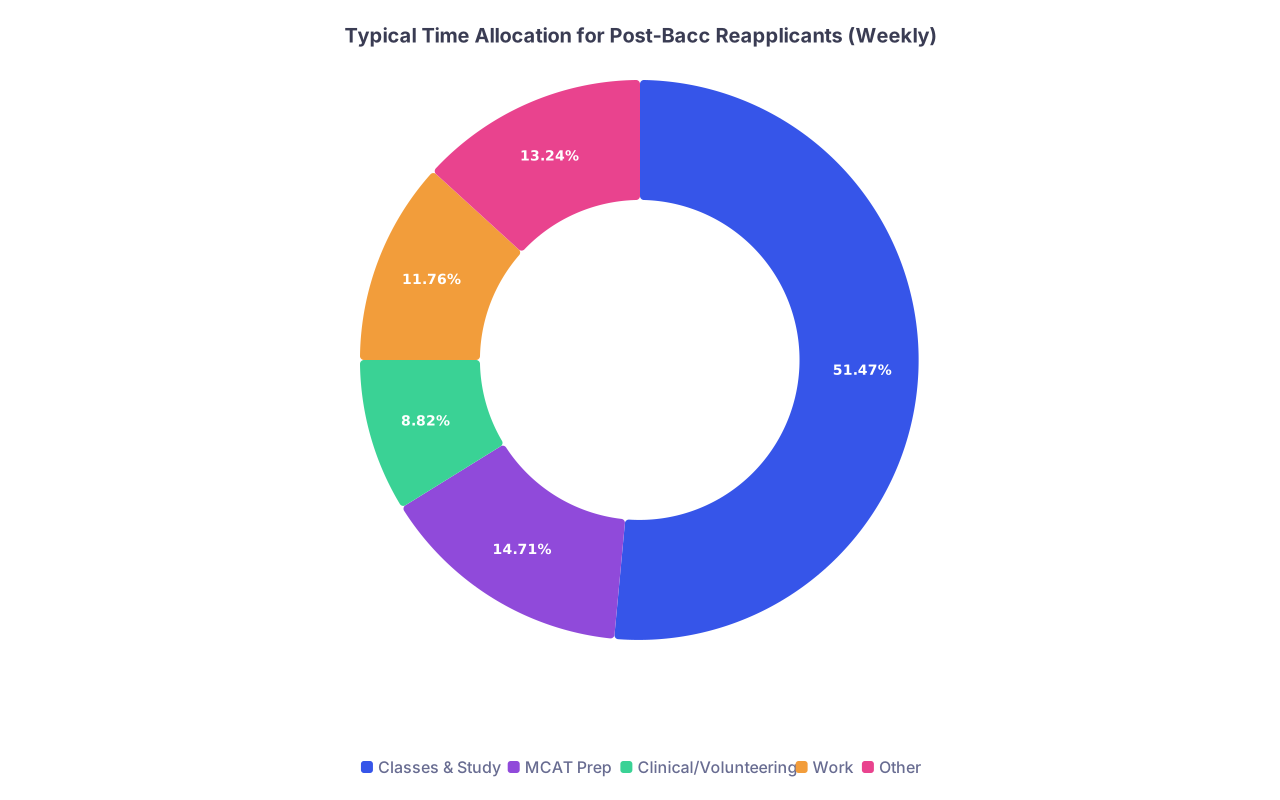
| Category | Value |
|---|---|
| Classes & Study | 35 |
| MCAT Prep | 10 |
| Clinical/Volunteering | 6 |
| Work | 8 |
| Other | 9 |
Month 3 (October): Midterm Reality Check
By now, you should have some graded work.
At this point:
- If you’re below an A-/B+ average in a course:
- Go to office hours weekly.
- Use tutoring if available.
- Fix the issue now, not after the final.
- Start structured MCAT prep if retaking:
- 3–4 days per week
- Focus on content gaps + question practice
- One full-length every 3–4 weeks once you’ve covered most content
You also quietly start your reflection work:
- One document with:
- What went wrong last cycle (short, honest)
- What you’re doing differently this year (very specific)
- What you’re learning about yourself during this comeback
This document will feed your personal statement and secondaries later.
Month 4 (November): Build Relationships, Start Application Skeleton
At this point, your professors know whether you’re serious.
Your tasks this month:
- Strengthen letter of rec prospects:
- Keep showing up prepared.
- Ask good questions.
- Volunteer answers in class.
- Start your school list rough draft:
- MD vs DO mix
- In-state/public vs private
- MCAT/GPA medians that fit where you will likely be after this year
Start jotting notes for your personal statement:
- A single turning point or theme that ties your previous failures + current growth.
- Not “I’ve always wanted to be a doctor.” That’s noise.
- More “Here’s where I failed, here’s what I learned, here’s how I changed.”
Month 5 (Early December): Lock in Fall, Plan Spring
As finals approach:
- Prioritize:
- Any course where you’re on the A-/B+ border → all-out effort.
- Review your planned spring courses:
- Avoid loading the hardest courses with your most intense MCAT month if you can.
- Aim again for 12–15 credits of upper-level sciences.
You should be ending fall with:
- A visible upward trend (ideally straight As or close).
- A clear MCAT date and preliminary study plan.
- A very rough sense of your application story.
Step 3: Winter + MCAT + Application Build (Months 5–8)
This is where the pressure multiplies. You’re doing:
- Spring post-bacc classes
- MCAT prep or exam
- Drafting your new application
Timing has to be intentional.
Month 6 (Late December – Early January): Reset and Commit
Between semesters:
- One week off. Actually rest.
- Then, 2–3 days of planning:
- Finalize your MCAT date (January–March is ideal).
- Confirm your spring schedule.
- Outline your application writing timeline.
If your fall grades were not stellar (say, 3.3–3.5):
- You must correct this in spring.
- Your story shifts to: “I rebuilt my approach after fall and here’s how I turned it around.”
Month 7 (January): Spring Launch + MCAT Sprint
At this point, you’re doing both:
Spring classes start
- Same system as fall, but with no warm-up period.
- You know what works now; implement it from Day 1.
MCAT final prep (if January/February exam)
- 15–20 hours per week.
- Weekly full-length exams 4–5 weeks before test day.
- Ruthless review: every missed question, why you missed it, pattern tracking.
If your MCAT is later (March/April), this month is heavy content review and section practice.
Month 8 (February): MCAT Peak + Begin Real Writing
At this point:
MCAT:
- If your exam is in February, this is all-out:
- One FL per week
- Daily review
- No new resources, just executing your plan
- If your exam is in February, this is all-out:
Writing:
- Start first actual personal statement draft:
- Different theme from last time (unless the old theme was unbelievably strong, which is rare)
- Clear reflection on growth, not just replaying the same story
- Start revising your activities list style:
- More reflection, less job description
- Emphasize leadership, resilience, and what changed between cycles
- Start first actual personal statement draft:
You also identify new letter writers:
- At least one post-bacc science professor who can speak to your recent performance
- Maybe a PI if you’re doing research, or a supervisor from a long-term clinical role
Step 4: Spring – Final Academic Push & Application Assembly (Months 8–11)
This is where your new profile becomes visible on paper.

Month 9 (March): MCAT Results + Data-Driven School List
Scenario A: You take the MCAT in January/February. By March:
- You have your score.
- You compare it to:
- Last score
- Target schools’ medians
If it’s:
- Improved and competitive (e.g., from 503 → 510, or 508 → 515):
- Good. You’re done. Do not chase perfection with another retake.
- Flat or worse:
- You must decide fast:
- Delay the cycle?
- Or take a late spring/early summer retake (high risk, must be very strategic)?
- You must decide fast:
Most reapplicants should not throw a second mediocre MCAT score onto their record. If you aren’t trending up in practice tests, reconsider.
Scenario B: Your MCAT is coming up in March/April.
- March is your heaviest prep month.
- Application writing still moves, but slower—don’t let it stop.
At this point:
- Refine your school list:
- 20–30 programs for MD/DO combined is normal for reapplicants.
- Use tools like MSAR (for MD) and the AACOM profiles (for DO).
- Favor schools that historically interview applicants with your stats and strong upward trends.
Month 10 (April): Writing in Earnest
Now your writing becomes your second full-time job.
Tasks this month:
Personal statement:
- Second and third drafts, with:
- A clear arc: past issue → insight → change → sustained action
- Evidence of maturity and honesty about your prior application
- Share with 2–3 smart, blunt people:
- One who knows you well
- One who doesn’t (reads it like an adcom)
- Second and third drafts, with:
Activities section:
- Update hours, roles, and reflections.
- Add:
- Post-bacc experiences
- New clinical exposure
- Leadership/growth moments since last app
Plan for secondary essays:
- Start a document with common prompts:
- “Why our school?”
- “Tell us about a time you failed.”
- “How have you improved your application since your last cycle?” (you’ll see this one)
- Start a document with common prompts:
Step 5: Late Spring – Lock Letters, Finalize Application (Months 11–12)
This is where you stop “preparing” and start finishing.

| Step | Description |
|---|---|
| Step 1 | Post-bacc Grades & MCAT |
| Step 2 | Draft Personal Statement |
| Step 3 | Revise Activities |
| Step 4 | Request Letters of Recommendation |
| Step 5 | Finalize School List |
| Step 6 | Submit AMCAS/AACOMAS Primary |
| Step 7 | Pre-write Secondaries |
| Step 8 | Submit Secondaries Within 2 Weeks |
Month 11 (May): Letters, Final Edits, Logistics
At this point:
Letters of Recommendation:
- Ask your post-bacc professors directly:
- In person if possible, or via a professional email.
- Provide:
- CV
- Draft of personal statement
- Brief summary of your journey as a reapplicant and why their perspective matters
- Make the ask clear: “Could you write me a strong letter of recommendation for medical school?”
- Ask your post-bacc professors directly:
Transcript logistics:
- Confirm that your post-bacc grades will be ready for AMCAS/AACOMAS in time.
- Know when final spring grades post.
- Request transcripts to be sent early.
Final application polishing:
- Clean up your personal statement.
- Make sure your story explicitly addresses growth from last cycle without sounding defensive or bitter.
Month 12 (June): Submit. Not “Work On,” Actually Submit.
Your job this month:
- Submit AMCAS/AACOMAS in the first 2–3 weeks of June.
- Perfectionism kills reapplicants. Do not drift into July “tweaking sentences.”
- Confirm that:
- All transcripts have been sent.
- Letters are uploaded or will be shortly.
You should also:
- Start pre-writing secondaries using prompts from previous cycles and online databases.
- Block off 4–6 weeks after verification for secondary essay writing.
Step 6: Summer – Secondaries and Showing Your Upward Trend
At this point, your primary is in. Now adcoms are looking for consistency between what you claim and what you’ve done.

July–August: Secondary Warfare
You treat secondaries like a series of short sprints, not a leisurely jog.
Your goal:
- Turn around each secondary in 7–10 days max, ideally faster.
Content to emphasize as a reapplicant:
- Specific changes:
- New GPA trend (with context: “In my post-bacc, I’ve completed 30 credits of upper-level biology with a 3.85 GPA.”)
- New MCAT score.
- New experiences or deeper commitment to ongoing ones.
- Specific lessons:
- What your previous rejection taught you about:
- Resilience
- How you study
- How you handle feedback
- What your previous rejection taught you about:
- Specific alignment with each school:
- Do not send generic “why us” essays.
- One or two tightly chosen reasons: curriculum style, mission, location, patient population.
You also keep:
- Ongoing clinical/volunteering. Even 3–4 hours/week of consistent work signals you’re not just gaming the system.
Step 7: The Payoff – How Your New Profile Looks on Paper
If you’ve actually followed this one-cycle rebuild, your “before vs after” will look something like this:
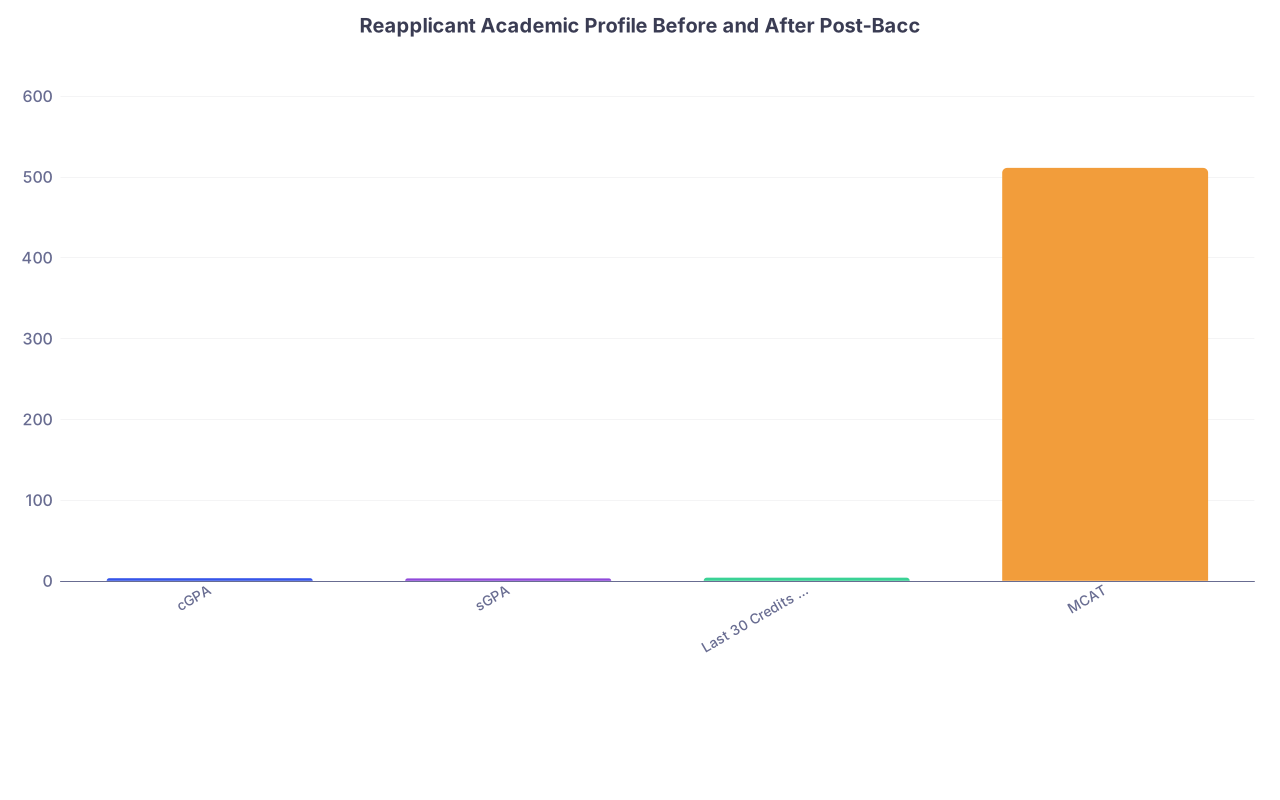
| Category | Value |
|---|---|
| cGPA | 3.2 |
| sGPA | 3 |
| Last 30 Credits GPA | 3.8 |
| MCAT | 511 |
(Imagine your old version had: cGPA 3.2, sGPA 3.0, last 30 credits 3.1, MCAT 503.)
That transformation is what makes adcoms pause and say, “OK, this person figured it out.”
The Non-Negotiables of a One-Cycle Rebuild
Let me be blunt: many reapplicants waste their post-bacc year. They take random classes, half-commit to the MCAT, and recycle the same application with a few tweaks. Those people usually get the same result.
If you want a different outcome using a post-bacc in one application cycle, lock in these core moves:
- Treat your post-bacc like an audition, not a do-over.
- Every exam, every class, every office hour is part of your case that you’ve changed.
- Plan the year backwards from your next application submission date.
- MCAT month. Transcript timing. Letter acquisition. Primary submission. None of this can be improvised.
- Show, don’t just say, that you’re not the same applicant.
- Strong new grades, improved MCAT (if needed), deeper experiences, and a mature, honest narrative that actually confronts your previous failure.
Follow the timeline. Make deliberate choices. And stop hoping the cycle will go better “this time” just because you want it more.