The wrong post‑bacc program can quietly sabotage your medical school chances.
Not because you are lazy. Not because you are unqualified. But because the program itself was designed for marketing, not for getting students into MD and DO schools.
You are not just picking classes. You are choosing the next 1–2 years of your life, your GPA trajectory, your MCAT prep environment, and the letters behind your name. If you ignore red flags, you may spend $40,000+ and end up explaining “what went wrong” on every future interview.
Let’s walk through 10 specific post-bacc program features that should make you pause, dig deeper, or walk away.
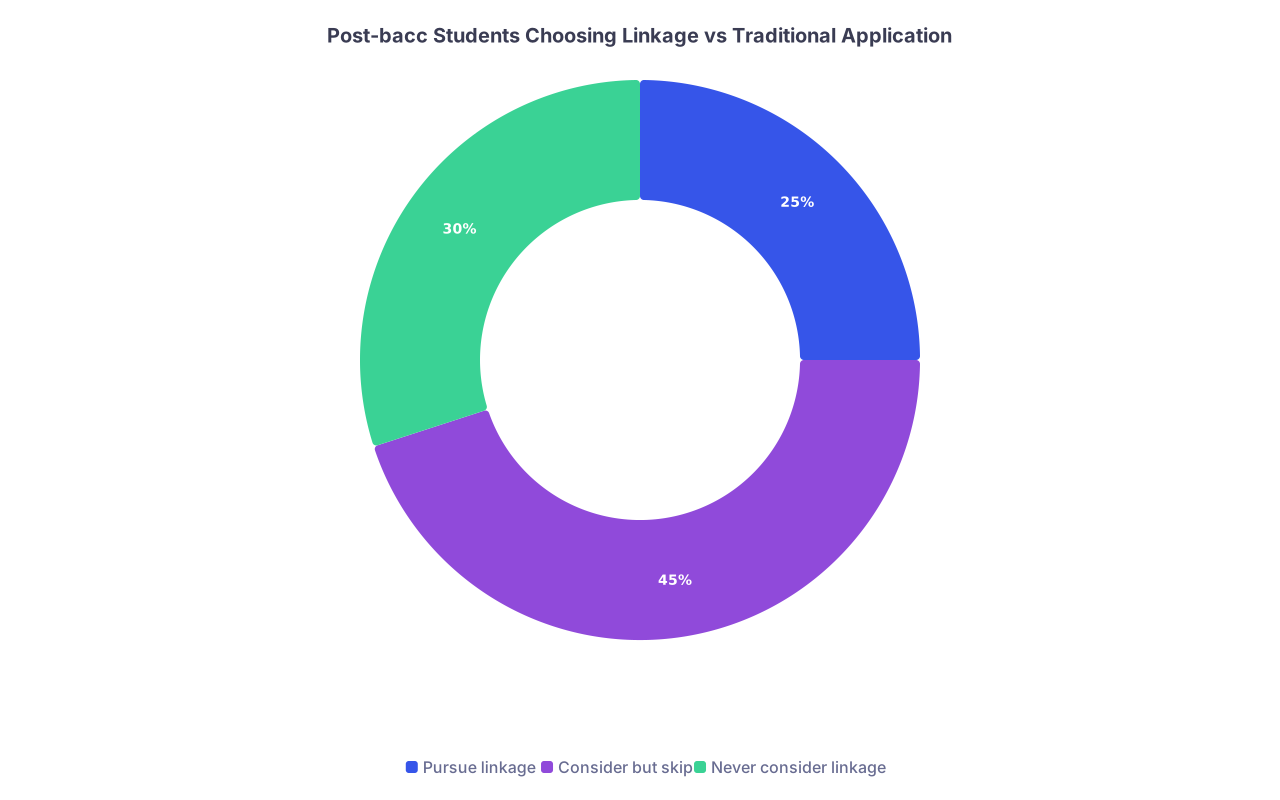
1. “Guaranteed Interview” or “Linkage” That Isn’t Really Guaranteed
The phrase “guaranteed interview” is one of the most abused marketing tools in post-bacc land.
(See also: GPA Repair Gone Wrong for insights on common pitfalls.)
The mistake: Believing “guaranteed interview” or “linkage” means you are basically in if you just show up.
The danger is in the fine print:
- “Guarantee” only applies if you:
- Earn a 3.7+ post-bacc GPA
- Score a 515+ MCAT
- Have no prior academic issues
- Are recommended by a committee letter
- The “linked” med school may:
- Be unaccredited or newly accredited with no track record
- Be abroad or offshore (Caribbean, etc.)
- Have low residency match rates
Red flags to watch for:
- No clear written criteria for the linkage or interview guarantee
- Vague statements like “strong consideration for admission” or “preferred applicant status” instead of specific outcomes
- Linkages only to one low-ranked or extremely new school with unknown outcomes
- Current or former students saying, “Basically nobody actually gets the interview” on Reddit or SDN
Avoid this trap by:
- Asking directly:
- “How many students met the linkage criteria in the last 3 years?”
- “How many actually matriculated to the linked med school?”
- Getting numbers, not adjectives:
- “Some” and “many” are useless. You want “12 out of 18” or “3 out of 25.”
If a program sells the linkage harder than they show real acceptance outcomes, that’s not a pathway. It is bait.
2. No Published Med School Acceptance Data (Or Suspiciously Vague Numbers)
Any serious post-bacc that claims to help premeds should know and share its results.
The mistake: Trusting “excellent outcomes” without seeing hard data.
Common tricks:
- Reporting “medical school acceptance” without separating:
- MD vs DO
- US vs Caribbean/offshore
- Recent graduates vs total alumni over 10 years
- Highlighting the one superstar (520 MCAT, 4.0 GPA) in all the marketing while the majority quietly disappear
- Saying “80% of our graduates go on to health professional schools” but that includes:
- Dental, PA, NP, podiatry, pharmacy, etc.
- Or even “health-related careers” with no clear definition
Red flags:
- No chart or PDF with acceptance stats over at least 3 recent cycles
- Numbers that are “lifetime” rather than recent:
“Since 1995, 500 students have gone to medical school” tells you nothing about how the program is doing now - They won’t break down:
- How many applied vs how many were accepted
- Median MCAT and GPA of their accepted students
- Where people actually matriculated
When you ask for more detail and they respond with, “Our students do very well,” you are not getting data. You are getting sales language.
How to protect yourself:
- Ask: “For the last 3 application cycles:
- How many students applied to MD/DO schools?
- How many were accepted to at least one US MD or DO program?
- Can you share a school list of where students actually enrolled?”
- Compare their results to national averages for your stats. If they are worse than or equal to what you could do on your own, why pay them?
If a program cannot clearly show that it improves your odds, assume it does not.
3. Open-Enrollment Programs That Admit Anyone With a Pulse
Open-enrollment post-baccs can be helpful in some cases, but they carry hidden risks.
The mistake: Thinking “easy to get into” automatically means “good second chance.”
Here’s the problem: If a program admits almost everyone:
- Your classmates may include:
- People not serious about medicine
- Students who repeatedly withdraw or fail courses
- People treating the program like “extra college” rather than career preparation
- The curve may not protect you
- Professors may teach to the lowest level of preparedness
- The program’s overall reputation with medical school admission committees may be weak
This can hurt you by:
- Diluting the meaning of a 4.0 post-bacc GPA (adcoms know some programs are grade-inflated and non-selective)
- Making it harder to get strong, targeted letters of recommendation if faculty are overwhelmed by high turnover
- Putting you in big, impersonal lecture settings with little structure, exactly what you were trying to escape
Red flags:
- No minimum GPA requirement, or something absurdly low like “2.0 cumulative”
- Application consists of a form and payment, no real screening
- Marketing language that focuses only on “flexibility” and “easy enrollment,” not outcomes or rigor
- You can enroll the week before classes start with zero advising
This does not mean every open-enrollment program is garbage. Some students do well in them. But if you have significant GPA repair to do, you need:
- Demonstrated academic rigor
- Some degree of selectivity
- Real advising and oversight
You are trying to show medical schools that you can handle a med-school-like environment. If your post‑bacc looks like a random extension program, that message doesn’t land.
4. No Real Academic Advising or Premed Support
A “premed post-bacc” without strong advising is like a plane without instruments. You might still fly, but you are doing it blind.
The mistake: Assuming “there’s an advisor” means you’ll get actual strategy, guidance, and feedback.
Weak advising looks like:
- Advisors who:
- Don’t know AMCAS or AACOMAS rules in detail
- Can’t explain how withdrawals, repeats, or institutional actions appear on your application
- Have never seen an actual AMCAS GPA breakdown
- No help with:
- Course sequencing for MCAT preparation
- Whether you need upper-division sciences vs just repeating intro courses
- Deciding whether to apply MD only, DO only, or both
- No structured support for:
- Personal statement development
- School list building
- Secondary strategy and timeline
- Mock interviews
Red flags:
- Advising is limited to picking classes, not planning your entire premed trajectory
- High advisor-to-student ratio (e.g., 1 advisor for 200+ students)
- Appointments are 15 minutes, booked 4–6 weeks out
- They advertise “committee letters” but:
- Provide no clear criteria
- Don’t explain what happens if you don’t get one
- Use them to control or delay applications
Ask:
- “How many dedicated premed advisors do you have?”
- “How many students are they responsible for?”
- “Do you help with personal statements, school lists, and interviews, or just course registration?”
- “What percentage of your students receive a committee letter?”
If advising is basically, “Here’s the course catalog, good luck,” that is not a premed program. That is tuition collection.
5. Programs That Bury You in Non-Science Coursework
You are not doing a post‑bacc for fun electives. You are trying to fix or strengthen the part of your record that matters most: your science performance and academic rigor.
The mistake: Choosing a program that looks full-time on paper but is padded with non-science credits.
Symptoms of this mistake:
- 30-credit “certificate” where:
- Only 8–12 credits are hard sciences (orgo, biochem, upper-level bio)
- The rest are “professional development,” “healthcare ethics,” “communication,” “leadership,” etc.
- Heavy emphasis on “career seminars,” “reflection courses,” and pass/fail electives
- Marketing that says: “You can complete this entire program without taking organic chemistry!”
Red flags:
- Required core includes more non-science than science
- Their sample schedules don’t look anything like a rigorous STEM course load
- Program directors say, “Medical schools will see your commitment,” but cannot articulate how the curriculum proves academic readiness
For most applicants (especially GPA repair students), your priorities should be:
- Enough hard science at a high level to:
- Raise your science GPA meaningfully
- Show you can handle med-school-like volume and difficulty
- Courses that help with the MCAT:
- Biochemistry
- Cell biology
- Physiology
- Psychology/sociology (ideally rigorous versions)
Non-science courses can help, but they should not dominate.
A 3.9 in “Health Humanities” and “Intro to Leadership in Healthcare” moves the needle far less than a 3.7 in biochem, physiology, and upper-level bio.
6. Minimal or No Access to Upper-Level Sciences
A common post-bacc design flaw: Everything stops at the introductory level.
The mistake: Assuming basic prereqs (Gen Chem, Bio, Orgo, Physics) are enough to impress med schools if your undergrad record is weak.
For career changers with no previous science, an intro-heavy program can be appropriate. But for academic enhancers trying to repair a 2.9–3.2 GPA, it’s not enough.
Red flags:
- Program offers:
- General biology I & II
- General chemistry I & II
- Organic I & II
- Physics I & II
- Maybe a token biochem
And that’s it.
- No opportunity to take:
- Physiology
- Microbiology
- Molecular biology
- Genetics
- Anatomy (if offered at a rigorous level)
- No integration with the wider university to let you enroll in advanced courses outside the “post-bacc track”
Medical schools look for evidence that:
- You can excel in advanced scientific material after your earlier struggles
- Your upward trend isn’t just from “easier” or lower-level courses
Fix this by:
- Prioritizing programs that:
- Explicitly advertise upper-division course access
- Show sample transcripts with advanced sciences
- Let you extend your time to take extra upper-level bio/chem if needed
- Asking:
- “Can post-bacc students enroll in 300/400-level biology and chemistry courses with majors?”
- “Do you restrict us to a specific track, or can we add rigorous electives?”
If the program locks you into only basic prereqs, ask yourself: will this transcript actually change an admissions committee’s opinion of your academic ability?
7. Grade Inflation, Grade Deflation, and Transcript Games
Some programs are known for being either absurdly easy or brutally harsh. Both can be a problem.
The mistake: Ignoring a program’s grading culture and how that looks from the other side of the table.
Grade inflation risks:
- You get a 4.0, but:
- Everyone else does too
- Exams are recycled, curves are generous, and expectations are low
- Adcoms familiar with the school discount your performance
(“We know that place. A 4.0 there is not the same as a 3.7 at a rigorous institution.”)
Grade deflation risks:
- Courses are designed as “weed out” for undergrads, not GPA repair for post-baccs
- Exams are set up so that the median is a 50–60%, with minimal curve
- You end up with a 3.1–3.3 post-bacc GPA despite massive effort, which doesn’t help your overall narrative
Transcript games to watch out for:
- Mandatory pass/fail “readiness” courses that:
- Don’t count toward GPA but eat time and tuition
- Let the program say, “You completed our curriculum!” without giving you graded proof of improvement
- Administrative policies that:
- Make it very hard to repeat a course for a better grade
- Limit how many science credits you can take each term, slowing down your repair
Red flags:
- Current or former students frequently mentioning:
- “Everyone gets A’s if you just show up”
- Or the opposite: “Nuclear grading, nobody can get an A”
- Professors known for:
- Not curving
- Being proud of high failure/withdrawal rates
Before committing:
- Ask current/former students on Reddit, SDN, or Discord:
- “Are post-bacc grades here respected by med schools?”
- “Is it realistic to earn mostly A’s if you are disciplined?”
- Look for balance:
Rigor + fairness + the realistic possibility of earning A’s with consistent effort.
You are not trying to prove you enjoy suffering; you are trying to construct a believable story of academic redemption.
8. No Integration With the Main Campus or Isolation From Premed Resources
Some post-baccs exist in a weird academic silo.
The mistake: Joining a program that lives entirely separate from the university’s real premed infrastructure.
Symptoms:
- Your courses are:
- Off-campus
- At night only
- Taught mostly by adjuncts with little connection to the main department
- You have:
- No access to premed club events
- No access to undergraduate research opportunities
- No chance to attend premed workshops intended for degree-seeking students
- You are treated as:
- A “continuing education” student, not a full member of the academic community
Why this matters:
- Letter writers from isolated programs may:
- Not be well-known to admission committees
- Not be involved in traditional department activities like research or honors programs
- You miss out on:
- Shadowing and volunteer pipelines often coordinated through main campus offices
- Opportunities to conduct or assist with research
- Some med schools will notice if your entire record is from a “satellite campus” or continuing ed unit with weaker oversight
Red flags:
- Your ID card is different from degree-seeking students’ cards
- You cannot register for the same classes as undergrads
- Post-bacc students are prohibited from:
- Research labs
- Honors science courses
- Campus pre-health advising events
Look for programs that:
- Explicitly state you take classes alongside degree-seeking students
- Provide access to:
- Pre-health advising office
- Career center
- Research opportunities or at least connections
- Encourage integration, rather than walling you off into “post-bacc only” sections for everything
9. Overpriced “Brand Name” Programs With Weak Individual Support
That Ivy League or top‑20 university logo is tempting. Some elite schools run excellent post‑baccs. Others run revenue machines.
The mistake: Paying for the brand without confirming what you actually get.
Risks:
- You pay $40,000–$60,000+ in tuition and fees for:
- Crowded lecture halls
- Advising that treats you like a number
- A certificate that impresses your parents far more than admissions committees
- You discover:
- The program is designed to generate money from hopeful premeds, not optimize outcomes
- Only the top 10–20% of students get full support, strong letters, or committee backing
Red flags:
- Huge cohort sizes (100+ new post-bacc students per year)
- Extremely limited committee letters:
- Only the “top tier” gets them
- Others are quietly discouraged from applying
- Vague language like “students who complete our program are very competitive” without data
- A strong reliance on brand prestige in marketing materials, minimal focus on structured support
Ask:
- “How large is each incoming cohort?”
- “What percentage of students apply to medical school with a committee letter from your program?”
- “How many students start the program vs how many complete it and actually apply?”
- “What is the median MCAT and GPA of students who successfully matriculate to med school from your program?”
The school’s name on your transcript can help—but only if paired with clear evidence of academic excellence and strong letters. Prestige alone cannot fix a broken advising structure or indifferent faculty.
10. No Flexibility for Your Specific Situation (Career Changer vs GPA Repair)
Not all post‑bacc students are the same, and any program that treats them as identical is dangerous.
The mistake: Entering a one-size-fits-all program that doesn’t match your real needs.
Two very different profiles:
Career changers
- Little to no prior science
- Decent or strong undergrad GPA (often 3.3–3.8)
- Need to complete prerequisites and build a science foundation
GPA repair/academic enhancers
- Significant prior science, often with:
- Cs and Ds in core courses
- Low science GPA (sometimes 2.5–3.1)
- Need:
- Upward trend
- Advanced coursework
- Evidence that previous patterns have changed
- Significant prior science, often with:
Red flags:
- Program doesn’t clearly distinguish between its:
- Career-changer track
- Academic enhancer track
- Everyone takes intro-level courses regardless of:
- Previous grades
- MCAT timing
- Long-term academic plan
- Program leadership gives generic advice like:
- “Everyone should take all prerequisites again”
- “We don’t really focus on upper-level sciences”
For career changers:
- A structured, prereq-focused program can work well
- But you still need:
- Advising on timeline
- MCAT planning
- Exposure to clinical and volunteer experiences
For GPA repair students:
- A career-changer style program can waste time and not raise your GPA enough
- You may need:
- Selective repeats combined with upper-level work
- Strategically chosen courses that count heavily in your science GPA calculation
Protect yourself by:
- Clearly identifying which profile you fit before applying
- Asking:
- “How do you tailor the program for career changers vs GPA-repair students?”
- “Do you have separate tracks or advising pathways?”
- “Can I see sample course plans for both?”
If the program treats everyone the same, it will inevitably fail someone—usually the ones with the most to lose.
Final Thoughts: The Red Flags You Cannot Afford to Ignore
Three points to keep at the front of your mind:
- If a program cannot show clear, recent, MD/DO-specific outcome data, treat every promise as marketing, not reality.
- Your post‑bacc must demonstrate rigorous, recent science excellence—intro-only, padded, or non-selective programs rarely do that well.
- Advising, structure, and transparency matter as much as prestige; a fancy logo does not compensate for weak support and vague promises.
Choose a post‑bacc that protects your effort, your money, and your future narrative—not one that quietly adds another problem you will have to explain later.