The name on your undergraduate diploma is not your destiny. But if it’s from a less-known school, you can’t pretend it doesn’t matter. Medical schools will notice. The question is whether you give them a reason to care—or a reason to be impressed anyway.
If you’re coming from a small regional college, an online-heavy program, a non-selective state school, or just a place nobody in admissions has ever heard of, you’re playing on “hard mode” by default. That doesn’t mean you’re doomed. It means you need to be strategic. A post-bacc can be your best move—but only if you understand what problem you’re solving and how to pick the right program.
Let’s walk through how to think about this like an adult, not a victim.
Step 1: Be Honest About What Your Undergrad Is Signaling
Forget what your friends say. Forget what your school’s premed advisor (if you even have one) tells you to keep morale high. Here’s how admissions people actually think.
When they see a less-known or less-selective undergrad, a few questions kick in:
- “How rigorous was this curriculum, really?”
- “Would their GPA look the same at my alma mater or a top-50 university?”
- “Has anyone from this school succeeded here before?”
They’re not automatically docking you points, but you’re not getting any “prestige boost” either. You’re starting neutral-to-skeptical, not neutral-to-optimistic.
Now combine that with:
- A 3.3–3.5 GPA
- Limited research opportunities
- Generic letters from assistant professors nobody knows
- Few (or no) prior matriculants to med school from your college
You can see the problem. They don’t have independent proof that you can survive (and excel) in a high-octane academic environment. A post-bacc is one very direct way to give them that proof.
Step 2: Know Exactly What a Post-Bacc Can Fix (And What It Cannot)
A post-bacc is not an “image upgrade.” It’s a tool. You use it to fix specific weaknesses. If you do not know what those weaknesses are, you will waste time and money.
Here’s what a post-bacc can realistically do for someone from a less-known school:
- Demonstrate you can crush rigorous science courses in a tougher environment
- Repair or elevate a mediocre GPA trend
- Put you in front of faculty who routinely write strong premed letters
- Plug you into a pipeline that med schools actually recognize and trust
- Give you access to clinical, research, and shadowing setups you probably lacked
What it cannot do:
- Erase a disastrous undergrad record (like a 2.3 overall with no upward trend) in one year
- Magically turn you into a competitive MD applicant without a strong MCAT
- Fix a weak work ethic or chronic procrastination
- Compensate for nonexistent clinical exposure
So before you start Googling “best post-bacc programs,” you need to be brutally clear:
What, exactly, are you asking a post-bacc to prove about you?
If your answer is “I want med schools to take me seriously coming from [Random College X],” then the thing you need to prove is: I can thrive in a more demanding, more competitive classroom and environment.
That’s solvable. But only if you choose the right type of program and execute cleanly.
Step 3: Decide If You Actually Need a Post-Bacc
Some of you don’t. Some of you absolutely do. Let’s sort it out.
You probably need a post-bacc if:
- Your undergrad is not well-known regionally or nationally, AND
- Your cGPA is <3.5, or
- Your science GPA is <3.4, or
- You had a rocky start (C’s in core sciences) and only improved later, or
- Your school has almost zero track record of sending people to med school
You might need a post-bacc if:
- Your GPA is solid (3.6+), but:
- Your science coursework was relatively light or lower-division heavy
- You lack strong letters from serious science faculty
- You had limited or low-quality clinical exposure
You probably don’t need a post-bacc if:
- You have a 3.7+ from a less-known school,
- Strong MCAT (515+),
- Consistent A/A- in upper-level sciences,
- Substantial clinical experience and meaningful extracurriculars,
- And at least one advisor or mentor who’s successfully guided others to med school.
In that scenario, your undergrad name is not your bottleneck. You’d get more ROI focusing on MCAT, clinical hours, and targeted school selection.
But if your gut feeling is, “My app will look flimsy or unproven next to others,” you’re not wrong—and that’s exactly where a good post-bacc helps.
Step 4: Pick the Right Type of Post-Bacc for Your Situation
Not all post-baccs are created equal. Some are glorified continuing-ed. Some are straight-up cash grabs. Some are powerhouses that quietly send a chunk of their class into med schools every year.
At a high level, you’re looking at three major flavors:
1. Career-Changer (You Haven’t Done the Prereqs)
If you majored in something far from science and your school wasn’t known, this type of program lets you:
- Take the full premed sequence (bio, chem, orgo, physics, biochem)
- Do so in a setting med schools recognize
- Show that you can handle STEM work at a high level
These are often at name-brand universities (e.g., Columbia SPS, Bryn Mawr, Goucher, Scripps). From a weaker undergrad, landing in one of these is a strong signal: “I can hang academically with serious peers.”
This is a good path if your GPA is okay but you just lacked the coursework.
2. Academic Enhancer (You’ve Done the Prereqs, Need Stronger Record)
This is the more common path for you if you already did a bio/chem-related major at a less-known school, but:
- Your grades were mixed (some B-/C+ in early sciences)
- Your school’s rigor and reputation are question marks
- You want to prove you can dominate upper-level sciences
These programs might be:
- Structured undergrad-level post-baccs for GPA repair
- Special Master’s Programs (SMPs) with med-school-level courses
For someone from a less-known undergrad, a well-chosen SMP or reputable enhancer is often the clearest “I belong in med school” statement you can make. Especially if you can handle exams written and graded like actual med school exams.
3. DIY Post-Bacc (You Build Your Own)
At a local state university or extension program, you:
- Enroll as a non-degree or second-degree student
- Take upper-level science courses (physiology, immunology, micro, etc.)
- Aim for straight A’s in 24–32 credits
- Build relationships for letters
This can work very well if money is tight or you can’t relocate. But from a less-known undergrad, you need to be thoughtful: a DIY at another equally anonymous campus may not fix the “unknown institution” concern unless you absolutely annihilate the coursework.
Step 5: Use the Post-Bacc to Fix the “Unknown School” Problem Directly
Let’s talk tactics. You’re not just collecting credits. You’re building a story that says:
“Yes, I come from [Small College X]. No, that doesn’t define my ceiling. Look at what I did next.”
Here’s how you actually do that.
Aim for Overperformance, Not Survival
This is not the time to “do okay.” You are trying to reset how admissions committees see you.
Target:
- 3.7+ in a traditional undergrad-level post-bacc
- 3.6+ in a legit SMP with med-school-style grading
- A sharp upward trend compared to undergrad, especially in hard sciences
Anything less than that and you lose a big chunk of the advantage you’re trying to buy with time and tuition.
Choose Courses That Scream “Rigor”
Do not hide in fluffy electives. You want a transcript that makes an adcom say, “These are real classes.”
Good options:
- Human physiology
- Biochemistry (if not already taken)
- Cell biology
- Microbiology
- Immunology
- Genetics
- Anatomy (if offered at a serious level)
If you can handle any course that overlaps with medical school M1 content (systems physiology, advanced biochem, etc.), all the better.
Build Relationships, Not Just Credits
A post-bacc at a stronger institution helps precisely because it puts you in the orbit of:
- Faculty who routinely write med school letters
- An advising office that actually knows how this game works
- Peers also aiming for med/dental/PA schools
You should leave your program with at least:
- 2 strong science letters from faculty who know your work ethic, character, and performance
- 1 letter from a program director or advisor (if available) who can say, “We know their undergrad; they outperformed many of our traditional students here”
This is how you reframe your background. The story becomes: “We’ve seen lots of students from big-name and small schools; this person is at the top of the pile in this context.”
Step 6: Use Program Reputation and Linkages Strategically
Coming from a less-known undergrad, you benefit enormously from “borrowed credibility.”
Some structured post-baccs and SMPs have:
- Formal linkages: If you hit certain GPA/MCAT thresholds, you’re guaranteed an interview or even a seat at a partner med school.
- Informal pipelines: Schools that know, “We like students from this program; they do well here.”
Yes, these programs are usually more expensive and more competitive. And yes, they are often worth it for someone in your exact situation.
You’re trying to move from:
“Applicant from [Unknown College Y] with a 3.3 and some B’s in orgo”
to
“Top 10% graduate of [Respected Post-Bacc/SMP] with A’s across upper-level sciences and a strong MCAT.”
Same human. Different narrative.
If you can get into a program with a known track record—think Georgetown SMP, Boston University MAMS, Cincinnati, EVMS, Temple ACMS, or a reputable undergrad post-bacc—your undergrad name matters a lot less afterward.
Step 7: Do Not Ignore the MCAT Just Because You’re “Fixing GPA”
Here’s a blunt truth: if you come from a less-known school and you also deliver a mediocre MCAT, adcoms will assume your undergrad GPA was inflated. Whether that’s fair or not isn’t the point. It happens.
Your post-bacc and your MCAT have to work together.
- Solid post-bacc + strong MCAT = “Okay, this person is legit. Their performance scales.”
- Solid post-bacc + weak MCAT = “Maybe their coursework wasn’t that hard either.”
So you time it correctly:
- Start your post-bacc.
- Prove you can handle higher-level science and a heavier load.
- Then, with that foundation and new discipline, prep for the MCAT.
Do not burn your only good MCAT attempt before you’ve fixed your study habits and academic engine via the post-bacc. From a weaker undergrad, you don’t have the margin for multiple poor scores.
Step 8: Money, Time, and Reality Checks
You’re not choosing between “post-bacc or nothing.” You’re choosing between:
- Apply now and likely strike out or land mostly DO/caribbean (depending on stats), OR
- Spend 1–2 years, significant money, and serious effort to become a clearly stronger, more credible applicant
From a less-known school, the return on a well-executed post-bacc is usually high. But only if:
- You can actually afford to live and study with minimal work, or
- You have a plan to balance part-time work without tanking your grades
Cut through the fantasy.
If you know you’ll need to work 40 hours a week to survive, taking 12–15 credits of brutal upper-level science at night is a fast path to mediocrity. Don’t do that. Better to:
- Work 20–25 hours, take 8–10 credits per term, stretch it slightly longer, and aim for perfection
than - Overload, burn out, and walk away with a 3.3 post-bacc GPA that changes nothing.
Think outcomes, not optics. Nobody cares how fast you did it; they care how well.
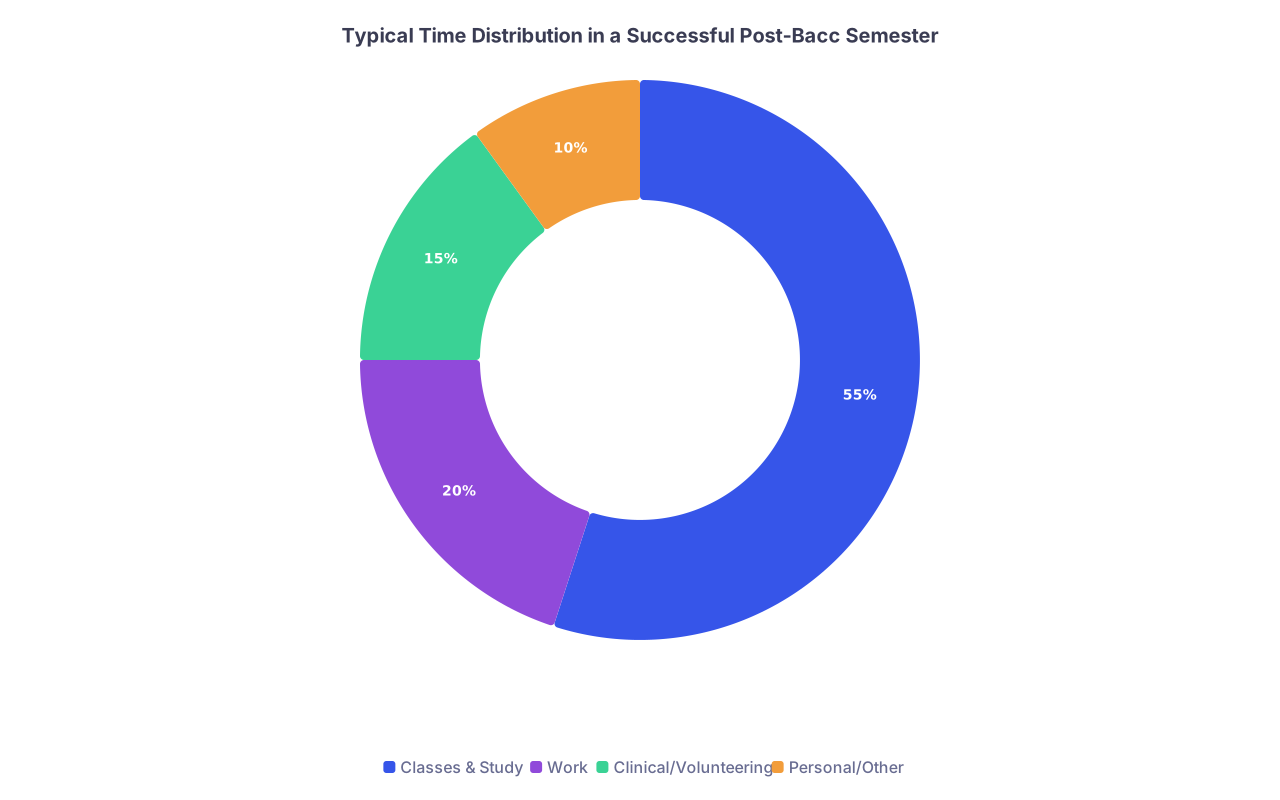
| Category | Value |
|---|---|
| Classes & Study | 55 |
| Work | 20 |
| Clinical/Volunteering | 15 |
| Personal/Other | 10 |
Step 9: How to Talk About Your Undergrad and Post-Bacc in Applications
You don’t whine about your undergrad. You frame it.
Your goal in the application is to say, implicitly:
“Yes, my undergraduate institution is not a household name. That’s exactly why I sought out a more rigorous environment and proved myself again.”
In your personal statement and secondaries, you can:
Mention limited opportunities at your undergrad briefly and specifically, not as an excuse:
“At my small regional college, there was no premed committee and limited research, so I had to seek shadowing and clinical exposure in community settings.”Then immediately pivot to what you did about it:
“After graduation, I enrolled in [Program] to challenge myself with advanced science coursework alongside other premedical students. There, I...”
You are showing initiative and agency. Not victimhood.
Letters from your post-bacc faculty should reinforce the point: “Despite coming from a smaller, less-resourced undergrad, this student thrived in our environment and matched or exceeded peers from traditionally stronger backgrounds.”
Now the undergrad name is context, not a liability.
Step 10: A Concrete Example So You Can See the Path
Let’s take a composite of students I’ve seen in this exact situation.
- Undergrad: “Midwest Valley College” (think 2,000 students, nobody outside the region knows it)
- Major: Biology
- GPA: 3.32 overall, 3.25 science
- MCAT: None yet
- Clinical: 60 hours of hospital volunteering, 20 hours shadowing
- Research: None
If this student applies straight away to MD programs, they’re dead in the water at most places. Maybe a few DO schools give them a look, but even then the lack of rigor history hurts.
Here’s what I tell them to do:
Year 1:
- Enroll in a reputable academic-enhancer post-bacc or SMP at a stronger institution (state flagship or known med pipeline)
- Take 24–30 credits of upper-level bio/biochem/physiology-type courses
- Aim for 3.7+
- Start building relationships with 2–3 professors
Year 2:
- Finish post-bacc / SMP
- Take MCAT after you’ve proven to yourself you can handle the new level of material
- Expand clinical hours to 150+ and shadowing to 40–60 hours
- Secure 3 strong letters from post-bacc faculty/advisors
Now the new profile:
- Undergrad: Same
- Post-bacc: 3.75 at [State U Post-bacc Program], heavy in upper-level biology and physiology
- MCAT: 511–514 (achievable now with stronger study habits and content base)
- Clinical: 200+ hours, with solid narrative and reflection
- LORs: Two from post-bacc faculty, one from program advisor, all explicitly noting performance vs. strong peers
That person goes from “probably auto-screened” to “seriously considered” at many MD programs and competitive at a broad range of DO schools. The undergrad name stops being the first thing people notice.
You’re not stuck with the story your undergraduate institution tells about you. A less-known school means you start with more to prove, that’s all. A thoughtful, disciplined post-bacc is one of the cleanest ways to prove it.
If you’re staring at your transcript from a college nobody at a med school roundtable seems to recognize, your next move isn’t to panic or start apologizing in your essays. Your next move is to build a track record—at a stronger, more visible institution—that makes your potential impossible to ignore.
Do that well, and your undergrad becomes a footnote, not a verdict.
Once you’ve locked down that new academic story, the next big chapter is how you align your MCAT timing, school list, and application narrative with where you now stand. That’s the phase where a solid post-bacc pays off—if you know how to cash it in.