
Finished a Non-Science Degree Abroad: Should You Do a U.S. Post-Bacc?
You’ve got a non-science bachelor’s degree from outside the U.S., a growing obsession with becoming a doctor here, and every med school website seems to say something vague like “strong foundation in science required.” Are they politely telling you: “Go do a U.S. post-bacc or don’t bother”?
Let’s be blunt. If you did a non-science degree abroad and want U.S. MD/DO, you’re not in the standard box. Some schools will quietly screen you out. Others will give you a real shot—if you play this next step right.
I’ll walk you through, as if we’re sitting with your transcript in front of us, figuring out whether a U.S. post-bacc is actually necessary, or just expensive self-punishment.
Step 1: What Are You Actually Starting With?
You cannot answer “Should I do a post-bacc?” until you’re brutally honest about where you stand.
(See also: Reapplicant with Multiple Rejections: When a Post-Bacc Is the Right Reset for insights on academic resets.)
Here’s what matters for a non-science international degree:
- Do U.S. med schools accept your foreign degree at all?
- Do you have any U.S. or Canadian coursework?
- How much science do you already have? Real science. Not “Health and Society.”
Foreign degree reality check
Most U.S. MD schools want:
- A bachelor’s degree (or equivalent)
- A chunk of recent U.S. or Canadian coursework, especially in sciences
Many will not consider a foreign degree alone sufficient, even if it’s “equivalent” on paper. Some will. But you can’t guess—policies vary.
Typical scenarios I see:
Scenario A: Foreign BA in Literature, no U.S. coursework, zero hard sciences.
→ You’re almost certainly going to need significant U.S. coursework, probably structured like a post-bacc.Scenario B: Foreign business degree + 2 years working in U.S. + 30 credits of community college science here already.
→ You might just need to complete prereqs and crush the MCAT. Not necessarily a formal post-bacc.Scenario C: Foreign psychology degree with some basic biology and statistics, but no chem/physics, all taken abroad.
→ You’ll still need key science prerequisites in the U.S. or Canada.
So first concrete action:
- Get your foreign transcripts evaluated (WES, ECE, etc.) for your own understanding.
- Then, look at AMCAS and AACOMAS rules: they do NOT count foreign transcripts (except Canadian) into your GPA. Your foreign grades will be “under review,” but not part of your AMCAS GPA.
That means this: your med school academic story, on paper, is going to be almost entirely built on U.S./Canadian coursework from this point forward.
Which is exactly why people in your situation end up seriously considering a U.S. post-bacc.
Step 2: What U.S. Med Schools Want From You
Forget the brochure fluff. Let’s strip it down to what you actually need to look competitive.
Minimum academic expectations
U.S. med schools (MD/DO) want you to show:
- You can handle upper-level, hard science in a U.S.-style system
- You can maintain strong grades in that environment (3.5+ in recent science is where you want to be, higher is better)
- You can destroy the MCAT, especially the science sections
Here’s a simple way to visualize what you’re building:
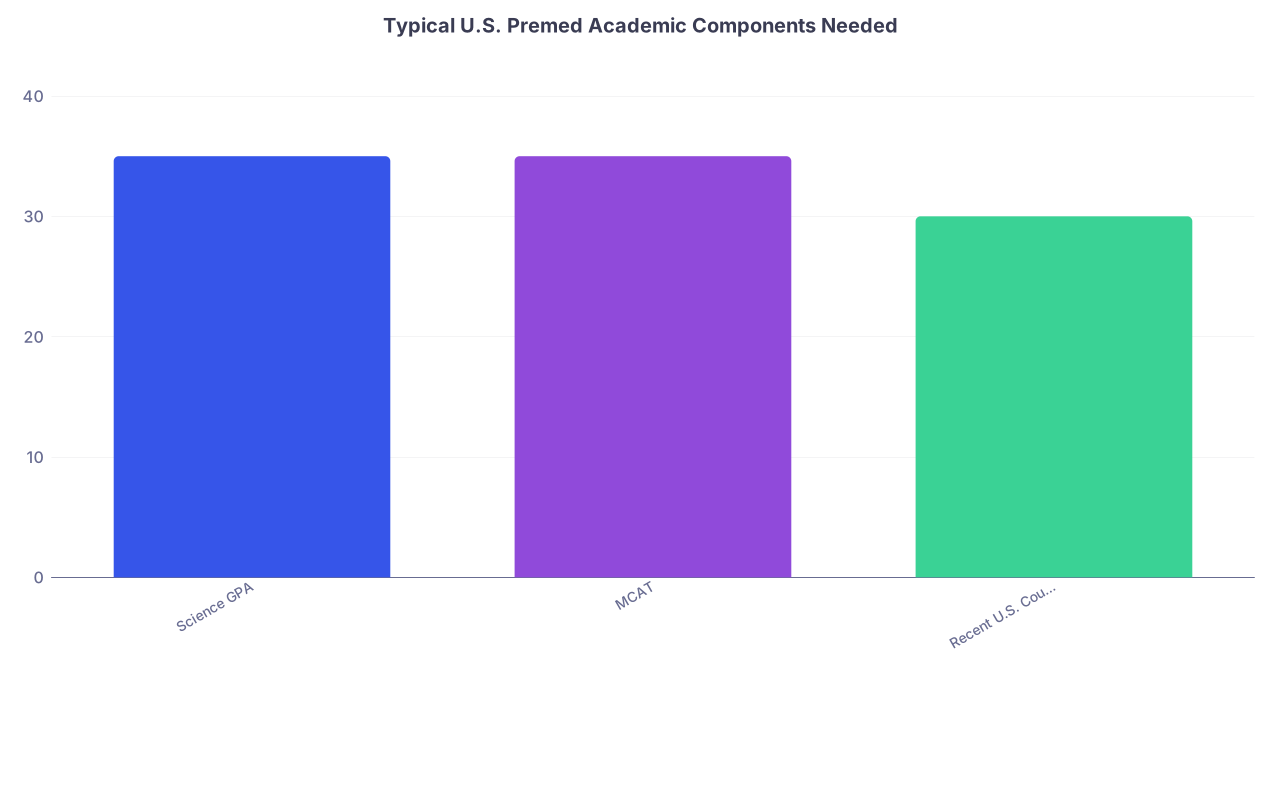
| Category | Value |
|---|---|
| Science GPA | 35 |
| MCAT | 35 |
| Recent U.S. Coursework | 30 |
Not exact percentages obviously, but close enough conceptually: your recent U.S. science performance is a huge part of your application weight, especially because your foreign degree doesn’t generate an AMCAS GPA.
The reality for non-science foreign grads
You are being asked, in effect, to re-prove your academic ability in a new system, in a different country, in courses you largely haven’t taken before.
You can do that three main ways:
- Ad-hoc U.S. coursework (community college or 4-year university, non-program)
- A formal post-bacc program
- A second bachelor’s degree in the U.S. (less common, sometimes overkill)
The question is not “should I do something?”
The question is “what’s the smartest, most efficient way for me to build a strong U.S. academic record?”
Now we can talk about whether a post-bacc fits that role for you.
Step 3: What a U.S. Post-Bacc Actually Buys You (And What It Doesn’t)
A lot of people treat “post-bacc” like a magic word. It’s not. There are different types, and some are great for your situation. Some are basically tuition traps.
Two big types of post-bacc programs
Career-changer post-bacc
Designed for people with no science background who decided late they want medicine.
They usually offer:- Full premed sequence: gen chem, orgo, bio, physics, maybe biochem
- Structured advising
- Linkage agreements with some med schools (sometimes)
- Cohort of similar students (you’re not the only non-science “late start”)
Academic enhancer post-bacc / SMP (Special Master’s Program)
Designed for people who already took the sciences, but didn’t do well.
You’re not that person if you have zero or minimal science. Don’t jump into an SMP just because it sounds “advanced.” That’s how people end up with $60k debt and mediocre grades.
You, with a non-science foreign degree, usually fall squarely into the career-changer bucket.
What a good post-bacc gives you
When it’s the right fit, a solid post-bacc offers:
- A clear course map: no guessing what you need; they line up the prereqs correctly.
- U.S. GPA foundation: med schools see a cohesive block of science courses at a known institution.
- Advising: help on MCAT timing, school list, letters, and when you’re actually ready to apply.
- Letters of recommendation: from science faculty who know post-baccs feed med schools.
- Sometimes linkages: conditional admission to partner med schools if you hit certain GPA/MCAT thresholds.
What it does not guarantee:
- Admission to med school
- A high GPA (you still have to earn it)
- A cost-effective path (some are absurdly priced compared to what you get)
So the question becomes: is this structured, expensive, programmatic route actually better for you than just piecing together coursework yourself?
Let’s walk through how to decide.
Step 4: Should You Do a U.S. Post-Bacc? A Decision Framework
If we had your info on a whiteboard, here’s the logic I’d use.
1. Do you have any U.S. science already?
If yes, and it’s:
≥ 30 credits of solid B+/A- or better in core sciences at a U.S./Canadian institution
→ You might NOT need a full post-bacc. You might just need to:- Finish missing prereqs
- Add 1–2 upper-level sciences
- Focus on MCAT + clinical/shadowing
Minimal or scattered with mixed grades
→ A structured post-bacc (or deliberately planned “DIY post-bacc”) can give you a cleaner, stronger academic narrative.
If no U.S. science at all, and you’re serious about U.S. MD/DO, a substantial amount of U.S.-based science coursework is basically non-negotiable. How you package that (formal post-bacc vs DIY) is the real question.
2. How much structure do you honestly need?
Let me be direct:
If you’re highly organized, good at researching requirements, and comfortable dealing with bureaucracy, you can successfully build your own “DIY post-bacc” with:
- Local 4-year university as a non-degree student, or
- Community college plus strategic 4-year coursework
But many people:
- Mis-time courses (orgo before gen chem, MCAT too early, etc.)
- Don’t realize some med schools look down on too much community college science
- End up with weak letters because they treated classes like one-and-done transactions
- Forget or misunderstand specific school quirks (like “we don’t accept online labs”)
If that sounds like you’re at real risk of messing up, the structure and advising of a formal post-bacc might be worth the money.
3. Are you targeting competitive MD programs or open to DO / broader options?
If your dream is:
- Big-name MD schools
- Possibly very competitive specialties later
- Visa sponsorship likely needed (for non-citizens / non-permanent residents)
Then:
- Strong, recent 4-year U.S. university science is extremely valuable
- A well-known post-bacc (e.g., Penn, Columbia, Goucher, Bryn Mawr, Scripps, etc.) can help establish credibility quickly
If you’re open to DO and a range of MD programs, and especially if cost is a big issue, a DIY route can absolutely work.
Step 5: Comparing Your Real Options (With Foreign Non-Science BA)
Let’s compare them like you actually have to choose.
Option 1: Formal U.S. Career-Changer Post-Bacc
Typically:
- 1–2 years full-time
- At a U.S. 4-year university
- Price tag: very high, think $25k–$60k+ total depending on location/program
Best for you if:
- You have no U.S. science, want a clean start
- You can afford it (or are willing to stretch)
- You want a structured, premed-focused environment
- You want access to linkages and real advising
- You’re gunning for MD and want to look as “traditional” as possible on paper
Option 2: DIY Post-Bacc at a 4-Year U.S. University
You enroll as a non-degree/second bachelor’s student and pick your own courses.
Pros:
- Cheaper than many formal post-baccs
- More flexibility in pace
- Same transcript line: it’s still U.S. university science
Cons:
- No formal advising or linkage
- Easy to mis-sequence courses or overload yourself
- You have to build your own peer network and LOR relationships
This works well for a lot of international degree holders who can get into a solid state university and are willing to plan carefully.
Option 3: Heavy Community College Route
You take most or all prereqs at a community college.
Pros:
- Cheap
- Flexible schedule (good if you must work full-time)
- Easier admissions into the courses themselves
Cons:
- Some MD schools are skeptical of too much community college science
- You’ll likely still need some upper-level science at a 4-year institution to show rigor
- Harder to impress adcoms if all your post-bacc work is at a CC, especially as an international grad
This can be a stepping stone: CC → strong performance → transfer or later upper-level science at a 4-year university.
Step 6: Extra Complication – Your Immigration / Visa Status
If you’re not a U.S. citizen or permanent resident, you have two games to play at once:
- Build a competitive academic record
- Maintain or obtain legal status (F-1 or other)
Formal post-bacc programs often:
- Are F-1 eligible, meaning they can issue I-20s
- Have international student offices who know this dance
- Sometimes understand med school visa realities and can advise at least generally
DIY setups:
- Some universities will let non-degree students do part-time. That often does NOT allow an F-1 visa.
- Second bachelor’s degree enrollment may qualify for F-1, but not always, and it’s bureaucratically annoying.
If you need an F-1 to be in the U.S., a formal post-bacc or second bachelor’s program that explicitly supports international students might not just be nice—it might be mandatory.
If you’re already here on another status (H-4, etc.), you have more flexibility.
Step 7: How to Vet Post-Bacc Programs as an International Non-Science Grad
If you decide a post-bacc might be right, don’t just click “Apply” on the first glossy website.
You want answers to questions like:
- Do they accept students with foreign bachelor’s degrees only? Or do they require a U.S. degree?
- Do they have data on international or foreign-degree students who successfully matriculated to med schools? Which ones?
- Are their classes integrated with undergrads, or is it a separate post-bacc cohort? (Integrated can be better for letters and rigor impression.)
- What’s the average GPA and MCAT of students who actually make it to med school from their program?
- Do they issue I-20s for F-1 visas? Have they done this before for post-baccs?
If an admissions person sounds confused when you say “I have a foreign non-science BA and want U.S. MD,” that’s a warning sign. You want staff who immediately say, “Yes, we’ve had people like you before. Here’s what they did. Here’s how it turned out.”
Step 8: A Simple Decision Flow for Your Situation
Here’s a straightforward logic path you can sketch out:
Use this as a sanity check against your own reality: money, visa, timeline, competitiveness goals.
When a U.S. Post-Bacc is Clearly the Right Move for You
Let me be decisive for a moment. In these situations, I’d almost always recommend a U.S. post-bacc (formal or DIY at a 4-year):
- You have: No U.S. coursework, non-science foreign degree, and you want MD/DO in the U.S.
- You need: F-1 visa, and the program can sponsor it.
- You’re able: To commit 1–2 years mostly to school and can afford at least a mid-level tuition.
- You aim: For a decent shot at MD (not just DO) and want to avoid questions about academic rigor.
In those cases, trying to “shortcut” with scattered CC classes often backfires. You end up re-doing work later at a 4-year institution anyway.
When You Probably Don’t Need a Formal, Expensive Post-Bacc
On the other hand, you might not need a branded post-bacc if:
You already have:
- 20–30+ credits of U.S. science with A/A– range
- Or significant U.S. undergraduate time (exchange year, etc.) with great performance
You’re comfortable:
- Planning course sequences
- Reading med school requirements carefully
- Proactively building relationships for letters
You’re okay with:
- A less “prestige” path if it gets you to the same end goal cheaper
Then a well-designed DIY path at a state university, plus intentional MCAT prep and strong clinical exposure, can absolutely be enough.
I’ve seen foreign business majors get into U.S. MD schools this way with nothing more “fancy” than 2 years of carefully selected university science courses and a 515+ MCAT.
Bottom Line: So, Should You Do a U.S. Post-Bacc?
If I had to give you a rule-of-thumb:
If your degree is non-science, fully foreign, and you have little to no U.S. science:
Yes—you should almost certainly do substantial U.S.-based science, and a post-bacc or structured second bachelor’s pathway is usually the cleanest way.Whether that needs to be a branded, formal post-bacc program versus a carefully built DIY plan depends on:
- Your budget
- Your need for a visa
- Your need for hand-holding vs independence
- Your target med school tier
The worst move? Dabbling. Random bio here, a CC chem there, no real plan, then trying to apply with:
- No coherent GPA story
- No strong science LORs
- A mediocre MCAT because your foundation is patchy
If you’re going to do this, build a real U.S. academic record, not a pile of random transcripts.
FAQs
1. Will U.S. med schools accept my foreign non-science bachelor’s degree, or do I need a new U.S. degree?
Most U.S. MD and DO schools will recognize your foreign bachelor’s as “having a degree,” but many will still expect significant U.S. or Canadian coursework, especially in science. A few schools explicitly require a U.S. or Canadian bachelor’s; others don’t. You don’t automatically need a second full U.S. degree, but you almost certainly need a solid chunk of U.S.-based science—often structured like a post-bacc.
2. Is community college science good enough for me as a foreign degree holder?
Some community college coursework is fine, especially early on or if you’re working a lot. But if all of your science is from community college, some MD schools will be skeptical, particularly given your foreign background and lack of a U.S. bachelor’s. A safer mix: start at CC if needed, but make sure you later take upper-level science at a 4-year U.S. university to prove you can handle higher rigor.
3. Do I need a formal post-bacc, or can I just enroll as a non-degree student and take the prereqs?
You can absolutely build a DIY post-bacc by enrolling as a non-degree/second bachelor’s student at a 4-year university and taking the core premed sciences + a couple upper-levels. This can be cheaper and flexible. A formal post-bacc becomes more attractive if you need F-1 visa support, want structured advising and linkage options, or don’t trust yourself to independently plan and sequence everything correctly.
4. How many U.S. science credits do I need to be taken seriously by med schools?
There’s no magic number, but practically, I’d aim for at least 30–40 credits of solid U.S. science (that’s roughly the core prereqs: 1 year each of gen chem, orgo, bio, and physics, plus maybe biochem and one upper-level course). You want these mostly in A/A– range. The more foreign your original degree and grading system, the more weight those U.S. credits will carry, so skimping here is not smart.
5. Should I take the MCAT before or after finishing a post-bacc?
Don’t touch the MCAT until you’ve completed most of your core prereqs: at minimum gen chem, orgo, bio, and physics, and ideally biochem. If you’re in a one-year intensive career-changer post-bacc, MCAT usually comes at the end or right after. If you’re DIY, plan your MCAT for shortly after you finish most of your science sequence so you can actually leverage what you learned. Taking it too early just to “try” usually results in a score that hurts you.
Open a blank document right now and write three headings: “Current Coursework,” “Needed U.S. Science,” and “Possible Paths (Formal Post-Bacc vs DIY).” Under each, list exactly what you have, what you’re missing, and which 2–3 program types or schools you’ll research this week. That’s how you stop thinking vaguely about “doing a post-bacc” and actually start building the academic record med schools need to see.