The email hits your inbox at 11:47 p.m. on a Tuesday. Interview invite. Real one, from a school you'd actually attend. And your first thought isn't joy, it's my orgo midterm is that Thursday.
Trust that instinct. It's the smartest thing your brain will do all cycle.
Here's the situation: medical school interview season runs September through February, which sits directly on top of the most punishing semester of nearly every post-bacc program in the country. You're carrying organic chemistry, maybe biochemistry, maybe physics, the exact courses admissions committees scrutinize hardest, and now you're expected to vanish for two or three days at a stretch, repeatedly, for four months. Undergrads absorb this and wobble. Post-bacc students, whose entire transcript is a make-or-break argument, can get destroyed by it.
I've watched it happen every fall. Smart, disciplined students who rebuilt a 3.1 into a 3.8 over two years, then torched it in ten weeks because they treated interview invites like celebrations instead of logistical attacks. This article is the defense plan.
The Post-Bacc Trap: Why Interview Invites Derail Your GPA
Interview scheduling is asynchronous. Your exams are not. That's the whole problem, and nobody warns you about it.
Medical schools release invites on their own calendar, offer you a fixed menu of dates, usually mid-week, usually clustered, and give you 48 to 72 hours to respond before slots vanish. Your biochemistry exam does not care. Your Wednesday afternoon lab practical does not care. The school offering you an 8 a.m. Tuesday interview in a city three flights away genuinely does not know, and will never ask, what your syllabus says.
Then there's the cognitive cost, which applicants wildly underestimate. Travel mode and problem-solving mode are different brains. On an interview day you're on for eight to ten hours, shaking hands, performing enthusiasm, tracking names, managing the low-grade adrenaline hum of being evaluated. You fly home that night, open your laptop at 11 p.m., and try to do mechanism problems. It goes badly. Not because you're lazy, but because context switching has a real physiological price, and the bill is usually a full lost day of recovery you didn't budget for.
The third trap is structural, and it's the one that stings most: post-bacc programs offer almost zero grace. Undergrad professors teaching 400-person lectures hand out makeup exams like candy because half the class has mono, a debate tournament, or a funeral. Your post-bacc orgo professor has 38 students, a strict syllabus policy written specifically to preempt your request, and a program director who markets the curriculum's rigor to med schools. Formal programs sell themselves on "we don't coddle." Believe them.
And if you're in a linkage program, where a conditional acceptance depends on maintaining, say, a 3.6, a grade collapse isn't just embarrassing. It can void the acceptance entirely. I've seen a student lose a linkage seat over a single C+ in a fall biochemistry course that she failed because she stacked four interviews into five weeks. Four interviews, one ruined semester, gone.
Mapping the Damage: The Logistics of Mid-Semester Chaos
Let me walk you through the cascade, because it never looks like a catastrophe in advance. It looks like one small absence.
Say you take a Wednesday interview in Chicago. You fly out Tuesday evening, that's Tuesday's review session gone. Wednesday you're gone entirely, which means the lab you can't make up (labs are typically 15-20% of your course grade and most post-bacc syllabi state flatly that missed labs are zeros) plus two lectures. You land Thursday night, exhausted, and there's a Friday quiz covering Wednesday's lecture. You haven't seen the material. You wing it, score a 6/10, and tell yourself you'll catch up over the weekend.
You will not catch up over the weekend. That plan is fantasy. You're jet-lagged, emotionally hungover from performing for two days, and your apartment is a disaster. You sleep until noon Saturday, do half a problem set Sunday, and walk into Monday's lecture already behind. And here's the compounding part: in organic chemistry and biochemistry, content is linear. Mechanisms stack. The lecture you missed Wednesday is the foundation for Monday's lecture, which means Monday's is half-comprehensible, which means the next exam, covering all of it, has a hole baked in.
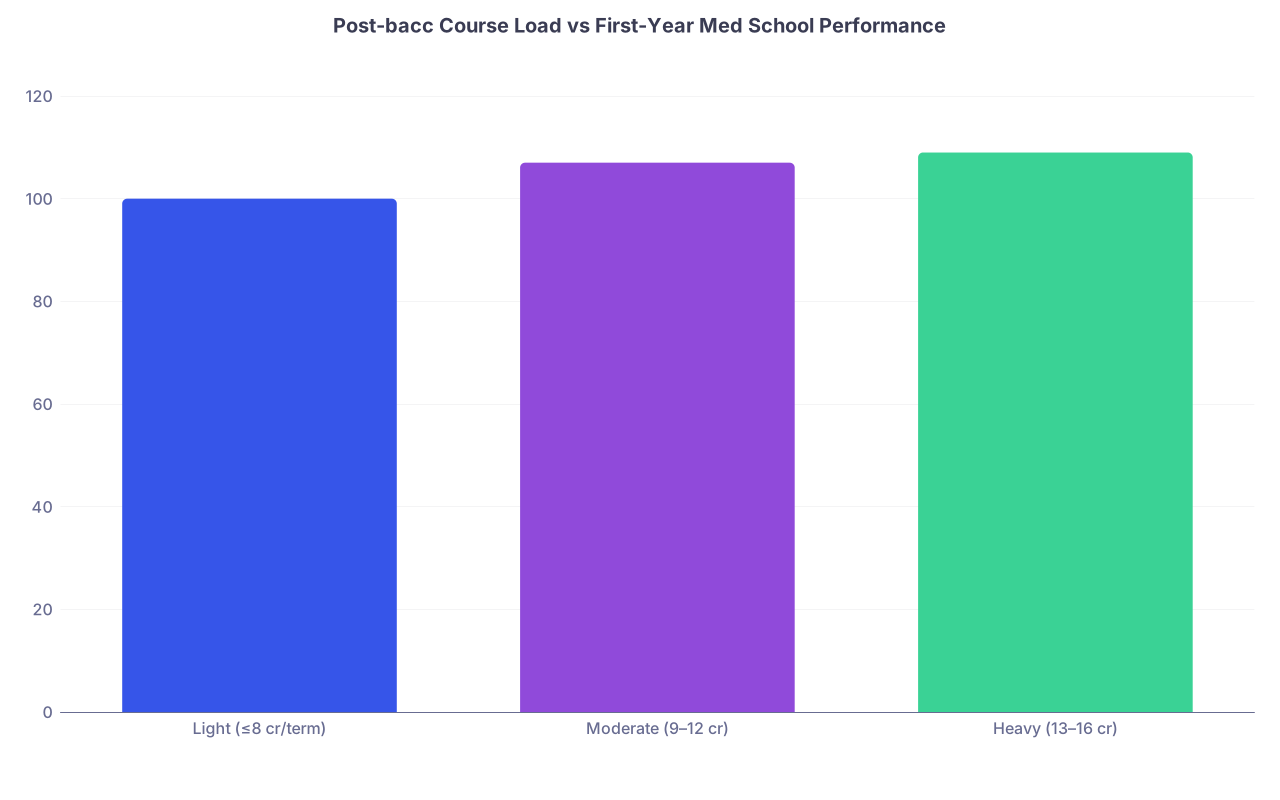
Now quantify it. A typical post-bacc science course runs three midterms and a final, each midterm worth roughly 20-25% of your grade. Drop from your usual 92 to a 74 on one exam because of a double-interview week, and you've surrendered about four points off your final course average. That's an A turning into a B+ from one bad week. In an accelerated eight-week summer-style course it's worse, two consecutive missed lectures is roughly a week of undergrad content, and the third lecture becomes a lecture in a language you no longer speak.
That dip from October through January isn't a mystery. It's the interview window, showing up on a transcript exactly where an admissions committee will see it.
Preemptive Defense: Building Your Anti-Destruction Game Plan
Everything above is preventable, but only if you move in August, not October. Here's the game plan, in order.
Week one: audit the syllabus like a lawyer. Sit down with every course syllabus and transfer every exam, quiz, lab practical, and major deadline onto one master calendar. Then overlay the interview window, September through February, and circle the collision zones. You're looking for the dangerous stretches: the week with an orgo midterm and a physics exam, the lab practical that can't move. Those circled weeks become sacred. No interviews, no exceptions, no matter how much you love the school.
Weeks two and three: talk to every professor before you need anything. This is the move almost nobody makes, and it's the highest-leverage one on this list. Walk into office hours in September, before you have a single invite, and say this, roughly verbatim:
"I'm applying to medical school this cycle, and interview invitations arrive with fixed dates and short response windows. If one ever conflicts with an exam or lab, I'd want to handle it correctly. What's your policy, and how much notice do you need?"
You've just done three things: flagged yourself as responsible, gotten the policy in the open, and made the future request feel like a plan instead of an emergency. Professors move mountains for students who show foresight. They shrug at students who appear 72 hours before an exam asking for mercy.
When invites arrive: batch ruthlessly. Schools almost always offer a range of dates. Use it. Push every interview you can into one or two designated travel blocks, ideally the stretches between your exam clusters, and stack schools regionally. Three Northeast interviews in one ten-day trip costs you one bad week. Those same three interviews scattered across October, November, and December cost you three bad weeks plus constant low-grade disruption. Missing one week badly twice a semester is survivable. Missing one day every single week for four months is how 3.8s become 3.3s.
Prefer Friday interview dates. Travel Thursday evening after your last class, interview Friday, fly home Saturday, recover Sunday. You lose one class day instead of three.
One non-negotiable in that flowchart: get the makeup arrangement in writing. A verbal "sure, we'll figure something out" from a busy professor evaporates by exam week. An email confirmation does not.
In-Flight Triage: Damage Control When You're Already on the Road
Maybe you're reading this in October from a hotel room. Fine. The preemptive ship sailed. Here's how you limit the bleeding mid-trip.
Rule one: passive review only, never new problem-solving. Airports and hotel desks are for Anki decks, recorded lectures at 1.5x speed, and one-page summary sheets you made before you left. They are not for new problem sets. Attempting fresh mechanism problems at Gate C17 produces garbage work, zero retention, and a guilt spiral, a triple loss. I've tried it. Everyone tries it once. Do high-yield flashcard review on the road and leave heavy problem-solving for your actual desk at home.
Rule two: the day before and the day of the interview, you do not study. I mean it. The interview is the entire point of the trip, and a flat, distracted, half-prepared interview performance wastes the two class days you already spent getting there. Protect the performance. The chemistry will still be there Thursday.
Rule three: build your peer infrastructure before you need it. You need exactly one reliable classmate per course who will record lecture audio and photograph the board, in exchange for coffee and your eternal loyalty. Class WhatsApp and GroupMe groups are decent for raw notes, but a designated person who knows they're your person is worth ten group chats full of "did anyone get what she said about the Krebs cycle?"

Rule four: know when to push back on the school. If an interview slot lands directly on your orgo final and your professor won't budge, email the admissions office. Politely, briefly, with the conflict stated in one sentence. Schools reschedule enrolled students for academic conflicts far more often than applicants assume, they were premeds once too. And if rescheduling fails and the choice is genuinely this interview slot or this prerequisite grade, you protect the grade. A ruined transcript follows you to every school for years. One awkward scheduling email follows you nowhere.
Action Steps: Securing Your Academic Recovery
If midterms already exposed the damage, stop improvising. Run this sequence.
1. Do the damage assessment this week, not after finals. Pull your current grade in every course. Calculate, with actual numbers, not vibes, what you need on each remaining exam and assignment to land an A, an A-, a B+. Write the targets down. You can't execute a recovery you haven't quantified.
2. Email every affected professor now. Not after the next exam. State the situation in two sentences, own it without groveling, and ask specifically what opportunities remain: dropped quiz policies, extra credit, office-hour review plans. You'd be stunned how many options exist for students who ask in November instead of sobbing in December.
3. Freeze all travel for the two weeks before finals. Email schools holding pending invites and state your unavailability with dates. Every admissions office on earth knows when finals happen. They'll accommodate it. Your GPA won't accommodate another lost week.
4. If a dip is already locked in, control the narrative. Address it in one or two sentences in a secondary or update letter, accountable, brief, forward-looking. "My fall grades dipped during a dense interview period; I restructured my spring schedule and finished with [X]." Then let the transcript show the recovery. Do not write a 600-word apology essay. The upward trend is the argument; the essay is just a signpost.
5. Finish violent. Adcoms forgive a October-December stumble followed by a strong close far more readily than they forgive a flat, fading semester. A 4.0 spring after a 3.3 fall reads as resilience. A 3.4 spring after a 3.3 fall reads as a ceiling.
Key takeaways:
- Treat every interview invite as an academic emergency: cross-reference the syllabus before you accept anything.
- Batch interviews into one or two dedicated travel blocks, never scatter them across the semester.
- Talk to professors weeks in advance and get every makeup arrangement in writing.
- On the road, review passively; solve problems at home; never study the day of the interview.
- A great interview cannot rescue a collapsed post-bacc GPA. Protect the grade first. Always.