
You open the email and your pulse jumps. A pre-match offer. Or at least a very strong signal. The problem? The program is so new you have barely heard of it. Maybe it was not even on your radar a month ago. Now it is suddenly offering certainty in a season built on uncertainty.
That mix of relief and dread is completely rational.
Educational disclaimer: This article is for educational purposes only and is not legal, financial, tax, immigration, or contract advice. Residency contracts, compensation packages, and visa issues can have major consequences, so review any offer with your medical school advisors and, when appropriate, a qualified attorney, immigration professional, or financial/tax advisor.
I have seen applicants make two bad mistakes here. The first is panicking and accepting immediately because they are terrified of not matching. The second is reflexively dismissing every new program as a trap. Both are lazy decisions. Both can cost you.
A brand-new program can mean several different things. It may be a newly accredited residency with its first intern class. It may be a program in year two, still trying to look organized while building basic systems in real time. It may be a hospital system that used to function as a community service site and is now trying to convert into a teaching environment. Or it may be an established institution launching a new specialty line without any actual track record in that department. Those are not the same thing. You should not evaluate them the same way.
The core tension is simple: a pre-match can lower your uncertainty about getting a position, but a new program raises uncertainty about almost everything else. Accreditation stability. Educational quality. Faculty investment. Culture. Board prep. Fellowship prospects. Even basic daily workflow. Established programs usually leave footprints. Graduates. Board pass rates. Alumni at fellowships. Online chatter. A new program leaves promises.
This article is not here to tell you that new programs are bad. Some are excellent. Some are shockingly well built from day one. But you do not get to assume that. You need a due-diligence process. Structured. Specific. A little skeptical.
That is what we are going to do. We will break this down through the domains that actually matter: accreditation, leadership, faculty depth, patient volume, supervision, curriculum, workload, support systems, contract details, and whether the risk-benefit equation fits your own goals.
First Principle: Understand What a Pre-Match Can and Cannot Tell You
A pre-match means the program wants to secure you early. That is all it means.
Do not romanticize it. Do not catastrophize it either.
Programs use pre-match for very different reasons. A strong new program may use it because it wants to guarantee a solid inaugural class before entering the chaos of the Match. A geographically less desirable site may use it because location hurts recruitment. A hospital that is worried about filling may use it because it knows applicants will hesitate if they have time to compare options. Some programs specifically target IMG applicants because they know that population is often more willing to accept early certainty in exchange for less prestige.
None of that tells you whether the training is good.
Here is the psychological trap: applicants interpret a pre-match as safety and stop asking hard questions. They start thinking, “At least I am done.” That mindset is dangerous. You are not buying a plane ticket. You are choosing the system that will shape your clinical judgment, your board performance, your letters, your mental health, and in many cases your visa timeline.
The upside of a pre-match is obvious. Certainty. Relief. A defined next step. The downside is quieter. You may walk into a program with immature scheduling, weak backup systems, faculty who are stretched thin, off-site rotations that still are not finalized, and a culture that talks a lot about education while using residents to plug service holes.
Treat the offer like a contract review. Not a compliment. Compliments are free. Residency is not.
Step 1: Verify Accreditation Status and Program Maturity With Precision
Start with the part applicants routinely hand-wave. Bad move. You need to verify the program, not merely listen to it.
Look up the program through the ACGME and the sponsoring institution’s GME presence. For a new program, “initial accreditation” is normal. That alone is not a red flag. But it absolutely triggers deeper questions. Initial accreditation means the program has been approved to begin training residents, not that it has a proven educational machine humming in the background.
Check these specifics:
- Accreditation status
- Program complement size
- Participating sites
- Sponsoring institution
- Whether the institution already runs other successful residency or fellowship programs
- Whether the advertised number of residents matches what is actually approved
Mismatch matters. If a website talks big and the accredited complement is smaller or unclear, someone is getting ahead of reality.
Also look at the sponsoring institution itself. A hospital that already runs multiple accredited programs usually understands onboarding, milestone evaluations, duty hour compliance, resident remediation, committee structure, and what happens when things go wrong. A first-time sponsor often underestimates how much machinery graduate medical education actually requires. They think hiring a program director and printing a brochure is enough. It is not.
(See also: red flags in pre-match offers for more.)
Ask directly, and ask professionally:
“Can you tell me where the program is in the accreditation cycle and what institutional GME support is already in place?”
That question does a lot of work. A serious program answers cleanly. You should hear specifics about the designated institutional official, GME office, resident evaluation platform, orientation systems, committee oversight, and plans for review. If you get vague marketing language instead, that is data. Bad data.
Red flags worth taking seriously:
- Evasive answers about accreditation stage
- Aggressive expansion plans before the first class is established
- Unclear rotation sites
- Institutional instability or public controversy affecting the hospital
- A sponsor with no visible GME infrastructure
- A complement that seems too large for the faculty and clinical volume described
New does not equal unsafe. Evasive does.
Step 2: Vet the Leadership, Faculty Bench, and Institutional Commitment
In an established program, good systems can partially protect you from mediocre leadership. In a new program, leadership is the system.
That is why this step matters so much.
Start with the program director. You want to know whether this person has actually taught residents, led teams, and advocated for trainees before. Board certification is basic. Not impressive. Expected. What matters more is their educational history. Have they served as APD, clerkship director, core faculty, site director? Have they helped build a curriculum before? Do they speak like an educator or like a hospital executive trying to fill a coverage model with cheaper labor?
You can tell the difference fast.
Good PD answers sound concrete: how feedback is delivered, how struggling residents are supported, how schedules are built, how clinic continuity is protected, how supervision works at night. Weak PD answers hide behind slogans. “We are excited to grow together.” Fine. That is not a training plan.
Then audit the faculty bench. Not the website glamour shots. The actual teaching bench.
You need to know:
- How many true core faculty there are
- Which subspecialties are represented
- Who staffs continuity clinic
- Who covers inpatient teaching services
- Whether ICU, night, and consult services have stable attending involvement
- Whether key faculty are already hired or merely “in process”
This distinction is everything. If half the program depends on “we expect to recruit” or “we are finalizing,” then you are being asked to finance uncertainty with your training years. I do not recommend that unless every other piece is unusually strong.
Ask blunt but fair questions:
- How many core faculty are already contracted and actively teaching?
- How much protected teaching time do they have?
- Who will review resident evaluations and milestones?
- How is remediation handled if a resident struggles?
- Which rotations are fully staffed today?
Positive signals are not hard to recognize. A strong designated institutional official. An organized GME office. Faculty with protected time. Simulation resources already functioning. Coordinators who answer logistical questions without fumbling. Administrative competence is underrated until you train in a place that lacks it. Then it becomes your entire day.
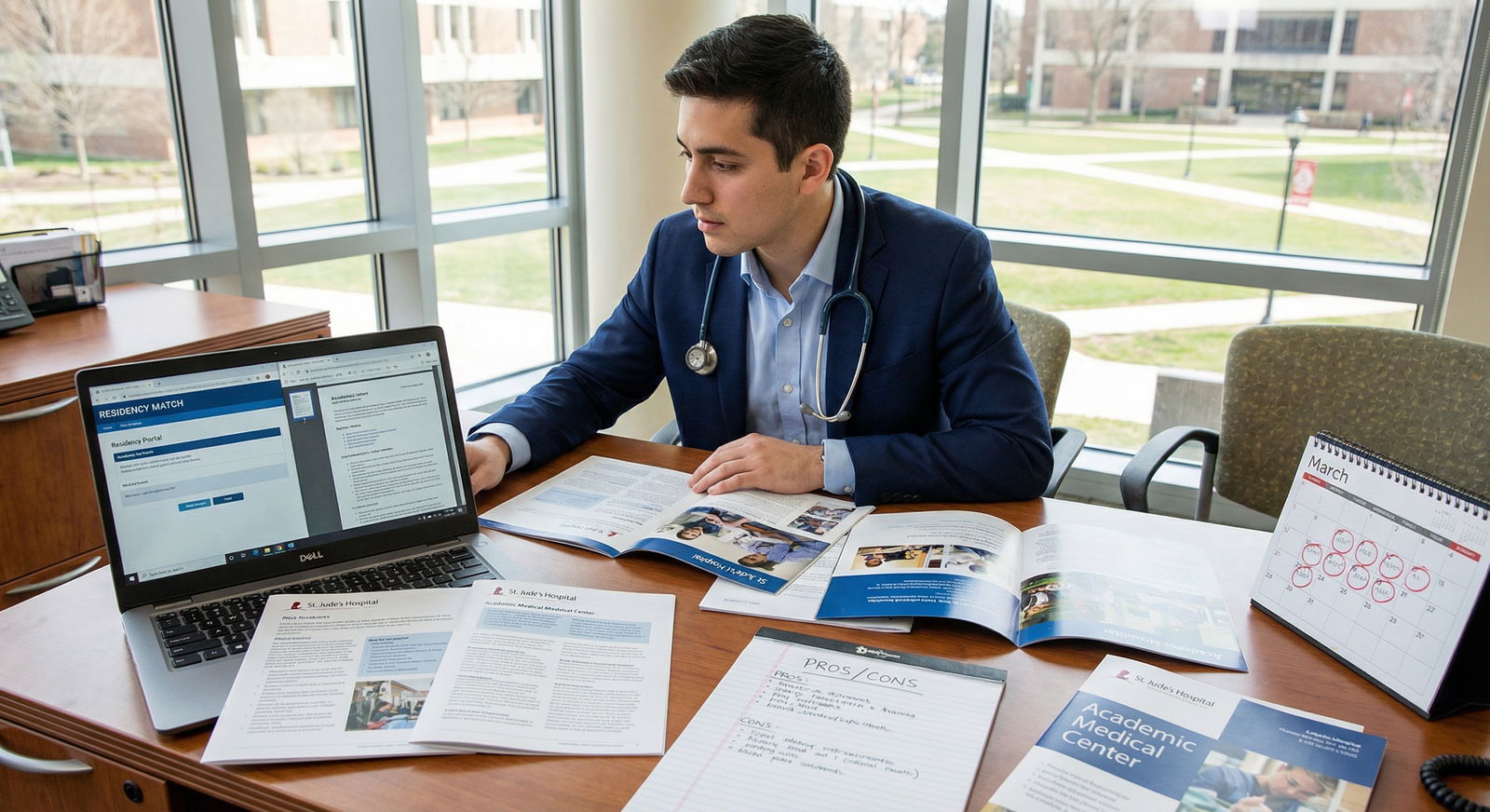
A critical red flag: the institution talks more about future expansion than current educational delivery. I have seen this. New cancer center coming. New ICU tower coming. More specialists coming. Fellowship pipelines coming. Wonderful. Are they here now? If not, do not give them full credit for a fantasy roster.
Step 3: Stress-Test the Clinical Training Environment
A residency lives or dies on patient care experience. Not branding. Not logos. Not polished interview days.
You need enough volume, enough acuity, enough diversity, and enough supervision. All four.
Ask what the hospital actually sees. Bread-and-butter pathology. Complex referrals. ICU cases. ED volume. Underserved populations. Procedural exposure. Transfer patterns. If this is a specialty where procedure count matters, ask exactly who gets those cases. Residents? Fellows? APPs? Senior attendings? If several learner groups compete for the same experiences, somebody gets squeezed. In new programs, it is often the residents.
The biggest conceptual distinction here is this:
Does the service train residents through clinical work, or does the service need residents to keep the place running?
Both involve service. Residency always does. But the balance matters. In a good setup, service is structured, supervised, and educationally useful. In a bad setup, residents become the patch for weak ancillary staffing, poor throughput, and attending shortages.
That is why ancillary support deserves real attention. Ask about:
- Phlebotomy
- Transport
- Social work
- Case management
- Interpreter access
- IV team
- Unit clerks
- APP support
- Scribes, where relevant
- Discharge support
Applicants often skip these questions because they sound mundane. They are not mundane. They determine whether your day is spent learning medicine or chasing wheelchairs, blood draws, and forms.
Then get specific about rotations. Where do they occur? Main hospital only? Multiple community sites? Academic affiliate? VA? Children’s hospital? Are those agreements signed and operational, or still being finalized? “We anticipate residents will rotate at…” is weak language. You want “Residents rotate at…” followed by details.
Supervision architecture is another make-or-break issue. Who is in house overnight? Is there senior backup? Are attendings physically present in the ICU? How easy is escalation? What happens when a resident falls behind clinically or academically? If the answer is just “our doors are always open,” that means nothing. I want structure, not sentiment.
Classic concern in newer community-based programs: heavy service burden, thin specialist backup, and a lot of rhetoric about autonomy. Be careful. Early autonomy is often just under-supervision wearing a nice outfit.
Step 4: Audit the Curriculum Like an Examiner, Not a Consumer
Do not listen to “robust curriculum.” Ask to see the schedule.
This is where you should think like someone dissecting an exam stem. What is explicitly there? What is implied? What is missing? If a program cannot show a coherent block schedule or longitudinal curriculum, that is not a minor issue. That is operational immaturity.
Ask for the actual structure:
- Orientation length and content
- Inpatient months
- Outpatient continuity schedule
- ICU time
- Electives
- Night float or call model
- Jeopardy coverage
- Didactics timing and protection
- Simulation
- Board review resources
- Scholarly activity expectations
- Evaluation cadence
Board prep matters even more in a new program because there is no pass-rate history to reassure you. The institution should be able to explain what they are doing to support first-time board success. Question banks? Protected review time? Faculty-led board sessions? Mock oral or OSCE-style assessments where relevant? If they have not thought that through, they are behind.
Also ask how competency is tracked. Case logs. Milestones. Direct observation. Procedure sign-off. Feedback timing. Formal remediation pathways. Every new program claims it will provide close attention because classes are small. Sometimes that is true. Sometimes it means there is no system and everybody is improvising.
If you care about fellowship, go one layer deeper. Who mentors scholarly work? Is there research support? Can residents present at conferences? Is funding available? Are there faculty with reputations strong enough to write useful letters? A new program without graduates can still place residents well, but only if the mentorship infrastructure is real.
Watch for fluff. “Opportunities will expand over time” should trigger an immediate follow-up:
What is guaranteed for me in year one?
Not year three. Not after future hires. Your training starts on day one.
Step 5: Read the Resident Experience Signals—Even if There Are Few Residents to Ask
This is the hard part. New programs often have no graduates and maybe only one inaugural class. So the usual resident grapevine is thin. That does not mean you are stuck.
Talk to whoever has seen the system from the inside:
- Residents in other specialties at the same institution
- Fellows
- Nurses
- Applicants who did rotations there
- Staff physicians not directly involved in recruitment
You are looking for pattern recognition, not gossip.
(See also: tell other programs I received a pre-match offer for guidance.)
If there is an inaugural class, ask focused questions. Not “Do you like it?” That gets you polite nonsense. Ask:
- Was the promised schedule accurate?
- How often are systems changing?
- When service spikes, are residents protected or abandoned?
- Is leadership responsive?
- Can you disagree safely?
- Has clinic workflow become more organized or more chaotic over time?
- What problem came up recently, and how was it handled?
That last question is gold. Good resident answers include specific examples: leadership fixed a call imbalance, added phlebotomy support, replaced a weak rotation, clarified supervision, responded to an EMR issue. Weak programs produce vague reassurance. “They are trying.” Fine. Everyone is trying.

You also need to compare resident descriptions with leadership messaging. Misalignment is often more revealing than any single complaint. If leadership says the program is highly supportive but residents describe constant last-minute schedule changes and weak backup, believe the lived experience.
Quality-of-life details matter too. Meal allowance. Parking. Call rooms. EMR usability. Wellness access. Parental leave. Mental health support. Coverage during illness. These are not luxuries. They tell you whether the institution sees residents as professionals or as replaceable labor.
Every new program has some friction. That is normal. The issue is whether the friction looks like launch-phase bumps or structural neglect.
Step 6: Examine the Contract, Money, Visa Support, and Restrictive Terms
Now shift from education to logistics. A pre-match decision is still a legal and practical commitment.
Review the contract carefully. Salary matters, but context matters more. A decent salary in a brutally expensive city may still leave you struggling. So compare compensation with cost of living, housing access, transportation, and what benefits actually offset the burden.
Check:
- Health insurance
- Disability coverage
- CME funds
- Meal stipend
- Parking
- Relocation support
- Vacation and sick leave
- Parental leave
- Start-date details
- Moonlighting policy
For IMG applicants, visa support is a major branch point. Ask whether the institution supports J-1, H-1B, or both. Ask who manages the process. Ask whether there is an experienced immigration team or outside counsel. Ask about Step 3 requirements and timing. Ask if the institution has processed visas on schedule for other trainees before. A hospital saying “we should be able to” is not enough. Visa timelines punish uncertainty brutally.
Then review the ugly clauses nobody wants to talk about: probation language, termination language, obligations after resignation, and any restrictive covenants if they apply. Contract transparency is a maturity marker. Programs that delay paperwork or stay vague on major terms are telling you something about how they operate when stakes are high.
Compare the total package against realistic alternatives, not fantasies. A flashy signing process does not make a weak structure strong.
Build a Decision Matrix: How to Weigh Risk Against Your Own Career Goals
This is where people need discipline. Stop asking “Do I feel good about this?” and start scoring what you found.
Build a simple decision matrix and rate each category from 1 to 5:
- Accreditation security
- Sponsoring institution strength
- Program leadership quality
- Faculty depth
- Clinical volume and diversity
- Supervision model
- Curriculum maturity
- Board prep structure
- Ancillary support
- Resident responsiveness and culture
- Contract clarity
- Visa reliability
- Fellowship alignment
- Geography and family fit
- Your personal risk tolerance
You do not need a perfect spreadsheet. You need a forced comparison method so fear does not make the decision for you.
Here is the nuance applicants miss: the same new program can be excellent for one person and a poor choice for another. If you need strong H-1B support, weak visa infrastructure may be disqualifying even if the clinical exposure is good. If your goal is competitive fellowship, you may need a stronger mentorship and letter-writing environment than a launch-phase program can offer. If your priority is simply securing a solid training spot in a reasonable location with a transparent institution, a well-built new program may be exactly right.
Situations where accepting makes sense:
- Strong sponsor with established GME systems
- Credible and experienced leadership
- Clear supervision
- Real clinical volume
- Concrete curriculum
- Transparent contract and visa process
- Good fit for your constraints or goals
Situations where declining is the smart move:
- Murky accreditation details
- Thin faculty bench
- Rotation plans still in development
- Weak specialist support
- Poor ancillary staffing
- Leadership answers that depend on future hires
- Signs residents are being recruited mainly to staff service lines
And ask the question that really matters:
What are you giving up by leaving the Match pathway?
If the answer is “only uncertainty,” that may be worth it. If the answer is “access to stronger, more established options I have not heard back from yet,” slow down.
What to Ask Before You Say Yes: Your Final Due-Diligence Checklist
Here is the practical checklist. Use it. Write down the answers immediately after every call.
Accreditation and institutional support
- What is the current accreditation status?
- What is the approved complement?
- What other residency programs does the sponsoring institution run?
- What GME infrastructure is already operational?
Leadership and faculty
- How many core faculty are already hired?
- Who staffs key rotations and continuity clinic?
- How much protected teaching time do faculty have?
- How are evaluations and remediation handled?
Clinical environment
- Where do all rotations occur?
- Are off-site rotations already finalized?
- What is the night supervision model?
- How is ICU supervision structured?
- What is the jeopardy system?
- What ancillary support is available on wards and overnight?
Curriculum
- Can you share a sample block schedule?
- How often are didactics protected?
- What board prep resources are guaranteed?
- How is clinic scheduled?
- What scholarly activity is expected and supported?
Resident experience
- Can I speak to current residents, including inaugural class members?
- What systems changed after launch, and why?
- How does leadership respond when resident concerns arise?
Contract and logistics
- What are the salary and benefits?
- What leave policies apply?
- Is visa sponsorship offered, and which type?
- Is Step 3 required for H-1B or institutional onboarding?
- What are the probation and termination terms?
- What is the exact start-date timeline and onboarding process?
If anything was vague during the interview, request a follow-up call. Do not apologize for this. You are not being difficult. You are being competent.
Then do one final pass:
- Verify accreditation and institution.
- Pressure-test leadership and faculty claims.
- Confirm the clinical environment is educational, not merely service-heavy.
- Read the curriculum like a skeptic.
- Gather resident signals.
- Review the contract and visa terms.
- Score the program against your actual goals.
If the answers are clear and the fundamentals are strong, move forward confidently. If major domains remain fuzzy, do not let fear force you into a program you cannot adequately vet. Desperation makes terrible career decisions. Evidence makes better ones.